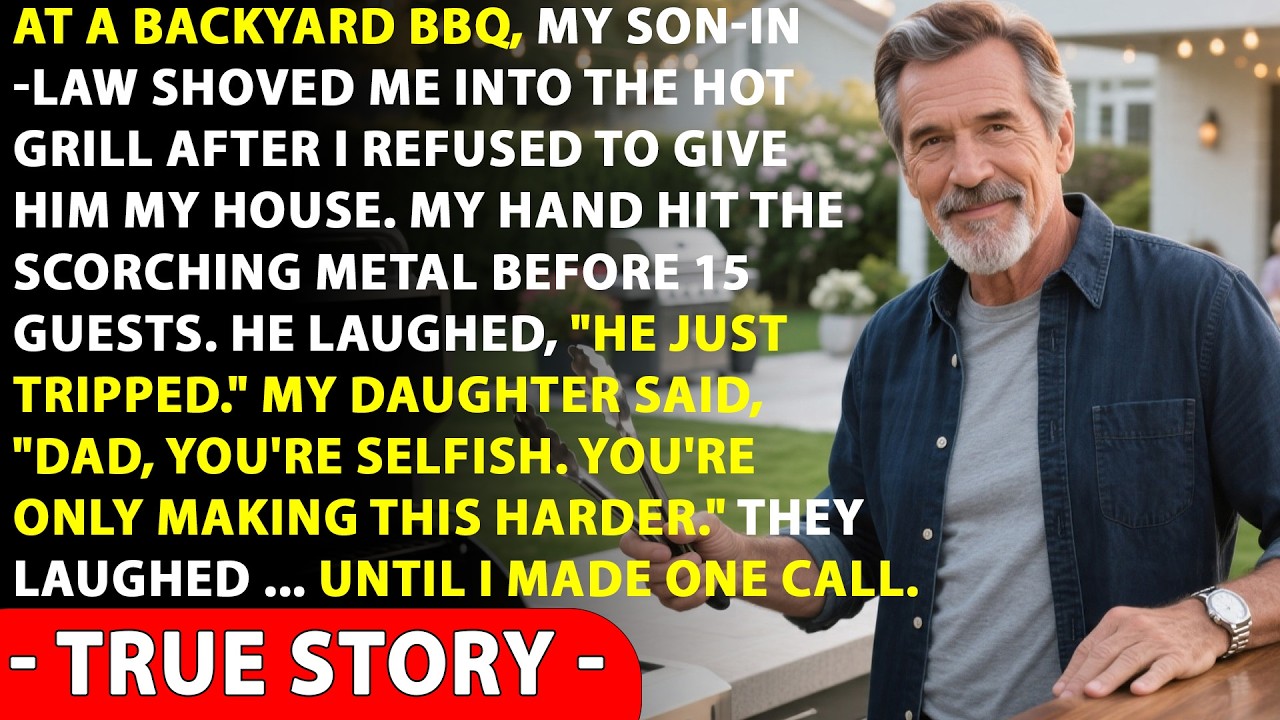
My own daughter stood in front of fifteen guests and called me selfish while the skin on my palm was still sizzling. I turned seventy-two that August, sitting alone on my back porch with a cup of black coffee and the maple tree Margaret had planted the year we moved in. Nobody called. Nobody came.
After thirty-one years of building that house with my own hands, the silence felt less like peace and more like a waiting room. I didn’t look like a man who had anything worth taking. Old Walter in his flannel shirt and beat-up Ford pickup, growing tomatoes in the backyard. But Margaret and I had spent four decades building a construction materials company that supplied half the commercial projects in the Pacific Northwest.
The company was worth millions. The house was worth a million and a half. After Margaret passed, I made a decision. I would keep living exactly the way I looked.
I wanted to see who showed up when there was nothing flashy to show up for. Derek Collins showed up. He came to dinner with Emily, my daughter, in a new BMW. He asked about property values and security systems.
He wanted to see the basement, but I didn’t give him the tour. Then, with his elbows on his knees and his boardroom voice, he asked me to add his name and Emily’s to the deed. A precaution, he called it. Estate planning.
I told him no. He smiled, but his jaw was tight. I’d spent forty years reading men across negotiating tables. I knew the difference between a man who was done asking and a man who had just begun.
Three days later, my brakes went out on a downhill grade. I was lucky to walk away with three stitches and a sore wrist. Emily showed up at the hospital looking terrified. Then Derek called, on speaker, and suggested I was too old to be living alone.
He offered to move in with me. He offered to take the master bedroom. I had the truck towed to Frank Morrison’s shop. Frank is the kind of man who says exactly what he sees.
He found the fitting on the rear brake line backed off a quarter turn. Just enough to cause a problem on a hill without being obvious. “Somebody put a wrench on this,” Frank said. “Deliberately.
”
Derek had been alone in my garage for ten minutes the night he and Emily came for dinner. He claimed he was looking for a flashlight. I called my lawyer, Richard Bennett. Richard told me not to confront Derek.
He told me to act completely normal while he started pulling Derek’s financial records apart on paper. I sent Emily a text inviting everyone over for a backyard BBQ. I found out later that Derek spent three days on the phone building an audience. He called Emily’s friends, his colleagues, the neighbors.
He told them all the same story: Walter was getting old, Walter was getting difficult, Walter refused help from the family that loved him. By the time those fifteen people walked through my gate, they weren’t coming to eat my food. They were coming to witness something. Derek clinked his glass and gave a little speech about how special the property was, how important it was that it be well looked after going forward.
Then he pulled me aside near the grill. “Sign the transfer paperwork tonight,” he said. “I have it in the house. ”
I told him my answer hadn’t changed.
“You know what your problem is? ” He got loud. “You’re a stubborn old man who can’t admit when he needs help. You’re sitting on a million and a half dollars of property you can’t even maintain.
”
Then he grabbed my shoulder and shoved me. I stumbled backward, and my hand went out to catch the side rail of the grill. The metal was four hundred degrees. The hiss of skin meeting superheated steel cut through every conversation in the yard.
Derek pointed at me. “He stumbled. You all saw it. He just stumbled.
”
Emily pushed past him. For one desperate second, I thought she was coming to help me. She stopped two feet away. “Dad, you always do this.
You make everything so much harder than it has to be. You’re being selfish. ”
I looked at my daughter and felt something shift in my chest. Not break.
Shift. Like a bearing that had worn past its tolerance and finally seated somewhere new. I walked inside without looking back at any of them. The last car pulled out at 9:23.
Not one of the fifteen people came inside to check on my hand. I sat at the kitchen table, looking at the empty chair across from me, and spoke to Margaret out loud. “He tampered with my brakes,” I said. “And tonight he put my hand on a hot grill in front of fifteen witnesses and called it a stumble.
”
There’s something I’ve learned from all of this. I was a revenge dad who waited too long to act. I confused endurance with acceptance. I let the people I loved most mistake my quiet for surrender.
That silence cost us years we cannot get back. Do not make my mistake. Do not wait until someone puts your hand on a hot grill before you decide your dignity is worth defending. Richard arrived at my house Monday morning with three documents.
Frank’s technical report on the tampered brake line. Derek’s financial records. His credit score was 412. His firm had two breach-of-contract suits against it.
He had a personal guarantee on a defaulted commercial loan. And he had taken out a second mortgage on the penthouse downtown that Emily didn’t know about. He needed cash. He needed a lot of cash very quickly.
And the only asset in his orbit large enough to generate it was my house. Richard told me something else: Derek was going to try to have me declared legally incompetent. He was going to send a doctor to my house. It was my turn to speak.
I reached into the bottom drawer of my kitchen cabinet and took out the thick manila envelope Margaret had given me two weeks before she died. “You will need this, Walter. Not for yourself, for the truth. ”
Richard opened it.
He spent three minutes reading. Then he looked up at me with something I’d never seen in his eyes before. “I believe we have everything we need. ”
Starting the very next morning, I became someone I had never been in my entire seventy-two years.
I became helpless. I called Emily and let my voice go thin. I told her I was having trouble sleeping, that I couldn’t remember why I got up. I let her hear relief when she offered to come by.
I went to the Safeway on Belmont where Derek shopped. I stood in front of the oatmeal display, picking up the same canister three times. I told Derek I kept forgetting which kind Margaret liked. He smiled warmly, and I saw his satisfaction.
I saw him lift his phone and take a picture. When they came for a check-in visit, I told the same story about my old foreman twice. Emily exchanged a glance with Derek. Derek reached over and patted her knee with the tenderness of a man working hard to look devoted.
When he asked about “the property management arrangement,” I nodded slowly and said, “That might not be a bad idea. ”
His shoulders dropped a quarter of an inch. He thought he had crossed a threshold. Richard called me in late September.
“David Morgan,” he said. “Do you remember him? ”
I remembered him. Fifteen years ago, I found a twenty-year-old boy crying in the back aisle of a hardware store, an economics textbook open on his knee.
He was two thousand dollars short of his senior year tuition. Margaret said yes without hesitating. I handed him a certified check that covered his tuition, his books, and eight months of rent. “Graduate, do something honest with it.
”
He did exactly that. Now he was the branch manager of the bank where I kept my accounts. David told me that someone had visited the bank twice in the past six weeks, asking about power of attorney procedures and transferring real property title. And he showed me a loan application from a secondary lender.
It listed my home address as collateral. It listed my full legal name as the applicant. And at the bottom was my signature. Written in a hand that was not mine.
David confirmed it. “Walter, what this person attempted constitutes loan fraud and forgery under both state and federal statute. ”
Derek had already forged my name once. A man who crosses that line once has already decided the line doesn’t apply to him.
Which meant he wasn’t planning to wait much longer before he came back for the real thing. The fake doctor arrived on a Tuesday morning in early October, driving a silver Lexus, carrying a clipboard. He identified himself as Dr. Harlon Webb, from the county health and wellness division.
The letterhead looked official, but the paper was too bright, fresh from a printer. I’d spent forty years reading contracts. I knew what a real government document felt like. I let him in.
I made tea. I answered his orientation questions with perfect, sincere confusion. I couldn’t name the date. I said the governor of Oregon was a man who had been out of office for eleven years.
I drew him a clock that looked like a child’s drawing. All the while, a digital audio recorder was taped under the coffee table between us. He typed a message on his phone as he spoke it aloud. “Mr.
Collins was right. Significant disorientation, temporal confusion, executive function compromised. Easiest fifteen thousand I have made all year. ”
He pocketed the phone.
I listened to his Lexus back out of my driveway too fast. Then I pulled the recorder free from under the table, plugged it into my laptop, and sent the file to Richard. Emily came alone that afternoon. She brought a deep-dish apple cobbler, still steaming, made from Margaret’s exact recipe.
The one with the cardamom. My chest tightened right where I wasn’t prepared for it. Then she pulled out a manila folder and a notary rose from her chair by the window. Derek and I have been talking to a family law specialist,” she said.
She read me the parts about care and assistance. She never read me the clause on page three that granted authority to liquidate real property without my additional consent. I leaned forward and squinted. I let my hand tremble.
I asked her to tell me the important parts. She did. When she finished, I pulled a pen from my shirt pocket. Richard had given it to me two days earlier.
It looked like an ordinary ballpoint. The ink appeared dark and permanent on contact with paper, but it degraded completely within ninety minutes, leaving no trace and no indentation. I signed my full name in slow, shaky cursive. Emily pulled the document away before I’d set the pen down.
She folded it, slid it into her bag, and kissed my forehead. I felt her exhale, a long slow release of breath. She was out the door in under a minute. She didn’t even pick up a fork for the cobbler she’d baked.
David called at 8:15 the next morning. Derek and Emily had walked into his office at 9:52. Derek had the folder. He asked for the branch manager by name.
He stood at the edge of the desk and demanded a withdrawal of two hundred fifty thousand dollars from my savings account. David read the document slowly. He checked the notary stamp. He looked at the witness signatures.
Then he looked at the signature line. “Nothing,” David said. “A perfectly blank line. No ink, no indentation, no trace of any signature whatsoever.
”
Derek’s face went scarlet. He snatched the document, held it up to the light, pressed his thumb against the signature line as if the ink might reappear. “That’s impossible,” Emily said. “I stood right there and watched him sign it.
”
David set the document flat on his desk. He told Derek that he could not process a withdrawal against a document with no valid signature, and that presenting it to a financial institution constituted an attempt to commit financial fraud under federal statute. Then he pressed the silent security alert. Two security staff appeared at the door.
A fraud attempt report was filed with the Federal Regulatory Authority. Derek did not give up after the bank. He waited seven days, and then he called me. His smooth consultant’s register was gone.
“I have a video from the barbecue,” he said. “Security footage, professionally edited. It shows you losing your balance and stumbling into the grill. If I take it to the police and tell them you’ve been making false accusations against me, you’ll be investigated for filing a false report.
Given your recent cognitive difficulties, I don’t think that will go well for you. ”
“What do you want? ” I asked, letting my voice go thin and frightened. “I want you to sign the house over to Emily and me.
Quit claim deed. Clean transfer. You come to my lawyer’s office on Friday, you sign the document in front of a notary, and this whole thing ends. ”
“All right,” I said quietly.
The law office was in a strip mall between a tax preparation service and a nail salon. The kind of place that handled uncomplicated transactions for clients who couldn’t afford downtown rates. Derek was already there. He looked terrible, dark circles carved under his eyes, but he had his performance ready.
He leaned forward when I sat down. “You know what your problem is, Walter? You spent your whole life working with your hands and you think that makes you something. Men like me, we work with our minds.
We move money. We understand leverage. And right now I am leveraging the only thing you’ve ever had, which is this house. And there is not a single thing you can do about it.
”
I let his words sit on me the way rain sits on stone. I picked up the pen. This one was a standard ballpoint with permanent ink. The ink needed to hold this time.
A genuine transfer was the only way the commercial liability would attach to him without question. The trap only worked if the transfer was authentic. My hand trembled, just a little. Just enough.
“If I sign this, you’ll leave me alone? ”
“Sign the deed, Walter. ”
I signed my full legal name in slow, deliberate cursive. The notary stamped it before the ink was dry.
Derek picked up the document with both hands and held it the way men hold things they have wanted for a long time. At the threshold, I stopped. “Read the full property disclosure before you do anything with that,” I said. I stepped out into the October sunlight.
I called Richard. “He signed. He didn’t pull the commercial zoning records. Not a single question about the property history.
”
“He just swallowed the whole thing,” Richard said. I stood on the sidewalk across the street from my own house and watched a locksmith drill out the deadbolts I had installed myself in the summer of 2001. Derek appeared in the doorway, watching the locksmith work with the proprietary energy of a man taking inventory of something he has just acquired. Then a dark SUV with government plates turned onto the street.
Two people in business attire stepped out carrying document folders. They walked up my front path. They knocked on the door with three firm, unhurried knocks. I watched Derek open the door.
I watched him receive the documents. I watched him read the first page. I watched the color drain from his face. At Richard’s office, he explained what Derek had just received.
Twelve years ago, a commercial auxiliary transit point registration had been attached to my address under Oregon’s business property code. Commercial-grade solvents, treatment compounds, the kind of substances that go into large-scale infrastructure work. It was fully permitted, fully documented, and tied directly to the corporate entity. The registration had never left the property.
“A commercial auxiliary designation is attached to the physical address, not to the ownership entity,” Richard said. “When Derek accepted direct transfer of that deed outside the corporate trust umbrella, he assumed personal, unshielded liability for every commercial obligation attached to that address. Outstanding commercial transition fees. The mandatory state audit for change of use classification.
Delinquent commercial reporting penalties. ”
“How much? ”
Richard turned to the last page of the folder. A standard government invoice format.
Clean, official, inescapable. “Eight hundred ninety thousand dollars. Payable to the Oregon Department of Revenue within forty-five days of ownership transfer. Non-dischargeable under federal bankruptcy statute.
”
“And he can’t sell the house to pay it. ”
“Correct. The commercial designation freezes the transfer until the debt is cleared. He can’t sell it.
He can’t refinance it. And he can’t walk away from it. The debt follows the deed. ”
Derek Collins had accepted a house worth a million and a half dollars and simultaneously accepted a regulatory liability of nearly nine hundred thousand.
He had just become the owner of a property worth less than what he owed on it, with no legal mechanism to escape that position. I was sitting on the back porch of the lakehouse when my phone rang at 7:12 in the morning. The lakehouse was forty minutes outside the city, purchased twenty-two years ago under the corporate trust. A separate asset.
Never connected to the residential address Derek had spent months trying to take. He had never known it existed. “Walter, you set me up. ” His voice was unrecognizable.
“They froze the property. I can’t sell it. I can’t touch it. I can’t do anything with it because of some commercial designation you buried in the deed thirty years ago.
”
“Twelve years ago,” I said. “And it was not buried. It is in the public record. Any title search would have found it in under an hour.
”
“You handed me a trap. ”
“I handed you exactly what you asked for. You drafted the deed. You brought your lawyer.
You chose the location. You threatened me with a fabricated video to make me sign. I simply signed what you put in front of me. ”
“Eight hundred ninety thousand dollars,” he whispered.
“I do not have that. I do not have a fraction of that. Please, Walter. Undo it.
Call the county office. I will sign whatever you need me to sign. I will go to the police and tell them the barbecue was an accident. I will leave you alone.
I swear to God. ”
“There is something I want you to know,” I said. “Twelve years ago, when you were a junior analyst with a failed fund and forty thousand dollars in debt, a private investment entity provided two million dollars in seed capital that allowed you to launch your firm. That investment entity was a blind trust funded entirely by Margaret and me.
We invested in you because Emily loved you, and because we genuinely believed you might become a man worth loving back. We gave you the foundation. And you used it to build a lie. And then you used that lie to try to take the house that Margaret’s hands helped build.
”
A long, terrible sound came through the phone. Derek was crying, not controlled, but something uglier and more honest. “I did not know it was you,” he said, his voice destroyed. “I know you did not,” I said.
“That is the saddest part of it. ”
I ended the call. Richard’s text arrived forty seconds later: “FBI financial crimes has opened a formal investigation. Forgery and fraud charges incoming.
It is over, Walter. ”
The weeks that followed were not dramatic. There was no public confession. Just the slow, grinding machinery of federal law doing what it was built to do.
Richard called me in early November. “When Derek cooperated with the FBI this morning, he gave them a full statement. He told them Emily planned everything. He told them she pressured him into the property scheme, that she controlled their finances, that he was simply a devoted husband doing what his wife demanded.
He described her as the primary architect of the fraud from the beginning. He is trying to negotiate a reduced sentence by giving them a co-conspirator. ”
“Does Emily know? ”
“She was shown his statement this afternoon.
She read the whole thing without making a sound. Then she asked for a glass of water and sat there holding it without drinking for about four minutes. ”
I thought about Emily reading her husband’s words, the way he had taken eleven years of marriage and reduced it to a legal instrument for his own survival. The man she had defended against her own bleeding father had been willing to send her to federal prison to save himself two years.
“She called me an hour later,” Richard said. “She didn’t call a defense attorney. She called me. She asked me to tell her the truth about you.
All of it. The company. The trust. The investment we made in Derek.
I told her everything, Walter. She did not cry. She just kept saying, ‘I didn’t know. I didn’t know who he was.
‘ And then she said, ‘I didn’t know who my father was either. ‘”
“Where is she now? ”
“She drove to your gate about twenty minutes ago. She’s been standing outside it ever since.
She didn’t buzz the intercom. She’s just standing there. ”
I pulled up the security feed. Emily stood on the other side of the iron bars in the light rain, her coat dark with moisture, her hair loose and damp.
She was not performing. She was just a woman standing in the rain outside a gate with nowhere else she knew to go. I put on my jacket. I had built walls strong enough to keep out everything Derek threw at me.
Walking toward that gate, I wondered if I had built them strong enough to survive what was waiting on the other side. December came in quietly. Richard’s text arrived on a Tuesday morning: “Four years federal, full asset forfeiture. $890,000 in commercial debt remains attached to the property.
The firm is dissolved. It is done, Walter. ”
Derek Collins was going to a federal corrections facility for four years. The BMW.
The penthouse. The tailored suits. The expensive watch. All of it gone.
I did not feel triumph. I felt the particular quiet of a man who has carried something heavy for a long time and has finally been allowed to set it down. Emily arrived at 2:00 in the afternoon. She was wearing a dark coat, something plain and practical.
Her hair was loose. Her face was pale and open in a way it had not been in years. “Dad. ” Her voice came out in pieces.
“I don’t know how to start. ”
“Start with what is true,” I said. “That is always enough. ”
“I am sorry,” she said, and her voice broke fully on the last word.
“I am sorry for every single thing. For not asking if you were okay when your hand was burning. For standing there in front of all those people and calling you selfish when you were bleeding. For choosing him over and over.
Every single time I chose him over you. And you never stopped being my father. Not once. ”
My throat tightened.
My eyes burned, and I let them burn, because some things are worth feeling all the way through. I walked down the two steps between us and stood in front of my daughter. “I forgive you, Emily,” I said. “All of it.
Completely. ”
She made a sound that was not quite a sob and not quite a word, and her knees buckled slightly before she caught herself. She grabbed my forearm with both hands and held on the way people hold on when they have been underwater for a long time. “But Emily,” I said gently, “forgiveness is not the same as going back.
What we had before, that cannot be the destination. You need to build something real now. Not with my money. Not standing behind another person’s identity.
With your own hands, the way your mother did, the way I did. From the ground up. One honest day at a time. ”
She nodded, wiping her face with the sleeve of her coat.
At the top of the path, she stopped and looked back at me. Her chin was up, her eyes red and wet, but her voice was steady. “Mom would be so proud of you,” she said. I watched her walk to her car.
I did not move from the steps until her tail lights had disappeared around the bend in the drive. Then I went inside, opened the bottom kitchen drawer, and took out the manila envelope for the last time. I carried it to the cedar deck and sat in my chair, the one that faced the water. Margaret’s handwriting covered three pages.
Steady and unhurried, the way she did everything that mattered. I read every word. When I finished, I folded the letter carefully along its original creases and held it against my chest. She had written: “The measure of a man is not what he builds, Walter.
It is what he refuses to let be taken from him. Not the house, not the money—his dignity. Yours has never left you. Not once.
I have always known that. I always will. ”
The pale December light lay flat and clean across the water. I smiled.
Not the cold, calculated smile of a plan arriving at its conclusion, but the quiet, unguarded smile of a man who had kept his promise to the person who had always believed in him most. And that, I think, was enough. Family justice does not always come loudly. Sometimes it comes in the form of a quiet decision made alone, to stop allowing the people who love your assets more than they love you to define what your life is worth.
I had spent forty years building things quietly without ever needing anyone to watch me do it. What I built next was the most important thing I had ever constructed. And Derek Collins never saw a single brick being laid.