The grandfather clock in the corner of Château Laurier chimed a quarter past eight. I smoothed the fabric of my navy blue silk dress for the hundredth time. It was a garment I felt ridiculous in—too soft, too slippery, bought solely because Patrick constantly complained that I looked too rigid in my ACUs. “You need to soften up, Alexa,” he had told me before I deployed.
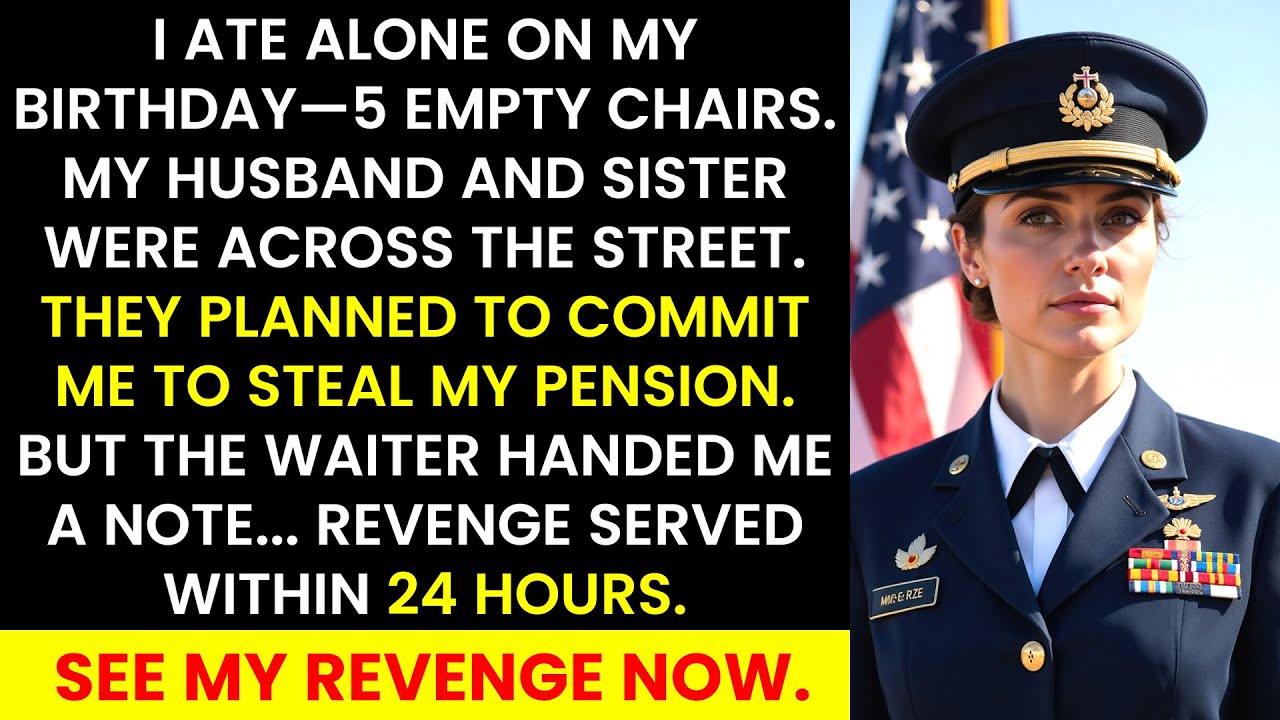
“Be a wife, not a sergeant. ” So here I was, soft, exposed, and completely alone. The restaurant was the crown jewel of Savannah’s historic district, a place where chandeliers dripped crystal and the air smelled of roasted duck and old money. But at table number six, the atmosphere was as cold as a tomb.
Five chairs sat opposite me, aggressively empty: my husband Patrick, my sister Victoria, my in-laws Ethan and Haley, my best friend Elizabeth. Not one of them had walked through the mahogany doors. I took another sip from my water glass, my fifth of the evening. The ice had long since melted, leaving the water tepid and bitter.
I could feel the weight of the room shifting against me. In a city like Savannah, silence is never truly silent. It’s filled with judgment. I felt the laser-focused stares from the nearby tables.
Couples holding hands. Families celebrating anniversaries. They were dissecting me. “Poor thing,” a woman in pearls whispered from the booth behind me, her voice carrying over the low hum of jazz.
“He probably stood her up for someone younger. It’s always the sad ones who wait the longest. ”
Her pity hit me harder than a physical blow. I wasn’t just a woman waiting for dinner.
I was a public spectacle, a discard pile in a room full of treasures. I gripped the linen napkin in my lap, my knuckles turning white, fighting the urge to stand at attention and scream. I picked up my phone again. It was my lifeline and currently my tormentor.
I opened my message thread with Patrick. The text I sent at 7:08 p. m. —”Honey, where is everyone?
I’m waiting”—still sat there, marked delivered, not read. I dialed his number. It rang four times, then went to voicemail. His cheerful recorded voice mocked me.
“You’ve reached Patrick, your premier Savannah realtor. Leave a message and have a blessed day. ”
I hung up and called Victoria. Straight to voicemail.
Desperation, cold and slippery, began to coil in my stomach. It wasn’t the adrenaline-fueled anxiety of a combat zone. This was the sickening dread of abandonment. I called my mother-in-law, Haley.
The line rang once, then clicked. User busy. She had hit the decline button. My breath hitched.
The soldier in me wanted to assess the tactical situation, but the wife in me immediately turned the weapon on herself. Did I get the date wrong? I checked the calendar. No, today was my birthday.
Did I say something to offend them last week? Was I too loud? Did I have another episode? I don’t remember.
Patrick had been telling me for months that my memory was slipping, that the stress of the service was making me unreliable. Maybe he was right. Maybe they were all punishing me for something I didn’t even know I had done. I lowered my head, staring at the empty bread plate, willing the humiliating tears not to ruin the silk dress.
“Ma’am. ” The voice was soft, hesitant. I looked up, expecting the maître d’ to finally ask me to relinquish the table to paying customers. It was Leo.
I recognized him from the name tag. He was a busboy, no older than twenty-eight, with the sharp, intelligent eyes of a law student working double shifts. But right now, those eyes were filled with a terrifying mixture of pity and urgency. He wasn’t holding a dessert menu.
His hands were trembling slightly as he slid a folded piece of receipt paper onto the tablecloth, keeping his body angled to block the view from the front of the restaurant. “I’m sorry, Sergeant,” he whispered, using my rank. He must have seen my military ID when I ordered the water. “I know who you are.
You don’t deserve this. ”
He glanced nervously toward the large bay window that looked out onto Broughton Street. “Don’t look out the window,” he hissed, his voice dropping to a barely audible level. “Read this and check your phone right now.
The text coming through is from my number. ”
Before I could ask a single question, Leo stepped back and vanished into the kitchen, acting as if he had just cleared a plate. My heart hammered against my ribs like a trapped bird. I looked down at the paper.
In rushed, jagged handwriting, it read: “They are at the Oyster Bar across the street. You need to see the truth. ”
My phone buzzed. I unlocked the screen.
A text from an unknown number. An image file. I tapped it. The world didn’t spin.
It stopped. The noise of the restaurant, the jazz, the clinking silverware—it all vanished into a vacuum of silence. The photo was grainy, taken through the glass window of the bar across the street, but the subjects were undeniable. Patrick was there.
He was laughing, his head thrown back, a glass of expensive red wine in his hand. Leaning into him, her arm draped possessively around his waist, was Victoria, my sister. She was whispering something in his ear, her face flushed with delight. But my eyes didn’t stay on their faces.
They were drawn like a magnet to steel. To Victoria’s hand resting on Patrick’s chest. On her ring finger, catching the dim light of the bar, was a vintage diamond ring with a unique filigree setting. My mother’s ring.
The air left my lungs. Three months ago, I had torn our house apart looking for that ring. I had sat on the floor sobbing while Patrick held me and stroked my hair. “Oh, Alexa,” he had said, his voice dripping with faux sympathy.
“Don’t you remember? You lost it during your panic attack last week. You threw it in the garden. We looked, but it’s gone.
You really need to take your meds, honey. ”
I had believed him. I had swallowed the pills he gave me. I had believed I was broken, that my mind was betraying me.
But I wasn’t crazy. He had stolen it. He had stolen my mother’s legacy, my sanity, and my dignity. And now he was across the street, sliding that stolen ring onto my sister’s finger while I sat here waiting for a birthday cake that was never coming.
I touched the screen, tracing the outline of the ring. The sorrow that had been drowning me evaporated instantly. In its place, a cold, hard rage began to crystallize—the kind of focus I hadn’t felt since my boots were on the ground in Iraq. “Psalm 23,” I whispered to the empty chair opposite me, my voice steady for the first time all night.
“Though I walk through the valley of the shadow of death, I will fear no evil. ” But tonight, Patrick and Victoria were the ones who should be afraid. A strange sensation washed over me. The nausea faded.
The tears dried up instantly, leaving my face tight and cold. The shaking in my hands stopped. I wasn’t sad anymore. I was operational.
I stared at the screen of my phone until the pixels seemed to burn into my retinas. That ring. That damned ring. Seeing it on Victoria’s finger didn’t just hurt.
It unlocked a door in my mind that I hadn’t realized was bolted shut. The fog that had clouded my brain for the last three months began to lift, replaced by a clarity so sharp it cut like a knife. Suddenly, the last ninety days made terrifying sense. Ever since I came back from deployment, I hadn’t felt like myself.
I was sluggish, forgetful, constantly wading through mental molasses. Patrick had been so solicitous, so caring. Every night after dinner, he would hand me a small paper cup with two blue capsules. “Here you go, babe,” he’d say, his voice smooth as velvet.
“Dr. Miles sent these over. High-potency vitamins for your brain health. It helps with the transition from the desert.
You need to sleep to heal. ”
I trusted him. I swallowed them down with water, grateful for a husband who cared about my recovery. Twenty minutes later, I would be barely conscious on the sofa, my limbs heavy as lead.
That’s when Victoria would usually come over. Through the haze of the drugs, I would see them in the kitchen drinking wine, whispering. I remember waking up once with drool on my chin, catching them looking at me with an expression I thought was pity. It wasn’t pity.
It was contempt. “She’s out of it again,” Patrick would say, sighing loudly. “The PTSD is getting worse. She doesn’t even know what day it is.
”
He wasn’t treating my PTSD. He was chemically inducing a state of incompetence. He was poisoning me with sedatives and calling them vitamins. My hand shook, but this time not from sadness.
I needed verification. I couldn’t use my cell phone. If Patrick was this calculated, he might be tracking my calls or have my family blocked. I waved Leo over.
“I need a landline now. ”
He nodded, understanding the urgency, and handed me the cordless phone from the server station. I dialed my mother-in-law’s home number. I knew Haley would be home.
She never went out on Tuesday nights. She picked up on the first ring. “Hello. ” Her voice was trembling, high-pitched with panic.
“Mom, it’s me. It’s Alexa. ”
There was a stunned silence on the other end, followed by a gasp that sounded like a sob. “Oh, dear God.
Alexa, where are you? Are you safe? Do you have the gun? ”
I froze.
“The gun? Mom, what are you talking about? ”
“Patrick called us ten minutes ago,” she cried, her words tumbling out in a hysterical rush. “He said you had a psychotic break at the restaurant.
He said you were screaming, flipping tables, and threatening the staff with your service pistol. He said he had to call the paramedics to sedate you and take you to the psych ward at Memorial. We were just putting on our coats to meet you at the hospital. ”
The air in the restaurant seemed to drop ten degrees.
It was the perfect crime, a masterclass in character assassination. While I sat here in silence, sipping water and waiting for a family that never came, Patrick was painting a picture of a dangerous, unhinged lunatic to everyone we knew. “Mom, listen to me closely,” I said, keeping my voice low and steady, utilizing the command tone I used with my platoon. “I am sitting at table number six at Château Laurier.
It is quiet. I am drinking water. I do not have my weapon. I have not raised my voice once.
”
“But—but Patrick said—” Haley stammered. “And Victoria—she called to say she couldn’t come to dinner because of a migraine, but then she called back crying, saying she was terrified you were going to hurt yourself. ”
“They are lying, Mom,” I said, the words tasting like ash. “Patrick isn’t at the hospital with me.
He’s across the street at the Oyster Bar drinking a three-hundred-dollar bottle of Cabernet with Victoria. And she isn’t home with a migraine. She’s sitting on his lap. ”
“No,” Haley whispered.
“That’s impossible. Not Victoria. Not his own sister-in-law. ”
“She’s wearing Mom’s ring, Haley.
The one Patrick told me I lost. ”
The silence on the other end was heavy, filled with the shattering of a mother’s illusion. “I need you to trust me,” I said. “Don’t call him.
Don’t let him know I know. Just stay by the phone. ”
I hung up. The deep sadness of the abandoned wife was gone.
The confusion of the forgetful patient was gone. In their place stood Sergeant McKe. I remembered a sermon our pastor gave before I deployed. “The truth will set you free.
” But Patrick had used lies to build a cage around me. He had isolated me from my friends, made my neighbors look at me with fear, and drugged me into submission, all to steal the pension I bled for. He thought he had broken me. He thought the crazy-war-vet narrative would cover his tracks.
I wiped my face with the linen napkin, scrubbing away the last trace of the victim I used to be. I looked at my reflection in the darkened window. The woman staring back had cold eyes and a set jaw. I stood up and turned to Leo, who was hovering protectively nearby.
“Take me to the security room,” I ordered. My voice was no longer a request. It was a directive. “I need to see the financial records.
I need to see exactly what they are doing with my credit cards while they think I’m being strapped to a gurney. ”
Leo nodded, his face pale but determined. “Follow me, Sergeant. ”
We marched toward the kitchen doors.
The dinner was over. The war had just begun. Leo signaled for me to follow him, cutting a path through the swinging double doors of the kitchen. The noise hit me first—a chaotic symphony of shouting line cooks, clattering pans, and the hiss of searing meat.
Then came the smell. The air was thick with the scent of garlic butter, roasting prime rib, and truffle oil. It should have been appetizing, but to my empty stomach and knotted insides, it was nauseating. We navigated through the chaos to a small, cramped office at the back, nestled behind the walk-in freezer.
“The manager is my uncle,” Leo explained as he unlocked the door and flipped on the lights. “He hates men who cheat. He’s going through a messy divorce himself. ”
He motioned for me to sit in the worn leather chair in front of a bank of monitors.
This wasn’t just a back office anymore. In my mind, the environment shifted. I was back in the TOC, the tactical operations center. The hum of the computer fans replaced the desert wind.
I wasn’t a crying wife. I was a sergeant analyzing intel. Leo’s fingers flew across the keyboard. “I’ve been watching them for weeks.
They come here every Tuesday. Always table twelve at the Oyster Bar across the street. It’s the darkest corner, but we have a cross-axis agreement with their security system for street monitoring. ”
A feed popped up on the center screen.
The image was high definition, far clearer than the photo on my phone. There they were, Patrick and Victoria. They were clinking glasses filled with a deep ruby liquid. I zoomed in with my eyes.
That label—I recognized it from the wine list Patrick kept in his study, but claimed we could never afford to open. A bottle of Cabernet that cost three hundred dollars. I’d never dared to order it, even though I was the primary breadwinner. I drank tap water so they could drink vintage wine.
“Look at this, Sergeant,” Leo said, his voice tight. He pulled a stack of crumpled receipts from his apron pocket. “I reprinted these from the system history. They always pay with the same card.
”
He slid the thermal paper across the desk. I looked at the last four digits: 4-1-9-0. My blood ran cold. That was my Army Visa Platinum card.
The one I had added Patrick to as an authorized user for emergencies and to buy groceries while I was deployed. My hands trembled as I pulled out my phone and opened my banking app. I bypassed the checking account and went straight to the credit card history. I scrolled, and with every swipe of my thumb, a fresh wave of horror washed over me.
The Ritz-Carlton, $800. Spa Bella Day Spa, $450. Savannah Luxury Imports, $2,500. The list went on and on—dinners, hotels, designer clothes.
“Thirty thousand dollars,” I whispered, the number tasting like bile. They spent over thirty thousand dollars in three months. This wasn’t just money. This was my hazard pay.
I closed my eyes and saw the desert. I felt the heat of the Iraqi sun, the weight of my flak jacket, the ground shaking from an IED blast that had taken the hearing in my right ear for a week. I had bled for this money. I had missed Christmases, birthdays, and anniversaries for this money.
I had risked leaving my husband, a widower, to earn this, thinking I was securing our future. Instead, I had financed their affair. They weren’t just spending my money. They were drinking my blood.
But the kill shot was yet to come. “The retirement fund,” I murmured, a sudden realization seizing my chest. I navigated to the long-term savings tab. This was the nest egg I had built over twenty years of service, intended to supplement my military pension.
It was supposed to have over one hundred thousand dollars in it. I stared at the screen. Available balance: $0. 00.
I gagged, covering my mouth with my hand. Patrick had power of attorney. I had signed the papers before I deployed. A standard procedure for soldiers to ensure bills got paid if we were incapacitated.
He had used that legal weapon to drain me dry. He had transferred everything out under the guise of real estate investments. There was no investment. There was only Victoria’s new Hermès bag and Patrick’s delusion of being a wealthy playboy.
I sat back, the leather chair creaking under the weight of my devastation. I was forty-seven years old. I had served my country for two decades, and I was destitute. I didn’t own the home I lived in—Patrick had refinanced it in both our names.
I had no cash. My credit was likely destroyed. And tomorrow morning, they planned to have me committed to a psychiatric ward to silence me forever. This wasn’t a marriage crisis.
This was a robbery in progress. It was a homicide of my future. I looked up at the monitor. On the screen, Patrick was laughing at something Victoria said, his hand reaching out to stroke her cheek.
He looked so smug. So victorious. He thought I was currently hyperventilating in a hospital waiting room or crying myself to sleep on the couch. He thought he had won.
“Sergeant? ” Leo asked, stepping back slightly, seemingly unsettled by the sudden change in my demeanor. “What are you going to do? ”
I took a deep breath, inhaling the scent of printer toner and dust.
It smelled like clarity. “Leo,” I said, my voice low and devoid of emotion. “Can you extract this video segment? And do you have audio from that bug you planted?
”
“Yes, ma’am. Crystal clear. ”
“Good. Send the files to my phone immediately.
”
“But why? ” Leo asked as he began the transfer. “To start a war,” I replied, my eyes locked on Patrick’s smiling face on the screen. They had taken my money.
They had taken my love. They had taken my trust. But they had made a grave miscalculation. You can strip a soldier of her weapon, but you cannot strip her of her training.
They want to tell the world I’m crazy,” I said, unlocking my phone and opening WhatsApp. “Fine, I’ll show them exactly what a crazy woman can do. ”
Leo reached into his apron pocket and pulled out a small black case. He opened it to reveal a sleek Bluetooth earpiece.
“I shouldn’t have this,” he murmured, his eyes darting around the office to ensure we were alone. “It’s a long-range directional mic. I bought it online to listen to gossip at the tables. It gets boring during the lull between shifts.
But tonight,” he trailed off, handing it to me. “Tonight, it’s a weapon. ”
I placed the device in my ear. At first, there was only the static hiss of ambient room noise—clattering silverware, the hum of the air conditioner.
Then Leo adjusted a dial on his laptop, and the audio sharpened into focus. The first sound I heard was Victoria’s laughter. It wasn’t the sweet giggle I remembered from our childhood. It was a jagged, cruel sound that grated against my eardrum.
“Oh my god, babe. Did you see her? ” Victoria’s voice came through crystal clear, slurring slightly from the wine. “She’s sitting there in that ridiculous blue dress.
She looks like a sausage casing about to burst. I told her to stick to her camouflage. At least that hides the ugly. ”
Her words felt like acid being poured directly into my ear canal.
I squeezed my eyes shut. This was the sister I had practically raised. I remembered skipping lunch for a month when I was twenty-two just to save enough money to buy her the perfect emerald prom dress because our parents couldn’t afford it. I had been the one to zip her up, telling her she looked like a princess.
Now she was laughing at me, calling me a sausage, dehumanizing me to please my husband. “Forget about the old hag,” Patrick’s voice cut in, low and thick with alcohol. “You’re killing the buzz. ”
“I just don’t know how you do it, Patrick,” Victoria giggled.
“Sleeping with her. It must be gross. ”
I held my breath, waiting for him to defend me. Even a cheater might have some shred of loyalty left, right?
“You have no idea,” Patrick sneered. “I have to turn the lights off completely. Touching her back—it makes me want to vomit. It’s like touching toad skin.
All those lumpy, jagged scars. She goes on and on about them being her war medals. But let’s be real, it’s just mutilated flesh. It’s repulsive.
”
My hand flew to my left shoulder instinctively. Under the silk of my dress, I could feel the ridges of the keloid scars. Afghanistan, 2010. A mortar round had hit our convoy.
I had thrown my body over Private Miller, a nineteen-year-old kid from Ohio. I took the shrapnel so he could go home to his newborn daughter. I had been proud of these scars. Patrick used to kiss them.
He used to trace them with his finger and whisper that I was his hero. Now to him, I was just a toad. A repulsive object he tolerated for a paycheck. The conversation shifted, the tone dropping from mockery to cold calculation.
“Are we set for tomorrow? ” Victoria asked, the ice clinking in her glass. “One hundred percent,” Patrick replied. “I slipped Dr.
Miles an envelope of cash this afternoon. He’s already signed the preliminary observation papers. ”
“And the police? ”
“I’ll make the call at nine a.
m. ,” Patrick said, sounding incredibly pleased with himself. “I’ll tell the 911 dispatcher that Alexa is having a flashback, that she’s armed and threatening suicide. When the cops show up, she’ll be groggy from the double dose of sedatives I’m going to crush into her water tonight.
They’ll see a confused, non-responsive veteran with a gun on the table. They’ll cuff her for her own safety. ”
My blood ran cold. “Once she’s in the seventy-two-hour involuntary hold,” Patrick continued, “I file for emergency guardianship.
I’ll argue that her mental state is deteriorating rapidly and she can’t manage her finances. By the time she gets out—if she gets out—I’ll have total control of the assets. The house. The pension.
Everything. It’ll be ours. ”
“You’re a genius, baby,” Victoria purred. I took the earpiece out and set it gently on the desk.
My hand was steady as a rock. The shaking, the tears, the heartbreak—it had all evaporated. In its place was the cold, focused calm of a sniper settling into position. There is an old saying: “The most dangerous enemy is the one sleeping next to you.
” Patrick and Victoria weren’t just unethical. They were domestic terrorists planning a coup on my life. They weren’t going to divorce me. They were going to erase me.
I looked at Leo. He was staring at the floor, his face flushed with secondhand shame. “Did you get that? ” I asked.
My voice sounded different—deeper, hollower. “Every word, Sergeant,” Leo whispered. “I have it saved. ”
“Good.
AirDrop it to me now. ”
I pulled out my phone. I didn’t dial 911. The police would need statements, investigations, probable cause.
Bureaucracy takes time, and I didn’t have time. I needed a nuclear option. I needed immediate, irreversible destruction. I opened WhatsApp.
I created a new group. I didn’t select just anyone. I scrolled through my contacts with surgical precision: Haley McKe, mother-in-law. Ethan McKe, father-in-law.
Aunt Martha, the family gossip. Pastor John, First Baptist Church. Colonel Thompson, Patrick’s boss at the realty firm. Cousin Sarah, the neighborhood watch group leader.
I named the group “The Truth About the McKe Family. ”
I looked at the blank text box. It was time to pull the trigger. I didn’t write a long, tear-stained manifesto.
I didn’t beg for sympathy or ask anyone to take my side. Soldiers don’t send diary entries from the battlefield. They send situation reports. I treated the group chat like a tactical briefing.
I selected three attachments. Exhibit A: the photo Leo had just taken. The timestamp was visible: 8:45 p. m.
It clearly showed Patrick kissing Victoria, with the distinct glint of my mother’s vintage diamond ring on her finger. Exhibit B: a screenshot of the bank statement Leo had printed. I used the markup tool on my phone to circle the transactions in red ink—Ritz-Carlton, Spa Bella, Victoria’s Resort Wear. Total: $30,000.
Beside the total, I typed one word: STOLEN. Exhibit C: the audio file, two minutes and twelve seconds of pure malice. I had trimmed it to start exactly at the moment Patrick said, “The scars on her back make me want to vomit,” and end right after he detailed the plan to call 911 and have me involuntarily committed to a psych ward tomorrow morning. I looked at the text box.
My fingers flew across the keyboard, typing a caption that was short, brutal, and impossible to misunderstand: “Happy birthday to me. This is the gift my husband and my sister bought me tonight using my entire life savings. Please listen to the audio carefully. They are planning to have me falsely institutionalized tomorrow morning to seize my pension.
If I disappear or get arrested tomorrow, you know who did it. ”
My thumb hovered over the blue arrow button. Time seemed to warp, slowing down to a crawl. In that single second of hesitation, I wasn’t a sergeant.
I was a wife mourning the death of a twenty-year marriage. I was saying goodbye to the man I thought I knew, the man I had vowed to love until death parted us. But death hadn’t parted us. Greed had.
I took a sharp breath. “Goodbye, Patrick. ”
I pressed send. The screen showed a spinning circle for a heartbeat, then—delivered.
Two blue check marks appeared instantly. I set the phone down on the desk. For ten seconds, there was silence. Then the phone began to vibrate.
It started as a low buzz and quickly escalated into a violent spasm, dancing across the hard surface of the desk like a live grenade. Notifications flooded the screen in a torrent. Aunt Martha: “OMG, is this real? ”
Cousin Sarah: “The audio…
I’m going to be sick. ”
Pastor John: “Alexa, please tell me this is a mistake. ”
I didn’t open a single message. I didn’t care about the gossip or the shock of the extended family.
I was waiting for one specific reaction. Five minutes later, the screen lit up with a call. Caller ID: Dad Ethan. My stomach dropped.
Patrick’s father was a retired general, a man of few words and immense pride. If he sided with his son, I was truly alone. I picked up the phone. “Hello.
”
There was no greeting. I could hear heavy, ragged breathing on the other end—the sound of a man fighting to keep his composure. “Alexa. ” His voice rumbled, low and dangerous, like approaching thunder.
“Where are you right now? ”
“I’m at the restaurant, Dad,” I replied, my voice trembling slightly. “Are you safe? Are you—are you having an episode?
”
“No,” I said firmly. “I’m sitting in the back office. I am sober. I am calm.
And I am completely sane. ”
“Good. ” The word was clipped. “Because your mother is on the floor right now.
She just listened to the audio. She’s wailing. Alexa, I’ve never heard her make a sound like that. ”
I gripped the phone tighter, guilt flashing through me.
“I’m so sorry, Dad. I didn’t want you to find out like this. ”
“Don’t you dare apologize,” Ethan snapped. His voice cracked, revealing a fury so intense it terrified me.
“Did he really say that? Did he really say your shrapnel scars—the scars you got saving a nineteen-year-old boy’s life—make him vomit? ”
“Yes,” I whispered. “He did.
”
“That son of a—” Ethan roared. I heard something shatter in the background—a glass, maybe a vase. “He is dead to me. Do you hear me?
He is no son of mine. He has dishonored this family, and he has dishonored the uniform. ”
“Dad—”
“Go home, Alexa. ” He ordered, shifting instantly into command mode.
“Go home right now. Call a locksmith. Change every damn lock in that house. Do not let him inside tonight.
Your mother and I are driving down from Charleston. We will be at your front door at 0900 hours sharp. ”
“Okay,” I said, tears finally spilling over—not from sadness, but from relief. “I’ll see you at 0900.
”
“Lock and load, soldier,” he said, and the line went dead. I lowered the phone. The weight that had been crushing my chest all night finally lifted. I wasn’t alone.
I had reinforcements. I turned to Leo. He was standing by the door, pretending not to listen, but his eyes were wide. I opened my wallet.
I had five hundred dollars in bills tucked inside my emergency cash stash, which I always kept on me. I pulled them all out. It was the last liquid asset I had to my name. “Here,” I said, shoving the cash into his hand.
“Sergeant, no. ” Leo shook his head, backing away. “I can’t take that. I just did what was right.
”
“Take it, Leo. ” I grabbed his hand and forced the bills into his palm. “You didn’t just serve water tonight. You saved my life.
You gave me the ammo to fight back. If you hadn’t slipped me that note, I would be in a psych ward by tomorrow afternoon. ”
Leo looked down at the money, then up at me, his eyes rimmed with red. “Give him hell, Sergeant.
”
“I intend to. ”
I walked out the back door of Château Laurier. The night air of Savannah hit my face, humid and smelling of jasmine and impending rain. It was a beautiful night.
I walked to my car, my heels clicking rhythmically on the pavement. I felt lighter, sharper. The party was over, but the eviction was just beginning. I got into my car and locked the doors.
I had a long night ahead of me. I had to turn my home into a fortress before the enemy returned. I pulled into my driveway at ten sharp. The house looked the same as I had left it—perfectly manicured lawn, the white picket fence glowing under the street lamps.
It looked like the American dream, but inside it was a crime scene of a marriage. I didn’t cry. I didn’t collapse. I picked up my phone and called Mark, an old buddy from my unit who now ran a twenty-four-hour locksmith service in Savannah.
“Mark, it’s an emergency,” I said. “I need a full perimeter rekey—front, back, garage, and the side gate. Tonight. ”
By eleven p.
m. , the deadbolts were replaced. Mark didn’t ask questions. He just saw the look in my eyes, gave me a discount, and said, “Watch your six, Sergeant.
”
Once the house was secure, the purge began. I grabbed a roll of heavy-duty black trash bags from under the sink. I went to the master bedroom closet. I didn’t fold Patrick’s Italian silk suits.
I didn’t organize his designer shoes. I swept them off the shelves in violent armfuls and stuffed them into the plastic sacks. His limited-edition Titleist golf clubs went into a bag. His collection of vintage bourbon—I didn’t break them.
I didn’t want to give him the satisfaction of calling me destructive. I tossed them into a bag with his dirty gym socks. I dragged the bags—fifteen of them—to the back patio, stacking them in a pile that looked like curbside refuse. Because that’s what they were.
I didn’t sleep. At six a. m. , I brewed a pot of black coffee strong enough to wake the dead.
I went to the guest room closet where I kept my gear. I bypassed the civilian clothes Patrick liked. I reached for my dress blues. I put on the uniform with ritualistic precision.
Shirt tucked tight. Tie straight. Jacket buttoned. I pinned my ribbons and medals to my chest.
The weight of them felt grounding. This wasn’t a costume. It was my armor. I sat in the armchair facing the front door.
On the coffee table in front of me, I placed my service pistol. The magazine was removed, the chamber empty, the safety on. It wasn’t there to be used. It was a statement.
It was the visual deterrent for the lie he was about to tell. I waited. At 9:15 a. m.
, a familiar silver BMW pulled into the driveway. I watched through the sheer curtains. Patrick stepped out, looking disheveled but trying to compose himself. In his hand was a bouquet of wilting carnations wrapped in cheap plastic, clearly bought from the gas station down the road.
The “I’m sorry I missed dinner” special. He walked to the door, put his key in the lock, and turned. It didn’t budge. He frowned, jiggling it.
He tried again. Nothing. “Alexa? ” he called out, his voice muffled by the wood.
He knocked, then pounded. “Alexa, are you in there? Open the door. You’re scaring me.
”
He was shouting loudly, pitching his voice so the neighbors, the nosy HOA board members, would hear. He was setting the stage. Worried husband. Unstable wife.
I stood up, smoothed my jacket, and walked to the door. I unlocked the main wooden door and swung it open, but I kept the metal security screen door locked tight between us. Patrick lunged forward, then stopped, his nose inches from the mesh. He saw me.
He saw the uniform. He saw the cold, dead look in my eyes. “What the hell is this? ” he hissed, dropping the act for a second.
“Why are the locks changed? ” Then he glanced at my chest, at the medals. A smirk twisted his face. “Oh, Jesus, Alexa, you’re wearing the suit.
Are you having a flashback? Do you think you’re in Baghdad? Did you take the pills I left you? ”
“Go home, Patrick,” I said, my voice calm and projecting clearly through the screen.
“Your belongings are in trash bags on the back patio. The gate is unlocked for fifteen minutes. ”
The passenger door of the BMW opened. Victoria stepped out.
She was wearing oversized sunglasses to hide her hangover, clutching a designer purse—likely bought with my hazard pay. “Sissy! ” she wailed, rushing up the walkway, putting on a show of tears. “Oh my god, we were so worried.
We drove to three hospitals looking for you last night. Please let us in. You’re not well. ”
It was repulsive.
A bad soap opera played out on my front porch. “Enough! ” Patrick shouted, his face turning red. He realized he was losing control of the narrative.
He pulled out his phone and held it up like a weapon. “You’ve left me no choice, Alexa. You’re unstable. You’re a danger to yourself.
I’m calling 911 right now. ” He tapped the screen furiously. “I’m going to have you committed. A seventy-two-hour hold.
When you wake up in the psych ward, remember that you did this to yourself. ”
He put the phone to his ear, a triumphant glint in his eyes. “There’s no need for that, son. ”
The voice was deep, gravelly, and came from the street.
Patrick spun around. He had been so focused on his performance, he hadn’t heard the vehicle approach. Parked silently at the curb, engine idling with a low rumble, was a black Ford F-150. My father-in-law’s truck.
The driver’s door opened. Ethan McKe stepped out. He was seventy years old, a Vietnam veteran, and he looked like a thunderstorm about to break. In his right hand, resting casually on his shoulder, was a Louisville Slugger baseball bat.
From the passenger side, my mother-in-law, Haley, stepped out. She wasn’t crying anymore. She held her smartphone up high, volume maxed out. Patrick’s own voice blasted through the quiet suburban morning, echoing off the siding of the house: “The scars on her back make me want to vomit.
It’s like touching toad skin. ”
Patrick’s face went from flushed red to the color of dirty paper. The phone slid from his hand and hit the concrete porch with a crack. The echo of Patrick’s recorded voice faded into the morning air, leaving a silence so heavy it felt like it could crush lungs.
Patrick stared at the phone in his mother’s hand, his face pale and sweating. He looked like a trapped animal. He turned his gaze to Ethan, forcing a shaky, incredulous smile. “Dad, Mom—come on, you know how technology works.
Alexa, she’s sick. She edited that. She spliced words together to make me sound crazy. ”
The sound was sickeningly loud, like a dry branch snapping in a storm.
It cut through the suburban quiet, silencing the birds in the oak trees. Ethan’s hand had connected with the side of Patrick’s face with the force of a freight train. The impact lifted Patrick off his feet. He stumbled backward, flailing for balance, and collapsed directly into the manicured rose bushes lining the walkway.
The thorns tore into his expensive dress shirt and scratched his cheek as he scrambled to get up, looking at his father with wide, terrified eyes. He had never seen Ethan raise a hand in his life. Ethan stood over him, his chest heaving, the baseball bat still resting ominously on his shoulder. The seventy-year-old veteran was trembling—not with frailty, but with volcanic rage.
“I did not raise you to be a liar,” Ethan growled, his voice vibrating with disgust. “I did not raise you to sleep with your wife’s sister. And I sure as hell did not raise you to mock the scars of a soldier who took a bullet for her country. ”
“Dad, please,” Patrick whimpered, wiping a trickle of blood from his lip.
“Don’t you call me Dad,” Ethan spat. “You are a disgrace to the name McKe. You are a disgrace to this family. You are dead to me.
”
Seeing her ally fallen, Victoria panicked. She scrambled toward Haley, tears streaming down her face—the same performance she had used since we were kids to get out of trouble. “Aunt Haley, please,” she sobbed, dropping to her knees on the concrete. “You have to listen.
It wasn’t my fault. Patrick—he seduced me. He told me they were separated. I didn’t want to—”
Haley McKe, a woman who had never spoken a harsh word in the twenty years I had known her, took a sharp step back.
She looked down at Victoria, not with anger, but with a cold, absolute revulsion. “Get away from me,” Haley hissed. “Do not touch me with those dirty hands. ”
Victoria froze, her hand reaching out.
“You are wearing the ring of your own dead mother,” Haley said, her voice shaking. “You are wearing it while you sleep with your sister’s husband. You aren’t a victim, Victoria. You aren’t even human.
Get out of my sight before I forget I’m a Christian woman. ”
Haley turned her back on them and opened her arms to me. I walked down the steps and collapsed into her embrace. She held me tight, smelling of lavender laundry detergent and safety.
For the first time in twenty-four hours, I let out a sob. It wasn’t a cry of despair. It was the release of a burden I’d been carrying alone. But the moment of comfort was brief.
I had a perimeter to secure. I pulled away from Haley, wiped my face, and stepped toward the rose bushes where Patrick was struggling to untangle his pants from the thorns. I reached into my pocket and pulled out a single key—the key to the back service gate where we kept the recycling bins. I threw it onto the dirt in front of him.
“You have fifteen minutes,” I said. My voice was calm, authoritative. “Everything you own is in black trash bags on the back patio. Grab them and get off my property.
”
Patrick scrambled up, trying to regain some shred of dignity despite the blood on his face and the leaves in his hair. “You can’t kick me out, Alexa. This is marital property. I have rights.
I’m not going anywhere until I talk to a lawyer. ”
“Wrong,” I said, a cold smile touching my lips. I stepped closer, invading his personal space. “I bought this house in 2001, Patrick.
Two years before we got married. I used my Army enlistment bonus and my savings for the down payment. ”
His eyes widened. He had forgotten.
“The deed is in the name of Alexa Anderson,” I continued. “I never added you to the title. I never refinanced. In the eyes of the state of Georgia, you are a tenant at will, and your lease has just been terminated for criminal misconduct.
”
I pointed to the silver BMW in the driveway. “And leave the car keys. The lease on that sedan is under my credit because yours was too low to qualify. ”
“But how am I supposed to leave?
” he sputtered. “Figure it out,” I said. “Your bank accounts are frozen. I suggest you start walking.
”
By now, the neighbors had gathered. Mrs. Higgins from across the street was watching from her porch with her morning coffee. The head of the neighborhood watch was standing on the sidewalk with his arms crossed.
Patrick looked around, realizing he had lost the audience. His reputation—the thing he valued more than his marriage—was incinerated. He snatched the key from the dirt and limped off to the backyard. Ten minutes later, a sad procession began.
Patrick dragged the heavy black trash bags down the driveway, sweating profusely. He had called an Uber. When the driver, a guy in a beat-up Toyota Camry, popped the trunk, Patrick tried to shove his Armani suits inside. They didn’t fit.
He had to jam them into the back seat, crumpling them into balls. Victoria stood by the curb, waiting. “Patrick, is my bag in there? Can I ride with you?
”
Patrick slammed the car door shut. “Get your own ride, you idiot. You ruined everything. ”
He jumped into the passenger seat, and the Uber sped off, leaving Victoria standing alone on the sidewalk with her designer purse and no ride.
She looked at me, then at the neighbors. No one moved to help her. Shame finally found her. She pulled out her phone, frantically typing for a taxi.
Ethan watched the Uber disappear around the corner. He turned his head and spat on the asphalt, cleansing his mouth of the taste of his son. He turned to me, his face softening back into the father I loved. He clapped a heavy hand on my shoulder.
“All right, Sergeant,” he said, his voice thick with emotion. “Sector clear. Let’s go inside. I picked up some rib eyes on the way down.
I’m going to fire up the grill. We’re going to celebrate your birthday properly this time. ”
I looked at the empty driveway. The enemy was gone.
My family was here. “Yes, sir,” I said. “I like mine medium rare. ”
I didn’t just want Patrick out of my house.
I wanted to ensure he could never crawl back. I needed a predator to fight a parasite. The next morning, I walked into the glass-walled office of Mia Chin. In Savannah, she was a legend.
They called her the Red Shark because she always wore crimson stilettos to court. And when she smelled blood in the water, she didn’t just bite—she devoured. Mia was a petite Asian woman with a razor-sharp bob cut and eyes that assessed my net worth in a single glance. She flipped through the file I had prepared: the bank statements with the circled fraudulent charges, the photos of the affair, and the transcript of the audio recording.
She paused at the credit card statement. A slow, terrifying smile spread across her lips. “He used your military-issued Visa Platinum? ” she asked, her voice silky.
“The one issued by a federal credit union? ”
“Yes,” I replied. “And he filed a false police report threatening to have a decorated veteran institutionalized to gain power of attorney. He plotted it.
He didn’t get the chance to execute it. ”
Mia drummed her red lacquered fingernails on the mahogany desk. Click, click, click. It sounded like a countdown.
“Sergeant, this isn’t a divorce case,” she said, closing the folder. “This is a legal execution. Unauthorized use of a military credit card is wire fraud. It’s a federal offense.
I can bury him under the jail for five years just as a warm-up. ”
“I don’t have a lot of cash for a retainer right now,” I admitted, my hands tightening on my lap. “He drained my liquid assets. ”
Mia waved her hand dismissively.
“Keep your money. I’ll waive the retainer. I’ll take my fee from his share of the assets—if he has any left by the time I’m done. I want to see the look on his face when I serve him.
”
Mia moved faster than a striking cobra. Within twenty-four hours, she had filed an emergency motion for a freeze on all marital assets, citing extraordinary dissipation of funds. The results were immediate and humiliating. Leo called me that evening, laughing so hard he could barely speak.
His roommate worked the front desk at the Perry Lane Hotel, the swankiest spot in town where Patrick had gone to cool off and wait for me to beg him back. “He tried to check in,” Leo choked out. “He slapped that platinum card on the counter like he owned the place. The machine beeped loud enough for the whole lobby to hear.
Declined. ”
“He tried three other cards,” Leo continued. “All frozen. The concierge said he started screaming about a bank error, but they escorted him out.
He didn’t have any cash—because you took his stash. ”
Remember that? Patrick didn’t sleep in four-hundred-thread-count sheets that night. He slept in the back seat of his rental sedan—a cramped economy-class compact car because his credit score had tanked the moment his name was removed from my accounts.
He ate cold gas station sandwiches for dinner. The dominoes didn’t stop falling there. The next morning, Colonel Thompson, Patrick’s boss at the realty firm, summoned him to the office. I hadn’t needed to say a word.
The group chat I created had done the heavy lifting. Mrs. Thompson had played the audio recording for her husband over breakfast. “You’re fired, son,” the colonel reportedly said, standing behind his desk, refusing to even offer Patrick a seat.
“We sell homes to military families. Trust is our currency. I cannot have a man who steals from a deployed soldier representing this company. It violates our code of ethics.
And frankly, it turns my stomach. ”
Patrick walked out of that office with a cardboard box of his belongings—unemployed and homeless. Victoria fared no better. The Southern church community is tight-knit and talks faster than a telegraph.
By Sunday service, she was a pariah. When she walked into the sanctuary, the entire third row stood up and moved to the other side of the aisle. By Monday, she was fired from her job at the high-end nail salon. Apparently, the wealthy wives of Savannah didn’t want their hands held by a woman famous for stealing husbands.
She was radioactively toxic. Three weeks later, the war ended in a conference room. Patrick sat across from me at a long oak table. He looked ten years older.
His tan was gone, his suit was wrinkled, and his arrogance had been replaced by a jittery fear. Mia Chin slid a document across the table. “This is an uncontested divorce decree,” Mia said. “It states that you, Patrick, waive all rights to the house, the pension, and spousal support.
You walk away with your personal effects and the debt you accrued on your own cards. In exchange, Sergeant McKe agrees not to press federal charges for credit card fraud and identity theft. ”
Patrick looked at the paper, then at me. “Alexa, please.
I have nothing. ”
“You have your freedom,” I said, my voice flat. “Which is more than you were going to leave me. ”
He picked up the pen.
His hand shook as he signed the line: Patrick McKe. Just like that, he was gone. I walked out of the office into the bright Georgia sunlight. I had my house back.
I had my paycheck back. I had my name back. But there was one loose end. One piece of the puzzle that still kept me awake at night.
My mother’s ring. Patrick claimed he didn’t have it. He said he gave it to Victoria, and she lost it when he kicked her out of the rental car. I knew they were lying.
That ring was the only asset they had left. I put on my sunglasses. I had won the war, but I had one last retrieval mission to complete. Three months had passed since the divorce was finalized.
The calendar on my wall no longer marked court dates or lawyer appointments. It marked yoga classes and volunteer shifts at the local veterans’ center. I walked through the automatic sliding doors of Whole Foods, the blast of air conditioning cooling the Savannah humidity on my skin. I took a deep breath.
I used to dread grocery shopping because Patrick would scrutinize every receipt, complaining if I bought name-brand cereal. Now my cart was a testament to my freedom. I tossed in a fillet of wild-caught salmon, a bag of organic kale, and a bottle of expensive kombucha. I was sleeping eight hours a night.
I hadn’t touched a sedative in ninety days. My skin was glowing, my back stood straight, and for the first time in years, I felt like the woman who had earned those stripes on her uniform. I steered my cart toward the back of the store near the dairy section, where they kept the last-chance clearance bin. It was a habit from my childhood that I couldn’t quite break—checking for deals.
That’s when I saw her. At first, I didn’t recognize the figure hunched over the refrigerated bin. She was wearing a faded yellow t-shirt that looked two sizes too big and stained at the collar. Her hair, usually blown out and glossy, was pulled back in a messy, greasy bun.
She looked skeletal, her collarbones protruding sharply against her pale skin. She was rummaging through the pile of discounted yogurts and wilting salads that were about to hit their sell-by date. It was Victoria. My breath hitched in my throat, but not from fear.
It was shock. The glamorous, arrogant woman who had sneered at my sausage-casing dress was gone. In her place was a ghost. I watched her pick up a container of potato salad marked down by fifty percent.
She checked the price tag, counted the crumpled dollar bills in her hand, and sighed. I almost turned around. I almost walked away to let her rot in her own misery. But then, as she reached for a carton of milk, the fluorescent lights of the supermarket caught a flash of brilliance on her left hand.
She was still wearing it. My mother’s ring. The diamond sparkled incongruously against her unmanicured hand and dirty fingernails. It looked grotesque.
Like a crown on a corpse. The anger didn’t explode like a bomb this time. It rose cold and steady, like a rising tide. That ring didn’t belong in a discount bin.
It didn’t belong to a traitor. I pushed my cart forward, moving with purpose, and parked it diagonally across the aisle, blocking her exit. Victoria looked up, startled. When she saw me, her eyes widened in panic.
She flinched so hard she dropped the potato salad. It hit the floor with a wet thwack, the plastic lid popping open. “S-Sissy—Alexa,” she stammered, backing up until she hit the refrigerated case. “I—I didn’t know you shopped here.
”
“Take it off,” I said. My voice was low, devoid of warmth. It wasn’t a request. Victoria instinctively covered her left hand with her right.
“What? Alexa, please. I’m having a really hard time. Patrick—he kicked me out of the rental car that day.
He blocked my number. I lost my job. I’m about to be evicted. ”
“I don’t care,” I cut her off.
I took a step closer, towering over her. “I don’t care if you’re sleeping on a park bench. I don’t care if you’re hungry. You lost the right to my sympathy the moment you crawled into my bed.
”
“I need it,” she sobbed, tears cutting tracks through the grime on her face. “I tried to sell it at a pawn shop downtown, but they wouldn’t take it without the original authentication papers or a certificate of inheritance. They thought I stole it. ”
“You did steal it,” I said icily.
“Patrick stole it from me, and you received stolen property. That makes you a criminal, Victoria. ”
People were starting to stare. A woman in yoga pants paused her shopping to watch.
A stock boy looked over with concern. “I’m going to count to three,” I said, holding out my open palm. “If that ring is not in my hand, I am calling the police. I will press charges for grand larceny right here in front of the organic produce.
”
“One. ”
Victoria trembled. She looked at the bystanders, then back at my face. She saw no mercy there.
“Two. ”
“Okay, okay, take it,” she cried. She yanked the ring off her finger. It was tight; she had to twist it over her knuckle.
She dropped it into my palm. It felt heavy and warm from her skin. “I’m sorry, Alexa,” she whimpered, wiping her nose on her sleeve. “Please, can you just—can you spare twenty dollars?
Just so I can buy some food? ”
I reached into my purse. I pulled out a travel pack of Kleenex. I took a tissue and deliberately, slowly wiped the ring.
I scrubbed the band, the diamond, the setting—cleaning off her sweat and her betrayal as if it were a physical contaminant. I didn’t look at her. I looked only at the ring. “Don’t ever call me sister again,” I said, wrapping the ring in the clean tissue and placing it in my pocket.
“Mom would be heartbroken if she knew she gave birth to a woman like you. ”
I turned my cart around and walked away. I didn’t look back at the clearance bin. I didn’t look back at the crying woman.
I paid for my groceries and walked out into the blinding Savannah sunshine. I stood on the sidewalk, clutching the tissue in my pocket. I thought I would feel sentimental. I thought I would want to put it on and cry for my mother.
But as I unwrapped it in the sunlight, I felt nothing. The stone was cold. The magic was gone. It had been on Victoria’s finger.
It had been part of their affair. It was tainted. I looked across the street. There was an old, family-owned estate jeweler there—a place that bought vintage pieces for cash.
I didn’t hesitate. I crossed the street. The bell above the door chimed as I entered. The jeweler, an elderly man with a loupe around his neck, looked up.
“I want to sell this,” I said, placing the ring on the velvet counter. “Today. Cash. ”
He inspected it for five minutes.
“It’s a beautiful piece,” he murmured. “Mid-century cut, very high clarity. I can offer you fifteen thousand dollars. ”
“Deal,” I said.
Ten minutes later, I walked out with a thick envelope in my purse. I felt lighter than air. I had traded a heavy, corrupted memory for fifteen thousand dollars of freedom. I wasn’t going to keep the money for myself, though.
I knew exactly where it was going. Mom was in my heart, not in that rock. And I was finally free. Exactly one year to the minute after the worst night of my life, I walked back through the mahogany doors of Château Laurier.
The maître d’ smiled warmly, recognizing me not as the pitiable woman who had been stood up, but as a regular patron. He led me through the bustling dining room, past the crystal chandeliers and the murmuring couples, straight to table number six by the bay window. The table was the same. The view of the street where I had once watched my world crumble through a pane of glass was the same.
But tonight, everything else was different. There were no empty chairs. To my right sat Ethan. He was in the middle of telling one of his terrible dad jokes, his booming laugh drawing smiles from nearby tables.
He wasn’t just a father-in-law anymore. He was the father I’d always wished for. To my left sat Haley. She looked radiant in an emerald green dress—a color she told me Patrick had always forbidden her to wear because he said it was too loud.
She was sipping champagne and actually glowing. Across from me sat Mia Chin. She wasn’t wearing her shark-fin court suit. She was in a silk blouse, her hair loose.
We weren’t lawyer and client anymore. We were running partners. We met three mornings a week at Forsyth Park to run 5Ks, sweating out the stress of our respective battles. And next to Mia sat Leo.
He wasn’t wearing a waiter’s apron. He was wearing a sharp navy blazer. He looked older, more confident. He was no longer just the busboy who cleared plates.
He was a senior law student at the top of his class. The fifteen thousand dollars from the sale of my mother’s ring hadn’t gone into a savings account. It had gone directly to the university registrar to pay for Leo’s final year of tuition. My mother’s legacy was no longer a cold stone on a traitor’s finger.
It was invested in a young man’s future who had the courage to tell the truth. “Sergeant on deck,” Ethan announced as I sat down, raising his glass. “At ease, soldier,” I laughed, placing my napkin on my lap. The air around the table was thick with genuine warmth.
We ordered appetizers—calamari, crab cakes—the things we liked, not what Patrick deemed appropriate. Nobody mentioned his name. Nobody mentioned Victoria. They didn’t exist in this space.
They were ghosts, fading memories that held no weight in the gravity of this joy. We didn’t talk about the past. We talked about Mia’s upcoming case. About Haley’s garden club.
About Leo’s mock trial victory. This was my family. Not by blood, perhaps, but blood is just biology. This was a chosen family.
These were the people who stayed when the building was burning down. These were the people who saw me when I was invisible, who believed me when I was labeled crazy. Their love didn’t come with conditions or fine print. It was solid.
It was real. “Dessert time,” Leo said with a grin, signaling his former colleagues. A waiter approached, carrying a cake stand. It wasn’t the vanilla sponge cake with white frosting that Patrick had forced me to eat for twenty years because he preferred it.
It was a rich, decadent, dark chocolate flourless cake dusted with cocoa powder and raspberries. Written on the plate in piped icing were the words: “Happy Freedom, Sergeant. ”
I looked at the cake, and a lump formed in my throat. It was such a small detail, but it meant everything.
It meant I was seen. “Make a wish,” Haley whispered, reaching over to squeeze my hand. I closed my eyes, but I realized I didn’t have anything to wish for. I had my health.
I had my home. I had my dignity. And I had a table full of people who would go to war for me. I blew out the candle.
“Before we eat,” I said, reaching into my purse, “I have something to show you. ”
I pulled out a small rectangular object. It was the piece of receipt paper Leo had slipped me one year ago. “Don’t look out the window.
Check your phone. ”
I had laminated it. The paper was wrinkled and the ink was fading, but preserved in plastic, it was indestructible. “I keep this in my wallet next to my military ID,” I said, holding it up.
“People ask me why I keep trash. I tell them it’s not trash. It’s my new medal of honor. ”
Leo looked down, blushing.
“It reminds me that intuition is a weapon,” I continued, looking around the table. “And that the truth is the only shield that matters. You all gave me the truth when it would have been easier to stay silent. ”
I poured myself a glass of heavy, complex Cabernet—the kind I was finally allowed to enjoy.
I stood up. The restaurant seemed to fade away until it was just me and the lens of my own life. I looked straight ahead, imagining I was speaking to every woman who had ever sat in a chair like mine, waiting for a text that wouldn’t come. “If you are sitting alone in the dark right now,” I said, my voice steady and clear, “if you are waiting for someone who is never going to show up, if you are being told that you are crazy or too old or too difficult—stand up.
”
I raised my glass higher. “Don’t let them take your value. Don’t let them rewrite your history. You are the soldier of your own life.
Fight back. Secure your perimeter. And I promise you, when the smoke clears, you will look around and see who is truly worthy of sitting at your table. ”
I took a sip of the wine.
It tasted like blackberries, oak, and absolute, terrifying, beautiful freedom. “Happy birthday to me,” I whispered. And for the first time in my life, I really meant it.