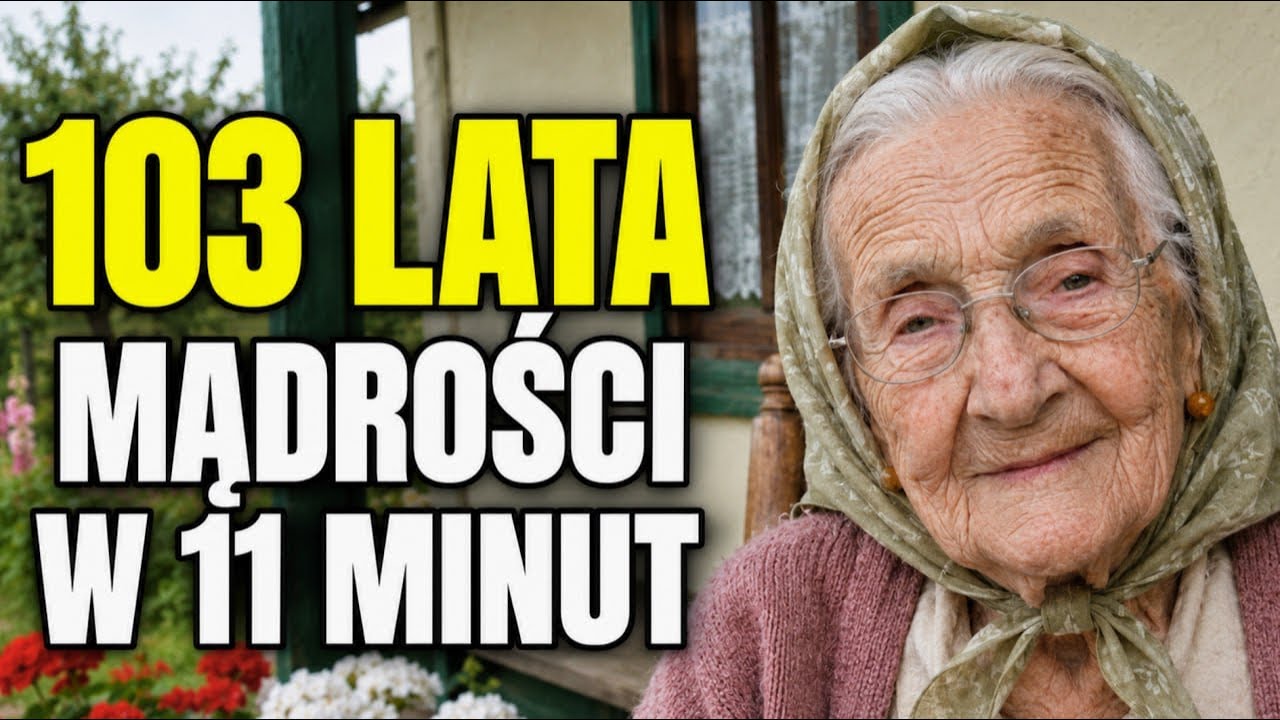
My name is Irena. I am one hundred and three years old. Most of my life, I was a doctor. In the beginning, I worked in a small clinic, and later, for many years, I treated children.
I have seen patients given almost no hope by other physicians, people who were supposed to fade away, and yet they found the strength to rise again. I have also seen those who received the best medicines, the finest care, and still, quietly, they dimmed from the inside. After all these years, I understand one thing clearly. A doctor can recognize an illness.
A doctor can prescribe a treatment or perform a surgery. But no doctor can live a patient’s life for them. I am not telling you to throw away your medication or to fight a fever with positive thinking alone. That would be foolish.
I am talking about that part of a human being that still wants to get out of bed and take the next step, even when everything inside them screams to give up. That will to live, that small stubborn flame, is something that medicine cannot manufacture. It has to come from somewhere deeper. For years, I recorded short sentences in an old notebook.
They were not grand theories about the nature of existence. They were just small fragments I wanted to remember. Out of everything I wrote down, five things remained with me. Life, love, laughter, work, and listening.
They are not a recipe for reaching one hundred years. I cannot promise anyone that. But they are five questions that helped me from losing my way. Five ways of checking whether I was actually alive or just moving through the hours.
And the last one, listening, I understood fully only thanks to a single look, a look I have carried with me since 1933. I was just a child then, but that moment became a kind of compass for everything that followed. The first two things are inseparable. Life and love.
Think of a seed hidden for years in a dry drawer. It sits still, motionless. It looks as though nothing could ever grow from it again. Then it falls into the soil.
It receives water, sunlight, and warmth. The hard shell softens, and a tiny sprout pushes through. For life, love is exactly that. It is not always made of great declarations or dramatic gestures.
More often it looks like a bowl of hot soup, an adjusted blanket on a cold night, an evening phone call, or patience for the person who is telling the same story for the tenth time. I treated children who were clean, well-fed, and neatly dressed. They had everything on the outside. And yet they were terribly lonely.
They had all the material things, but they lacked the feeling that someone actually saw them. That is why I used to tell the young doctors, do not just look at the lab result. Look at the person holding it in their hand. The number on the paper is not the whole truth.
The third thing is laughter. People say laughter is good for your health. That is true, but only when it comes from the right place. Laughter without love can humiliate.
One sentence spoken as a joke can stay inside a person for many years, cutting deeper than any wound. But laughter connected to kindness brings relief. It is a kind of laughter where no one has to defend themselves, because everyone knows we are laughing together, not at one another. In difficult times, that kind of laughter helped us survive.
We did not have much. There were days when the cupboard was nearly empty and the future was uncertain. But for a brief moment, we could forget what was missing. We could sit together and laugh until our stomachs hurt.
That was not an escape from reality. It was a way of holding on to what made us human. The fourth thing is work. Work without meaning becomes a burden.
The person gets up in the morning because they have to, performs their duties, and spends the whole day waiting for the moment they can go back home. But work in which we see another human being works differently. It changes the relationship between the effort and the fatigue. I cannot count how many times I returned from a night shift so exhausted that I fell asleep at the kitchen table with my head resting on my arms.
In the morning, I got up and went back. Not because I was a hero. I was never a hero. I was an ordinary woman who often felt tired and uncertain.
I simply knew that on the other side of the door, there was someone who needed help. When a person sees meaning, they can do more than they ever expected of themselves. They can find strength they did not know existed. I have witnessed it in the sick and in the healthy.
It is one of the most common miracles in the world, and we rarely recognize it. The fifth thing is listening. And I think this is what I learned last. A person can hear every word and not listen at all.
The patient speaks, and the doctor glances at his watch. The child tells a story, and the parent is already preparing the response instead of hearing what is being said. Someone admits they are afraid, and we immediately tell them there is nothing to be afraid of. We hear everything.
None of us tries to understand. Listening does not mean we have to agree with everything. It means that for a moment, we put our own importance aside. It means we let the other person finish.
It is a small thing. But after so many years of working with people, I know this. Some people tell the truth for the first time in their lives only because no one interrupted them. They need that silence.
They need that space. The moment we fill it with our own words, we close the door they were about to walk through. Life, love, laughter, work, and listening. From time to time, I still ask myself the same questions.
Is what I am doing serving life? Am I truly listening, or am I just waiting for my turn to speak? Do I see the person in front of me, or do I only see my own plans and worries? I do not always have a good answer.
I have made many mistakes. I have been impatient when I should have been calm. I have been tired when I should have been present. But I kept returning to those questions because they kept pulling me back to the essential.
For many years, I also carried an image in my head. I imagine myself walking at night along a dark road with a small flashlight. I cannot see the end. I can only see a few steps in front of me.
When I was young, this bothered me terribly. I wanted to know the whole future. I wanted to know if I had chosen the right profession, if there would be enough money, if something bad would happen tomorrow. I wanted a map of the entire route.
Life never gave me that. It gave me light only for the next step. And today I think that is enough. When the road ahead is not visible, you learn to pay attention to the ground beneath your feet.
You learn to trust that the next step will be revealed when you need it. That is how it worked for me, not once, but again and again. Sometimes, on the edge of that dark road, I see a faint glow. It is weak, almost imperceptible.
But when I direct my own light toward it, the glow grows stronger. It is the same with people. The person next to us may be lonely or frightened. They may not need a grand lecture or a brilliant piece of advice.
Sometimes they just need someone to look at them as a human being. That single look can be more powerful than any medicine I ever prescribed. I have seen the effect of such a look countless times. It is not magic.
It is not even complicated. But it requires something from us. It requires us to stop for a moment. It requires us to put our own distractions aside.
I remember one particular look from my childhood. I was ten years old, and it was the year 1933. My mother took me to Warsaw. For a child from a small town, the capital was enormous and loud.
The buildings seemed to touch the sky. The streets were crowded with people I had never seen before. Near Krochmalna Street, we saw a group of children. There was a short, slender man wearing glasses standing among them.
He was talking to them calmly, as if nothing in the world was more important than that conversation. I recognized him. It was Doctor Janusz Korczak. I knew he ran a home for children.
But until that moment, I had never seen the way he looked at them. A little girl was holding a crumpled paper flower. She approached him uncertainly, holding out her hand. The gaze she gave him was hesitant, as if she expected to be brushed aside.
Korczak did not take the flower from above. He knelt down, lowering himself so that his face was level with hers. He accepted the flower seriously, as if he had just received the most precious gift in the world. Then he raised his head and, for a moment, looked directly at me.
He did not say a single word. I remained silent too. And yet, something clicked inside me. That look said everything.
In that moment, I understood something I did not have words for yet. You can look at a child as someone small and unimportant. You can look at them as a problem to be managed or an obligation to be fulfilled. Or you can see in them a complete human being.
A person with dignity, with feelings, with a whole world inside their head. My mother pulled me along, and we continued walking. But I kept looking back over my shoulder for a long time. That scene stayed with me.
Many years later, I learned that Korczak did not abandon the children, even though he could have saved himself. He had opportunities. He could have walked away. He chose to stay.
I do not want to turn this into a beautiful legend. There was nothing beautiful about it. There was war, there was fear, and there was death. It was terrible.
But the question it left with me stayed for my whole professional life. When I examined a frightened child, I tried to sit a little lower first. I put myself at their height. I asked them their name and what they were afraid of.
I tried to look at them the way I had seen that man look at the girl with the paper flower. I did not always have time. I was not always patient. I made many mistakes.
I was sometimes short-tempered at the end of a long shift. But I always returned in my mind to that paper flower. I remembered how it felt to be seen, not as a nuisance, but as a person. People are waiting for someone to notice them.
It is not about praise. It is not about admiration. It is about the simple certainty that we truly exist for another person. That is what it means to be seen.
It is a fundamental need, and it never disappears, no matter how old we become. A patient lying in a hospital bed fears being reduced to their diagnosis. A mother exhausted from caring for her family fears being invisible to the very people she cares for. A lonely person sitting on a bench in the park is not waiting for a lecture, they are waiting for acknowledgment.
We can meet someone only once. On a train, in a waiting room, in a shop, or on a bench. We may never learn their name. Yet the way we look at them can stay with them for years.
It can give them strength or it can diminish them. I have seen this happen. I have seen the power of a simple glance. Nothing about it was expensive.
Nothing about it required special training. It only required attention. It required the willingness to be present. If I have to leave one thought behind, it would be this.
The most important thing is love. Not as a beautiful word. Not as a decoration for a special occasion. But as a way of treating a person when no one is watching.
It shows itself in laughter that does not hurt. In work that serves someone. In listening without interrupting. In the ordinary act of noticing the person standing next to us.
Love has to pass from one person to another. It is not a treasure to be locked away. If we keep it only for ourselves, it begins to die. It withers like a plant without water.
But when we give it away, when we let it move through us to someone else, something within us stays alive. When we get to the very center of the question about life, about healing, about meaning, we always return to the same place. We always come back to love and to life. At one hundred and three, I can tell you that there is no secret formula.
There is no magic potion. There is just how we treat one another, how we see one another, and how we keep choosing to get up and continue. The seed in the dry drawer looks like nothing will ever grow and then one day, it finds the soil.
And it grows.