Five nights after my highway accident, I lay alone in my hospital room, recovering from injuries that still ached with every breath. My daughter had visited earlier that evening, held my hand, promised everything would be okay. At 11:47 p. m.
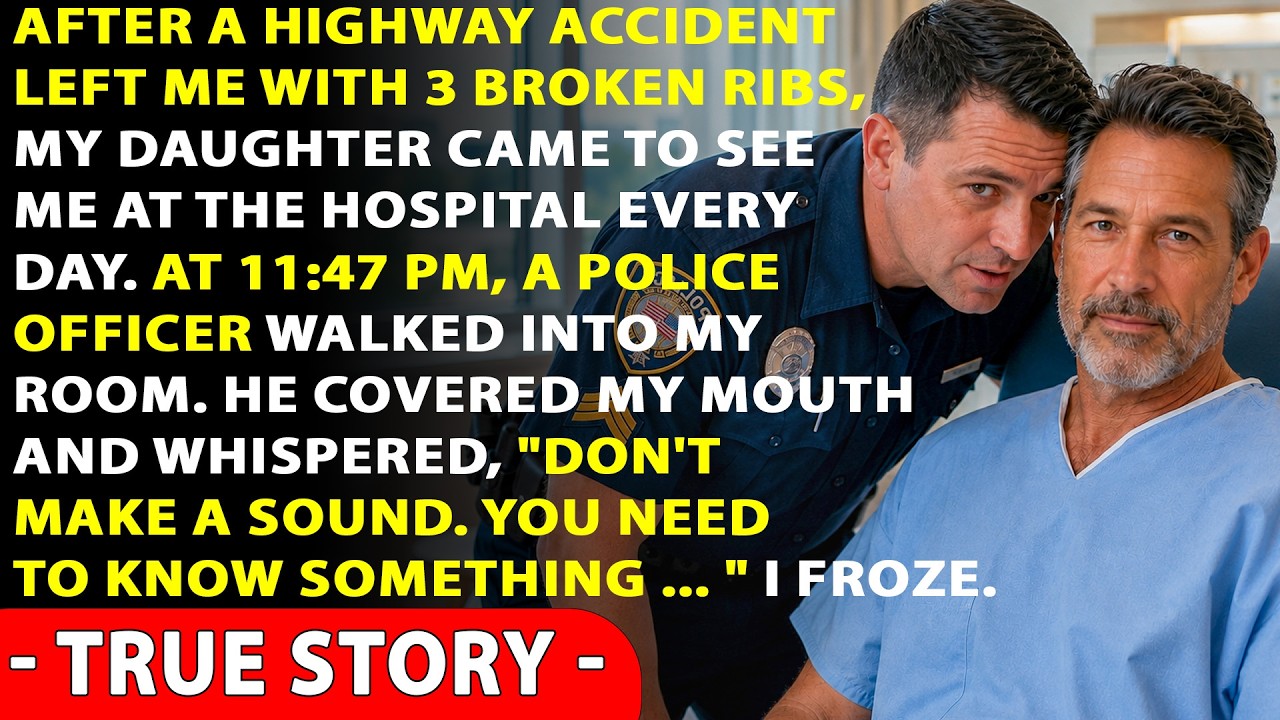
, the door opened slowly. A police officer stepped inside, locked the door behind him, and pressed his hand over my mouth. I froze, staring into his eyes until he whispered her name. The box was not heavy.
That was the first thing I noticed when I picked it up from the passenger seat of Ethan’s truck. Thirty-five years of work, and the evidence that would end everything fit in a cardboard box I could lift with one hand. I carried it through the front entrance of Hayes Freight Solutions and took the elevator to the second floor. My ribs still ached when I breathed too deeply, a reminder of what had put me in Cedars-Sinai for the better part of three months.
The doctor had warned me about pushing too hard. I told him I appreciated his concern, then asked Ethan to bring me my suit. The conference room door was closed. Through the narrow window beside the frame, I saw Audrey standing at the head of the table, a presentation slide glowing blue behind her.
She wore the gray blazer I had bought her for her thirtieth birthday. I pushed the door open and stepped inside. The room went still. Audrey’s hand, which had been gesturing at the screen, dropped to her side.
The color left her face the way water drains from a glass. Her lips parted, but no sound came out. “Dad,” she finally said, her voice cracking on a single word. “You should be resting.
”
I set the box down at the center of the table. “I’ve been resting long enough. ”
To understand what was in the box, you need to go back to a Friday morning in September. I started Hayes Freight Solutions in 1987 with one used Peterbilt and $400 in my checking account.
My wife Margaret believed in me with a certainty I never quite managed to feel about myself. “You know how to drive,” she told me. “The rest you’ll figure out. ”
I did.
Fifteen years of early mornings grew one truck into twenty, then into two hundred thirty rolling out of our Commerce yard every week. We hauled freight across California, Nevada, Arizona, New York. We had a reputation for showing up on time and keeping our word. Margaret didn’t live to see most of it.
She passed in 2003 when Audrey was eleven. The morning after her funeral, my daughter sat across the kitchen table in a black dress, folding and unfolding a napkin between her hands. “Are we going to be okay? ” she asked.
I stared at the window until I trusted my voice. “Yes. We’re going to be okay. ”
I kept that promise for twenty-two years.
The morning of the accident was ordinary. I had an eight o’clock meeting at the yard and was running ten minutes late. I merged onto the 10 heading east just after 7:40. I never saw the truck coming.
It hit the rear driver’s side hard enough to send me across two lanes. I remember the sound, a deep impact from everywhere at once, and the world rotating in ways it wasn’t supposed to. When I stopped against the concrete divider, my chest felt rearranged. Three broken ribs.
A head injury the doctors described as mild, though the headaches that followed felt anything but. The truck that hit me was gone before the first patrol car arrived. At Cedars-Sinai, they put me in room 412. The nurse asked if there was family to call.
I gave them my daughter’s number. What I didn’t know was that someone else would arrive first. Victor Langford was sitting in the chair beside my bed when I opened my eyes the next morning. Silver hair, dark slacks, a jacket that cost more than my first truck payment.
He held a paper cup from the hospital cafeteria like a man with nowhere more important to be. “Walter,” he said, with a warm, patient smile. “You gave everyone quite a scare. ”
I hadn’t given him my room number.
I had never given him my phone number. “How did you know which room I was in? ”
“I still have a few friends in this building. Old colleagues from the state transportation office.
”
He told me he had come to check on me. He told me that if I needed anything, anything at all, the offer still stood. The offer, meaning the one he had made six years ago across a conference table in my own building, when he had walked in with a purchase offer forty percent below market value and a smile just like this one. I had turned him down, watched him close his leather portfolio and walk out without shaking my hand.
Now he was sitting beside my hospital bed, and I could hear the truck engine idling under every word. After he left, one question kept circling in my mind. How had Victor Langford known which room I was in before my own daughter had been called? Audrey arrived at 2:30, still in her work clothes.
Her eyes were red at the edges, mascara smudged beneath her left eye. She crossed the room in four quick steps and pressed her cheek against mine, careful not to touch my chest. “I came as fast as I could. I should have been here this morning.
”
I reached up and covered her hand with mine. “I’m all right. ”
She stayed for two hours, asked precise questions about the injury, the recovery timeline, the monitoring protocol. Then she told me she would handle things while I rested.
The company, the contracts, everything. “Let me take care of things for once. ”
I looked at my daughter, at the woman I had raised from an eleven-year-old girl in a black dress, and felt something loosen in my chest. “All right.
”
What I missed, looking back, was that she had not asked what I needed. She had told me what she was going to do. The pain medication kept me in a strange half-waking state. The nurses came and went in regular patterns.
On the fifth night, at 11:47, the door opened without a knock. The man who stepped in was broad-shouldered, wearing an LAPD uniform. He paused just inside the doorway, let his eyes adjust to the low light from the monitors, then turned and locked the door behind him. He crossed the room in eight steps and leaned over the bed.
His hand came down over my mouth before I could draw a full breath. “Don’t make a sound,” he whispered. “I’m not here to hurt you, Mr. Hayes.
”
I grabbed his wrist with both hands, not to fight him off since my three cracked ribs would have lost that contest, but because it was what a frightened man would do. He lifted his hand slowly. “My name is Daniel Cross. LAPD Commercial Transport Division.
Your daughter is not managing your company, Mr. Hayes. She is dismantling it. ”
I let my eyes go wide, my jaw loose, the particular blankness of a man whose world has just been knocked sideways.
“What are you talking about? ”
“She’s been redirecting freight contracts to outside operators connected to a private investment group since the day you were admitted. By the time you’re discharged, your most valuable shipping lanes will belong to someone else. ”
Then his gaze swept the room.
The nightstand. The closet. The tray table. The way a man’s eyes move when he’s looking for something specific.
“Is there anything in this room that belongs to the company? Documents, a laptop, a storage device of any kind? ”
He hadn’t come to warn me. He had come to find something.
I let my shoulders sag, the posture of a man deflating under bad news. “I don’t keep work things here. My daughter brought paperwork yesterday. She took it home with her.
”
Something shifted behind his eyes. Not disappointment. Recalculation. He moved to the nightstand and pulled open the drawer, found my glasses, a paperback, and my phone.
He checked the screen, set it back down. He searched the closet, my jacket pockets, the shelf above the rod. Nothing. He set a business card on the tray table.
“If you find anything, documents, records, anything that seems out of place, call this number directly. ”
“I understand,” I said. My voice was steady. He left without another word.
I waited until his footsteps faded, then exhaled a long breath that sent pain through my left side. Cross had searched every surface he could reach. He had not checked the one place that mattered. Three days before the accident, I had noticed something wrong in the September routing data.
I didn’t know what I was looking at, but I had learned long ago that when something in your own company doesn’t add up, you don’t wait to find out why. I had copied everything onto a small drive and given it to Marcus Reed, my chief accountant of twenty-two years, with instructions to hide it somewhere only he knew. Cross had come away empty-handed, which told me two things. Whoever sent him didn’t know about Marcus.
And I had approximately one day before they started looking harder. I picked up the phone and called Marcus. He answered on the second ring. “Don’t move it.
Don’t tell anyone. Watch everything. ”
The next morning, Audrey brought me coffee from the place on Wilshire with the green awning. Dark roast, no sugar, a splash of whole milk.
She had remembered the way I liked it, the way she always had. She sat by my bed and told me about the changes she was making. Tom Gilroy would handle the Pacific Southwest contracts. She had rescheduled the November carrier review.
And then, in a tone so casual it almost slipped past me, she said, “I’ve also been talking to some of the regional partners about restructuring a few of the smaller shipping lanes. Just streamlining. Nothing major. ”
I wrapped both hands around the coffee cup and looked at her face.
She was looking at the window, her expression open, relaxed. But I had built this company from the ground up. I knew every lane we ran, every contract we held. The lanes she was calling secondary were the backbone of our California-to-New York corridor.
“Which lanes? ” I asked. She smiled and looked back at me. “Just the secondary connectors.
”
I nodded and let it go, because that was what a tired, injured man who trusted his daughter completely would do. I have thought a great deal since about the blindness that love produces. Not the foolish kind, but the kind that comes from watching someone grow from a frightened eleven-year-old into a capable, sharp-minded woman, and believing that the person you raised is still the person you know. I remembered teaching her to ride a bicycle.
The year after Margaret died, when Audrey was twelve and decided she wasn’t going to cry anymore because crying didn’t help, she had started leaving lists on the kitchen table. Grocery lists, homework lists, things that needed fixing around the house. She had been trying to take care of me even then. How do you hold that against a set of suspicious numbers?
Marcus called me that afternoon. I heard it in the first breath he took, the particular heaviness of a man carrying something he cannot set down. Fourteen routing changes, all in the last ten days. All carrying Audrey’s authorization codes.
I called Ethan Cole, a retired FMCSA inspector I had known for thirty years. I had pulled him out of a blown transmission in the Nevada desert once, and he had never forgotten it. “Pull the freight records for September,” I said. “Cross-reference them against the delivery confirmations, and tell me where the numbers stop matching.
”
He was quiet for a moment. “You know what you’re describing. ”
“I know. ”
Ethan called back the next evening with a name.
Sierra Pacific Transport LLC, a shell company registered in Nevada, traced through two layers of nominee directors and a Delaware holding company. The beneficial owner was a trust administered on behalf of Audrey Christine Hayes. I sat in the dark of room 412, phone against my ear, and felt everything go very still and very quiet. The truck that had hit me belonged to my daughter.
Ethan laid out the rest carefully, the way he had always delivered difficult news. Victor Langford had not stumbled into Audrey by accident. He had targeted her deliberately, introduced himself at the Southern California Logistics Association dinner in the spring of 2023, built the relationship for six months before he ever mentioned my company by name. “By the time she understood what he was actually after, she was already deep enough,” Ethan said.
“Getting out was complicated. ”
I thought about Victor Langford sitting beside my hospital bed, with his patient smile and his paper cup of coffee. He had waited six years after I refused his offer. The way in had been my daughter.
A week later, Marcus called. One of the logistics coordinators, a quiet woman named Sophie Mercer, had come to him frightened. She had been asked to run revised manifest templates through the system for a subset of shipments, templates that changed cargo descriptions. Industrial cleaning supplies became general freight.
Chemical compounds became equipment components. Hazardous material classifications were removed entirely. She had kept copies. Original manifests, revised versions, emails from Audrey with the instructions.
She had photographed everything on her personal phone because she was terrified to file a complaint internally, terrified no one would believe her word over Audrey Hayes. Then Sophie was called to present the new manifest process to the full logistics team. Eighteen people. She stood up there and walked them through the falsified system with a steady voice and never looked at Audrey once.
After the meeting, Audrey announced a full internal review of accounts payable, looking directly at Marcus when she said it. She was setting him up. Ethan compiled the financial records. The shell accounts feeding Langford Capital Group passed through three intermediate entities.
One was a charitable organization called the California Senior Assistance Fund. Its listed director was Deputy Chief Everett Shaw of the LAPD. When Victor Langford needed law enforcement coverage, he didn’t go to a street-level officer. He went to someone with enough rank to make problems disappear.
Then my phone buzzed with a notification from the hospital patient portal. Not a medical document. A legal notice. Petition for appointment of conservator of the estate of Walter James Hayes.
The petitioner was Audrey Christine Hayes. I read all forty-two pages. The petition argued that the head trauma I had sustained made me unable to manage my own financial resources. It was supported by a detailed assessment from Dr.
Harmon, my attending physician, describing confusion, impaired memory, reduced judgment. None of it was true. Every word was a lie he had been paid to write. I called Helen Vance, an elder law attorney Ethan had found.
She filed an independent medical examination request that afternoon. And she told me, in a voice that was direct without being sharp, “Don’t sign anything. Not a medical form, not a hospital release, not a get-well card. ”
Ethan called the next morning with the financial trace.
Eighty thousand dollars, transferred in two installments, from a Langford Capital subsidiary into Dr. Harmon’s personal account. The first payment was made three weeks before my accident. The second was four days after I was admitted.
The medical assessment had been planned before I was ever in that bed. Then Cross broke. Victor had called him with two words. “Clean it up.
” Cross sat in his car for twenty-two minutes, did the math, and drove to the federal building on Wilshire Boulevard. He walked in voluntarily and spent two hours describing the entire operation to Special Agent Rebecca Okafor. Sophie Mercer did the same the next morning. She had stood outside the federal building for fourteen minutes, terrified, almost turned around twice.
Then she walked in with her phone and three months of evidence, forty-seven shipments, dated and labeled, and set it on the table. I had people moving in every direction. Ethan. Marcus.
Sophie. Helen. And I was still lying in room 412. Ten days before the shareholders meeting, Audrey filed an emergency motion for temporary conservatorship.
She needed the board on record supporting the petition before the independent medical examination could counter it. She scheduled an emergency session. Rebecca Okafor wanted to use the meeting. She wanted to make the arrests there, both of them, before either realized the walls were closing.
I walked into that conference room on a Wednesday morning in December, wearing the suit I had worn the day I signed Hayes Freight’s first major contract. Ethan was waiting outside with his truck running and the heater on. The suit was loose across the shoulders. I had lost weight I could not afford to lose.
But I lifted the cardboard box from the passenger seat and carried it through the front entrance of the building with my name on it. The board meeting was in progress. Audrey stood at the head of the table. She saw me, and her face drained white.
I opened the box and laid out the evidence. The electronic logging data showing twenty-three routes with unauthorized stop locations. The shell company registration. The email chain between Audrey and Langford’s associate.
The financial transfer records to Dr. Harmon, paid before and after my accident. “Dr. Harmon signed the medical assessment supporting the conservatorship,” I said.
“He was paid to write it before I was ever injured. ”
Then the last document. The record of $62,000 paid to Officer Daniel Cross, now cooperating with federal investigators. The room had the quality of held breath.
I looked at my daughter. Her eyes were wet, quietly full, one tear moving down her cheek that she did not reach up to wipe away. “You didn’t build this company,” I said. “You only used it.
”
The conference room door opened. Rebecca Okafor stepped in with two federal agents and a warrant for Audrey’s arrest. Audrey did not argue. She did not run.
She simply let go of the chair, took one step back, and stood there, smaller than she had seemed ten minutes earlier. Victor Langford was arrested at LAX, at the boarding gate for a business class flight to Zurich, with two carry-on bags and no words left to offer anyone. Rebecca sat beside me in the hallway after it was over. She told me that Audrey had talked before her attorney arrived, that she had chosen to.
She told me about Langford’s patient approach, the trust built over a year, the small suggestions that became demands, and the moment Audrey tried to stop. “He told her if she withdrew, her father would be the one investigators looked at first. ”
I pressed my palm flat against my thigh and said nothing for a long moment. “She asked about you,” Rebecca said.
“Whether you had come out of this okay. ”
“What did you tell her? ”
“I told her you were standing up. That seemed the most accurate thing I could say.
”
Six months passed. Hayes Freight was still standing. Marcus returned to his office, Sophie became director of compliance and redesigned the manifest system from the ground up. We added an independent audit committee, three external accountants reviewing every transaction above ten thousand dollars.
In June, an envelope arrived on my desk, a return address from a law office on Wilshire. Inside, a single sheet of paper folded once. Two words written in handwriting I recognized before I recognized what I was feeling. I’m sorry.
I sat at my desk for a while with the morning light coming through the window. Then I folded the letter carefully and opened the bottom drawer. In the back corner, where I had kept it for thirty-nine years, was a photograph of Audrey at eight years old, sitting in the cab of the 1987 Peterbilt, grinning at the camera with both hands on the steering wheel and her feet not quite reaching the pedals. I placed the letter beside it and closed the drawer.
Outside the window, the yard was full. Two hundred thirty trucks, engines starting one by one, the sound of a freight operation coming to life in the morning. Honest work, honest routes, honest people doing what they had always done. I had built it once.
I had kept it. That was enough.