The first thing I noticed when I opened my eyes was the smell. Sharp antiseptic, bleach, the kind that strips a room of anything warm. My chest ached with every breath. My left leg throbbed from hip to heel.
A machine beside me beeped in a slow, indifferent rhythm. I turned my head. There was a visitor’s chair in the corner, positioned at just the right angle for someone to sit and watch over a person lying in a hospital bed. It was empty.
I told myself Ryan was down the hall getting coffee, talking to the doctor, handling paperwork. But the older, quieter part of me already knew. That chair hadn’t been warm in a very long time. Then I noticed the paper on the bedside table.
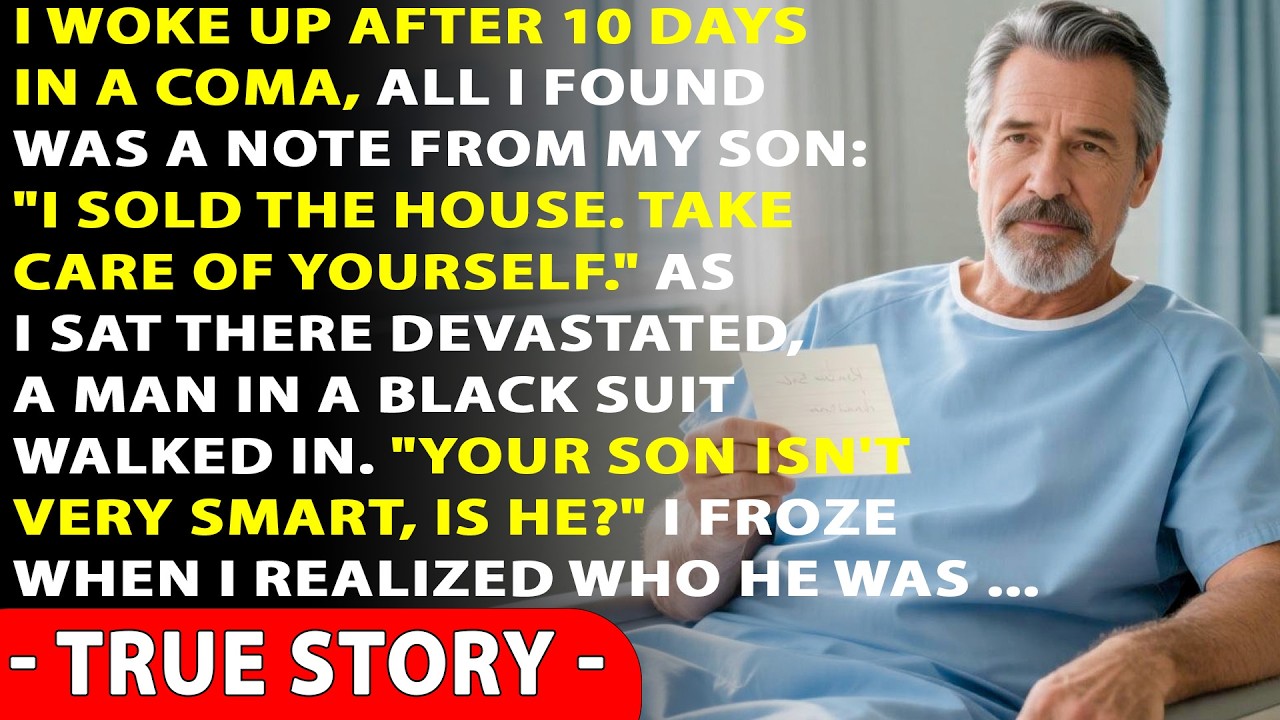
Folded in half, set down the way you set down something you’re done with. I recognized the handwriting before I even reached for it. *Dad, I sold the house. You’re nothing but a burden.
Figure it out yourself. Don’t call me. *
Three sentences. I read them three times because my mind kept refusing to let them land.
Thirty years of double shifts. The truck I sold so Ryan could go to college. The jar behind the canned goods. My son’s graduation, when I stood in that crowd with a shirt I’d ironed three times.
And I thought this was what it all added up to. The sob that came out of me was ugly. It shook my whole body, and the machine started beeping faster, like it was panicking on my behalf. The door opened.
A nurse in blue scrubs crossed the room, set a box of tissues beside my hand. “Is there someone I can call? ”
I looked at the paper still in my hand. Then at the empty chair.
“No,” I said. “There’s no one. ”
She left quietly. And then three slow knocks landed on the door.
Not a nurse’s knock. Deliberate, unhurried. The kind made by a person who already knows they’re coming in. He was in his mid-sixties, silver-haired, wearing a charcoal wool suit that cost more than most people’s monthly rent.
His shoes were dark Oxford leather, buffed to a quiet shine. He carried a black leather briefcase like it weighed nothing. He pulled the visitor’s chair from the corner, sat down, folded his hands in his lap, and looked at me the way you look at someone you’ve been waiting on. “Mr.
Carter,” he said. “I’m Harold Bennett. Attorney and chief administrator of a private estate based here in Charleston. I’ve been looking for you for a very long time.
”
“I’m a retired warehouse worker from North Charleston,” I said flatly. “There’s nothing to find. ”
Harold looked at the note in my hand. Something shifted in his expression — not surprise, more like quiet fury held very still.
“Perhaps your son isn’t very smart. ”
“It’s a silver bracelet I’ve worn since before I could remember. No one ever told me where it came from. ”
“I’ve seen that bracelet before.
In photographs, in documents, in a description written by a forensic archivist who spent fourteen months trying to match it to a family crest. ”
He drew a photograph from his briefcase. Old, edges softened, colors shifted toward warm sepia. A little boy, maybe four years old, standing in front of a tall iron gate.
Behind him rose a white three-story house with black shutters and columns across the front. On his right wrist, clearly visible, a silver bracelet. Identical to mine. Not similar.
Identical. Same narrow gauge, same engraved crest, same slight irregularity on the left side where the silver had been shaped by hand. “That little boy,” Harold said, “is you. Taken in the summer of 1961 in front of your family home.
Your real name is not Joseph Carter. ”
The room went very quiet. “Your name is William Ashford. Your father was Edmund Ashford.
He spent the last forty years of his life looking for you. And when he died, he left you everything he had. ”
I stared at the photograph. My hands were shaking so badly I had to set it down.
“I grew up in an orphanage. I don’t have a father. ”
“You have one,” Harold said firmly. “Or rather, you had one.
A very stubborn, very devoted man who refused to accept what everyone kept telling him for sixty-three years. ”
He told me about Ashford Capital Group — the forty-story building on Meeting Street, the black marble crest in the lobby. Founded in 1938 by my grandfather, passed to my father, Edmund, in 1971. “I’m a warehouse worker,” I said.
“I drove a forklift for thirty years. I am nobody. ”
“Don’t do that,” Harold said quietly, steel underneath the calm. “Don’t reduce yourself to what someone else’s cruelty made you into.
The man who spent sixty-three years refusing to stop looking for you would be very angry to hear you say that. ”
“He looked for me? ”
“Every single day. When the investigators ran out of leads, he hired more.
When the trails went cold, he kept the files open. ”
He showed me another photograph. A man in his late seventies, silver-haired, sitting behind a mahogany desk. The jaw, the set of the brow.
The bones were the same as mine. “He passed away two years ago. January 2023. Heart disease.
He was eighty-nine. ”
My father had been alive for sixty-three years while I was driving forklifts and ironing shirts for Ryan’s graduation. Seventy miles away, in the same city. He never found me.
“He never stopped looking,” Harold said. “But no. He never found you. Not in time.
That is the one thing in his life your father considered a failure. Everything else he built — none of it mattered to him the way you did. ”
“Tell me about him,” I said. “Please tell me everything.
”
Harold settled back. “Your mother Catherine was a school teacher from Beaufort. He proposed three weeks after they met. You were born in September of 1957.
Your mother had a difficult delivery, and afterward the doctors told him there would be no more children. He told me once that when it was over and you were both safe, something in him settled permanently, like a compass finding north. You were everything to him. The whole of it.
”
My chest cracked open so quietly I almost missed it. “She passed when I was two. ”
“An illness that moved quickly. He was gutted, but he had you.
He raised you himself. He read to you every night. He took you to every baseball game that summer of 1961. And then August of 1962.
”
He paused. “Her name was Martha Groves. She’d worked for the family for eleven years. One afternoon, while your father was at a board meeting, she took you from the house.
Told the staff she was bringing you to the park. You never came back. ”
The trail went cold within three days. Everyone told Edmund to accept the worst, to begin succession planning, to let grief resolve itself.
He told them all exactly where they could put that advice. “He kept your room exactly as it was the morning you disappeared. Your books on the shelf. A drawing you’d made of the two of you still taped to the wall above your desk.
Every single week for sixty-three years, I went into that room and placed a fresh flower on your desk. Magnolias, mostly. They grew in the garden. Your father’s instructions were simple.
Keep the room ready. He was coming home. ”
Three thousand two hundred and seventy-six Mondays. “How did you find me?
” I asked. “After all this time, how? ”
“A letter. Delivered to the estate in the spring of 2008.
No return address. From Martha Groves, three weeks before she died. She confessed everything — taking you, registering you at St. Andrews Children’s Home under a false name.
A man had paid her. Someone with a business interest in destabilizing the Ashford estate while Edmund had no heir. ”
“She couldn’t even take it off me,” I said roughly. “The bracelet.
She took everything else, and she couldn’t take the bracelet. ”
“No,” Harold said. “She couldn’t. And that is why you’re sitting here today.
”
He met my eyes. “A woman who worked at St. Andrews remembered a child being brought in during the summer of 1962. She remembered one unusual detail.
The woman who brought the child was insistent about one thing: don’t take the bracelet off him. Whatever else happens, leave the bracelet. ”
It took three more years, but in February of this year, my name appeared in the Trident Medical Center system. Emergency admission, head trauma, next of kin listed as Ryan Carter.
“I drove to the hospital that same night. I saw the bracelet through the glass of the ICU window. And I sat in the parking lot and waited for you to wake up. ”
I closed my eyes.
When I opened them, Harold was watching me with the careful attention of someone who knew the next part was going to land differently. “There’s something else. Something about Ryan that I haven’t told you yet. What I’m about to show you is not the story of a son who panicked.
It’s the story of something that was planned. ”
He opened his briefcase and withdrew a manila folder. On the cover, in neat black ink: *Ryan Carter*. “Your savings account shows a zero balance as of March nineteenth — ten days ago, while you were in the ICU.
Seven separate withdrawals over five days, in amounts small enough to avoid the bank’s fraud alert. Your apartment building was sold on March eighteenth. Seventy-thousand below market value. Seller: Joseph Carter, represented by Ryan Carter under power of attorney.
”
“I never signed a power of attorney. ”
“The signature was forged. Ninety-four percent certainty per forensic handwriting analysis. ”
“The buyer was Amber Carter.
His wife. He sold your home to his own wife, using your money as the down payment. The net result is that you woke up from a coma with no home, no savings, and nowhere to go. ”
He slid a series of printed text messages across to me.
Amber to Ryan, spanning eight months. *Old men who work that long always have something put away. *
*You’ve been emotionally responsible for him. That counts.
*
By January they were discussing the apartment’s market value. By February, Ryan was asking how power of attorney documents worked. “She drove this,” I said. “From the beginning, she drove this.
”
“She provided the direction,” Harold said carefully. “Ryan made the choices. ”
Then he reached into the briefcase one final time. A USB drive.
The footage was grainy but workable. March tenth, 7:14 p. m. The interior stairwell of my apartment building.
Ryan walked into frame in a gray athletic jacket and a baseball cap. He crouched beside the stair railing, removed a screwdriver from his backpack, and loosened the base bracket. Not removing the screws entirely — just enough that the railing looked normal, but would give way under any meaningful downward pressure. I had asked him twice to tighten that railing.
I’d mentioned the vertigo more than once. He didn’t get to it. He made it worse. The second file showed me, three days later, taking my weight on that railing.
Harold stopped the video before the impact. I was grateful. “In South Carolina, intentionally creating dangerous conditions with knowledge of a specific victim’s vulnerability, with documented financial motive, can be charged as reckless endangerment causing great bodily harm,” Harold said. “Depending on the full evidence picture, it could reach as far as attempted murder.
”
“There’s more. ”
He set a manila envelope on the bed. A life insurance policy. The insured party was me.
The beneficiary was Ryan Carter. Applied for on February twenty-fifth, sixteen days before he loosened that railing. $750,000. The signature on the application wasn’t mine.
Confidence level, 96. 8%. Perry. Yes.
He pulled out the text messages again, continuing past where he’d stopped before. *Amber, January 14th: The life insurance is the cleanest option. If something happens to him naturally, you collect. No questions.
*
*Amber, February 3rd: The railing on his staircase is loose. Has been for months. I keep meaning to fix it. *
*Don’t.
*
A man who panics abandons his father in a hospital. A man who plans buys an insurance policy first. “What do we do now? ” I asked.
“I can have everything on that table in front of a Charleston PD detective within the hour. Ryan would be arrested by tonight. Amber likely within forty-eight hours. ”
“That’s one option.
What’s the other? ”
Harold looked at me steadily. “Ryan works at Ashford Capital. He has worked there for six years, earning a salary from your family’s company, sitting in meetings in a building that bears your father’s name, not knowing any of it.
You are the legal owner of that company. If you walk into that building as its rightful head — before the police are called — Ryan faces not just criminal charges. He faces the complete and public collapse of everything he thought he had. ”
“Schedule the board meeting,” I said.
“I want every executive in that room. ”
Three days passed. On the morning of Thursday, March twenty-seventh, a charcoal suit was laid out for me. On the breast pocket, embroidered in silver thread so small you had to look twice: the Ashford crest.
“It was your father’s,” Harold said. “In the last year of his life, he had it made in the size of the son he always pictured coming home. ”
The boardroom was long, paneled in dark wood, with floor-to-ceiling windows overlooking the harbor. Ryan was at the far end of the table, scrolling through his phone, leaning back with the easy posture of a man who believed this room belonged to him.
He looked up. The phone dropped two inches. I watched the color leave his face in real time — and I saw the exact moment he understood. “Dad.
” The word came out cracked and airless. I walked to the head of the table and set both hands on the polished walnut surface. “My name,” I said, “is William Edmund Ashford. And I am home.
”
Margaret Holloway pressed a button, and the screen lit up with the DNA certification, red-stamped and notarized. Then the will, the key clause enlarged: *My biological son, William Edmund Ashford, sole heir to all personal assets, real property, and controlling interest in Ashford Capital Group. *
Ryan shoved back from his chair. “You walk in here with some documents and a DNA test—” His finger shook.
“He’s my father. Joseph Carter. He worked in a warehouse for forty years. ”
“The third document,” I said.
The screen changed. Bank records. Seven withdrawals from my savings account, each dated during the ten days I lay in a coma. “The fourth document.
” The real estate deed. Amber Carter, $155,000, financed using a forged power of attorney. Ryan’s hand came up and covered his mouth. “The fifth document.
” The staircase footage. Ryan in a gray t-shirt, crouched with a wrench. Then the text messages, projected large enough for everyone to read. *The old man might be worth more than we thought.
Try 950 million. *
*We need to make sure he never does. *
Ryan’s legs gave. He caught himself on the back of his chair, his whole body shaking.
“That railing sent me into a ten-day coma,” I said, and my voice broke. “I woke up alone with a note telling me I was a burden. You wrote that note, Ryan. You sold my house.
You took my savings. And you stood in that stairwell and made a choice. ”
A tear ran down my face. “The Charleston Police Department is currently in the lobby,” Harold said.
“They have warrants for your arrest. A simultaneous warrant is being executed at your home for Amber Carter. ”
Two officers entered. Ryan looked at me one last time, his face crumpled entirely.
“Dad,” he said, shattered. “I know,” I said. And I meant it. The door closed behind them.
The motion to recognize me as legal owner of controlling interest in Ashford Capital passed seven to zero. I signed the resolution with a heavy silver pen, my hand trembling so badly Harold placed his hand over mine to steady it. Afterward, he reached into his breast pocket and drew out a cream-colored envelope. Aged honey paper, the handwriting careful and slanted.
*Dear William. *
There were sixty-three letters. One for every year I was gone. The first was dated May 14th, 1963.
My sixth birthday. *You would have been six today. I bought a cake anyway. I sat with it at the kitchen table for an hour before I could bring myself to put it away.
I don’t know where you are. I don’t know if you’re warm. I don’t know if someone is reading to you at night. But I want you to know wherever you are that your father is looking.
I will not stop. *
He wrote one every year. The last was dated May 14th, 2022, eight months before he passed. *I am eighty-nine years old today.
So are you. Can you imagine that? My boy, eighty-nine years old. I am leaving everything to you.
Not because of the money — the money is nothing. It is just numbers. But because this company is the thing I built while I was waiting for you to come home. Come home, William.
It is not too late. It was never too late. I love you. I have always loved you.
*
*Your father, Edmund. *
I pressed my palms flat on my father’s desk and looked around the room that had waited sixty-three years for me to fill it. Six months later, I was at that same desk when Harold entered without knocking — which meant something important. He set two items in front of me.
A manila folder. And a plain white envelope in handwriting I recognized. Ryan’s handwriting, from a correctional institution in Ridgeville. “The folder first,” I said.
“Amber Carter filed for divorce on August third. Uncontested. She retained the Milbrook Drive property — the house purchased with your money — along with all joint bank accounts and Ryan’s personal investment portfolio. He has nothing, William.
Not a dollar. ”
The man who had taken everything from me had been left with nothing by the same woman. The irony was so complete I didn’t know whether to laugh or grieve. I picked up Ryan’s letter.
Two pages, handwritten, the penmanship uneven. *Dad, I don’t expect you to forgive me. I’m not sure I deserve to ask. But I need you to know I’m sorry.
Not because I got caught, not because she left me with nothing, but because of who I chose to be. You worked forty years in a warehouse. You never asked me for anything. And I looked at you and saw a problem to solve instead of a father to love.
That is the thing I will carry for the rest of my life. *
I set the letter down. The love that had not died even in the boardroom was still there. Reduced, reshaped, carrying scar tissue.
But still there. “I’m going to write him back,” I said. Harold’s expression warmed. He reached into his pocket and set a small velvet pouch on the desk.
Inside was a silver bracelet. Narrow gauge, handcrafted, unmistakably made by the same hand as the one on my wrist. Not identical — a companion piece. Where mine bore the Ashford crest, this one bore an inscription along its inner band.
*An Ashford is never truly lost. *
“Your father had it made in 1961,” Harold said. “He wore his half every day until the morning he went into hospice. He asked me to keep the other half until I found you.
”
I clasped it onto my wrist. The weight of it was different now. Heavier, fuller. We went up to the roof.
The September evening was cooling, the sky going amber and rose, the harbor a strip of hammered silver in the distance. I stood at the low wall, my wrist resting on the stone, the completed bracelet catching the last of the light. “Thank you, Harold,” I said. “For every single year of it.
”
He stood beside me, eyes on the horizon, and exhaled long and slow — the breath of a man who had just set down something he’d been carrying for a very long time. “It was the only promise worth keeping. “