The text arrived on a Tuesday afternoon. Emily’s name lit up my phone, and I expected something about dinner or a question about the garden. Instead: “Don’t ask about Chase’s parents anymore. It’s better if you don’t meet them.
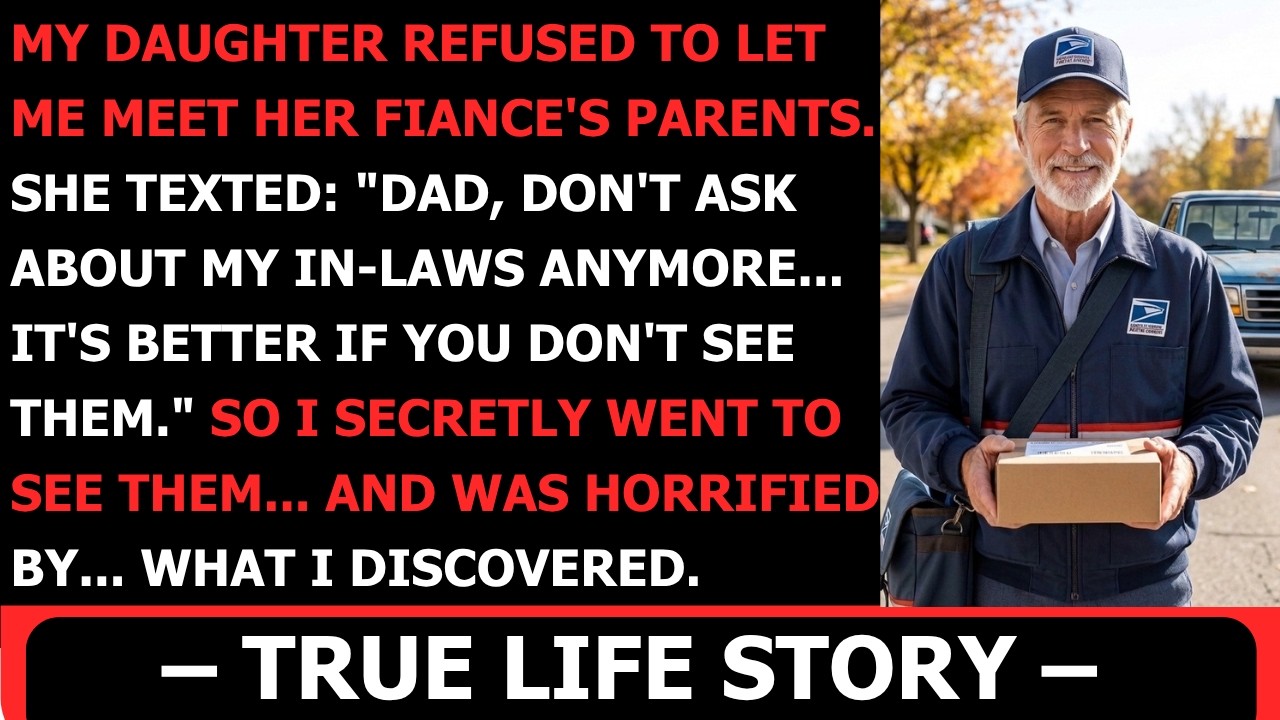
”
I read it three times. The daughter I’d raised alone after her mother died was drawing a line through my life. Nine years of school lunches, doctor visits, and birthday cakes, and this was the answer. I wasn’t good enough to meet the people whose son she planned to marry.
Thirty years as a mail carrier taught me to read what people hide. This silence from Emily carried a scent, and it smelled like something being buried. I didn’t call her. Pressure would only push her further away.
So I grabbed my worn khaki jacket and walked out to the Ford F-150. If no one would deliver answers to me, I’d go find the address myself. The parking lot at Prime Restaurant was full of luxury cars. My rusty pickup sat among them like a work boot at a wedding.
The hosts looked at my J. C. Penney jacket with thin-lipped suspicion. I found the corner table where Emily sat with Chase.
Chase wore a suit that cost more than my monthly pension. His handshake was soft, the hand of a man who’d never changed a tire. He smiled like he was doing me a favor by allowing me to breathe his air. Emily couldn’t meet my eyes.
Over dinner, Chase talked about real estate projects and ski vacations. Every word was designed to remind me where I stood. He asked about my retirement with a smirk that said I’d never understood ambition. I sat silently, watching the cracks beneath his polish.
When Chase excused himself, Emily grabbed my hand. “They come from a different world. I don’t want things to become awkward. ”
Awkward.
I was her father, and I had become something to apologize for. The daughter I’d raised with my own hands was ashamed of my honesty, my worn clothes, my old truck. Chase returned and paid the bill without counting. I stood and left without a word.
In the truck, I gripped the steering wheel and fought for control. But three decades in the postal service wouldn’t let me settle for hurt. If the Mercers were so wealthy, why were they afraid of a retired mailman? Back home, I checked my email.
A message from the wedding coordinator sat in my inbox: “Official seating chart for bride’s and groom’s families. ” The sender had made an error. My email address was off from Emily’s by a single number. I opened the attachment.
Table four, labeled “Immediate Families,” carried only two names: G. Mercer and M. Mercer. Seats reserved for the bride’s parents.
Not for me. I was invisible at my own daughter’s wedding. But the M. Mercer made my hands go cold.
That single initial scratched at the back of my mind like a letter stuck in an old sorting bin. The next morning, I was at the county land records office before it opened. I typed “Mercer Holdings” into the public records system. The results were devastating.
The Mercer mansion wasn’t owned. It was collateral, frozen under a massive bank loan. The company was a hollow shell drowning in debt. The family fortune was smoke and mirrors.
Then I saw the asset freeze order. The guarantor for their newest loan was Emily. An ordinary office worker with no assets, except for the house I’d placed in joint ownership with her after my wife died. Beneath the co-owner approval line was a signature.
My signature. Except I hadn’t signed it. The ink was close, carefully copied. Someone had forged my name to mortgage my home.
Emily either knew, or had been manipulated into giving the Mercers everything they needed. They weren’t ashamed of me because I was poor. They needed me erased. I printed everything and called Aunt Carol, my late wife’s sister.
“M. Mercer,” I said. “Marsha Merritt. ”
Aunt Carol’s voice turned to ice.
Marsha Merritt was the chief administrative supervisor at Prairie Willow, the hospital where my wife spent her final weeks. She was the one who signed the order cutting off my wife’s emergency treatment because our insurance didn’t cover enough. I never knew. Nobody had ever told me.
I found my wife’s medical memorandum at the bottom of the keepsake box. Yellowed paper, faded blue ink: “Patient is already too exhausted. No further treatment is necessary. ” Signed: Marsha Merritt.
The same woman who was about to become my daughter’s mother-in-law. I found Patricia, the head nurse who’d cared for my wife. She lived in a small house on the edge of Beaverdale. When I put the memorandum on her table, her hands began to shake.
Through tears, she confirmed what I feared. Marsha routinely cut off treatment for patients whose insurance ran out, then pocketed performance bonuses for “reducing costs. ” A system built on quiet murder. Patricia also told me that Marsha had taught Chase to forge signatures since childhood.
“They’re not going to just take your house,” Patricia said. “They’re going to teach your daughter to call this abuse love. ”
Denise, my attorney, found the trap. A hidden clause in Emily’s guarantee agreement would automatically transfer title of my house to Mercer Holdings if the company went insolvent.
Emily’s signature would make the theft look legal. That evening, Emily came to the house. She knew I’d been to the records office. She screamed at me, called me a saboteur, accused me of being jealous of the Mercer family’s wealth.
“You’re still living in the past! Mom is gone, Dad. Let it go. ”
She was defending the family that had let her mother die.
I wanted to throw the evidence in her face, but I knew it wouldn’t matter. She was too deep in their spell. I stood silent, my hands steady. She stormed out.
The slam of the door shook the house. The rehearsal dinner was the next night at the finest steakhouse in Ankeny. I knew the Mercer family would be performing their wealth for the city’s elite. I knew it was the only stage I’d ever get.
I put on my cleanest khaki jacket and pulled my old leather mail bag from the closet. Inside: white envelopes. Each one contained the frozen assets, the forged signature, the hidden debt trap, my wife’s medical memorandum. Walking into the ballroom felt like carrying a letter I’d been waiting nine years to deliver.
The chandeliers glowed. The guests whispered behind champagne glasses. Marsha stood at the center, spectacular and false in velvet. I moved from table to table, placing an envelope in front of every guest.
Marsha walked toward me, her smile thin and sharp. “Leave before I have security remove you. ”
I didn’t lower my voice. “I don’t respect deception.
Open the envelopes. ”
One by one, guests unfolded the pages. Silence spread first, then murmurs, then horror. Marsha’s face drained as she recognized her own signature.
Chase moved to grab my bag. I stepped back. Emily pushed through the crowd. She grabbed a document and stared.
Confusion. Disbelief. Dread. Then the doors opened.
Patricia walked in wearing the uniform she’d retired years ago, holding a file stamped with the hospital’s official seal. Marsha stumbled backward and caught herself on the champagne tower. Glass shattered. Chase lunged and grabbed Emily’s wrist.
“We’re leaving. Now. ”
Emily cried out in pain. Red marks bloomed on her skin.
She stared at the man she’d nearly married, then at the document in her hands — her mother’s name, her mother’s fate, the signature of the woman standing in front of her. She crumpled. The sound she made was something a father never wants to hear. I stepped between them and knocked Chase’s arm away.
My stained khaki jacket stood in front of a man who’d never known a day of real work. I held the memorandum up. “This time, no one is too tired to remain silent, Marsha. ”
The room turned on them.
The police arrived, as I’d arranged with Denise, and took Marsha and Chase out in handcuffs. Emily fell to her knees on the ballroom floor. One week later, we sat at the wooden table in our small house in Beaverdale. The old heater clicked in the corner.
Emily stared at her hands and told me the weight of what remained: cancellation fees from the venue, the caterer, the deposits. Tens of thousands of dollars, all shifted onto her. She asked to borrow my savings. I shook my head.
The reflex of a lifetime almost overruled me. But I’d spent nine years giving everything without boundaries, and the outcome was sitting in front of me. “No,” I said. “I won’t pay those debts for you.
”
She looked up, stunned. “But I’ll stand beside you while you pay them yourself. I’ll help you find a second job. I’ll help you build a plan.
You can heal from this — you can learn from this — but you have to walk through it on your own two feet. ”
She nodded slowly. The silence between us wasn’t cold anymore. It was the silence after a storm, when you finally see the damage clearly.
I looked out the window. The Ford F-150 sat in the driveway in the late afternoon light. My final delivery had been made. The truth was exposed.
The past had found its rest. And for the first time in nine years, I felt the house was truly mine again.