Five nights after the highway accident, I lay alone in room 412 of Cedar Sinai. At 11:47 p. m. , the door opened slowly.
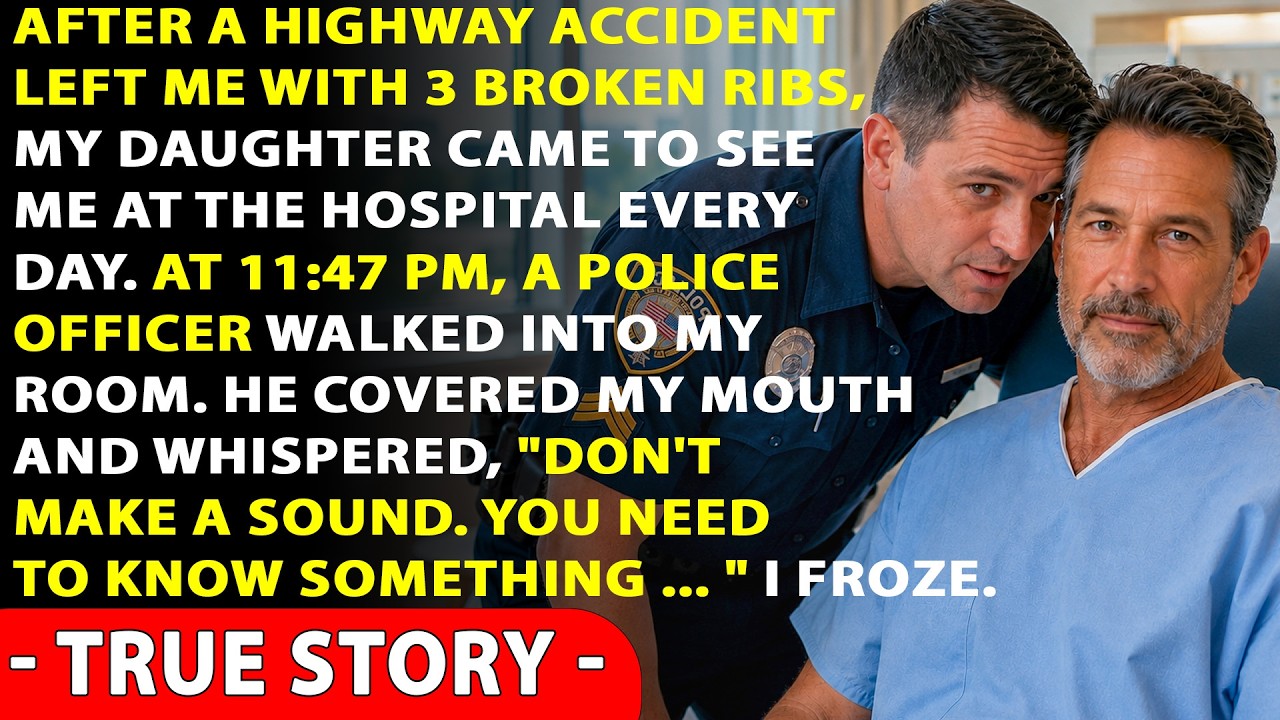
A police officer stepped in, locked the door, and pressed his hand over my mouth before I could draw a full breath. “I’m not here to hurt you, Mr. Hayes,” he whispered. “I need you to listen.
”
His name was Daniel Cross, LAPD Commercial Transport Division. He leaned close, his face inches from mine. “Your daughter is not managing your company. She is dismantling it.
”
I grabbed his wrist the way a frightened man would. But I wasn’t frightened. I was watching. I’d spent 35 years reading people across negotiating tables and loading docks.
And I could see what he was really doing. His eyes kept moving around the room. The nightstand. The closet.
He hadn’t come to warn me. He’d come to find something. “Is there anything in this room that belongs to the company? ” he asked.
“Documents, a laptop, a storage device? ”
I let my shoulders sag, gave him the posture of a man deflating under bad news. “My daughter brought paperwork yesterday. She took it home with her.
”
He searched anyway. Nightstand. Closet. Jacket pockets.
My phone. He left a business card on the tray table and walked out without another word. I waited until his footsteps faded. Then I exhaled slowly, pain moving through my cracked ribs.
He never checked the one place that mattered. Three days before my accident, I’d noticed something wrong in the routing data. I didn’t know what it meant, but I knew enough to copy everything onto a small drive. I gave it to Marcus Reed, my chief accountant of 22 years, the morning before the crash.
Now I called him in the dark. “The drive is safe,” he said. “Don’t move it. Don’t tell anyone.
”
That night I understood two things. Whoever sent Cross didn’t know about Marcus. And I had maybe a day before they started looking harder. The accident itself happened on an ordinary September morning.
Running late, merging onto the 10 freeway, and then a truck hit my rear driver’s side and sent me spinning across two lanes. Three cracked ribs. A head injury. The driver never stopped.
The police found nothing but skid marks and shattered tail light. I started Hayes Freight Solutions in 1987 with a single used Peterbilt and $400 in my checking account. My wife Margaret believed in me before I believed in myself. She died of ovarian cancer in 2003, when Audrey was eleven.
The morning after the funeral, my daughter sat across from me in a black dress, folding a napkin, and asked if we were going to be okay. “Yes,” I said. “We’re going to be okay. ”
I kept that promise for 22 years.
I raised Audrey on my own, taught her to drive a truck when she was sixteen, watched her earn her MBA, and brought her into the business. Hayes Freight grew from one truck to 230, moving freight across five states, employing 340 people who showed up and did honest work. What I didn’t know was that someone else had already been watching my daughter. Victor Langford came to my hospital room the morning after the accident, dressed in expensive slacks and holding a paper cup of cafeteria coffee.
He’d tried to buy my company in 2017 at 40 percent below market value. I’d turned him down. He’d left without shaking my hand. Now he sat beside my bed like an old friend.
“How did you know which room I was in? ” I asked. He waved a hand. “I still have friends in this building.
Old colleagues from the state transportation office. ”
“I appreciate you coming,” I said carefully. “The offer stands, Walter. It always has.
”
He meant the other offer. I heard it underneath every word, the way you hear an engine idling two blocks away on a quiet street. Audrey arrived that afternoon. Her mascara was smudged.
Her voice cracked on the word “Dad. ” She pressed her cheek to mine, careful not to touch my ribs. “I should have been here this morning. I’m so sorry.
”
I believed her. I wanted to believe her. She pulled the visitor’s chair close and opened her laptop. She talked about managing the company while I recovered.
The contracts. The day-to-day. She brought paperwork. She came prepared.
Looking back, I missed what was right in front of me. I was too grateful to notice she hadn’t asked what I needed. She’d told me what she was going to do. Marcus called a week later.
“Something is wrong with the September numbers,” he said. “Not data entry. Someone went in and changed them after the fact. ”
“How many entries?
”
“Fourteen routing changes. All in the last ten days. ”
He paused. I heard him exhale like a man setting down something heavy.
“The authorization codes on every single one belong to Audrey. ”
I set the phone down and stared at the ceiling. Then I called Ethan Cole, a retired FMCSA inspector and my friend for thirty years. I asked him to cross-reference the freight records against the actual delivery confirmations.
He called back in 48 hours. His voice had lost its warmth. “I found the name of the company that owns the truck that hit you. Sierra Pacific Transport LLC.
Registered in Nevada through a law firm that handles anonymous entities. ”
“Who owns it? ”
“The beneficial owner, traced through two layers of nominee directors, is a trust administered on behalf of Audrey Christine Hayes. ”
Everything went very still.
Not the floor dropping away. The opposite. Everything became quiet and small, and I was sitting in the center of it with a phone in my hand and the sudden absolute understanding that the person I had built everything for had put me in this bed. “I checked four times before I called you,” Ethan said.
“Same result every time. ”
“I believe you. ”
Then Marcus called about Sophie Mercer. Sophie was a logistics coordinator at the commerce yard.
Quiet. Reliable. Three years with the company. Marcus said she was scared, really scared, and wanted to talk.
He met her at a coffee shop on Telegraph Road. When he called me afterward, I could hear the heaviness in his voice. “About six weeks ago, Audrey told Sophie to use a revised manifest template for a subset of shipments. The template changed the cargo descriptions.
Industrial cleaning supplies became general freight. Chemical compounds became equipment components. Hazardous material classifications removed entirely. ”
My chest tightened.
“Some of those original descriptions listed precursor chemicals, Walter. The kind that require special federal permits to transport. She’s been running falsified manifests for six weeks. About forty shipments.
”
“Does she have evidence? ”
“She kept copies of everything. Original manifests, revised ones, emails from Audrey with the template instructions. She photographed them on her personal phone.
She’s also been recording herself going through the filing process. ”
Sophie Mercer had been sitting in our office for six weeks, carrying a fear she could not share because she worked for a company with my name on the side of every truck and she didn’t believe anyone would listen to her. That was my failure as much as anyone’s. “Tell her she’s not alone,” I said.
“Tell her the name on those trucks is supposed to mean something. ”
Then the conservatorship petition arrived through the patient portal. Superior Court of California, Probate Division. Petition for appointment of conservator of the estate of Walter James Hayes.
The petitioner: Audrey Christine Hayes. I read all 42 pages. The petition argued that the head trauma from the accident had left me cognitively compromised, confused, unable to manage my own financial affairs. The medical foundation was a detailed assessment from Dr.
Harmon, the physician who had treated me for three months. I remembered his questions. The three words he asked me to recall: table, pencil, September. I’d repeated them correctly.
Now his report described a man who struggled with memory and couldn’t critically evaluate information presented by family members. None of that was true. I called Helen Vance, an attorney Ethan found. Elder law with corporate fraud experience.
She answered on the second ring. “I know the outline,” she said. “Tell me the rest. ”
I told her everything.
The shell company. The falsified manifests. The conservatorship. And the doctor who had signed a report that was never true.
Helen was quiet for four seconds. Then she said, “Two things at once. First, I’m filing a request for independent medical examination. Second, I’m opposing the emergency motion for temporary conservatorship.
A man who managed a 230-vehicle freight company for 35 years does not require emergency financial protection based on a six-week assessment authored by a physician who received eighty thousand dollars from the opposing party’s primary financial backer. ”
I stopped breathing. “You found the payment? ”
“Forty thousand in late August.
Forty thousand in early September. Four days after you were admitted. From a Langford Capital subsidiary into Dr. Harmon’s personal account.
”
The doctor had been paid before the accident. The medical assessment wasn’t improvised. It was planned. Victor Langford didn’t react to my accident.
He engineered it, then built the medical documentation around it while I was still in surgery. Ethan called the next morning. “There was an emergency meeting at Langford’s office yesterday. Two of his senior associates flew to New York.
The pattern looks like asset movement. ”
“Make the call,” I said. “Today. ”
What happened next reached me secondhand.
Victor Langford called Daniel Cross and said four words: “Clean it up, Daniel. ” Cross sat in his car for 22 minutes. Then he called his attorney. The next morning, he walked into the federal building on Wilshire Boulevard and asked to speak with financial crimes.
He told them everything. The payments. The deleted camera footage from the intersection where I was hit. The surveillance.
The names. By the time Sophie Mercer walked into the same building with her phone full of evidence, the walls were already closing in. Ethan told me Audrey had called an emergency board meeting. Wednesday, ten a.
m. She was moving to formalize the conservatorship, get the board on record before the independent medical examination could be completed. The FBI wanted to make the arrests at that meeting. Audrey and Victor together, before either of them realized the walls were closing.
I had eight days. The navy suit still fit, barely. I’d lost weight in the hospital. But I put it on that Wednesday morning and walked into the Hayes Freight conference room carrying a cardboard box.
It was not heavy. It had never been heavy. But everything that mattered was inside it. Through the window beside the door, I saw Audrey standing at the head of the table.
She wore the gray blazer I’d given her for her thirtieth birthday. The slide behind her read: Hayes Freight Solutions, new management structure. I pushed the door open. The room went still.
Audrey’s hand dropped to her side. The color left her face like water draining from a glass. “Dad,” she said, and her voice cracked on the word. “You should be resting.
”
“I’ve been resting long enough. ”
I walked to the center of the table and set the box down. Then I began placing documents on the surface, one stack at a time. “The first document is the electronic logging device data from 23 Hayes Freight vehicles.
Under federal law, this data cannot be altered. It shows stops at locations not listed in any client contract. A warehouse in Fontana. A cold storage facility in Queens.
”
I set it down. “The second is the corporate registration for Sierra Pacific Transport LLC. The beneficial owner of the trust that controls that company is administered on behalf of my daughter. ”
Audrey’s knuckles went white on the back of her chair.
“The third is an email chain detailing how Hayes Freight shipping lanes were redirected to carry undisclosed materials. ”
I set it down. “The fourth is a financial transfer record showing eighty thousand dollars paid from a Langford Capital subsidiary to Dr. Harmon.
The first payment was made three weeks before my accident. ”
I paused. “Dr. Harmon signed the medical assessment supporting the conservatorship petition.
He was paid to write it before I was ever injured. ”
The room had the quality of held breath. “The last document records sixty-two thousand dollars paid to Officer Daniel Cross, who has been cooperating with federal investigators since last week. Deputy Chief Everett Shaw was taken into federal custody this morning.
”
I looked at Audrey. Her eyes were wet. One tear moved down her left cheek, and she didn’t wipe it away. “You didn’t build this company,” I said.
“You only used it. ”
The door opened. Special Agent Rebecca Okafor walked in with two federal agents. “Ms.
Hayes, I have a federal warrant for your arrest. ”
Audrey didn’t argue. She didn’t run. She let go of the chair and stood there, smaller somehow than she had seemed ten minutes before.
Victor Langford was arrested at LAX, waiting at the gate for a flight to Zurich. The leather portfolio he’d carried into my conference room six years ago went into an evidence bag. Afterward, I stood at the window of the conference room and looked down at the yard. The trucks were still lined up along the east fence.
Two hundred thirty of them, waiting. In an hour, they’d run the routes they’d run for 35 years. Ethan appeared beside me. He didn’t say anything.
That was the way we’d always been. Rebecca found me in the hallway outside the interview suite later that afternoon. I’d been sitting on a plastic chair for an hour. My ribs ached.
My throat was tight. “She asked about you,” Rebecca said. “Whether you were all right. Whether you came out of this okay.
”
“What did you tell her? ”
“I told her you were standing up. ”
I nodded. My daughter was behind that door, and I didn’t go in.
I turned and walked toward the elevator. Six months later, Hayes Freight was still standing. Marcus had an independent audit committee in place and never once mentioned what it had cost him to carry those records through the months when no one knew he was carrying them. Sophie Mercer became director of compliance.
She hung the original falsified manifest on her office wall as a reminder. Ethan joined the advisory board and drove down from Sacramento the first Tuesday of every month. The Hayes Integrity Logistics Foundation opened in April, helping small businesses understand their rights when larger companies pressure them into agreements they don’t fully understand. On a Thursday morning in June, an envelope arrived on my desk.
The return address was a law office on Wilshire Boulevard. Inside was a single sheet of paper, folded once. Two words, handwritten. I’m sorry.
I recognized the way she formed her lowercase letters, the slight leftward lean she’d had since middle school. I sat at my desk for a while. Then I opened the bottom drawer. In the back corner was the photograph of Audrey at eight, sitting in the cab of the original Peterbilt, grinning at the camera with both hands on the steering wheel.
I placed the letter beside the photograph and closed the drawer. Outside the window, the yard was full. Two hundred thirty trucks, engines starting one by one. The sound of a freight operation coming to life in the morning.
Honest work. Honest routes. Honest people. I had built it once.
I had kept it. That was enough.