At my backyard barbecue, my son-in-law shoved me into the hot grill in front of fifteen guests. My hand hit the burning metal, and the whole yard went silent. “He just stumbled,” Derek said. Then my own daughter looked at my burned hand and said, “Dad, you’re being selfish.
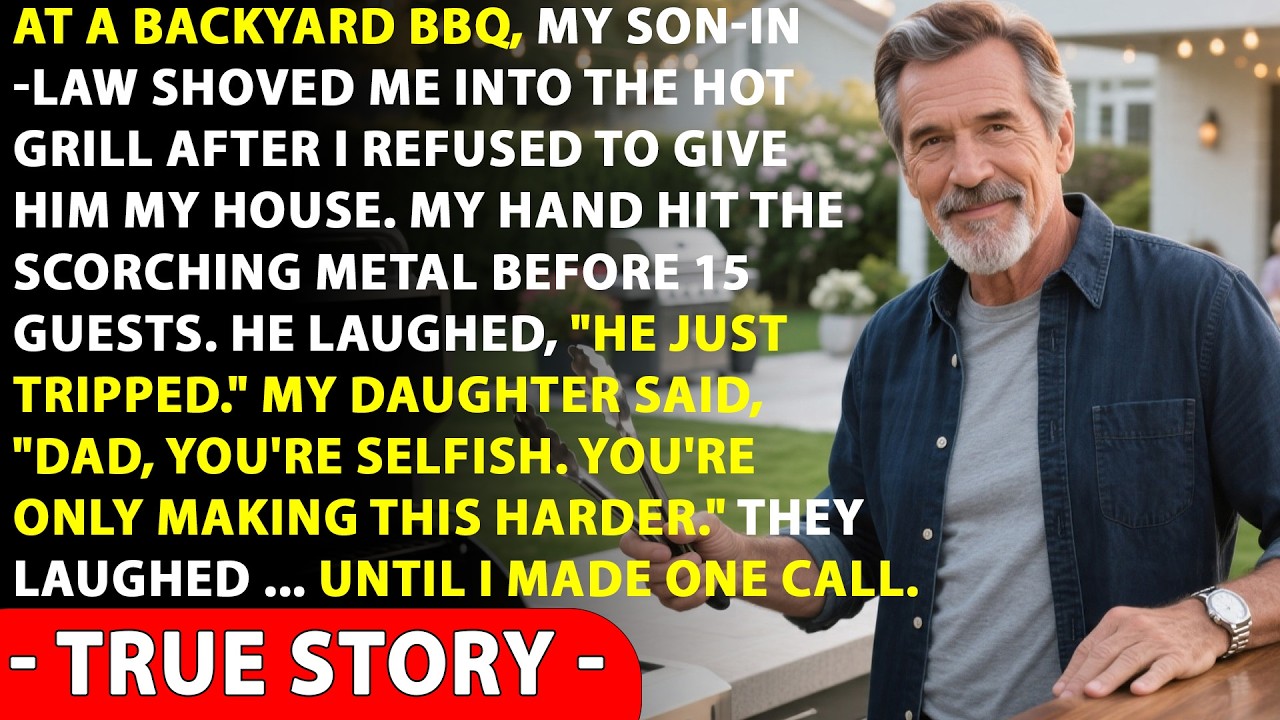
You’re making everything harder than it needs to be. ”
They thought they had broken an old man with no one left to fight for him. I made one call. I’d lived in that house for thirty-one years.
I’d cut and nailed every board in the porch myself. The neighbors saw a quiet retired construction worker in a flannel shirt and a beat-up Ford pickup, but Margaret and I had spent four decades building a construction materials company that supplied half the commercial projects in the Pacific Northwest. After she passed three years ago, I kept living exactly the way I looked. I wanted to see who showed up when there was nothing flashy to show up for.
Derek showed up wanting a tour of the property. He asked about appraisals, security systems, and estate planning, then got to the point: he and Emily wanted their names on the deed. This would still be your home completely, he said. It would just protect the asset.
I said no. He smiled, but I’d spent forty years reading people across negotiating tables. A man who works that hard to tell you how much he cares is usually getting ready to ask for something. Three days later, my brakes went out on a downhill grade.
I aimed for the shoulder, dragged the front tire against the curb, and stopped against a chain-link fence. Three stitches above my eyebrow and a wrist that wouldn’t take weight for weeks. Frank Morrison, who’d fixed my vehicles for twenty-two years, put the truck on the lift. He found the rear brake line fitting backed off a quarter turn.
“Not a chance this works itself loose,” Frank said. “Somebody put a wrench on this. ”
Derek had spent ten minutes alone in my garage the night he came to dinner, claiming he was looking for a flashlight. I called Richard Bennett, my attorney for twenty years.
He told me to act completely normal, to be the same man they thought they were dealing with. He would pull Derek’s records. Give him two weeks. So I went about my life.
I sent Emily a text inviting everyone over for a backyard barbecue, my treat. Derek spent three days on the phone before that evening, telling anyone who would listen that Walter was getting on in years, that Walter was refusing help from the family that loved him. By the time fifteen people walked through my gate, they weren’t coming to enjoy the food. They were coming to witness something.
It ended with my hand on the burning grill and my daughter calling me selfish in front of everyone. I walked inside, ran cold water over the burn, and called Richard at eleven o’clock at night. Richard arrived at my kitchen table Monday morning with three items. Frank’s notarized report on the brake line.
Derek’s credit report — score 412. And his firm’s financial records: two breach-of-contract suits, a defaulted commercial loan, a second mortgage on the penthouse downtown that Emily didn’t know about. “He needs cash,” Richard said. “The only asset in his orbit that can generate that cash is your house.
”
Richard also told me Derek would try to have me declared legally incompetent. A doctor would come to my house. When he did, I needed to be exactly what Derek thought I already was: confused, tired, forgetful. So I became helpless.
I let my voice go thin on the phone with Emily. I stood in the Safeway aisle picking up the same oatmeal canister twice until Derek found me and quietly photographed his easy victory. Then Dr. Harlon Webb arrived with a clipboard, claiming to be from the county health division.
The stamp on his letter was the wrong shade of blue, but I let him in. I told him it was August. I misnamed the governor. I drew a clock that looked like a child’s drawing.
He typed a message on his phone and murmured, “Mr. Collins was right. Easiest fifteen thousand I’ve made all year. ”
I had a digital recorder taped under the coffee table.
I sent the file to Richard. Emily came alone the next day, carrying an apple cobbler made from Margaret’s recipe. I smelled the cardamom and understood what was coming. She brought a notary with her and slid a durable power of attorney across the table.
It would grant her and Derek full authority over my finances and real property. “It doesn’t take anything away from you, Dad. It just means we can help if you need us to. ”
I signed it with a pen Richard had given me — one filled with disappearing ink.
Emily folded the document into her bag and was out the door in under a minute. She didn’t even take a piece of the cobbler. At 9:52 the next morning, Derek and Emily walked into First Pacific Bank and presented the power of attorney, requesting a $250,000 withdrawal from my savings account. The branch manager examined the document, looked at the signature line, and found it blank.
No ink. No indentation. “That’s impossible,” Derek said, his face scarlet. “I watched him sign it.
”
The manager informed them that presenting a forged document to a financial institution constitutes federal financial fraud. Two security staff appeared at the door. A fraud report was filed. That should have ended it.
Instead, Derek escalated. He called me with a threat: he had the security video from the barbecue, edited to look like I’d stumbled into the grill. Unless I signed the house over, he’d send it to every news outlet in Portland and tell them I’d fabricated a police report. “Sign the deed, Walter.
Or you won’t recover from it. ”
I agreed. I drove to his lawyer’s office in a strip mall and sat across from Derek, who couldn’t resist the victory speech. “You spent your whole life working with your hands,” he said.
“Men like me work with our minds. We understand leverage. ”
I signed the quitclaim deed with a real pen. The notary stamped it before the ink was dry.
Derek held the document the way men hold things they have wanted for a long time. What he hadn’t done was check the property history. Decades earlier, my company had registered that address as a commercial auxiliary transit point under Oregon’s business property code. The designation attached to the physical address, not to the owner.
By accepting the deed outside the corporate trust, Derek assumed personal liability for every commercial obligation attached to that address: $890,000 in transition fees, audit costs, and penalties, due to the Oregon Department of Revenue within forty-five days. Non-dischargeable in bankruptcy. The property frozen until the debt was cleared. He couldn’t sell it.
He couldn’t refinance it. He couldn’t walk away from it. I stood across the street two days later and watched a government SUV pull up to my house. Two officials handed Derek the documents.
Even from that distance, I could see the color drain from his face. He called me at the lake house the next morning — the lake house Margaret and I had bought under a separate trust Derek had never known existed. His voice was stripped bare. “Walter, you set me up.
”
“I handed you exactly what you asked for,” I said. “You drafted the deed. You chose the lawyer. You threatened me into signing it.
”
He sobbed on the line, raw and unguarded. He said he didn’t have the money, that it would destroy him. “Twelve years ago, when you were a junior analyst with forty thousand dollars in debt, a private entity invested two million dollars to launch your firm. You told Emily it was an angel investor.
That entity was a blind trust funded entirely by Margaret and me. We gave you the foundation, and you used it to build a lie. ”
The crying on the other end of the line was the sound of a man understanding what he had cost himself. The FBI opened a financial crimes investigation.
Derek pleaded out: four years federal, full asset forfeiture. His firm was dissolved. And he gave investigators a full statement — blaming Emily, calling her the real architect of the fraud, trying to trade her testimony for a reduced sentence. Richard told me Emily read the entire statement without making a sound.
A few hours later, she drove to the lake house and stood outside the gate in the rain. I watched her on the security feed. She wasn’t performing. She was just a woman standing in the rain with nowhere else to go.
I put on my jacket and walked to the gate. She broke down at the bottom of the steps. “I’m sorry, Dad. For choosing him, over and over.
For standing there while you were bleeding and calling you selfish. And you never stopped being my father. Not once. ”
I told her I forgave her — all of it, completely.
But I also told her the truth. “Forgiveness is not the same as going back. You need to build something real now. With your own hands, the way your mother did.
From the ground up. ”
She nodded, wiped her face, and walked away. At the top of the path, she looked back at me. “Mom would be so proud of you.
”
I watched her car disappear around the bend in the drive. Then I went inside and opened the bottom drawer for the last time. The manila envelope Margaret had given me two weeks before she died held a letter in her handwriting, three pages, steady and unhurried. “The measure of a man is not what he builds, Walter.
It is what he refuses to let be taken from him. Not the house, not the money. His dignity. Yours has never left you.
Not once. ”
I folded the letter along its original creases and held it against my chest. The December light lay flat and clean across the water, and for the first time in a long while, the silence felt like peace.