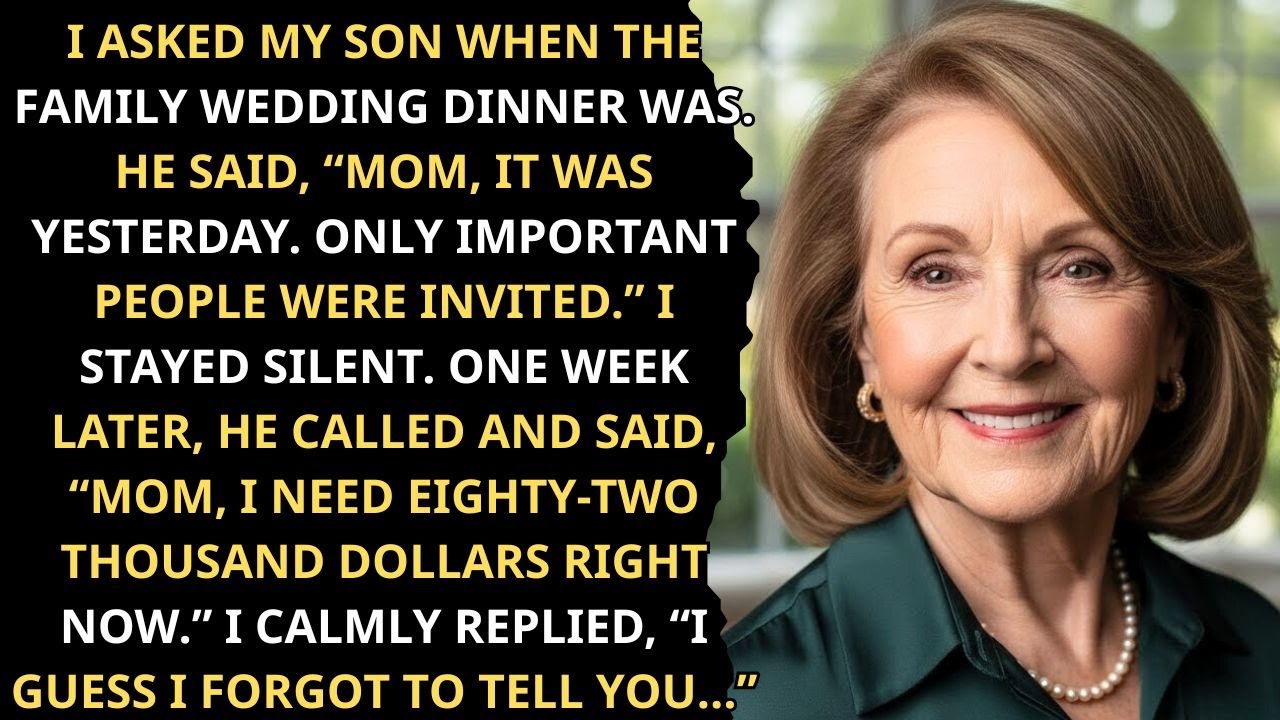
The call came at five in the morning. Eleanor Vance stood in her kitchen with a cold mug of tea while her son told her, in a voice meant to sound reasonable, that he had married Saraphina Holloway the previous afternoon at a private vineyard in Napa. She hadn’t been invited. She wouldn’t be invited.
He said the Holloways had a vision for the wedding: social equilibrium. His mother, with her practical shoes and her museum stories, didn’t fit the brand. Three months earlier he had promised the date was still being finalized. Eleanor had already bought the dress—soft lilac lace, two weeks of pension.
It hung in her closet like a garment for a funeral that hadn’t happened. Then he asked for the money. The Holloways had a temporary freeze on an offshore trust. The venue and caterer needed $82,000 by noon.
A bridge loan. He would repay it with interest the moment the audit cleared. $82,000 was almost everything she had. She thought of the winters in the same thin coat, the extra shifts scrubbing grease in a diner, the repairs to her shoes while Julian got the latest laptop.
She had sacrificed for four decades so he could stand in the sun. Now he was asking her to set her life on fire so he could feel warm in someone else’s castle. She didn’t say no. She didn’t say yes.
She hung up and started looking. The archival researcher in her knew how to find what was buried. She went into the databases she had access to through the Legion of Honor and pulled the Holloway family apart. What she found was not old money.
It was a system of shell companies, tax liens, vendor judgments, foreclosure notices, a shared jet that hadn’t been paid for in six months. The estate was quietly collapsing. The wedding wasn’t the start of their wealth; it was a bid to stay alive. Julian called again at ten.
His voice had lost its calm. Saraphina was crying. Genevieve was humiliated. He called Eleanor selfish.
A relic. He said she was clinging to her money to watch him fail. He reminded her that he was her only legacy. Eleanor felt something inside her lock.
She had taught her son to lean so hard he had forgotten how to stand. If she kept holding him up, they would both fall. “I’ll meet you at the Gilded Leaf,” she said. “Noon.
”
She wore the lilac dress and her grandmother’s pearls. The Holloways were there with Julian, polished, patient, performing. They spoke to her slowly, as if she were a child. They pressed her to make the transfer, to smooth over the whole unpleasantness.
Genevieve smiled without warmth. Allaric explained the complexities of global finance. Julian watched her purse. Eleanor set the manila folder she had brought onto the white tablecloth and opened it.
She read the first lien aloud. Then the next. The foreclosure. The unpaid vendors.
The names of the shell companies. She read them the way she had read archival records for forty years—completely, without emotion, letting the facts do the damage. Allaric’s face emptied. Genevieve turned into stone.
Julian stared at the papers like a man seeing his own name on a death certificate. Allaric tried to call the documents forged. Genevieve ordered Julian to silence her. Julian stood, furious, and called her a bitter old woman.
“I’m done paying for your life,” Eleanor said. “If you want to live in a house of cards, you’ll learn to keep it upright yourself. ” She left the folder on the table and walked out. She did not look back.
The months after were quiet. Julian didn’t call; Eleanor didn’t reach out. She went to the museum as a visitor, then to Kyoto in the spring, Florence in the autumn, Maine in the winter. She learned to be with herself, and that was harder than any of the work she had done in the archives.
She also learned that forgiving herself for loving the wrong person was the last archive she had to open. A year later Julian came to her door. The Holloway marriage had collapsed under the weight of its debt. He was working as a junior clerk in a firm that didn’t care about his aesthetic.
He asked to come in, to sit at the oak table, to find the mother he had discarded. Eleanor looked at him from the doorway. “I love the boy you used to be,” she said. “I don’t know the man you have become.
Find your way back to the truth before you find your way back into this house. ”
For a moment she saw the child who had promised her a castle. But Julian’s eyes were still hunting for someone to pay for the stones. She closed the door.
She began volunteering at a literacy center. She made a fresh pot of tea and read the books she had postponed. The silence in the house stopped feeling like a sentence. It began to feel like company.
The fog would always come back over the city. Families would keep building their houses of cards. But Eleanor Vance no longer needed to be invited to her own life.
She set her cup down, opened her book, and began to read.