The morning I was supposed to fly to Denver, I stopped at my daughter’s house with an early birthday gift. My father’s Omega watch was in my breast pocket, the one I’d meant to give Emily for years. I also had sunflowers because she always kept them on her kitchen counter. Then I heard her scream.
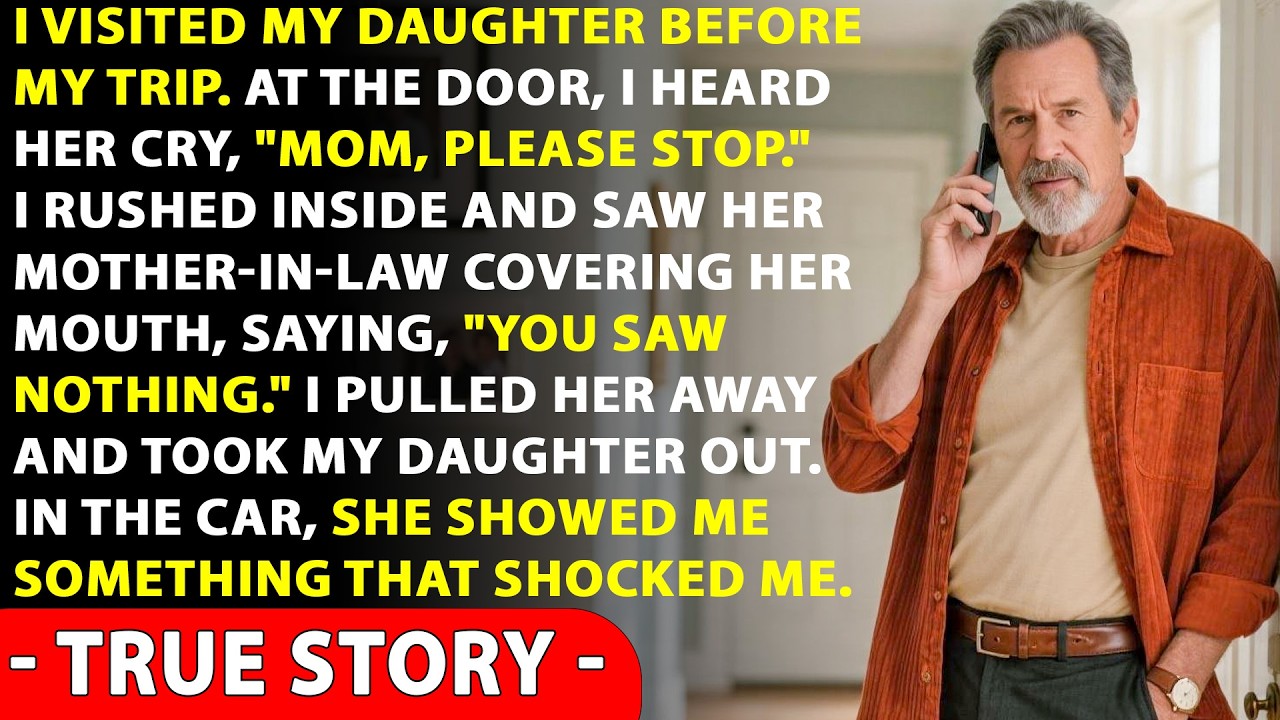
It wasn’t a startled cry. It was raw and choked, the sound of someone fighting to breathe through something pressed over her mouth. I threw the front door open so hard the handle dented the drywall. The living room was empty, and the sound came from deeper in the house.
In the sitting room, Victoria Grayson, Mark’s mother, had Emily pinned against an armchair. One hand was clamped over Emily’s mouth, the other gripping her shoulder. Victoria leaned close and whispered, “You saw nothing. Say it.
If you say one word to anyone, Emily, you will regret it in ways you cannot imagine. ”
“Get your hands off my daughter. ”
I pulled Victoria away hard enough that she stumbled into the bookcase. Emily scrambled behind me, shaking, her breath coming in ragged pulls.
Victoria straightened, smoothed her face, and became the composed woman I’d known for years. “Thomas, I know what this looks like. Emily has been under tremendous stress. I was trying to calm her down.
”
“Dad, please,” Emily said, her voice cracking. “Can we just go? ”
I walked her out to my truck, my hand steady on her back, and I talked about nothing important until the shaking slowed. Then Emily reached into her cardigan and pulled out a USB drive.
“I’ve been collecting things,” she said. Her hand was trembling so badly she could barely hold it flat. “Files, emails, records. Dad, I think they’re trying to take everything you built.
”
I opened the drive on my laptop. The first email was from Mark to Victoria. Subject line: Phase 2. Ready to move.
It said they needed everything in place before the board meeting. I read the financial records next: wire transfers routed through a shell company to an offshore account registered under GV Holdings. Over $800,000, carefully structured to stay below reporting thresholds. Then the legal documents: Richard Hail, a corporate attorney, had prepared an incapacity filing to have me removed from my own company on grounds of cognitive decline.
And audio files, recorded by Emily in her own home, of Mark and Victoria discussing what would happen once her father was gone. She’d been collecting evidence for seven months, alone, afraid to come to me until she had enough. My phone buzzed. It was Sandra, my assistant of twenty-two years, barely above a whisper.
“Mr. Miller, they just served papers to the board. They’re saying you sold proprietary trade secrets to a competitor. There’s an emergency meeting.
”
I drove to the office. Mark was already in the boardroom, dressed in what he thought looked like reluctant duty. Victoria sat beside him, composed, a single strand of pearls at her throat. Richard Hail presented the case methodically: forged emails, wire authorizations, a bank account in my name I’d never opened.
Mark’s voice cracked at exactly the right moment. The vote took four minutes. Seven in favor of suspending my authority. Two abstentions.
I walked out without a word. I called Daniel Ortega, retired FBI, financial crimes, the only man I trusted to untangle this. We met at the Santa Monica Pier. I laid out everything: the USB drive, the transfers, the shell company, the incapacity filing.
Daniel listened without interrupting. “This is wire fraud,” he said. “Trade secret theft. Federal jurisdiction.
And Tom, Apex Interiors? I’ve heard that name before. They did this to another manufacturer in San Diego. This isn’t just Grayson’s scheme.
It’s a system. ”
He gave me three instructions. Let them think they won. Have Emily keep collecting, but only on personal devices.
And give him time to pull the financial thread. Sandra met me at her house that night. She admitted what she’d found: Mark had installed cameras in my private conference room, hidden inside the smoke detector and lighting panel. They’d been watching every private conversation for eight months.
Mark had threatened her into silence. “I was scared,” she said. “I did the wrong thing. ”
“The people who threatened you won’t protect you when this comes apart,” I told her.
“And it is going to come apart. ”
Driving home, she texted me: Mark just came to my house. He knows we met. Daniel pursued the money.
He found a third account. Kevin Parsons, my IT manager, had been receiving monthly payments from the same shell structure. Daniel offered to talk to him alone. Kevin signed a cooperation agreement with the FBI and provided text messages, access logs, and a full statement.
He also gave Daniel something worse. Victoria had said Emily wouldn’t be able to fight back. Not permanently. There were ways to make sure of it.
I called Emily that night. “I need you to get out of that house. ”
Mark had taken her keys, and her phone was being monitored. I told her one more day.
The next night, I parked two blocks away, walked past the house, and used the old knock on the fence post beneath her window—the same knock she’d taught me when she was fourteen. The window slid open. Emily dropped out and grabbed my arm. Her whole body was shaking.
I got her to Daniel’s house. At his kitchen table, she told me the rest. Mark had isolated her for years, made her question her own judgment, told her I was controlling and didn’t want her to have a life beyond the company. She’d doubted herself for so long she’d been ashamed to come to me.
“The morning Victoria came,” Emily said, “I found draft conservatorship documents. A petition to declare me legally incapacitated. Notes from a psychologist I’ve never met. Victoria saw me reading them.
”
The next day, Special Agent Rachel Torres called. The FBI had been investigating Apex Interiors for months. Seven companies confirmed. Victoria was the common thread.
They had wiretaps on Mark, sealed evidence that could not be used in a boardroom but could support arrests. They needed a controlled environment. I requested the annual shareholder meeting. For six weeks I became the tired old man they wanted.
I showed up late. I forgot a supplier’s name. I repeated myself. Mark asked Sandra whether I was losing my mind.
Sandra told him she was worried about me. Victoria began appearing at company events like a woman waiting for the calendar to catch up. On the morning of the meeting, Emily arrived at my house wearing a borrowed gray blazer. I put on the suit Margaret had picked out for me in 1998—the one I wore when things mattered.
We drove to Wilshire Boulevard. In the corridor outside the boardroom, Victoria saw Emily. Her step faltered for just a second. Then she murmured to Mark, “She doesn’t have anything that matters.
”
The boardroom was full. Victoria stood first and presented the case against me: the forged emails, the fabricated bank account, a timeline printed on card stock. Mark spoke next, reluctant and sorrowful. Then Victoria moved to formalize my removal.
“Does anyone wish to speak before we vote? ” she asked. “Yes,” I said. I picked up the remote Sandra had left beside my glass.
On the screen behind me went the real email chain. The access log showing Mark’s laptop downloading 47 proprietary design files at 3:47 a. m. The transfers to GV Holdings.
Kevin Parson’s cooperation agreement. The room went silent. Then the door opened. Special Agent Torres walked in with two agents behind her.
She arrested Mark for wire fraud and theft of trade secrets. She arrested Victoria for wire fraud, conspiracy, and witness intimidation. Mark looked at his mother and said, “Mom,” but Victoria did not look at him. At the threshold, Victoria turned to Emily.
“She was never strong enough for this. ”
Emily’s hand tightened on my arm. She was standing straight, clear-eyed, still standing after everything. “No,” I said.
“She’s mine. ”
The indictment ran thirty-one pages. Apex Interiors was raided and frozen. The stolen design files were ordered returned to Miller Woodcraft.
Richard Hail faced a state bar investigation and surrendered his license. Kevin received probation because he gave them everything. Emily filed for divorce, and her attorney found that Mark had taken out a two-million-dollar life insurance policy on her, with himself as the sole beneficiary. Torres opened a separate investigation.
I didn’t ask her to elaborate. Months later, Emily began rebuilding the company. Not restoring it. Rebuilding, with new clients and ideas we’d never tried.
On a Saturday in May, I drove back to the old Pasadena garage where everything had started. Emily had turned it into a small museum. Daniel was already there, holding two bottles of beer. Emily arrived with Daniel’s granddaughter, Lily, four years old.
Lily walked to the east wall and put her hand flat on the concrete. She’d found the name Margaret had pressed there when Emily was born. “Mr. Miller, what’s this?
”
“That’s Emily’s name,” I said. “Someone who loved her very much put it there so she would always have a place here. ”
Lily looked up. “Will you put my name too?
”
“Yes,” I said. I reached into my jacket and took out the velvet pouch. Emily opened it, pulled out the watch, and turned it over in her hands. On the inside of the case were the words: To the one who carries it forward.
She held the watch against her chest. Her face broke open, and everything she’d carried for so long finally had somewhere to go. I put my arms around her, and we stood in the room where forty-one years of work had begun, with the sawdust smell and the old concrete floor and the name still pressed in it.
Then I found something to write with, knelt down beside Lily, and made a space for the next name.