My daughter-in-law laughed out loud. “What is that poor woman doing here at the auction? ”
My son followed her gaze and found me at the back of the room. He didn’t look surprised to see his mother.
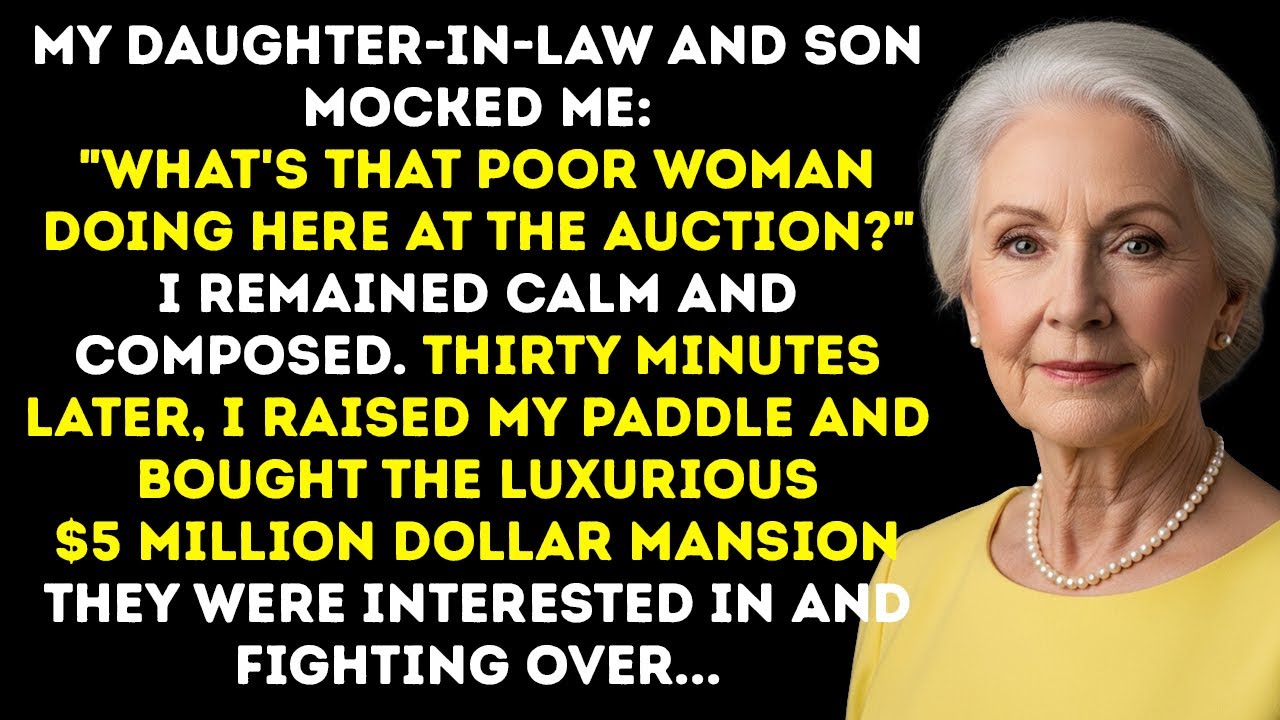
He looked annoyed, as if I were a stain on his expensive evening. I stayed calm. I kept my paddle low, in my lap, and let them whisper about me. “Mom, what are you doing here?
” Mason asked when they reached my table. His voice was hard, clipped. “I came to the auction. ”
“To the auction,” Victoria repeated.
She looked at my beige dress, my twenty-year-old handbag, my quiet shoes. “You at a luxury property auction? ”
“Yes. Here I am.
”
Mason ran a hand through his hair. “Mom, this isn’t for you. These properties are very expensive. I don’t know what made you think you could come here—”
“You don’t have the money, Eleanor,” Victoria cut in, using my name like it was a stain.
“We all know you live off your social security. There’s nothing wrong with that, but you have to be realistic. This is not your place. ”
I didn’t argue.
I just looked at them. Victoria leaned closer and lowered her voice to a stage whisper. “Tell her to leave, Mason. This is embarrassing.
People are staring. ”
He sighed. “Mom, please. Victoria and I have a reputation to maintain.
If people start associating us with you in this context…”
“We are family,” I said. “You know what I mean. ”
I knew exactly what he meant. I was an embarrassment.
A reminder of where he came from. The auctioneer called the next lot. Victoria pulled Mason back to their table, and I watched them study their catalog. They were here for Lot 18.
The Westwood estate. Five bedrooms, six bathrooms, an infinity pool, lake views. Five million dollars. I was here for the same house.
They didn’t know that. No one knew that. I raised Mason alone after his father died. Washed clothes by hand, cleaned other people’s houses, worked double shifts to pay for his private school.
I bought his first suit by working three months of extra shifts. I watched him graduate, get the good job, meet Victoria, and slowly turn into someone who looked at me like I was a burden instead of a mother. What he didn’t know, what neither of them knew, was that I had been saving for forty years. It started with two hundred dollars and a kind financial adviser named Arthur Sterling.
I cleaned his office at night. He caught me counting crumpled bills one evening and asked what I was saving for. I told him about my son, about college, about wanting something for emergencies. He taught me about investing, about compound interest, about making money work.
I put in fifty dollars a month when I could. Sometimes a hundred. Every month without fail. The account grew.
Slowly at first, then faster. By the time Mason got married, I had over a million dollars. I didn’t tell him. I wanted to see who my son really was when he thought I had nothing to offer.
Six months ago, Arthur called with news: my portfolio had reached six million dollars. And then I heard Mason and Victoria talking at one of the rare dinners where I was allowed at their table. They were planning to buy the Westwood estate. Five million dollars.
They’d arranged the loans, the down payment. They had it all worked out. I decided the house would be mine. Now I sat at the back of the exclusive auction hall with paddle number 137 in my hands.
The bidding moved quickly. Properties sold one after another. Mason and Victoria stayed focused on their catalog, whispering numbers, marking strategies. Then the auctioneer announced Lot 18.
The Westwood estate filled the screens. Gardens, pool, lake. Victoria squeezed Mason’s hand. Bidding opened at three million.
Paddles went up fast. The price climbed: three-four, three-six, three-eight, four million. People dropped out one by one. At five million, only a few remained.
Mason raised his paddle, but his hand trembled. Victoria looked pale. Five million was their absolute limit. The million they had saved, plus the four million loan.
They couldn’t go higher. The middle-aged couple withdrew. Only the lone man remained. He raised his paddle with a bored smile.
Five million two. “Going once,” the auctioneer called. Victoria had tears in her eyes. Mason clenched his fists on the table.
Their house was slipping away. “Going twice. ”
I raised my paddle. “Five point three million,” I said.
My voice carried through the silent hall. Every head turned toward me. Mason went white. Victoria’s mouth fell open.
For a long moment, no one moved. The auctioneer asked if anyone would offer more. The lone man looked at me, smiled, and lowered his paddle. The gavel fell.
Sold. To bidder number 137. Five million three hundred thousand dollars. Applause rippled through the room.
“Mom! ” Mason shouted, standing so fast his chair scraped the marble floor. “What are you doing? ”
I kept my eyes on the auctioneer as the staff brought papers.
My signature had never been steadier. Mason reached my table. “You can’t pay that. This is a mistake.
”
The auctioneer looked at me. “Ma’am, are you making a serious offer? Do you have the means to complete this transaction? ”
“Yes,” I said.
“I have the means. ”
“Liar! ” Victoria shrieked. “She lives on a miserable pension!
She can’t buy a five-million-dollar house! ”
The auctioneer’s face hardened. “All participants are verified before the auction. If this lady has a paddle, she has met the financial requirements.
Please return to your seat or I will have you removed. ”
Victoria dropped into her chair and covered her face. She was crying. Not from sadness.
From rage. Mason stood over me as I signed. “Mom. Where did you get that money?
”
I looked up at him. “I saved. For forty years, I worked and saved and invested while I raised you. I paid for your school, your clothes, your college.
And I never told you about the money because I wanted to see who you really were. ”
His jaw tightened. “Now I know. ”
“We can fix this,” he said quickly.
“We can talk. We can—”
“Fix what? You can treat me well now that you know I have money? You can respect me now that I bought something you couldn’t afford?
”
He had no answer. Victoria found her voice. “You did this on purpose. You heard us talking about the house.
You came here to ruin it for us. ”
“I came to buy a property. I bid. You bid less.
That’s how auctions work. ”
“But the house—” She was desperate now. “Maybe you could sell it to us. We’ll pay you what you paid, plus a little extra.
We’re family. ”
“I’m not going to sell you the house. I’m going to live in it. I earned that house.
” I stood up. “Every time you treated me like a burden, every time you made me feel small, I kept going. And now I’m done making myself small so you can feel big. ”
Mason’s eyes filled with tears he didn’t let fall.
“We never despised you. ”
“Never? Then why did you ask, tonight, what that poor woman was doing here? ”
Silence.
“Being alone is better than being surrounded by people who make me feel lonely,” I said. “I learned that today. ”
I picked up my bag, took my folder of documents, and walked out. The air outside smelled like freedom.
I took the bus home, paid my fare, sat in my usual seat. The driver greeted me like always. He had no idea the woman in the window seat had just bought a five-million-dollar mansion. Mason called.
I let it ring. Then came the texts. Mom, please. We need to talk.
Not like this. I turned my phone face down. Three weeks later, I received the keys to the Westwood estate. I drove there alone, walked through every empty room, touched the walls, stood on the balcony overlooking the lake.
And for the first time in weeks, I cried. Not from sadness. From relief. That night, I called Mason.
He answered on the first ring. “Mom—”
“I’m going to say this once. I’m willing to try to rebuild our relationship. But it will be on my terms.
You will come to my new house every Sunday for dinner. Just you, not Victoria. We will talk about real things. You will listen.
And if you come, you come because you understand you hurt me and you want to be better. Not because you want something from me. Do you understand? ”
“Yes,” he said, his voice shaking.
“Whatever it takes. ”
“Then I’ll see you Sunday. ”
He came. The first few Sundays were difficult, full of silences.
But he kept coming. He talked about his fears, his failures, his marriage. He took responsibility. He listened.
And he cried for the years he had lost. Victoria wrote a letter of apology months later. I accepted it, for my own sake, not hers. Now I sit on my balcony and watch the sun set over the lake.
I am seventy-two years old, and I am finally living. Not surviving. Not sacrificing. Living.
They mocked me at that auction. They asked what that poor woman was doing there. I stayed quiet, raised my paddle, and bought the mansion they wanted.
More than that, I bought myself back.