HUNTSVILLE, Texas – A man who terrorized southwest Houston in a five-month crime spree that left four people dead, two women raped, and a community paralyzed by fear was executed by lethal injection Tuesday evening, closing a chapter of violence that began with a boy singing in a church choir and ended with a man strapped to a gurney, apologizing for “poor choices.”
Franklin DeWayne Alex, 34, was pronounced dead at 6:20 p. m. inside the Huntsville Unit, seven minutes after a lethal dose of drugs entered his system.
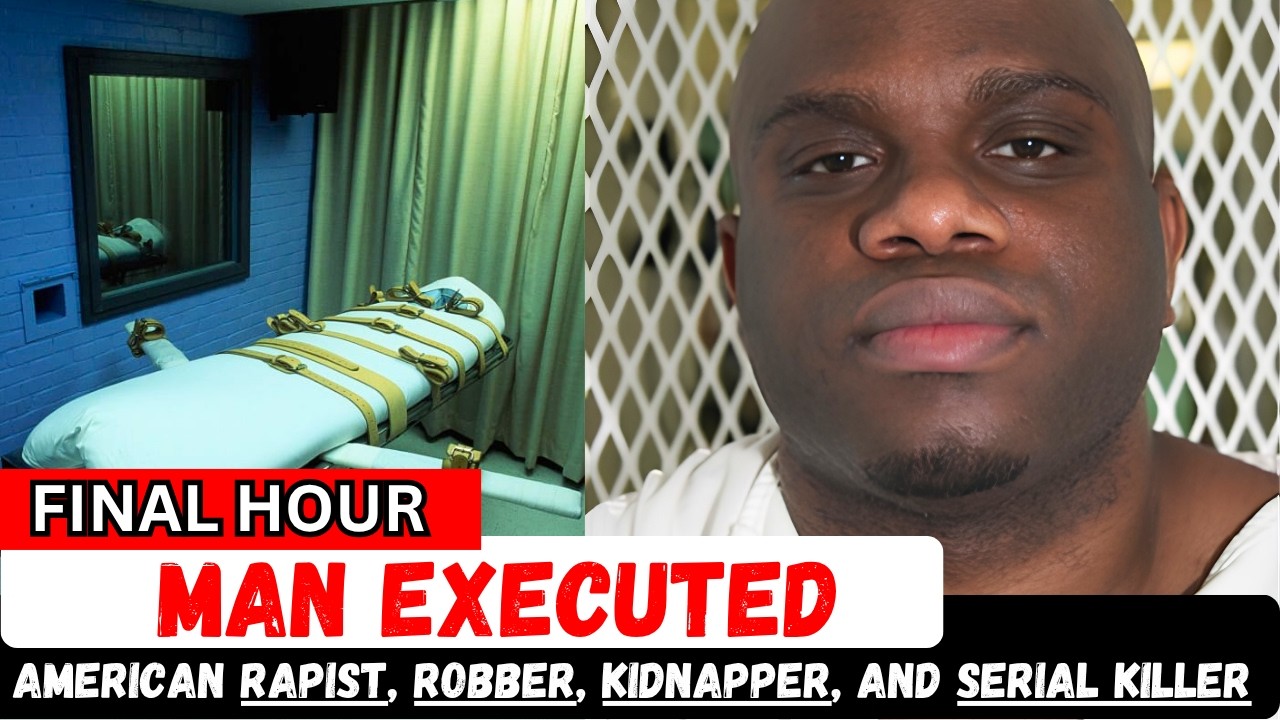 His final words, spoken through a window to the families of two of his victims, were not a confession of total guilt but a plea for understanding. “I am not the monster they painted me to be,” he said. “I made mistakes that took your son.
I messed up. I will take it to the grave. I have peace in my heart.”
Across the glass, the mother and sister of Eric Bridgeford, 23, and the father and sister of Christopher Thomas, 34, watched in silence. They had driven hours to see the end. For Janie Bridgeford, Eric’s mother, the moment brought no satisfaction, only a hollow finality.
“Our lives are forever changed,” she told reporters afterward. “We have to go on. I have forgiven him.
I took no pleasure in what I watched.”
The execution capped a 12-year legal odyssey that traced Alex’s descent from a devout child in a Harris County church to a cold-blooded predator who stalked apartment complexes and driveways, robbing, raping, and killing with a gun that never seemed to jam. The state of Texas argued he was the “poster boy for the death penalty.” His victims’ families agreed.
But the story of Franklin Alex cannot be told without confronting a haunting question: How does a boy who sang gospel music in a choir and taught Sunday school become a man who shot a security guard in the back, forced a woman into the trunk of her own car, and murdered a young man in the street outside his family’s home?
The answer, according to the official record, is not a simple one. There is no documented 𝓪𝓫𝓾𝓼𝓮, no single traumatic event, no expert witness who pinpointed the moment the choirboy turned criminal. The timeline simply goes quiet after his childhood, then picks up when he is 17 years old and already in trouble.
That silence, prosecutors and defense attorneys alike have noted, offers no comfort. It offers no explanation that can be neatly filed away. It only leaves a void where the truth should be.
Alex was born on August 6, 1975, in Harris County, Texas, into a strict religious household. Church was not an occasional Sunday morning obligation; it was the center of life. Sunday morning, Sunday evening, Wednesday night, every special service – the family was there.
Franklin sang in the choir. He taught Sunday school to younger children. He stood in front of a congregation and lifted his voice, repeating scripture, explaining right from wrong.
 By every external measure, he was being shaped into something good.
Then something went wrong.
By the early 1990s, the strict household and the church choir had not held him. In September 1992, when he was 17, Alex stole a full-size Alamo shuttle bus and led police on a 10-minute high-speed chase through Houston. He was sentenced to six months for theft.
He served the time, walked out, and within a month, on April 8, 1993, he stole a woman’s car from her driveway while she was inside getting ready to leave. Police spotted him the same day, arrested him, and he got three years for unauthorized use of a motor vehicle. He served the full sentence, released in 1996 at age 20.
Prison did not fix him. It did not break him. It just held him still.
Shortly after his release, Houston police stopped him for jaywalking. They searched him and found an illegal firearm. He was a convicted felon carrying a gun.
The penalty: 70 days in county jail. Then they let him go.
Every time the system had a chance to interrupt what was building inside Franklin Alex, it gave him the minimum and turned him loose. Six months, three years, 70 days. Each sentence handed back to the world a man who had learned that consequences were manageable, that you could do the thing, survive the punishment, and come back to do the next thing.
By 1997, Alex was 21 years old, living in the Sunny Slope area of southwest Houston, unemployed, and according to his own account, carrying a debt of a couple of thousand dollars to a friend. He said the debt felt out of control, and he saw no way to pay it back except through crime. That explanation – a debt, a few thousand dollars – is what he carried for the rest of his life.
Between August 1997 and January 1998, Franklin Alex committed one of the most sustained and violent individual crime sprees in Houston’s history. He acted alone, targeting people in apartment complexes and residential streets. He killed four people.
 He raped two women. He robbed at least nine individuals at gunpoint. He shot a security guard in the back and left him for dead.
He shot a female security employee in the face. He forced multiple victims into the trunks of their own cars.
The spree began on August 8, 1997. Gregorio Ramirez, 41, was in a parking lot at his apartment complex when Alex approached him, demanded money, and shot him anyway. Ramirez died.
He was the first murder.
One week later, on August 15, Alex drove a stolen car to a Sunmart gas station, filled the tank, and drove away without paying. The station owner walked out to confront him. Alex got out of the car, punched the man twice, knocked him to the pavement, and drove off.
On September 2, 1997, Alex rear-ended a woman’s car in an apartment complex parking lot. When she got out to exchange information, he grabbed her, threw her to the concrete, put a gun to her head, robbed her, and hit her repeatedly. A woman in an apartment above heard the screams and shouted that she was calling the police.
Alex left the victim on the pavement and walked away.
On September 29, 1997, he forced a woman into the trunk of her own car, drove to a secluded location, pulled her out, and raped her. Then he put her back in the trunk, drove to the apartment complex, left her inside the car, and walked away.
On October 5, 1997, he approached a man named Selamawi Tewolde in an apartment complex parking lot, robbed him at gunpoint, and shot him dead. Tewolde became the second murder. Alex was never tried for that killing; it was used as evidence during the sentencing phase of his trial.
On October 13, 1997, he robbed another man and left him alive.
 On November 30, 1997, he robbed a man, forced him into the trunk of his own car, and left him there. Another person heard the muffled cries and called police, who opened the trunk.
On December 6, 1997, Alex approached a security guard working for Top Flight Security at an apartment complex. He put a gun in the guard’s face. The guard cooperated.
When Alex told him to run, the guard ran. Alex shot him in the back. The guard survived.
Later that same night, Alex robbed another man at gunpoint.
On December 19, 1997, Alex broke into the management office of an apartment complex. A female security employee walked in on him. He grabbed her and shot her in the face.
She survived.
The neighborhood was terrified. People were watching their mirrors in parking lots. Women were calling ahead before leaving buildings at night.
The man responsible was still out there, still moving, still choosing targets.
Then came January 1998, the month that sealed his fate.
On January 3, 1998, a Sunday evening, Carol Bridgeford, 19, was coming home to her family’s townhouse. She lived with her parents and brothers. She pulled into her parking spot.
Franklin Alex stepped out of the dark. He pointed a gun at her and told her to get in the trunk. She complied.
He drove somewhere secluded, opened the trunk, pulled her out, and raped her. Then he put her back in the trunk and drove to her family’s town