BOISE, Idaho — Bryan Kohberger stood motionless before Judge Steven Hippler on July 23, 2025, and did what virtually no one expected: he voluntarily surrendered to four consecutive life sentences without the possibility of parole, abandoning every appeal and extinguishing any chance of freedom for the rest of his natural life.
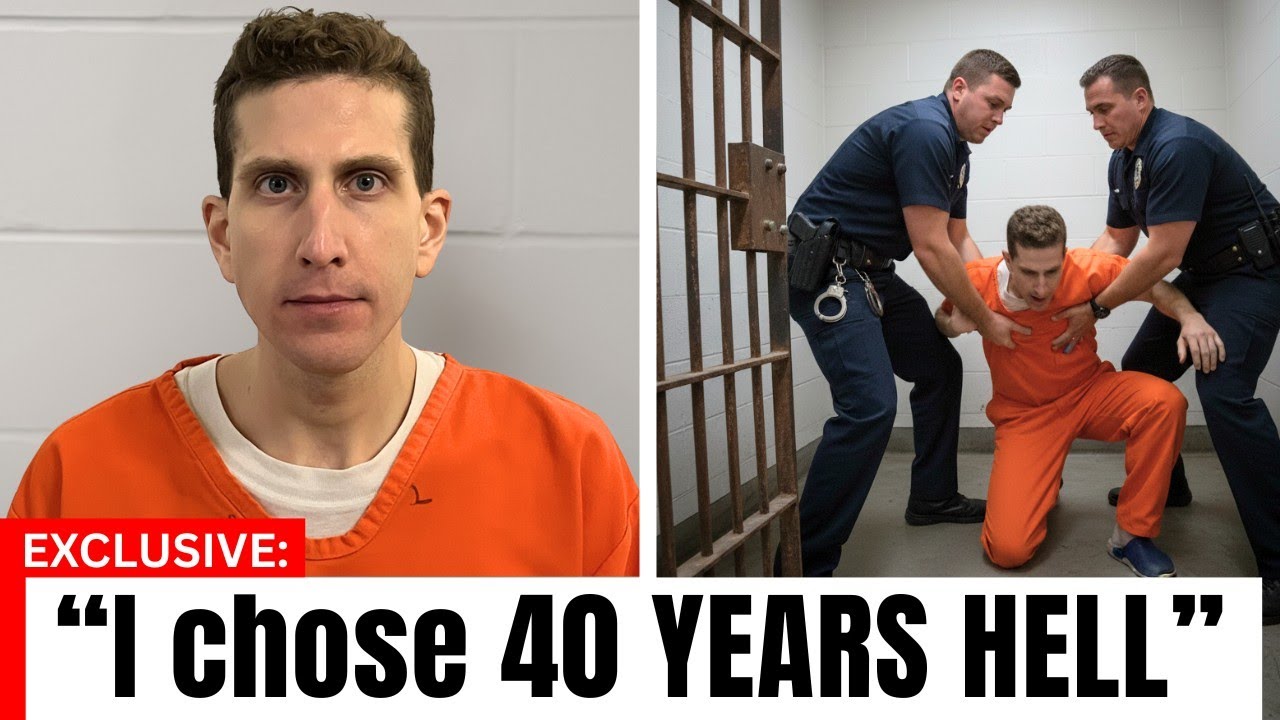
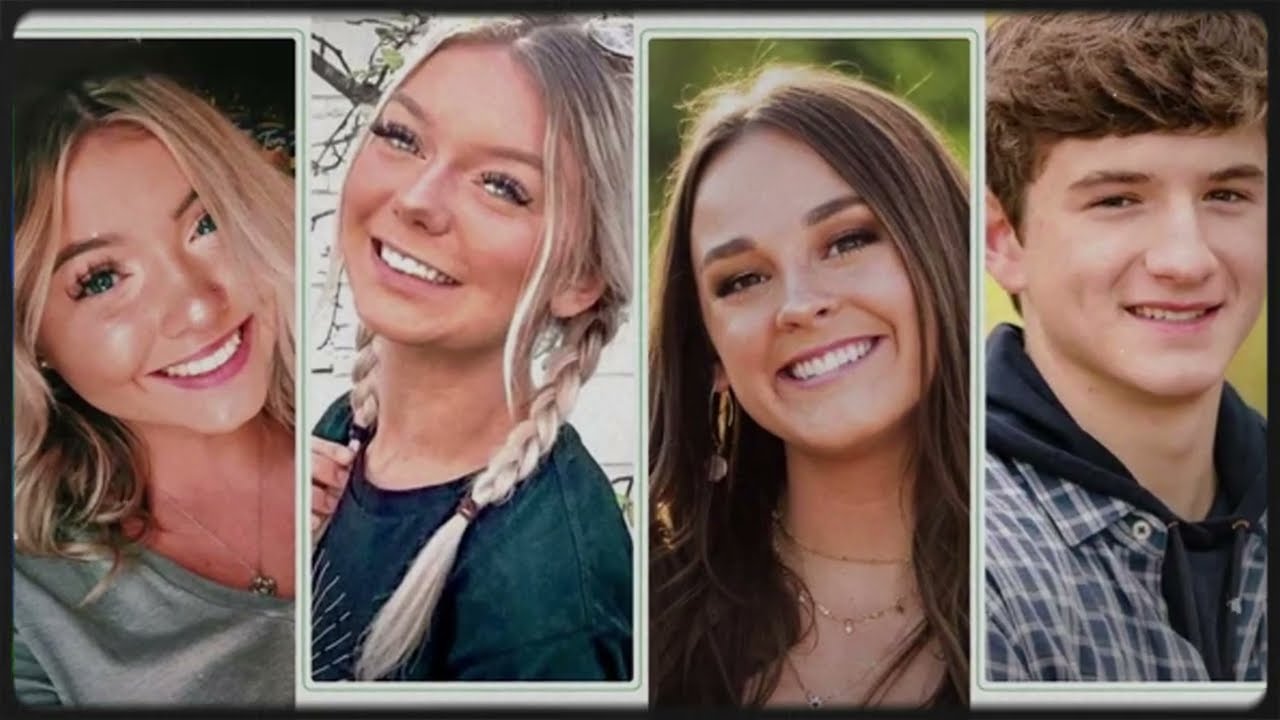
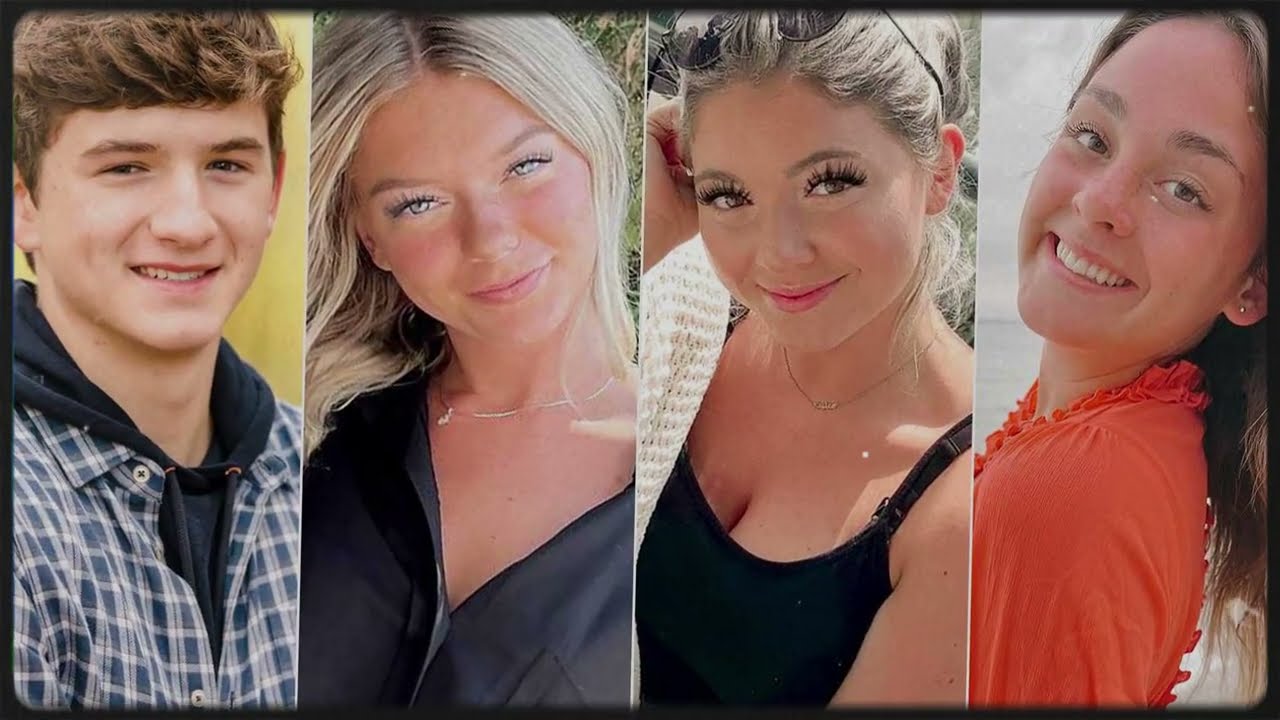
The decision stunned prosecutors who had spent months preparing for a capital trial. It stunned the families of Madison Mogen, Kaylee Goncalves, Xana Kernodle, and Ethan Chapin.
It stunned legal analysts across the nation who had predicted a dramatic courtroom confrontation. But most of all, it stunned anyone who believed they understood the mind of the criminology PhD student accused of committing one of the most horrifying quadruple homicides in recent American history.
Kohberger, 30, did not break down.
He did not show remorse. He did not even appear frightened. Instead, the former Washington State University doctoral candidate made what legal observers are now calling one of the most calculated strategic decisions in the history of Idaho criminal jurisprudence.
He chose decades of prison over the death penalty, and the reasoning behind that choice is far more disturbing than simple fear of lethal injection.
The deal, confirmed in open court, carries severe terms. Four consecutive life sentences without parole.
An additional ten years for burglary. Fines totaling $50,000 plus $5,000 for each victim’s family. Kohberger will never see the outside of a correctional facility again, and he explicitly waived all appellate rights, guaranteeing that no court will ever revisit his case.
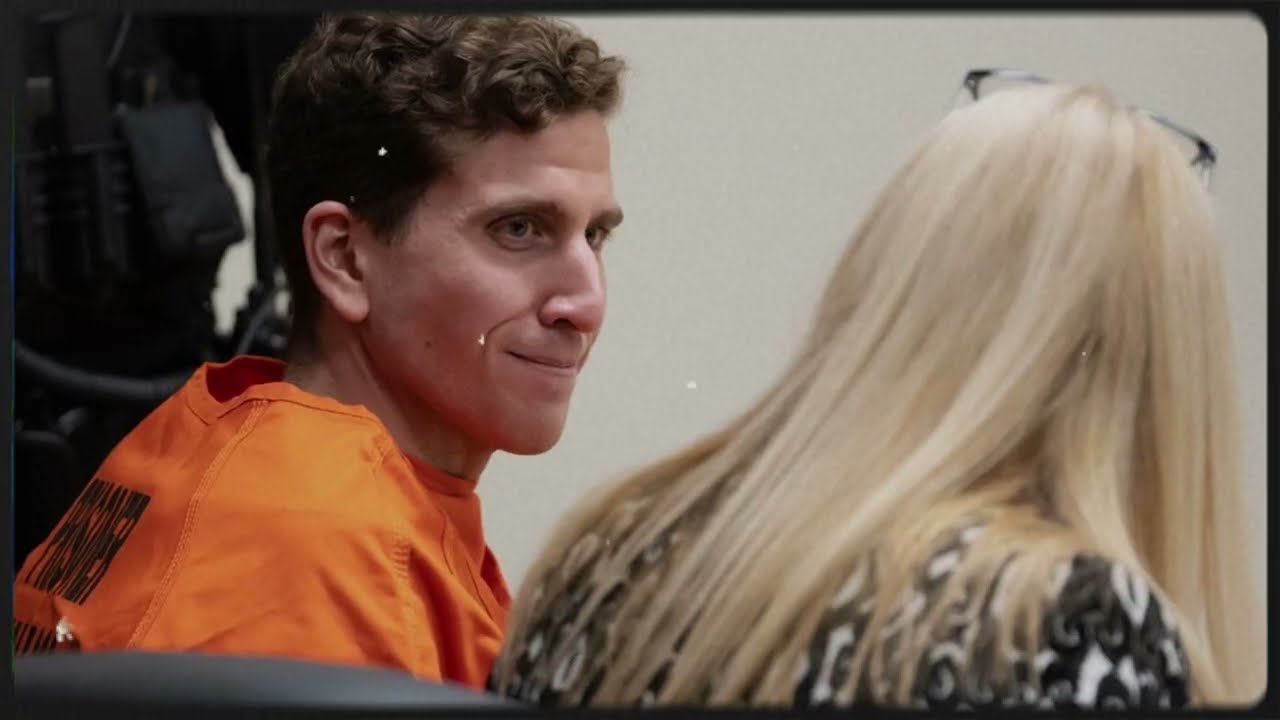
Those who watched him in the courtroom described a man entirely in control of his faculties. He did not slump in his chair. He did not weep.
He sat upright, occasionally glancing toward his mother, and appeared to absorb the proceedings with the detached attention of someone observing a case study rather than living through his own sentencing.
To understand why Kohberger made this choice, one must first understand the man himself. Long before his arrest, Kohberger was known among his peers at Washington State University as a vocal and passionate participant in death penalty debates.
Newly released police documents reveal that he did not merely argue both sides of the issue in criminology seminars — he dominated them.
His central position was chilling in hindsight. Kohberger argued that the families of murder victims should have the final say on whether their loved one’s killer lives or dies.
He insisted that grieving families, not prosecutors or juries, were best positioned to determine the ultimate punishment. That academic position now carries a grotesque irony, given that he stands convicted of slaughtering four college students in their sleep.
The irony cuts even deeper within his own family.
His mother, Marian Kohberger, published an editorial in 2008 passionately opposing capital punishment, calling it state-sanctioned murder and questioning whether any human being possesses the divine power to decide who lives and who dies. The son who supported victim-directed executions and the mother who opposed all executions were both present on July 23, forced to confront the collision of their philosophies in the most brutal way imaginable.
Prosecutors had been preparing to seek the death penalty.
Jury selection was weeks away. The case had already generated extraordinary national attention, with media outlets camped outside the Latah County Courthouse and cameras positioned on every approach. Then Kohberger’s defense team delivered the news that changed everything: their client was willing to plead guilty to all charges in exchange for consecutive life sentences.
Legal experts immediately recognized the tactical brilliance of the move. Kohberger, who spent years studying criminal decision-making and wrote papers on how offenders rationalize choices under pressure, understood something that most defendants never grasp. He understood that a death sentence in America rarely means death.
It means decades of legal limbo, endless appeals, and procedural purgatory while the state decides whether the ultimate punishment will ever actually be carried out.
The statistics are devastating. The average wait time on death row in America exceeds 22 years.
Some inmates have waited 30, even 40 years for executions that never came. During that entire period, the condemned person remains trapped in a state of suspended animation, attending hearing after hearing, watching their face plastered across headlines with every procedural update, and forcing victim families to relive their trauma again and again.
High-profile cases prove the point.
Scott Peterson received a death sentence in 2004 for the murders of his wife and unborn child. In 2020, that sentence was overturned, and Peterson now serves life without parole — the exact sentence Kohberger accepted. Dzhokhar Tsarnaev, the Boston Marathon bomber, received a death sentence in 2015.
He is still alive today, still appealing, still consuming resources and generating headlines a decade later.
Kohberger knew these cases intimately. He knew that gambling on a death sentence meant gambling on decades of uncertainty, continued media exposure, and the very real possibility of eventually ending up with life in prison anyway — but with one crucial difference.
If a jury sentenced him to life after a long and public trial, the decision would be theirs, imposed upon him by the state. By accepting the plea deal, the decision became his alone.
Control, according to investigators who studied his alleged behavior, was the defining feature of the murders themselves.
Authorities say he stalked the victims for weeks, planned entry and exit routes with precision, selected a specific military-style knife, and carried out four killings in approximately thirteen minutes. For a man who operated with such obsessive attention to detail, losing control of his own fate may have been the one outcome he could not accept.
But what awaits Kohberger behind the walls of Idaho State Prison may be far worse than any execution chamber.
Former prison officials who have managed high-profile murderers have issued stark warnings about his future. He will almost certainly spend the next four decades in protective custody or complete isolation, confined to a cell for 23 hours per day with minimal human contact.
In prison, Kohberger is not just another inmate.
He is a trophy. Seth Ferranti, a documentary filmmaker and former federal prisoner, stated it bluntly: the convicts are going to destroy him inside Idaho State Prison. Kohberger, who never even sparred at his boxing gym, who showed up only for shadow boxing and conditioning, is an intellectual who lived entirely inside his head.
He is about to enter a world where violence is not theoretical.
Every shower carries danger. Every meal requires vigilance.
Every interaction with another inmate is a potential confrontation. He is famous in the worst possible way — a man who murdered four beloved college students, whose trial was national news, and whose face is instantly recognizable to every violent offender in the federal system.
Ron McAndrew, a former Florida prison warden who managed death row for years, explained a terrifying reality: some inmates view killing a high-profile prisoner as a status symbol.
The punishment for murdering a famous inmate is another life sentence, which carries no deterrent weight for prisoners already serving life. Kohberger has essentially entered an environment where his notoriety makes him a target rather than a protector.
The psychological toll may be even more devastating.
For someone who pursued a PhD in criminal justice, who dreamed of becoming a professor, publishing research, and commanding respect in academic circles, prison represents an intellectual death sentence. No more seminars. No more debates.
No more feeling superior. Just silence, repetition, and the slow erosion of a mind with nowhere left to expand.
He will watch his parents grow old through bulletproof glass.
Their visits will become less frequent as they age, eventually stopping altogether. He will miss every birthday, every holiday, every milestone for the next four decades. The same beige walls.
The same steel toilet. The same routine. Day after day after day, until his body finally gives out in a place designed to break him.
But even in that bleak future, Kohberger retained one thing that matters more to him than freedom: agency. He dictated his own ending. He denied the state its death penalty verdict.
He shut down the media circus before it reached its peak. And he avoided something he apparently feared more than death itself — the complete and total surrender of control.
Inside the courtroom, the reaction was divided.
Some family members felt cheated. Steve Goncalves, Kaylee’s father, stared directly at Kohberger and delivered a blistering assessment. “You were that careless.
You were that foolish. You were that stupid. You’re a joke.”
His words hung in the air, ignored by a defendant who offered no reaction whatsoever.
But it was Kaylee’s sister, Olivia Goncalves, who delivered the most devastating blow of the afternoon. “No one is scared of you today.
No one is impressed by you. No one thinks you’re important. You act like no one could ever understand your mind.
But the truth is, you’re basic. You’re a textbook case of insecurity disguised as control.”
Those words — basic, insecure, unremarkable — may be the cruelest punishment of all for a man who spent his entire academic career cultivating an image of intellectual superiority.
The families who wanted death felt robbed. They had written in victim impact statements that life in prison means Kohberger would still be able to speak, form relationships, and engage with the world while their loved ones were silenced forever.
Other families saw the outcome differently.
They had watched death penalty cases drag on for decades, witnessed families waiting 30 or 40 years for executions that never came. One family member wrote about waiting 31 years for closure, enduring appeals, legal notices, retrials, and retraumatization again and again. By accepting a deal with no appeals, no retrials, and no more headlines, the case ends today.
Prosecutors emphasized this point in their remarks after sentencing. They took the deal, they said, to spare the families decades of legal torture and to guarantee that Kohberger would never again appear in a courtroom, never again generate publicity, and never again force the victims’ loved ones to relive their trauma in public.
And then came the moment that may have revealed everything about why Kohberger made this choice.
Given the opportunity to address the court, the families, and the world — to explain, to apologize, to offer anything resembling an acknowledgment of the devastation he caused — Kohberger declined. He sat in complete silence.
He made eye contact with family members as they called him a sociopath, a coward, and basic.
He showed no emotion. At one point, witnesses described a slight smile directed toward his mother. He said nothing.
He offered nothing. He gave the grieving families no explanation, no remorse, no human connection whatsoever.
Judge Hippler expressed visible frustration with the silence.
“Even if he explained his actions, it would not be satisfying because there is no reason for these crimes that could approach anything resembling rationality,” he said from the bench. The judge also made clear his hope that Kohberger would never profit from his crimes through media deals or book contracts.
But the silence itself is a statement.
By refusing to speak, Kohberger maintains the mystery that has surrounded this case from the beginning. He preserves his image as an enigma, a riddle too complex to solve, a criminal mind too sophisticated for ordinary people to understand. In a universe where he has lost his freedom, his future, his family, and his reputation, silence is the last power move he has left.
The death penalty question adds another layer of complexity. Idaho law permits execution by firing squad if lethal injection drugs are unavailable. The image of five rifles, a target placed over the heart, and the countdown to impact may have been too visceral, too immediate, too real for a man who had spent his life analyzing crime from a safe intellectual distance.
Forty years in a cell may have felt abstract. Manageable. Easier to rationalize.
Death, by contrast, is permanent in a way that even life without parole cannot match. As long as he is breathing, there is a chance — infinite decimal, nearly impossible, but a chance — that laws change, that Supreme Court rulings shift, that some future legal development opens a door that seems permanently closed today.
With execution, there is no hope.
No future. No possibility of any outcome other than the end. Kohberger, the student of criminal psychology who analyzed how offenders rationalize choices under extreme pressure, applied that same analysis to his own life and concluded that survival offers more options than death.
Even if every option is theoretical, even if none will ever materialize, the possibility itself was worth choosing.
What no one can calculate is whether this decision represents victory or damnation. Kohberger will spend every day for the rest of his life in a cell roughly the size of a parking space.
He will never feel sunshine without shackles. He will never have privacy, never have intimacy, never have freedom. He will live with the knowledge that he destroyed five families — including his own — for no reason at all.
No motive has ever been established. No logic has ever been articulated. Just violence, executed with mechanical precision in the early hours of November 13, 2022, against four young people with their entire lives ahead of them.
Madison Mogen, 21. Kaylee Goncalves, 21. Xana Kernodle, 20.
Ethan Chapin, 20. Their families will carry this pain forever.
Some wanted his death.
Others wanted closure. What all of them received was a man who chose to disappear into the machinery of the Idaho Department of Corrections rather than face the judgment of the people he harmed. He chose control over death, but he will spend every day of that choice knowing what the world sees him for exactly what Olivia Goncalves said he was.
Basic. Insecure. Utterly unremarkable.
A man who spent his entire life trying to prove his intellectual superiority now sits in a cell where no one cares about his degrees, his theories, or his research. He is just another inmate, another number, another convict who will eventually be forgotten by the world outside the walls.
The families of Madison, Kaylee, Xana, and Ethan will never forget.
They will spend the rest of their lives visiting graves instead of college graduations, attending memorials instead of weddings, and wondering what their children would have become if a man they had never met had not decided that night to end their futures.
And Bryan Kohberger will spend the rest of his life alone with the full weight of what he did. No applause.
No recognition. No platform for his ideas. Just four decades of silence, repetition, and the knowledge that no matter how carefully he planned, no matter how precisely he calculated, he could not control the one thing he valued most: how the world remembers him.
He wanted to be brilliant. He wanted to be feared. He wanted to be understood as a mastermind.
Instead, he has become exactly what the sister of one of his victims called him — a textbook case of insecurity disguised as control. And that, perhaps, is the cruelest sentence of all.