John William King, the white supremacist convicted in the horrific 1998 dragging death of James Byrd Jr., was executed by lethal injection in Huntsville, Texas, on April 24, 2019, closing a chapter of one of the most notorious hate crimes in American history.
King, 44, was pronounced dead at 7:08 p. m. inside the Huntsville Unit, the same facility where his accomplice Lawrence Russell Brewer was put to death eight years earlier.
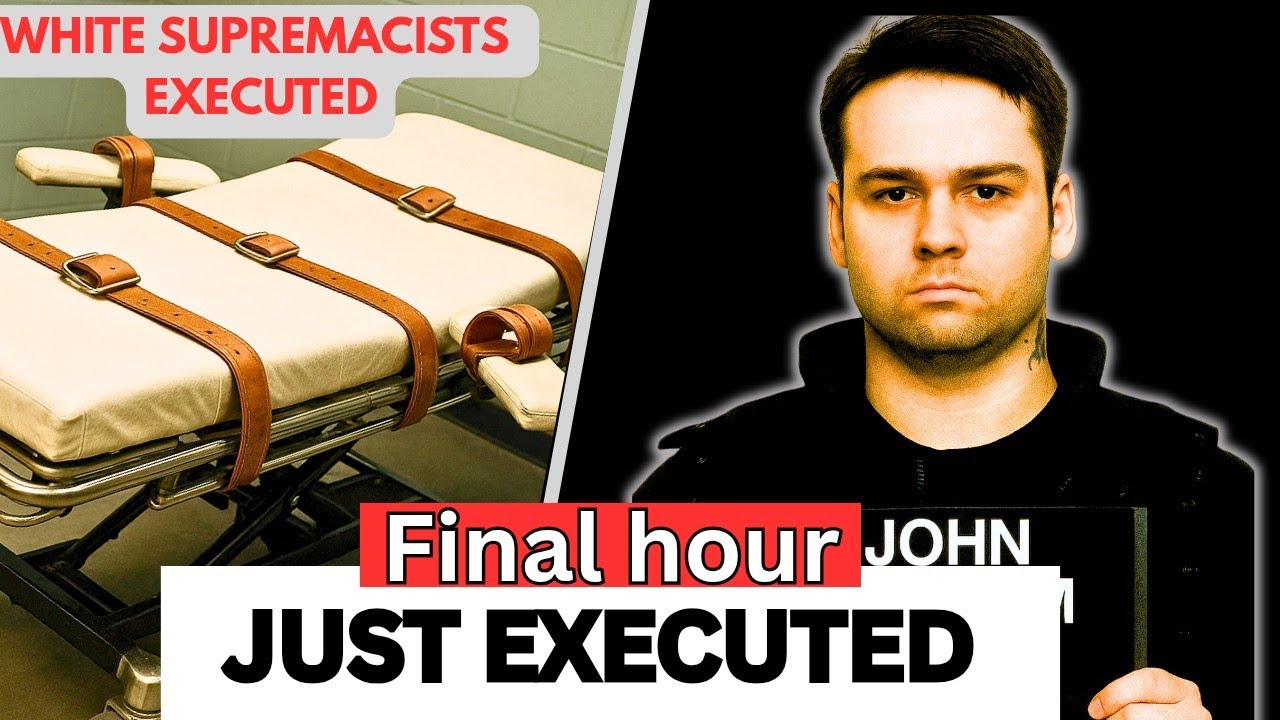 He refused to make a final statement, offering no apology or expression of remorse.
The execution came after more than two decades of appeals, during which King maintained his innocence despite overwhelming evidence linking him to the racially motivated murder. His final hours were marked by cold silence and a standard prison meal.
King was moved from death row at the Polunsky Unit in Livingston to the Huntsville Unit early on the morning of April 24. He spent his last day under suicide watch, monitored every 15 minutes by guards. No family visited.
Because of the controversy surrounding Brewer’s last meal, Texas had abolished the tradition of allowing condemned inmates to choose their final feast. King received the standard prison offering: meatloaf, mashed potatoes, green beans, and a roll.
When asked if he had any final words, King declined. No confession, no apology, no rage. He simply closed his eyes as the lethal dose of pentobarbital began to flow.
Witnesses said his chest stopped moving within minutes.
Outside the prison, a crowd of protesters and supporters of James Byrd Jr.’s family gathered, waiting for the announcement. The victim’s sister, Clara Taylor, watched through the glass and whispered a prayer as King took his last breath.
The execution of John William King marks the second time the state of Texas has put to death one of the men responsible for the June 7, 1998, murder. Brewer was executed on September 21, 2011, after an infamous final meal request that sparked a nationwide debate.
Brewer ordered a massive feast: two chicken fried steaks, a triple bacon cheeseburger, a pound of barbecue, fried okra, a meat lover’s pizza, half a loaf of white bread, three root beers, peanut butter fudge with crushed peanuts, and a pint of vanilla ice cream.
But when the food arrived, Brewer refused to eat any of it. The stunt angered Texas lawmakers, and within days the state abolished the last meal tradition for all death row inmates. Brewer’s last words were equally chilling.
“As far as regrets, I have none,” Brewer told a reporter days before his execution. “I do it all over again.” When he entered the death chamber, he offered no final statement.
He was pronounced dead at 6:21 p. m. on September 21, 2011.
Now King has followed the same path. The execution was carried out at the same Huntsville Unit, where the walls have witnessed more than 500 executions in Texas history. King’s refusal to speak mirrored Brewer’s defiance.
To understand the full weight of these executions, we must go back to the summer of 1998 in the small East Texas town of Jasper. That’s where James Byrd Jr., a 49-year-old black man, was walking home after a family gathering on Father’s Day weekend.
Byrd was less than a mile from his parents’ house when a pickup truck pulled up beside him. Inside were three white men: John William King, Lawrence Russell Brewer, and Shaun Allen Barry. They offered him a ride.
He accepted.
Instead of taking him home, they drove him to a remote logging road deep in the woods. There they beat him, spray-painted his face, and urinated on him. Then they chained his ankles to the back of the truck and began to drive.
For three miles, James Byrd Jr. was dragged down an asphalt road. His body was torn apart, skin and flesh shredded against the pavement.
Forensic evidence showed he was alive for most of the dragging until his body struck a concrete culvert, decapitating him instantly.
 The killers then drove to a black church and dumped the remaining body parts in front of it. They went home and had a barbecue. The dismembered remains were discovered early the next morning by a motorist who called police.
Law enforcement arrived to a scene of unimaginable brutality. A trail of blood, bone, and flesh stretched nearly the length of 48 football fields. The Texas Rangers and FBI joined the investigation immediately.
Evidence was everywhere.
Investigators found a broken chain, a wrench engraved with the name Barry, and cigarette butts. Blood samples, hair, and paint from the truck clung to the road. In a nearby neighborhood, a tip led police to a 1982 Ford pickup owned by Shaun Barry.
Under pressure, Barry cracked. He implicated King and Brewer. Within 48 hours, all three were arrested and charged with capital murder.
The town of Jasper was stunned by the realization that racist violence had not died in the past—it was alive and festering.
James Byrd Jr. was a father, grandfather, and the third of eight siblings. He had grown up in the Jim Crow South, attending segregated schools.
He had a passion for music and played piano at church. He battled alcoholism but was sober and rebuilding his life.
John William King was 23 years old. He had been arrested for burglary at age 19 and sent to prison, where he joined a violent white supremacist gang. He covered his body with racist tattoos, including an image of a black man hanging from a tree on his chest.
Lawrence Brewer was 31, with a long criminal record. He also joined white supremacist gangs in prison, where he met King. The two bonded over shared hatred and a desire to start a race war.
Barry, the youngest, did not have the same ideology but drove the truck.
The trials were split into three parts. King was tried first in February 1999, moved to Bryan, Texas, for a fair jury. He arrived in court with no remorse, his tattoos visible.
The prosecution presented letters and manifestos filled with hatred.
In one letter, King wrote, “Regardless of the outcome of this, we have made history. Death before dishonor.” The evidence was overwhelming: blood stains, the chain, paint chips.
A forensic pathologist testified that Byrd was alive for nearly two miles of the dragging.
The jury took just two hours to convict King of capital murder. He was sentenced to death. Brewer’s trial followed in September 1999, moved to Brazos County.
Barry testified that Brewer wrapped the chain around Byrd’s ankles. Brewer was also found guilty and sentenced to death.
Barry, who cooperated with investigators, was convicted of murder in November 1999 and sentenced to life in prison with the possibility of parole in 2038. He is currently serving that sentence at the Ramsey Unit in Rosharon, Texas.
 The Byrd family attended every hearing. They did not seek revenge, they said, but justice. His sister Clara Taylor told the press, “We want the world to remember James.
Not just how he died, but how he lived.”
James Byrd Jr.’ s legacy lives on through the Matthew Shepard and James Byrd Jr. Hate Crimes Prevention Act, signed into federal law in 2009.
It expanded the definition of hate crimes to include those motivated by race, color, religion, national origin, gender, sexual orientation, gender identity, or disability.
The executions of Brewer and King have been seen as a measure of justice for a crime that shocked the nation. But for the Byrd family, the scars never fully healed. Clara Taylor whispered a prayer as King took his final breath, hoping for peace.
Shaun Barry remains the only one of the three still alive. He will be eligible for parole in 2038, but the parole board will consider the nature of his crime. Many believe he will never be released.
The execution of John William King on April 24, 2019, was carried out without incident. The lethal injection protocol used a single dose of pentobarbital. King was declared dead at 7:08 p.
m. The media reported the news live from outside the Huntsville Unit.
Inside the witness room, members of the Byrd family watched through the glass. They had waited 21 years for this moment. Some expressed relief, others sorrow.
The cycle of violence had ended for two of the men who took James Byrd Jr.’ s life.
But the broader questions remain. How did such hate fester in a small Texas town? What drives a man to chain another human being to a truck and drag him to death?
The executions provide no easy answers.
The state of Texas has carried out more executions than any other state since the death penalty was reinstated in 1976. The Byrd case remains one of its most infamous. The last meal controversy sparked by Brewer led to legislative change.
Today, Texas death row inmates receive the standard prison meal before execution. No special requests are allowed. The tradition was eliminated in 2011, a direct result of Brewer’s stunt.
John William King’s execution was the ninth in Texas in 2019. He was the 562nd inmate executed in the state since 1982. His death marked the end of a long legal battle that included appeals to the U.
S. Supreme Court.
King’s final appeal centered on claims that his original trial attorney failed to present evidence that he was not present during the dragging. The courts rejected those arguments, citing the overwhelming evidence of his involvement.
The victim’s family has expressed mixed feelings about the death penalty. Ross Byrd, James’s son, publicly stated that he forgave Brewer and did not support capital punishment. He said, “An eye for an eye leaves the whole world blind.”
 But the state of Texas moved forward with the executions, upholding the sentence handed down by juries in 1999. The legal process took 20 years for King, a reflection of the lengthy appeals process.
As the sun set over Huntsville on April 24, 2019, the execution chamber fell silent. John William King, covered in racist tattoos, died without a word. His final act was the same as his crime: cold and devoid of humanity.
The legacy of James Byrd Jr. continues to inspire legislation and awareness about hate crimes. Every year, communities gather to remember him and to stand against racism.
His name became a symbol of a nation’s shame and its hope for change.
The breaking news of John William King’s execution is a stark reminder of the brutality that racist hatred can produce. It also underscores the long, often painful journey toward justice in the American legal system.
For the people of Jasper, Texas, the memory of that summer night in 1998 will never fade. The trial, the appeals, and the executions have brought a measure of closure, but the wound remains.
As Clara Taylor said after watching King die, “We prayed for him. We prayed for his soul. But we also prayed for James.
Justice has been done.”
The execution of John William King is now history. Two of the three killers have paid with their lives. One remains behind bars.
The story of James Byrd Jr. is a cautionary tale about the depths of human cruelty and the resilience of a family demanding accountability.
This breaking news article covers the execution of John William King and the surrounding events. The details are drawn from court records, official statements, and firsthand accounts. The hate crime that changed America is remembered not just for its horror, but for the laws it inspired.
Matthew Shepard and James Byrd Jr. share a place in the annals of hate crime history. Their names are forever linked to the fight for equality and justice.
The executions of their killers do not erase the pain, but they mark the end of a legal chapter.
The state of Texas has closed the book on John William King. The lethal injection chamber has seen its last moments of this case. But the story of racial violence and the fight against it continues across the nation.
As we report this breaking news, we honor the memory of James Byrd Jr. , a man who simply wanted to walk home on a summer night. His death sparked outrage and change.
His life, though cut short, left an indelible mark.
The execution of John William King is a reminder that justice, however slow, can be achieved. And that the ghost of racism, though persistent, can be confronted in the courtroom and in the heart.
This concludes the breaking news coverage of the execution. We will continue to follow any updates regarding Shaun Barry’s parole status and any further developments in hate crime legislation. Stay informed.