PART I — The Card That Was Supposed to Pay for Betrayal
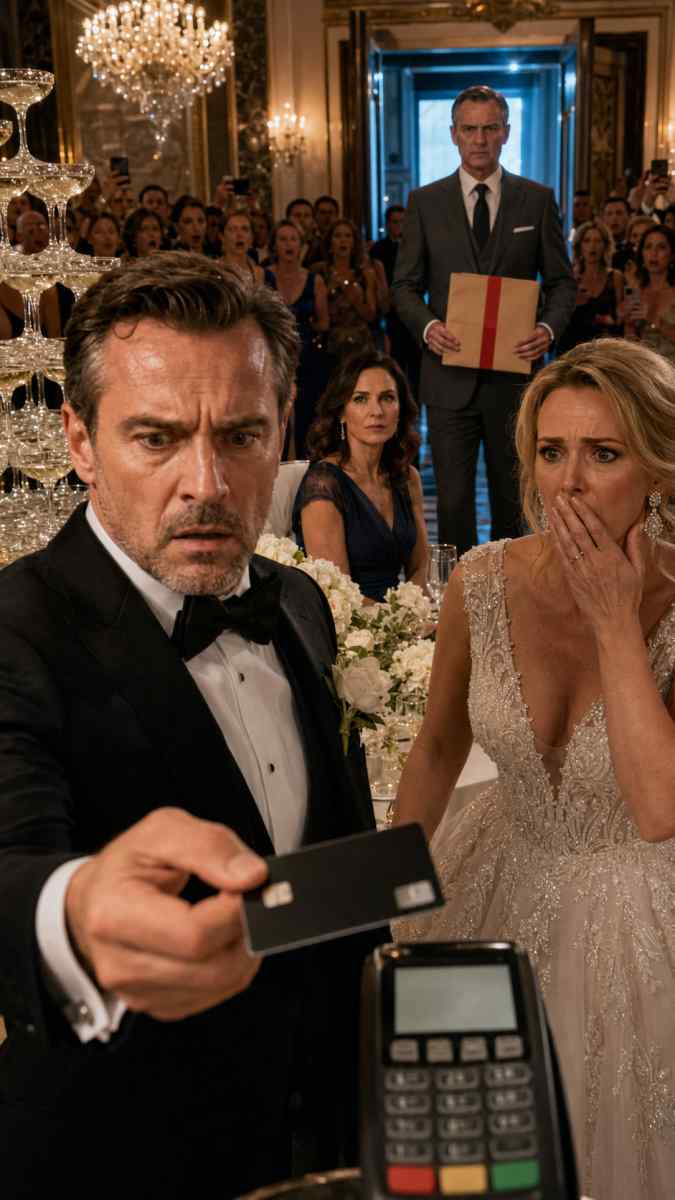
“Mr. Zieliński, the card has been declined. The account isn’t frozen. It no longer exists.”
The hotel manager spoke calmly, but in the crystal ballroom, his words sounded like a gunshot. The orchestra fell silent. Three hundred and twenty guests turned toward the groom, who stood beneath a seven-tier wedding cake with a black card trembling in his hand. Beside him, his new wife—wearing a gown that cost what an average Polish family earned in a year—stared at the payment terminal as if it had just sentenced her.
And I sat at the last table in a simple navy dress and, for the first time in eight years, did nothing to save my ex-husband.
If anyone has ever mistaken your kindness for a lifelong obligation, stay with me. Because that night wasn’t only about an unpaid bill. It was about a man who had spent my money for years, used my name, and slept with the woman I had considered my best friend. And when I finally stopped protecting him, far more than his wedding came crashing down.
My name is Marta Lewandowska. I was forty-six when I arrived at the Bellaria Hotel on the banks of the Vistula in Warsaw to watch my ex-husband marry Karolina Bielecka. Until recently, Karolina had been my closest friend. We met at university, shared a cramped dorm room, borrowed each other’s dresses, and promised we would remain family even if life scattered us across different cities.
When her mother became ill, I found a specialist and paid for private medical tests. When Karolina lost her job, she lived in my apartment for four months. Then she entered my marriage with the same ease with which she had once entered my kitchen.
Tomasz later claimed their affair began only after we separated. That was a lie. For nine months, they met in hotels, in his office, and at least once in our home. Our divorce had been finalized only twelve weeks before their wedding. Even so, they sent me an invitation printed on thick cream paper in gold lettering: “True love always finds its way.”
At the time, Tomasz owned a company that designed luxury interiors for hotels and office buildings. When we met, he had talent, debt, and an unshakable belief that the world would soon discover his genius. I ran a small strategy agency that eventually began working with major brands.
During the first years of our marriage, I financed his office, guaranteed his business loan, and introduced him to clients who trusted my name. I also made him an authorized user on my premium credit card. At first, he asked before every large purchase. Later, he merely informed me. Eventually, he stopped doing even that.
Whenever I tried to discuss money, he accused me of controlling him and stripping away his dignity. I did not yet understand that, to Tomasz, respect meant being free to do whatever he wanted without facing consequences. I confused love with rescue for so long that I stopped being his wife and became his private emergency system.
The wedding invitation arrived three weeks before the ceremony. That same morning, I received an automated email from the Bellaria. Tomasz must have used an old reservation profile I had created during a corporate conference. The message said that after the cake was cut, the card ending in 4081 would be charged the remaining balance: 387,000 złoty.
The hotel had already received deposits covering the ceremony, dinner, and basic reception. The final payment would cover imported flowers, additional suites, an open premium bar, a concert by a popular singer, a late-night seafood buffet, and brunch for eighty guests.
I recognized the number immediately. It was my card—the one Tomasz had agreed to destroy under the divorce settlement.
I called the bank. The representative confirmed that I had closed the entire account three days after the divorce. Every linked card was invalid. Apparently, Tomasz did not know. Or perhaps he knew and assumed that when the bill came due, I would panic at the thought of a scandal and pay, as I always had.
My attorney, Anna Rogowska, told me not to contact Tomasz or the hotel. I was not a party to the wedding contract. I had not supplied the card, approved the transaction, or promised to cover the debt.
“The hotel already has the money for the food and staff,” she said. “The guests won’t be thrown out halfway through dinner. But the couple may lose the extras they haven’t paid for. Marta, don’t try to prevent a disaster Tomasz planned for himself.”
That last sentence stayed with me. For eight years, I had prevented his disasters. When he was late paying salaries, I transferred the money. When he insulted an investor, I repaired the relationship. When he lost an important client, I assured him the next opportunity would be better.
I never noticed the moment when my support stopped helping him and began removing every obstacle between him and his next lie.
The real reason I attended the wedding was not revenge. I wanted to see what would happen if, for once, I stayed in my own seat.
Tomasz and Karolina invited me because they counted on my silence. They seated me in the back—close enough to watch their happiness, far enough away to remain outside the family photographs. A video played on a large screen about their “love arriving at the right time.” Guests sighed as Karolina described Tomasz as a lonely man trapped in a cold marriage.
My name was never mentioned.
I sat motionless, remembering all the evenings I waited with dinner while he texted that he was working late. I remembered Karolina embracing me after I discovered the affair and saying that not every man deserved a second chance.
She had been right. I simply had not known she was talking about herself.
At 9:32 p.m., the manager approached Tomasz. They tried the card twice. Both times, the terminal made the same sound. When the manager announced that the account had been closed, Tomasz scanned the ballroom and found me instantly.
He pushed between the tables, threw the card down in front of me, and hissed, “What did you do?”
“I divorced you,” I replied. “And three days later, I closed my own account.”
A murmur swept through the room. Karolina ran toward us in her wedding gown, gripping the train in both hands.
“You knew we planned to pay with that card!” she shouted.
“No,” I said. “I knew you planned to pay with my card. There is a fundamental difference.”
Tomasz leaned toward me, and I recognized the command in his eyes. I was supposed to stand, apologize, take out my phone, and save him from public humiliation.
Before he could speak, the ballroom doors opened again. A man in a gray suit entered, and Tomasz recognized him immediately. He was the chief financial officer of Tomasz’s largest client. Under one arm, he carried a sealed folder marked in red:
URGENT — PRESERVATION OF EVIDENCE
PART II — The Bill Was Only the Beginning
The man’s name was Marek Wysocki, and he oversaw finances for Nordica Hotels, the largest client Tomasz’s company had. He walked toward us without haste, though his face was tense.
He handed Tomasz an envelope and informed him that Nordica had launched an audit of every invoice issued during the previous eighteen months. All new orders and payments had been suspended pending the investigation.
Tomasz tore open the envelope, scanned the first page, and looked at me.
“You did this.”
His father, who only moments earlier had toasted his son’s “extraordinary success,” slowly lowered his glass.
Marek explained that the notice resulted from documents supplied by my law firm. Everyone turned toward me as if closing the card had been merely the first act of an elaborate revenge scheme.
They did not know that the documents had nothing to do with the affair. They concerned a crime that could destroy my company as well.
Several months before the divorce, Tomasz had secured a contract to renovate twelve Nordica properties. He presented the proposal as a joint venture between our businesses. My agency would handle branding, communications, and customer experience; his company would handle construction.
I never signed that agreement.
Tomasz told me that the client had selected only the construction portion and that my role was no longer necessary. It was not until the divorce that Anna found a document in the backup of our shared tablet bearing a signature almost identical to mine. According to it, my company guaranteed the project’s quality and agreed to cover part of the costs if delays occurred.
The signature was forged.
The attachments were worse. The estimates carried my agency’s logo but included charges we had never approved. Tomasz was using my name as collateral while directing inflated payments to a consulting company owned by Karolina.
Anna advised me to notify Nordica immediately and preserve the evidence. I did not want to do it during the week of the wedding. I still had the reflex to spare Tomasz the worst possible timing.
Then Anna showed me a message recovered from the tablet.
Tomasz had written to Karolina: “Once the final Nordica payment clears, we won’t need Marta anymore. Her signature closes the matter, and if she protests, everyone will think she’s taking revenge on us.”
So he had not merely betrayed me. He planned to use my pain as a shield. Every accusation I made would look like a desperate attack by an abandoned wife.
That was when I authorized Anna to turn over the evidence.
Nordica began its internal investigation on the wedding day because, at 4:12 p.m., auditors found three invoices totaling more than two million złoty for work no one could identify.
The hotel manager reminded the couple that they needed a valid payment method by 10:00 p.m. Otherwise, the premium bar would close, the concert would be canceled, the unpaid suites would return to inventory, and the reception would end at the time specified in the basic agreement.
Tomasz approached his father.
“Dad, give me your card. I’ll repay you tomorrow.”
The older man did not reach into his pocket.
“With what? Money from the contract that was just frozen?”
Tomasz insisted it was all a misunderstanding. Karolina appealed to her parents, but they had already paid for her dress and the honeymoon deposit. Her father asked why they had organized a wedding costing nearly a million złoty without having the money to cover it.
Karolina turned to her husband. “You said everything was paid.”
“I said it was handled,” he snapped. “That isn’t the same thing.”
Tomasz called his company’s managing director and put him on speaker. He demanded that 387,000 złoty be transferred from the operating account. A long silence followed.
“I can’t authorize that,” the director said. “Nordica ordered us to secure the records, the bank has restricted withdrawals, and payroll is due Monday. Besides, this is a private wedding. I will not book it as a corporate event.”
Tomasz clenched his fist. “I own that company.”
“You were also the only person who signed the disputed invoices,” the director replied. “The board has just suspended your authority to make independent transfers.”
The call ended.
One of Tomasz’s business partners stood, removed the company pin from his lapel, and walked out without a word. Only then did the guests begin to understand that they were witnessing not a minor financial embarrassment, but the public collapse of a carefully manufactured image.
Karolina stood before me with tears in her eyes.
“You ruined my wedding.”
“No,” I said. “I simply stopped financing it.”
I reminded her of the night she slept on my sofa after breaking up with her fiancé. I reminded her of the money I lent for her mother’s surgery, the holidays we spent together, and the calls I answered at every hour.
“You were like a sister to me,” I said. “Then you climbed into my bed.”
Karolina immediately found an excuse. Tomasz had been lonely because I worked too much. He had felt unnecessary beside me. Their love had simply happened.
“A nine-month affair does not simply happen,” I replied. “You have to make time for it. You need a hotel, lies, and nine months of decisions. You didn’t love him because I neglected him. You wanted my life, and he wanted a woman who would admire him and never check the bills.”
Tomasz changed tactics. His aggression softened into something almost tender.
“Marta, we were married for eight years. You can’t stand there and let them throw me out of my own wedding. That amount is nothing to you.”
I admitted that I could afford to pay it. Relief spread across his face.
“But the fact that I can doesn’t mean I should,” I continued. “For eight years, I paid your bills, repaired your relationships, and explained your mistakes. After your affair, I gave you a quiet divorce. I told neither your parents, your investors, nor the media. You received more dignity than you ever gave me. Today, for the first time, you will pay for your own choices.”
I picked up my coat. Karolina blocked my path and asked what they were supposed to do now.
I pointed to her new husband.
“An hour ago, he promised to care for you for the rest of his life. This is the perfect moment for him to begin.”
I had almost reached the exit when my phone vibrated. Anna had sent a message:
Do not leave alone. We found something else. The forged signature is the smallest problem.
I turned around. Tomasz stood in the center of the rapidly emptying ballroom, staring directly at me. He held Karolina’s phone. On its screen was part of a photograph taken years earlier in my office.
It showed a blank sheet bearing my signature—something I kept for emergency document approvals when I traveled. Karolina must have photographed it when she was living with me after losing her job.
Tomasz noticed me looking and slowly smiled. It was not the smile of a defeated man.
“If you bury me,” he said loudly, “everyone will see that you signed those documents with me.”
That was when I understood: I had not been invited merely to witness their victory. They needed me in that ballroom as the final piece of a trap.
PART III — The Woman They Planned to Blame
Anna entered the ballroom with two security guards and Marek Wysocki. She told me not to touch anything.
The photograph of my signature did not prove my consent, but Tomasz could try to persuade the auditors that we had created the overbilling scheme together and that, after the divorce, I began portraying him as a fraud.
Karolina had access to my apartment and office for years. She knew the password to my home network, accepted deliveries, and once helped Tomasz “organize tax records” while I was away. That was probably when she photographed the signature.
But Anna had found something they did not anticipate: the original image still contained metadata. It had been taken on Karolina’s phone two years before the Nordica agreement was signed. Minutes later, she sent it to Tomasz with the message:
Keep this. It may be useful one day.
It was not an impulsive mistake. It was the beginning of a plan.
Tomasz tried to snatch the phone from Karolina, but security stepped between them. Guests recorded the scene. The manager announced the reception was over, yet few people wanted to leave. The same guests who had photographed the cake and flowers were now whispering about forged invoices.
Tomasz’s parents stood against the wall. His mother looked at her son as if, for the first time, she could see the man hiding beneath the elegant suit.
Karolina screamed that the photograph proved nothing. Anna calmly said that the police and forensic experts would secure the devices. Karolina hid the phone behind her back and insisted that it was private property.
“That device likely contains evidence of fraud,” Anna explained. “If you delete even one file, there will be consequences.”
Karolina looked to Tomasz for rescue. He turned away.
Only an hour earlier, they had looked like a couple from a luxury advertisement. Now each was calculating how much blame could be shifted onto the other.
The arrival of the police ended the public performance. No one was placed in handcuffs, but officers secured the phones and copies of the documents.
Anna drove me to my mother’s apartment. It was only in her kitchen, over a bowl of hot chicken soup, that I cried for the first time.
I did not cry for Tomasz or for the marriage I had lost. I mourned the woman I had been for eight years—patient, loyal, and convinced that if she solved other people’s problems well enough, someone would eventually call it love.
My mother did not say she had warned me. She merely rested her hand over mine.
“You didn’t lose,” she whispered. “You finally stopped fighting for a man who treated your love like a line of credit.”
At that moment, I wanted to believe the worst was over.
The following morning, I discovered how wrong I was.
Videos from the wedding spread online. The first showed the manager announcing that the account no longer existed. The second ended after Tomasz said, “That amount is nothing to you,” but omitted my response.
Within hours, strangers had decided I was a bitter millionaire who deliberately humiliated her ex-husband. Tomasz gave a short interview outside his office, claiming the card was supposed to remain active until the completion of a shared project and that I had broken a private agreement to punish him for his new relationship.
Karolina posted a photograph of her smeared makeup and wrote about “financial abuse.”
Neither mentioned the audit nor my forged signature. Once again, they used my silence to tell my story for me.
Clients began calling my agency. One suspended a campaign until the matter was resolved. My employees found a reporter waiting outside the office.
For several hours, I considered publishing every message, photograph, and piece of evidence proving the affair. I could have destroyed Tomasz’s reputation with one click.
Anna stopped me.
“If you publish private material now, they’ll say revenge was your motive all along. The truth needs documents, not fury.”
Nordica hired outside auditors. They traced payments to Karolina’s company and discovered that, over one year, it had received nearly three million złoty for “image consulting.” The company had no employees, office, or records of completed work.
Some of the money returned to Tomasz as “private loans.” The rest financed the wedding, an apartment, and the planned honeymoon in the Maldives.
The most damaging evidence came from a man I had never met. Piotr Kaczmarek, the chief accountant at Tomasz’s company, arrived at Anna’s office carrying a portable drive.
For two years, he had copied invoices, messages, and payment orders because he feared he would one day be made the scapegoat. He showed us a recording in which Tomasz instructed him to charge wedding expenses to the Nordica project.
When Piotr refused, Tomasz said, “Marta guaranteed the contract anyway. If anything comes out, we’ll say her agency designed the financial strategy.”
Then Karolina’s voice could be heard: “People will believe Tomasz. Marta always looks as though she’s judging the entire world.”
My silence, discipline, and reserve were supposed to become evidence against me. Every quality that had made it easy for them to exploit me would later be presented as the character of a fraudster.
Prosecutors opened an investigation, but Tomasz made a move that surprised even Anna: he formally accused me of running the entire scheme.
He produced copies of emails supposedly sent from my business account approving the inflated invoices. They looked authentic. They contained my signature, the correct footer, and expressions I genuinely used at work.
A forensic expert determined that they had been sent at night from the IP address of our former home while I was abroad. Tomasz knew my password, but the login required an additional code. That code was sent to an old tablet I had left in the study.
Home security footage could prove who had used it.
The problem was that the camera archive had been deleted the day after I filed for divorce.
I returned to the house, now owned by Tomasz, with police officers and an IT specialist. In a storage room, we found the old recording device. Its drive appeared to have been wiped, but the specialist recovered several damaged frames.
One showed Karolina entering my study at 2:13 a.m. Another showed her sitting in front of the tablet. A third showed Tomasz standing behind her.
There was no audio, and the timestamps were partly corrupted. It might not be enough.
Then the specialist noticed that the system had once synchronized with a forgotten driveway camera. Its recordings were not stored on the home device but in a cloud account belonging to my late mother-in-law. Tomasz did not know about the connection.
We opened the archive.
It contained footage from the same night and audio from a conversation carried through the study’s open window.
Karolina’s voice was clear: “What if Marta discovers the messages?”
Tomasz replied, “Then she’ll lose her company before she can prove it was us.”
The specialist advanced the recording several seconds. A third person entered the frame.
When I saw his face, I could not breathe.
It was Paweł—my business partner and friend of twenty years, the only person besides me with full access to my agency’s finances.
PART IV — The Most Valuable Thing I Took from Them
Paweł had not merely known about the plan. He had helped build it.
He created the fraudulent messages using hundreds of my genuine emails. He gave Tomasz contract templates and my travel schedule so they could access my accounts while I was abroad.
His motive was painfully simple. For years, Paweł believed he deserved half the agency even though he owned thirty percent and had never invested as much as I had. Tomasz promised him control of my clients after the scandal. In exchange, Paweł would testify that I had personally approved the Nordica documents.
Their plan was to destroy me on three fronts: financially, professionally, and emotionally.
The affair would make every accusation sound like jealousy. The forged emails would make me a suspect. The public scene at the wedding would provide footage of a “vengeful ex-wife.”
That was why they invited me.
They expected me to scream, throw a glass, attack Karolina, or pay the bill and appear to confirm my connection to their finances.
Instead, I did the one thing they could not use against me.
I calmly said no.
Paweł was arrested while trying to leave for the Czech Republic. On his laptop, investigators found copies of the forged emails and a spreadsheet titled “Scenario M.” It listed my predicted reactions: pay the bill, threaten Tomasz, publicly reveal the affair, or leave the hotel visibly devastated.
Beside each possibility was a media strategy.
They had failed to predict that Anna would tell me to remain calm, that Marek would arrive with an official notice during the reception, that the chief accountant had kept copies, or that the cloud recording still existed.
Prosecutors connected the evidence. In exchange for a reduced sentence, Paweł admitted his role in the fraud. His testimony confirmed that Tomasz had designed the scheme and Karolina had managed the flow of money through her company.
Karolina was the first to blame her husband. She claimed she believed the transfers were legitimate payments and knew nothing about the forged documents. Tomasz answered that she had stolen the sample of my signature and persuaded him to use my account.
Their marriage lasted forty-nine days.
Karolina filed for divorce after the bank seized the luxury apartment purchased with money from the fictitious services. The honeymoon was canceled, and the hotel sued them for the unpaid balance.
Nordica terminated the contract and demanded repayment of more than five million złoty. Tomasz’s company collapsed before the end of the year. Under a criminal settlement, he agreed to repay the losses and sell the house and all his shares. He received a prison sentence, part of it suspended because he cooperated. Karolina was also convicted, though she received a lighter sentence. Paweł lost his stake in my agency and was barred from serving as a corporate officer for several years.
People later asked whether I felt satisfied.
The answer was not simple.
I was grateful that my name had been cleared, that my employees kept their jobs, and that money was returned to Nordica. But I did not enjoy watching the man with whom I had spent eight years sit in the defendant’s chair.
I remembered the young Tomasz repairing the leaking roof of our first office, bringing me coffee at midnight, and holding my hand beside my dying father’s bed.
A person may once show you kindness and later cause terrible harm. One truth does not erase the other. That is what makes betrayal so painful. We do not mourn only the person someone became. We also mourn who we once were beside them and the future we both promised existed.
My company survived. Nordica officially confirmed that I had no involvement in the fraud, and a year later, it hired us for a new project.
The first time I entered its conference room without Tomasz and Paweł, I did not feel triumph.
I felt peace.
It was worth far more.
I began therapy. I learned to turn off my phone on Saturdays and not answer every crisis immediately. I took a pottery class and spent three months making remarkably ugly bowls. I traveled to the Baltic coast with my mother and let her plan the entire trip.
Slowly, I learned that rest is not a reward for exhaustion and love does not require you to prove your usefulness every day.
My therapist asked the hardest question:
“Why did you remain with Tomasz so long if you had already recognized his selfishness?”
“Because leaving would have meant admitting I chose badly,” I replied.
“And staying?”
“Staying allowed me to believe I could turn a bad decision into a good life.”
One year after the trial, I received a letter from Tomasz. He did not ask for money or a meeting. He wrote that throughout our marriage, he had treated my success as something owed to him because he was my husband. He considered every act of help not a gift, but proof that my work had no meaning without him.
When he fell in love with Karolina, he wanted neither to lose her admiration nor surrender the security I provided.
“I thought you would always be the reasonable one,” he wrote. “Now I understand that, to me, ‘reasonable’ meant someone willing to face the consequences in my place.”
I read the letter once and put it in a drawer.
Forgiveness is not a return ticket. You can stop hating someone and still refuse to open the door.
Several months later, I met Karolina by chance at a medical clinic. She looked different without meticulous makeup and clothes selected for photographs.
She approached me and said she was sorry.
For a moment, I wanted to ask what exactly she regretted—the affair, the theft, the lies, or merely being caught. Instead, I listened.
She admitted that she had envied my stability since we were young. Not my money, as I had assumed, but my ability to build relationships and a career without constantly begging for attention.
When Tomasz complained about me, she felt chosen over the woman against whom she had always measured herself.
“I wanted your life,” she said. “And when I got it, I discovered it wasn’t yours. It had been built on you.”
I did not answer.
Not every honest reflection deserves reconciliation, but sometimes it can end a war we no longer wish to carry inside us.
Even now, I sometimes remember the ballroom, the silent payment terminal, and the black card lying on the white tablecloth.
Closing the account took seven minutes. Understanding why I had allowed Tomasz access to my life for so long took several years.
My freedom did not begin on the day of the divorce or when the court cleared my name. It began when a man accustomed to my money, connections, and forgiveness reached out his hand once more—and I no longer felt obligated to fill it.
If this story reminded you of someone who has spent a lifetime paying for other people’s choices, share it and stay with us for more stories about betrayal, courage, and the moment truth finally finds its voice.
Tomasz believed the greatest pain would be losing his company, his home, and his reputation.
He was wrong.
The most valuable thing I took from him was not money.
It was access to the woman who had always saved him.
That woman no longer existed.
And for the first time in my life, I had no intention of apologizing for her absence.