Part One — The Man She Thought Had Nothing
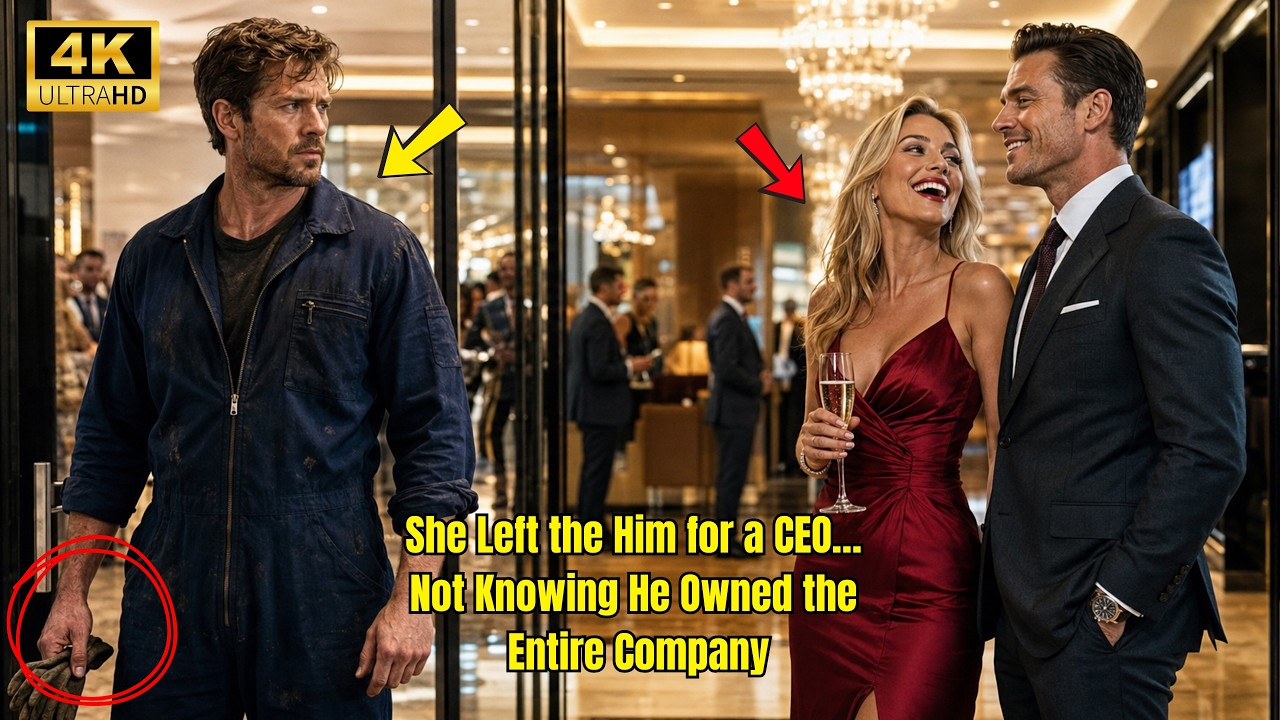
The night Lauren Hayes left Daniel Rowan, she placed her engagement ring on a grease-stained workbench and told him she could no longer build a future around a man who repaired other people’s broken cars. Ten-year-old Noah heard every word from the office upstairs—but neither Lauren nor the powerful CEO waiting outside knew the truth: Daniel did not merely work near the company that had made Adrian Voss famous. He owned the invention holding it together. And before that night was over, someone would try to erase his name from it forever.
If you believe quiet people are often carrying stories the world never bothered to ask about, stay with us. Because this story begins with what looked like an ordinary betrayal—but the deepest wound was not Lauren choosing another man. It was discovering why that man had chosen her.
Daniel’s garage stood between an abandoned furniture warehouse and a family bakery on the outskirts of Pittsburgh. The redbrick building was old enough to have survived three recessions, two floods and a fire that had blackened one wall but never reached the work bays. On winter mornings, the heater rattled like loose bolts in a coffee can. In summer, sunlight sliced through dusty windows and turned the air golden above the engines. To customers, Rowan Auto Works was a reliable neighborhood garage. To Daniel, it was the last place in the world that still felt honest.
Every weekday, Noah sat at the desk in the upstairs office until his school bus arrived. He did homework beside invoices, drew spaceships on discarded diagnostic printouts and knew the names of every mechanic by the sound of their footsteps on the metal stairs. His mother, Rachel, had died from an aneurysm when he was four. Daniel had raised him alone until Lauren entered their lives three years later, first as a customer whose aging sedan refused to start, then as the woman who began leaving a toothbrush beside Daniel’s sink and extra cinnamon rolls in Noah’s lunchbox. Noah had never called her Mom. Lauren never asked him to. That patience was one of the reasons Daniel trusted her.
For two years, the three of them built a life that was modest but not unhappy. Sunday breakfasts. Baseball games in cheap seats. Homework at the kitchen table while Daniel prepared pasta and Lauren corrected advertising proposals on her laptop. Then the bills began arriving. Not because Daniel lacked money, though Lauren believed he did. He was covering medical care for his father, funding a confidential engineering project and refusing to replace his twelve-year-old truck merely to look successful. He wore work boots to dinner, repaired appliances instead of buying new ones and treated expensive objects as though they were no more important than inexpensive ones. Lauren began to see restraint as failure.
Then she met Adrian Voss.
Adrian was the celebrated chief executive of Halcyon Motors, an electric-vehicle company valued at nearly four billion dollars. His face appeared in business magazines above headlines about American innovation. He spoke at universities, rang the opening bell on Wall Street and arrived at charity events in prototype cars that had not yet reached dealerships. Lauren’s marketing firm won the Halcyon account, and Adrian took an immediate interest in her. He invited her to strategy dinners that became private dinners, introduced her to investors and asked questions about Daniel that seemed casual at the time. Did he design things himself? Did engineers visit the garage? Did he keep old notebooks? Lauren believed Adrian admired her ambition. She never wondered why so many of his questions concerned the quiet mechanic waiting at home.
By the time Daniel noticed the distance between them, Lauren had already been measuring his life against Adrian’s. Adrian had a penthouse overlooking the river. Daniel had a two-bedroom house with a patched porch. Adrian discussed expansion into Europe. Daniel discussed replacing a customer’s transmission without bankrupting her. Adrian sent Lauren white orchids to her office. Daniel packed her lunch before dawn and left notes beneath the napkin. One gesture photographed beautifully. The other disappeared before anyone could admire it.
On the night she left, rain struck the garage roof hard enough to drown out the radio. Daniel was beneath the hood of a delivery van when Lauren entered wearing the charcoal coat she saved for important meetings. She did not remove it. She did not sit down.
“I can’t keep waiting for your life to begin,” she said.
Daniel lowered his wrench. “I thought this was our life.”
“That’s the problem.”
Upstairs, a floorboard creaked. Daniel glanced toward the office where Noah was supposed to be asleep on the couch.
Lauren continued before she lost her nerve. “I’m thirty-nine. I want security. I want to travel without calculating what every day costs. I want to walk into a room and not have people ask whether my fiancé is there to repair something.”
Daniel’s face changed only slightly. “Who asked you that?”
“It doesn’t matter.”
“Apparently it does.”
Headlights washed across the rain-streaked windows. A silver Halcyon sedan waited by the curb, its motor silent, Adrian visible behind the wheel.
Daniel looked at the car, then at Lauren’s ring on his workbench.
“You came with him.”
“He offered me a ride.”
“In a vehicle powered by a system I designed.”
Lauren stared at him, waiting for a smile that never came.
“What does that mean?”
But before Daniel could answer, the lights went out. Every computer in the garage shut down at once. A second later, his phone vibrated with a security alert from the private server hidden behind the upstairs office.
Someone was downloading every file connected to Halcyon’s original battery patent.
And the login credentials belonged to Lauren.
Part Two — The Name Beneath the Famous Man’s Signature
Daniel reached the office before the emergency lights fully awakened. Noah stood beside the couch in dinosaur pajamas, frightened but unharmed. On the desk, Daniel’s secure laptop displayed a red warning: unauthorized transfer in progress. Thousands of engineering files were being copied to an external account. The system identified Lauren’s password, Lauren’s phone and the garage’s wireless network.
Lauren followed him upstairs. “I didn’t do that.”
Daniel disconnected the server and looked at her phone. It was missing.
She searched her handbag twice, then remembered leaving it in Adrian’s car while walking through the rain. Daniel turned toward the window. The silver sedan was already gone.
“You think Adrian took it?” she asked.
“I think someone used your device to enter a system you were never supposed to know existed.”
“I didn’t know it existed.”
“But Adrian did.”
Daniel called Miriam Shaw, a cybersecurity attorney who had helped establish the ownership structure behind Halcyon Motors twelve years earlier. She answered on the second ring. Within minutes, she remotely froze the server, preserved the transfer record and notified the company’s independent directors. The intruder had copied most of the original research but had failed to obtain a second encryption key stored offline. Without it, the files were incomplete. With enough time, however, they might still reveal details Halcyon’s competitors would pay millions to acquire.
Lauren stood in the doorway, pale and confused. “Why would the CEO of Halcyon know about a server in your garage?”
Daniel looked at Noah, who was pretending not to listen.
“Take him home,” Daniel said.
“Our home?”
“No. Yours.”
Her face tightened. “Daniel, don’t punish me for asking a question.”
“I’m not punishing you. I’m protecting my son from the answer.”
Noah stepped forward before Lauren could leave. “I heard what you said downstairs.”
She knelt, but he moved behind his father.
“I’m sorry,” she whispered.
“For leaving us?”
“For hurting you.”
“That isn’t the same thing.”
The precision of his answer silenced everyone. Lauren rose slowly, took her keys and walked into the rain. Adrian returned twenty minutes later, claiming he had driven around the block to give her privacy. Her phone lay conveniently beneath the passenger seat. He laughed at the suggestion that it had been used for theft and told her Daniel was manufacturing a crisis because he could not handle rejection.
“He repairs cars, Lauren,” Adrian said as they drove away. “Men like that protect their pride by pretending they’re more important than they are.”
Yet his hands gripped the steering wheel so tightly that his knuckles had turned white.
By morning, Halcyon’s directors had scheduled an emergency meeting for Friday evening, immediately before the company’s annual Future of Mobility Gala. Lauren was expected to attend with Adrian because she had designed the event’s national campaign. The gala would unveil a next-generation battery platform called Aurora, which Adrian publicly described as the culmination of his life’s work. Investors, reporters and federal transportation officials would be present.
Daniel spent the next three days inside the garage with Miriam and a forensic specialist. He told Noah only that a problem at work required his attention. He did not explain that Rowan Auto Works was where Halcyon had been born.
Twelve years earlier, Daniel and his college friend Elias Mercer had developed a thermal-control system that allowed electric-vehicle batteries to charge rapidly without overheating. Daniel built the first prototype inside the same garage using salvaged cooling equipment and cells purchased through his father’s machine shop. Elias understood capital and manufacturing. Daniel understood the machine. Together, they formed Halcyon.
Then Rachel became pregnant.
Daniel had already watched reporters destroy the privacy of another young founder’s family. He wanted no cameras near Rachel, no strangers following Noah, no investors turning his marriage into corporate property. Adrian, then an ambitious operations director, offered a solution. Daniel would remain chief technical founder and controlling shareholder through Rowan Engineering Trust. Adrian would become the public chief executive, raise money and handle the attention Daniel despised.
For years, the arrangement worked. Daniel attended critical meetings remotely, voted through Miriam and continued experimenting in the garage. Adrian became famous. Daniel became invisible. When Rachel died, invisibility became refuge. He stepped even farther back to raise Noah and trusted Elias, then chair of the board, to watch Adrian.
Elias died eighteen months before Lauren left.
That was when Adrian began rewriting history.
He removed Daniel’s name from internal presentations, surrounded himself with directors loyal to him and negotiated side agreements with foreign manufacturers. Aurora was not Adrian’s breakthrough. It was Daniel’s newest design—and unlike the original system, it had not yet been assigned to Halcyon. Ownership remained with Rowan Engineering Trust, whose beneficiary was Noah.
Lauren listened to Adrian rehearse his gala speech that Friday afternoon. Every sentence now sounded borrowed. He described late nights “alone with the first prototype,” though Daniel had once mentioned sleeping in the garage during a winter testing cycle. Adrian told a reporter that sacrifice meant missing his children’s birthdays, even though he had no children. He wore confidence the way an actor wore a costume: beautifully, until someone stepped close enough to see the seams.
“What were you doing at Daniel’s garage the night I left?” Lauren asked.
“I was picking you up.”
“You drove away while I was still inside.”
“I moved the car.”
“For twenty minutes?”
Adrian adjusted his cuff links. “Are you interrogating me on the most important night of my career?”
“My phone accessed his server.”
“His lawyer made that allegation.”
“The access came from my device.”
“Then Daniel had your password.”
“He didn’t have my phone.”
Adrian walked toward her and lowered his voice. “You came to me because you were tired of living inside that man’s limitations. Do not let him drag you back by inventing secrets.”
“Does he own Halcyon?”
Adrian’s pause lasted less than a second, but it was enough.
“He owns shares.”
“How many?”
“Ownership is complicated.”
“Is he the controlling shareholder?”
Adrian turned away. “Control belongs to the person capable of using it.”
For the first time, Lauren understood that he had not denied anything.
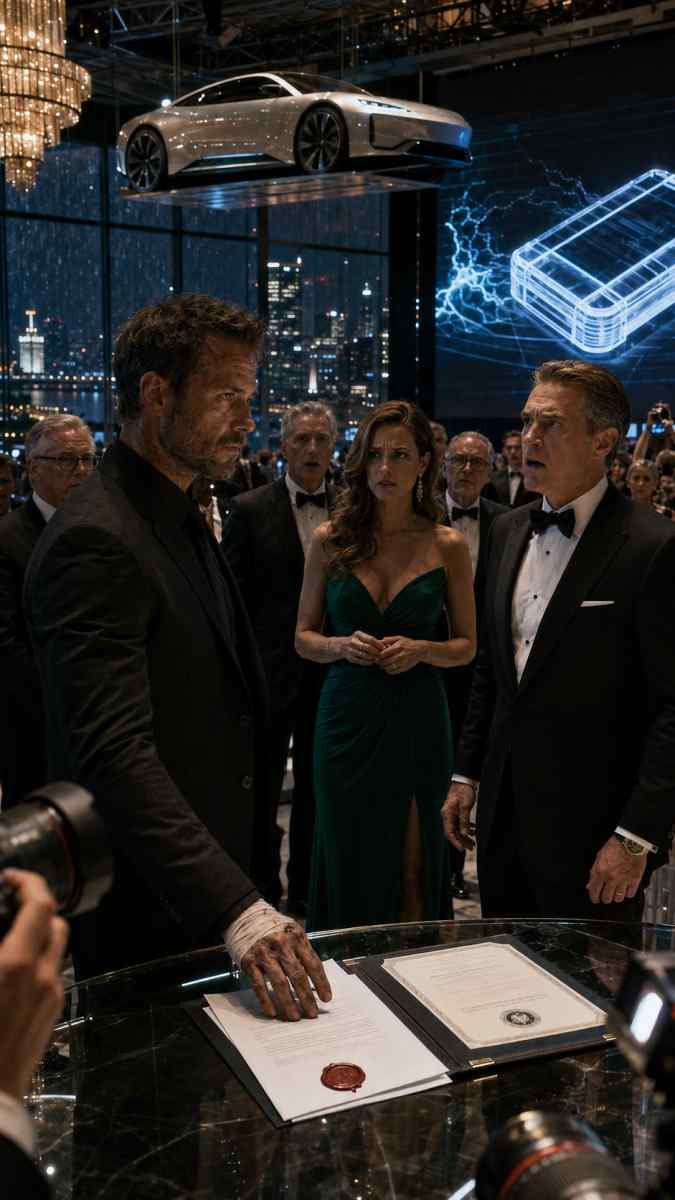
The gala occupied the top floors of Halcyon Tower, all glass walls and white stone suspended above Pittsburgh’s river lights. Lauren arrived alone in the emerald dress Adrian had chosen for her. The ballroom screens displayed his face beside the Aurora battery pack. Guests raised champagne beneath a suspended prototype vehicle. Every surface announced that Adrian Voss had built the future.
Then the service elevator opened.
Daniel stepped out wearing a plain black suit that did not quite conceal the breadth of a man accustomed to physical work. The cut on his hand had been covered with a narrow bandage. Miriam walked beside him carrying a locked case. Three members of Halcyon’s board followed.
Adrian intercepted them before they reached the ballroom.
“This is a private event,” he said.
Daniel looked at the enormous image of Adrian above the stage. “That’s what I was told about my own company.”
Nearby conversations began to fade.
Lauren approached. “Tell me the truth. All of it.”
Daniel’s eyes rested on her for a moment. “I founded Halcyon. My trust controls forty-six percent of the voting shares. The company’s charter gives me emergency authority when its core patents or beneficiaries are threatened.”
“Beneficiaries?”
“Noah owns the future rights to Aurora.”
Lauren turned toward Adrian.
His famous smile remained in place, but sweat shone at his temples.
Miriam opened the case and handed Daniel a sealed packet. “The directors are waiting.”
Adrian blocked the private elevator. “You surrendered leadership years ago.”
“I delegated it.”
“You hid in a garage while I built your company.”
“You built your image.”
“And that image created billions in value.”
Daniel nodded toward the ballroom. “Then you should have no trouble explaining why you tried to sell my son’s patent to Kessler Dynamics.”
Adrian went still.
Lauren recognized the name. Kessler was Halcyon’s largest foreign competitor.
Daniel pressed the elevator button.
As the doors opened, Miriam spoke quietly enough that only the four of them could hear.
“We recovered the draft sale agreement from the stolen files. It contains Lauren’s electronic signature as witness.”
Lauren stared at her.
“I never signed anything.”
Miriam’s expression was cold but not unkind.
“Then someone is preparing to make you responsible for a federal crime.”
Part Three — Why the CEO Chose Her
The boardroom overlooked the city from forty floors above it. Rain traced silver paths down the windows, turning traffic into blurred ribbons of red and white. Daniel sat at one end of the table. Adrian took the other. Lauren remained near the wall, uncertain whether she was a witness, a victim or the woman who had delivered a thief directly to the door.
Miriam connected a laptop to the central screen. First came the attempted transfer from Daniel’s garage. Then the draft contract granting Kessler Dynamics exclusive access to Aurora’s thermal architecture in exchange for $180 million paid through three holding companies. The document carried Daniel’s forged authorization and Lauren’s electronic signature as witness. It also contained a clause transferring a portion of Noah’s trust rights if Halcyon’s board approved the deal.
An elderly director named Helen Park removed her glasses. “Mr. Voss, did you negotiate this agreement?”
Adrian leaned back. “Preliminary discussions are not agreements.”
“Did you authorize the use of Daniel Rowan’s signature?”
“No.”
“Did you possess Lauren Hayes’s phone when someone used it to enter the Rowan server?”
“I picked up the wrong phone by accident.”
Lauren stared at him. Their phones were different sizes, different colors and protected by different cases.
Daniel did not raise his voice. “How did an accidental phone unlock a server requiring Lauren’s password?”
Adrian glanced toward her. “Perhaps she entered it.”
“I didn’t,” Lauren said.
His expression sharpened. It was the first time she had contradicted him publicly.
Miriam displayed security footage from Adrian’s car. Halcyon vehicles continuously recorded their surroundings for autonomous-driving research. Adrian had apparently forgotten that company servers retained encrypted cabin diagnostics during prototype use. The video had no sound, but it showed him taking Lauren’s phone, connecting it to a device beneath the dashboard and driving to the alley behind Daniel’s garage. A second clip showed him returning the phone after the security alert.
The board voted unanimously to suspend him. Federal investigators waiting downstairs were notified that he might attempt to destroy evidence. Adrian listened to the vote with unnatural calm. Then he looked directly at Lauren.
“You should tell them,” he said.
Her stomach tightened. “Tell them what?”
“Why you photographed Daniel’s notebook.”
The room seemed to lose oxygen.
Daniel’s face did not change, but Lauren saw the wound arrive.
Months earlier, Adrian had admired a diagram she accidentally captured in the background of a photograph taken at Daniel’s kitchen table. He asked whether Daniel had more notebooks like it. Lauren thought Adrian wanted to recruit him. She photographed six pages while Daniel was helping Noah with a school project.
“I didn’t know what they were,” she said.
“But you sent them,” Adrian replied.
She could not deny it.
Daniel looked toward the rain beyond the windows. “You searched my desk?”
“You told me you repaired vehicles. I thought the drawings were ideas you never intended to use.”
“So you gave them to a stranger?”
“He wasn’t a stranger. He was our client.”
“Your client,” Daniel said. “The man asking questions about me while you were deciding I wasn’t successful enough.”
Shame rose through Lauren so violently that she gripped the nearest chair. She finally understood why Adrian had pursued her. The private dinners, the flattering attention, the effortless access to a glamorous life—each had moved him closer to Daniel’s home, Daniel’s notebooks and Daniel’s trust.
“You never loved me,” she whispered.
Adrian smiled without warmth. “You were already looking for a door out. I simply opened one.”
The words devastated her because they contained enough truth to be cruel. Adrian had manipulated her, but he had not invented her contempt. He had noticed it, polished it and used it.
Two federal agents entered the room. Adrian stood before they reached him.
“You think Daniel is the victim?” he said to the board. “Ask him why Elias Mercer died with a fraud investigation on his desk.”
Daniel’s gaze snapped toward him.
Adrian continued. “Ask him where forty million dollars disappeared during the first Aurora trials. Ask why he hid behind a trust while his best friend took the blame.”
Miriam closed her laptop. “That matter was audited.”
“By people paid by Daniel.”
Helen Park looked between them. “What is he talking about?”
Daniel remained silent.
For the first time that evening, Adrian looked confident again.
He explained that Elias had discovered unauthorized payments from Halcyon to Rowan Applied Research, a private laboratory controlled by Daniel. Weeks later, Elias died when his car left an icy mountain road. Adrian claimed Daniel had hidden financial records and used his voting power to bury the investigation.
“Now he has returned at the perfect moment,” Adrian said. “He removes me, protects the patent and blames every irregularity on the public executive. He gets to remain the humble mechanic while other people absorb the consequences.”
The agents paused. The directors turned toward Daniel.
Lauren wanted him to dismiss the accusation. Instead, he opened both hands on the table.
“The payments happened,” he said.
The admission struck harder than denial.
Daniel explained that Rowan Applied Research had received forty million dollars through confidential development agreements. The money funded Aurora prototypes outside Halcyon’s ordinary laboratories. Only Daniel, Elias, Miriam and one board committee knew the full structure. Privacy protected Noah’s ownership and prevented Adrian from announcing the technology before it was safe.
“Why was Elias investigating?” Helen asked.
“Because someone changed the destination account on three transfers.”
“Who?”
“I never found proof.”
“And his death?”
Daniel’s voice grew quieter. “The police ruled it an accident.”
Adrian gave a short laugh. “How convenient.”
Daniel rose so suddenly that his chair struck the window. “Do not use his death to protect yourself.”
“Why not? You used it to take his voting proxy.”
One of the agents moved between them. Adrian was escorted from the boardroom, but the damage remained. The board suspended Daniel’s emergency authority pending an independent audit. Aurora’s unveiling was canceled. News of the investigation spread before the gala ended.
Outside, reporters surrounded the building.
Daniel took a freight elevator to the parking garage. Lauren followed him.
“Daniel, wait.”
He kept walking.
“I was wrong about you.”
He stopped beside his truck. “Which part?”
“All of it.”
“No. You were right about some things. I kept secrets. I decided privacy was more important than letting you understand my life. But you didn’t leave because I lied about being rich. You left because you believed a man without status deserved less loyalty.”
She began to cry. “I was afraid.”
“So was I.”
“I thought Noah and I would always come second to this garage.”
“Noah never came second.”
“I know that now.”
He faced her. “You photographed private pages from my home and sent them to a man who was studying me. Whether you knew their value or not, you crossed a line.”
“I’m sorry.”
“I believe you.”
Hope flashed painfully across her face.
Then he added, “But an apology is not a bridge. It is permission to begin building one.”
Before driving away, Daniel asked her to cooperate fully with investigators. Lauren agreed.
At home, however, she discovered her apartment had been searched. Drawers stood open. Her laptop was gone. On the bathroom mirror, someone had written a message in red lipstick:
YOU WANTED A BETTER LIFE. KEEP QUIET AND YOU CAN STILL HAVE IT.
Lauren called Daniel before the police.
He arrived with Noah’s babysitter’s car keys still in his hand and fear stripped across his face. Lauren showed him the mirror and told him the laptop contained copies of Adrian’s schedules, including meetings with a shell-company representative.
“Where were those meetings?” Daniel asked.
“A private airfield outside Morgantown.”
He called Miriam. She went silent when Lauren provided the dates.
Those were the same dates Elias Mercer had flown to West Virginia before his fatal crash.
The police found Lauren’s stolen laptop inside Adrian’s hotel suite. But Adrian had already disappeared from federal supervision by claiming chest pain during transport. His attorney said he had gone to a hospital.
No hospital had admitted him.
At 1:12 in the morning, Noah called from Daniel’s house.
“Dad,” he whispered, “Mr. Adrian is downstairs.”
Then the line went dead.
Part Four — The Invention Hidden Inside a Toy Car
Daniel reached his house in nine minutes. A patrol car arrived seconds behind him, but the front door was open and the living room empty. Noah’s backpack lay beside the stairs. A lamp had been knocked over. On the kitchen table sat a handwritten note instructing Daniel to bring the offline encryption key to the garage and come alone.
Daniel knew Adrian did not merely want Aurora’s files. Without the key, he could not complete the sale to Kessler or prove he controlled the technology. He also knew that if Adrian escaped with the design, Halcyon would face years of litigation while Noah’s inheritance disappeared into foreign holding companies.
Miriam begged him to wait for the police. Daniel refused to gamble with his son.
He entered the garage through the rear door shortly before two. Only one work light burned above the central bay. Adrian stood beside Daniel’s restored 1967 Mustang, holding Noah by the shoulder. The boy was frightened but alert. A pistol hung in Adrian’s other hand.
“You took the wrong child,” Daniel said.
Adrian’s eyes narrowed. “There is no right child for this.”
“Then let him go.”
“Give me the key.”
Daniel removed a small metal device from his jacket and placed it on the workbench. Adrian ordered him to step back. Noah stared at the device, then at his father.
“That isn’t it,” the boy said.
Daniel’s heart stopped.
Adrian tightened his grip. “What did you say?”
Noah swallowed. “Dad said the real key was safe because nobody would recognize it.”
“Where is it?”
Noah looked toward a shelf filled with model cars.
Daniel had hidden the encryption key inside the battery compartment of the red toy roadster Noah had carried since preschool. Adrian followed the boy’s gaze and smiled.
Before he could move, the garage doors rolled upward.
Floodlights burst across the room. Police vehicles blocked both exits. Adrian dragged Noah backward and raised the pistol, but Lauren stepped from behind Daniel’s truck holding her phone toward him.
“Everything you said is live,” she told him.
She had guessed where Daniel hid the key because she had once watched him replace the toy’s batteries. More importantly, she knew Adrian needed to believe he was still controlling her. From the hotel phone, she sent him a message offering to help recover Aurora in exchange for protection. She directed him to the garage, then shared the conversation with investigators.
Adrian aimed the gun at her. “You think he will take you back for this?”
Lauren’s voice shook. “This isn’t how I earn him back.”
“Then why are you here?”
“Because Noah trusted me once.”
The distraction lasted two seconds. It was enough.
Noah drove his heel into Adrian’s foot and dropped. Daniel crossed the distance before Adrian recovered, striking his wrist against the Mustang’s fender. The gun fired into the ceiling. Officers surged through both doors. Adrian was forced to the concrete, shouting that Aurora belonged to him because he had made the world believe in it.
Daniel knelt and pulled Noah against his chest.
“I knew you’d come,” Noah whispered.
“There was nowhere else I could be.”
When police recovered the red toy roadster, Daniel opened its battery compartment. It was empty.
Noah gave the first uncertain smile of the night.
“I moved the key after I heard you and Ms. Miriam talking.”
“Where?”
“In my dinosaur night-light. Nobody likes that thing except me.”
Even Daniel laughed then—a broken sound filled with terror and relief.
The arrest ended the immediate danger, but the investigation had one final secret to uncover. The dates from Lauren’s calendar led authorities to security records at the private airfield. Elias Mercer had met Adrian there three times. On the last occasion, Elias recorded their conversation.
Elias had discovered that Adrian was redirecting development payments into shell companies. He planned to expose him at the next board meeting. Adrian threatened to release confidential records that would make Daniel appear responsible. Elias refused to cooperate.
His death occurred six hours later.
Investigators could not prove that Adrian caused the crash. Weather records showed dangerous ice, and no physical evidence survived. But the recording established motive for the financial sabotage that followed. Adrian had altered the transfer accounts, then preserved the suspicious payments as future evidence against Daniel. After Elias died, he waited for Daniel’s isolation to deepen.
Lauren’s arrival gave him the access he lacked.
His interest in her began the day her agency submitted a campaign photograph containing Daniel in the background. Adrian recognized the garage and understood that the woman standing beside his hidden founder might lead him into Daniel’s private life. He studied her frustration, rewarded her embarrassment and turned every insecurity into a tool.
That revelation nearly destroyed Lauren.
“It would be easier if he had fooled someone innocent,” she told Daniel months later. “But he used something ugly that was already inside me.”
Daniel did not tell her she was wrong.
Adrian pleaded guilty to attempted theft of trade secrets, wire fraud, unlawful access to protected systems, forgery and kidnapping. Other charges related to the Kessler agreement carried his sentence to twenty-two years. The foreign company denied authorizing the theft, though two intermediaries were later convicted.
Halcyon’s board asked Daniel to become permanent chief executive.
He declined.
He agreed to serve as executive chairman until the company rebuilt its leadership, but he would not abandon the garage or turn Noah’s childhood into a corporate stage. Miriam became chief executive after a unanimous vote. She moved Halcyon’s research division into a renovated factory fifteen minutes from Rowan Auto Works and created an independent trust to protect employee inventions from executive appropriation.
The company publicly corrected its history.
At the first press conference, Daniel stood beneath a photograph of the original prototype. Reporters asked why he had allowed Adrian to take credit for so long.
“I believed avoiding attention protected the people I loved,” he said. “But secrecy does not only hide you from the world. Sometimes it hides danger from the people standing beside you.”
He did not look at Lauren, though she was watching from the back.
She had lost her job after her firm discovered she had shared Daniel’s notebook photographs. No criminal charges were filed because she cooperated and had not understood their significance, but innocence from prosecution did not restore her reputation. Adrian’s lawyers portrayed her as a willing conspirator who changed sides when his fraud was exposed. Several friends stopped calling. Invitations disappeared. The doors she had once considered proof of success closed quickly.
Daniel did not rescue her.
He did, however, testify truthfully. He told investigators she had been manipulated. He also told them she had violated his trust before that manipulation became criminal. He refused both revenge and false absolution.
Lauren found work at a small nonprofit that helped families recover from financial fraud. At first, Daniel suspected she had chosen it to perform remorse. But she avoided interviews, rejected speaking invitations and spent her days organizing evidence for elderly victims whose signatures had been stolen by relatives. She did work no camera would notice.
For six months, she did not ask Daniel to forgive her.
She wrote to Noah once. The letter contained no excuse and no request to see him.
I loved the life we had, she wrote, but I treated ordinary happiness as though it were proof that I had failed. When I looked at your father’s hands, I saw grease instead of the meals they cooked, the shoelaces they tied and the machines they created. That blindness belongs to me. I am sorry I made you hear that your home was not enough.
Noah placed the letter inside his science notebook.
A year after Adrian’s arrest, Daniel reopened the garage after a complete renovation. One work bay became a free engineering lab for local teenagers. Students learned to repair engines, build battery systems and understand that intelligence did not always arrive in a suit.
At the opening, Noah demonstrated a small electric go-kart powered by a simplified version of Aurora’s thermal system. He had painted it red.
Lauren stood near the back, uncertain whether she was welcome.
Noah saw her first.
“You can come closer,” he said.
She approached slowly. “It looks incredible.”
“Dad helped.”
Daniel shook his head. “Mostly, I stopped him from setting the workbench on fire.”
For a few seconds, the three of them laughed as they once had. The moment did not erase anything. That was why it mattered. It existed beside the damage, not in place of it.
Later, Lauren found Daniel outside beneath the old garage sign. Snow had begun falling, softening the street and gathering on his shoulders.
“I used to think success meant never having to worry about being left behind,” she said.
“And now?”
“Now I think I was the one leaving everything before it could disappoint me.”
Daniel studied her face. “Why are you telling me?”
“Because apologies should be honest even when they don’t purchase anything.”
He looked through the garage window. Noah was showing Miriam the go-kart’s control panel.
“I loved you,” Daniel said. “Part of me may always love the woman who sat beside Noah when he had nightmares.”
Lauren’s eyes filled.
“But love is not the same as access,” he continued. “And missing someone is not proof that returning is wise.”
“I understand.”
This time, she did.
Daniel did not take her back that winter. Or the following spring. They began with coffee in public places and conversations that ended before nostalgia could pretend to be trust. Lauren attended counseling. Daniel learned to speak about his work instead of using silence as armor. Noah decided when he wanted to see her, and neither adult pressured him.
Repair came slowly.
Two years later, Lauren arrived at the garage before sunrise and found Daniel replacing the brakes on a nurse’s old sedan. He had offered to finish before her hospital shift. His sleeves were rolled up, and grease marked the same hands Lauren had once treated as evidence of a small life.
She set two coffees on the workbench.
“I have a question,” she said.
Daniel glanced at her. “About the car?”
“About us.”
He waited.
“I don’t want the life I imagined with Adrian. I don’t want access to Halcyon or your money. I want Saturday baseball games, burned pasta and Noah complaining about my pancakes. But I know wanting those things does not mean I deserve them again.”
“No,” Daniel said. “It doesn’t.”
She nodded, accepting the answer.
Then he wiped his hands and picked up one of the coffees.
“But deserving isn’t the only question.”
Hope appeared carefully in her face.
“What is the other question?”
“Whether we have both become people capable of building something better than what we broke.”
They did not kiss. There was no music, no sudden promise and no ring returned to her finger. Daniel handed her a wrench and asked whether she remembered how to bleed a brake line.
She smiled through tears. “You taught me once.”
“Then show me you were listening.”
That morning became the beginning—not of the old relationship restored, but of a new one tested by truth. Lauren earned Noah’s confidence in small, unphotographed moments. Daniel allowed himself to be known before he expected to be understood. Three years later, they married in the garage courtyard beneath strings of warm lights. Miriam stood beside Daniel as his closest friend. Noah carried the rings inside the red toy roadster.
Daniel still owns Rowan Auto Works.
He also remains Halcyon’s controlling shareholder, though his name now appears openly on every patent he creates. Aurora made electric vehicles safer, cut charging times and generated a fortune that secured Noah’s future. Yet Daniel continued repairing cars twice a week.
When a reporter asked why a billionaire still changed oil, Daniel looked toward the work bays.
“Because work does not become small when the world stops applauding it.”
Lauren heard him from the office. This time, she was not embarrassed by his grease-stained shirt or the customers waiting beneath the faded sign. She understood what she had almost lost.
Adrian had possessed the penthouse, the cameras and the title. Daniel had possessed the thing Adrian could never manufacture: the patience to build something real when nobody was watching.
The difference between those men was never wealth.
It was character.
If this story reminded you of someone whose quiet work has been mistaken for failure, share it with them—and follow our page for more stories about betrayal, courage and the moment truth finally enters the room.
Because the person with the cleanest hands is not always innocent.
And the person covered in grease may be the one holding the entire future together.