If you believe the quietest person in the room may be carrying the greatest story, stay with this one. Because by sunset, the family gathered in that Ohio backyard would never look at Claire Bennett—or themselves—the same way again.
Part One: The Daughter No One Celebrated
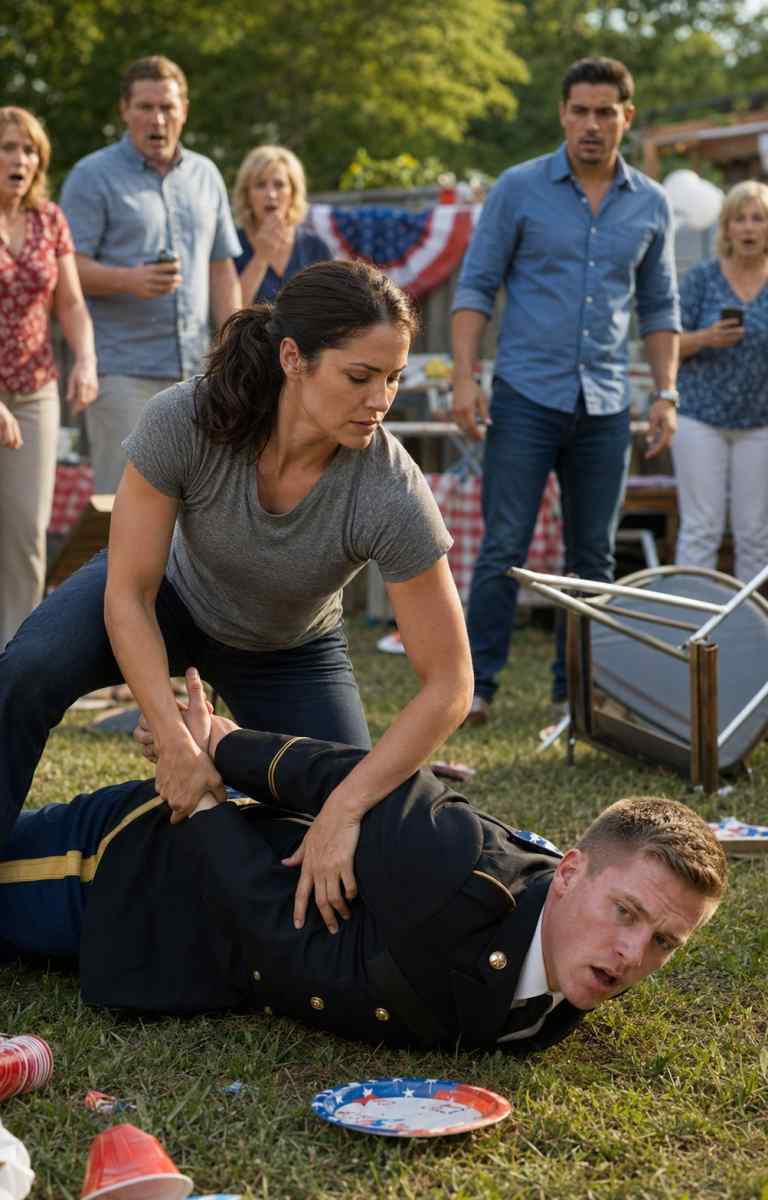
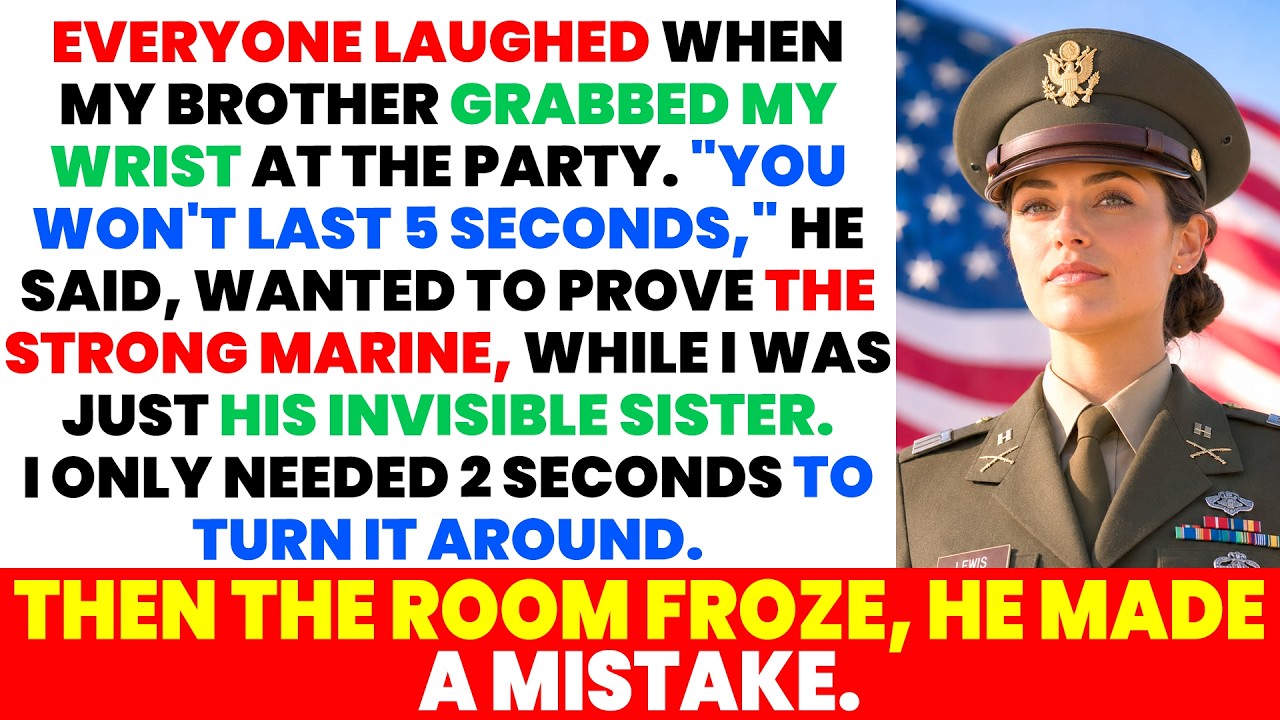
The moment Ethan Bennett twisted his sister’s wrist, twenty-three relatives raised their phones.
He smiled for the cameras, tightened his grip, and said, “Come on, Claire. Show everyone what they teach you behind that supply desk.”
The laughter surrounding them was warm, careless, and cruel.
Claire looked into her younger brother’s eyes and understood two things immediately. First, Ethan had consumed at least four beers since noon. Second, if she used even a fraction of what she knew, she could put him on the ground before anyone finished laughing.
But Ethan didn’t know that.
None of them did.
Three hours earlier, Claire had arrived at her parents’ home outside Columbus wearing jeans, a faded gray T-shirt, and the expressionless calm she had practiced for twelve years. Beside her walked Daniel Reyes, introduced to the family as her boyfriend from work. He carried a grocery-store pie in both hands and wore a blue button-down shirt that concealed the scar where a bullet had once entered beneath his shoulder blade.
The backyard had been transformed into a patriotic shrine. Red, white, and blue ribbons hung from the trees. A six-foot banner stretched across the garage: WELCOME HOME, PRIVATE ETHAN BENNETT. A cake decorated with an American flag occupied the center table, surrounded by framed photographs of Ethan in uniform.
There were no photographs of Claire.
Her mother, Susan, hurried over, accepted the pie without hugging her daughter, and immediately turned to Daniel.
“You must be the warehouse boyfriend.”
Daniel glanced at Claire.
She gave him the smallest nod.
“That’s me,” he said pleasantly.
Susan laughed. “Well, at least you two understand each other’s world. Inventory forms, shipping schedules, boxes going in and out. I suppose somebody has to keep track of everything while the real soldiers are out there.”
Daniel’s smile remained in place, but Claire noticed the slight tightening around his eyes.
“Somebody does,” he replied.
Across the yard, Ethan stood surrounded by cousins and neighbors. At twenty-two, he was broad-shouldered, loud, and handsome in the way that made strangers forgive him before he misbehaved. He had graduated from Army basic training ten days earlier and wore his uniform as if he had personally won a war.
Their father, Thomas, rested one hand proudly on Ethan’s shoulder while recounting the same story for the fifth time.
“Top three in his platoon on the obstacle course,” Thomas announced.
Ethan corrected him. “Top two.”
Claire knew neither claim was true. Ethan had already sent her a photograph of his graduation certificate, forgetting that the document reflected no special distinction. She hadn’t corrected him. She rarely corrected anyone in this family.
Susan spotted Claire watching and waved her over.
“Your sister finally made it,” she told Ethan.
“Look who escaped the warehouse.” Ethan opened his arms theatrically. “Did they shut down the forklift for you?”
Several cousins laughed.
Claire hugged him anyway.
“Congratulations,” she said. “You finished something difficult. I’m proud of you.”
For one brief moment, uncertainty crossed his face. Her sincerity had denied him the argument he wanted. Then cousin Brad shoved a beer into Ethan’s hand, and the performance resumed.
“I wish Claire had your ambition,” Susan said. “Twelve years in the military and she’s still moving supplies.”
Claire felt Daniel turn slightly beside her.
It was not an accidental movement. In their real world, Daniel always positioned himself where he could reach her quickly.
Claire touched two fingers to his forearm.
Stand down.
It was a message they had exchanged without words in deserts, mountains, safe houses, and once inside a burning embassy corridor. Today it meant something simpler: Let them believe what they need to believe.
Claire had spent most of her adult life protecting information. She knew the difference between secrecy and lying. A lie invented something false. Secrecy merely refused to surrender the truth to people who had not earned it.
Her family had never earned it.
Officially, Captain Claire Bennett served in Army logistics. Her parents imagined warehouses, spreadsheets, and long afternoons beneath fluorescent lights. The cover was dull enough that nobody asked serious questions.
The truth was sealed behind layers of classification.
Claire led a joint special operations recovery unit that entered places where the United States officially had no personnel. Her team retrieved hostages, intercepted weapons, and brought home people whom governments had publicly abandoned. She had completed nineteen operations across eight countries. Three scars crossed her body. None had come from a car accident, though that was what her family believed.
Six days before Ethan’s party, Claire had crawled through a drainage tunnel beneath an abandoned factory with Daniel behind her. Four aid workers were being held upstairs by men who had already killed one hostage.
The operation lasted nine minutes.
Daniel had taken a round against his body armor. Claire had disarmed a guard in a concrete stairwell and held his throat beneath her forearm until he stopped resisting. They recovered three living hostages and carried the fourth out beneath a blanket.
Then Claire flew home and sat at a picnic table while her aunt asked whether she had considered applying for a “more meaningful position.”
“I could speak to my manager,” Aunt Diane offered. “The insurance company needs dependable clerks.”
“I’ll keep that in mind,” Claire said.
Daniel stared down at his plate to hide his reaction.
Susan moved among the guests, introducing Ethan to every new arrival as “our soldier.” When people asked about Claire, her mother’s answer never changed.
“She helps with supplies.”
Once, she added, “It isn’t exciting, but it suits her.”
Claire had been underestimated by armed men, foreign intelligence officers, and commanders who believed a woman could not lead the kind of team she led. Their doubt had never wounded her as deeply as her mother’s casual embarrassment.
She hated herself for that.
A rifle round was impersonal. It did not know your childhood nickname. It had not held your hand on your first day of school. It had never taught you to measure your worth by the warmth in its voice.
Daniel sat beside her beneath an oak tree.
“You can still leave,” he murmured.
“I promised Grandpa I’d stay for dinner.”
“He isn’t here.”
“He will be.”
Daniel looked toward Ethan, who was demonstrating a clumsy takedown on cousin Brad.
“You sure about that?”
“No.”
That was unusual. Claire was certain about almost everything.
Her grandfather, Walter Bennett, had called her two weeks earlier. A retired Army medic, Walter rarely wasted words.
“Come to the party,” he had said. “Whatever happens, stay until I get there.”
“What’s going to happen?”
A pause had followed.
“People eventually become careless around the person they think is weak.”
Then he hung up.
Now, as Claire watched her brother accept applause for pinning an untrained cousin in the grass, Walter’s warning returned to her.
Ethan climbed onto the patio and tapped a spoon against a bottle.
“I want to say something.”
The yard quieted.
He thanked his parents, his instructors, his friends, and everyone who had “supported the mission.” He spoke about sacrifice as though he had spent years away instead of one training cycle in Georgia. Yet Claire did not resent his pride. Basic training was difficult. He had earned the right to be pleased.
What troubled her was the hunger behind his eyes.
Praise was no longer enough. He needed contrast. Someone had to become smaller so he could keep growing.
His gaze found Claire beneath the tree.
“And I want to thank my big sister,” he announced, “for proving there are safe jobs for people who aren’t built for the hard stuff.”
The laughter came quickly.
Daniel’s fork stopped halfway to his mouth.
Claire remained still.
Ethan raised his beer toward her. “To the brave men and women protecting our cardboard boxes.”
More laughter.
Claire’s father looked directly at her. For one second, she thought he might intervene.
Instead, he lowered his eyes.
That small act hurt more than Ethan’s joke.
Claire rose from her chair and walked toward the house.
Behind her, Ethan called, “Where are you going? I’m honoring you.”
She did not turn.
Then his hand closed around her wrist.
“Don’t walk away from a soldier when he’s talking to you.”
Claire stopped.
The backyard fell silent, not because anyone sensed danger, but because everyone expected entertainment.
Ethan pulled her around to face him.
His grin widened as the phones rose.
And Claire realized her grandfather had been right.
Someone had finally become careless.
But what Ethan did next would force Claire to choose between protecting her secret—and protecting him from the worst mistake of his life.
Part Two: Five Seconds
“Let go of me,” Claire said.
Her voice was quiet enough that only Ethan and Daniel understood it as a warning.
Ethan mistook it for fear.
“What happened?” he asked. “All those years in uniform and nobody taught you how to break a grip?”
He turned Claire’s wrist outward. The pressure was amateurish but painful. Claire could have escaped by rotating toward his thumb. She could have controlled his elbow, taken his balance, and lowered him gently to the grass.
Instead, she waited.
She wanted to give him one last chance to release her voluntarily.
Susan stood near the cake, smiling nervously. “Ethan, don’t wrinkle your uniform.”
Not Don’t hurt your sister.
Not Let her go.
Don’t wrinkle your uniform.
Claire looked at her mother and felt something inside her become very still.
Ethan tightened his grip.
“You know what the problem is with desk soldiers?” he said. “They wear the same flag as the rest of us, so civilians think we’re equal.”
A few relatives stopped smiling.
Daniel set down his plate.
Claire noticed everything at once: Daniel shifting his right foot; her father’s beer trembling slightly; cousin Brad continuing to record; the open gate behind Ethan; the kitchen knife beside the grill; three children watching from the porch.
She lowered her voice.
“Ethan, you’ve been drinking. Release my wrist, step back, and we forget this happened.”
He leaned closer. “Or what?”
“Or you’ll remember it for the rest of your life.”
His expression changed.
The party laughter had given him courage, but her lack of fear insulted him. He wanted her embarrassed, flustered, and struggling. Her calmness suggested he was not in control.
So he twisted harder.
Pain flashed from Claire’s wrist to her elbow.
Daniel rose.
“No,” Claire said without looking at him.
He stopped instantly.
Ethan heard the command and glanced over. “What, your warehouse boyfriend needs permission?”
“Everybody needs permission before putting hands on someone else.”
“That’s not how the real world works.”
Claire almost laughed.
Ethan knew nothing about the real world she inhabited. In her world, uninvited hands were often followed by gunfire. Mistakes were measured in funerals, not wounded pride.
Yet beneath her anger, she still saw the five-year-old boy who had crawled into her bed during thunderstorms. She remembered teaching him to ride a bicycle, running behind him while he shouted for her not to let go. When he fell and split his knee, Claire carried him home.
After college, she enlisted. Ethan was ten. Before she boarded the bus, he wrapped both arms around her waist and cried into her jacket.
“Come back,” he had whispered.
She had always come back.
But every return made her more foreign to the family. They knew less about her work, so they filled the silence with assumptions. Ethan learned from his parents that Claire’s career was ordinary. Over time, admiration became pity, and pity became contempt.
Claire had watched it happen without stopping it.
Perhaps that had been her mistake.
“I bet I can put you down in five seconds,” Ethan said.
The crowd stirred.
Claire studied his pupils, breathing, shoulders, and balance. He was intoxicated but not helpless. His right foot carried too much weight. His chin was high. His left elbow drifted away from his ribs.
“Do not do this,” she said.
Ethan released her wrist and stepped back.
For a moment, she thought it was over.
Then he shoved her.
The movement was sudden and hard enough to send an unprepared person into the picnic table. Claire absorbed the force through her rear leg and moved only half a step.
Several people gasped.
Thomas finally spoke. “Ethan, that’s enough.”
But the protest was weak and late.
Ethan glanced at their father, then at the watching phones. He had crossed a line. He could apologize and become the drunken recruit who shoved his sister, or he could convince everyone it had been part of a demonstration.
“Relax,” he said. “She knows we’re sparring.”
“No,” Claire replied. “We’re not.”
The simple contradiction trapped him.
His cheeks darkened. He dropped into an exaggerated fighting stance.
“What’s wrong, big sister? Afraid your paperwork won’t protect you?”
Daniel moved close enough that Claire could hear him.
“Say the word.”
“If he reaches for a weapon, take the children inside.”
“And if he doesn’t?”
“I’ll handle it.”
Ethan lunged.
His right hand came in a wide arc, more shove than punch, aimed at Claire’s shoulder. She turned just enough for his fingers to brush her shirt. His momentum carried him forward. Claire guided his arm past her and stepped away.
To the family, it looked as if he had missed.
To Daniel, it was a precise evasion that required inches, not luck.
Ethan spun around.
Claire saw embarrassment ignite into rage.
“Hold still.”
“In a fight?”
“It’s not a fight.”
“You’re right,” she said. “It’s a tantrum.”
A stunned murmur moved through the family.
Ethan attacked again.
This time, his fist was closed.
Claire could have stopped him before the punch developed. Instead, she waited until the last possible instant, wanting every camera to capture who had initiated the violence.
She slipped outside his arm, caught his wrist, and placed her other hand above his elbow. One turn would have driven him face-first into the ground.
She released him.
Ethan stumbled several feet and nearly fell into the cooler.
Someone laughed.
It was only one person, somewhere near the fence, but Ethan heard it.
Humiliation emptied the last of his judgment.
He charged with both arms extended, intending to tackle her.
Claire stepped aside and redirected him. Ethan crashed shoulder-first into a lawn chair, scattering paper plates across the grass. Children screamed. His beer spilled over the front of his uniform.
Susan rushed forward.
“Claire, stop this!”
Claire stared at her.
“I haven’t hit him.”
“You’re embarrassing him.”
“He is attacking me.”
“He’s celebrating! You could let him have one day without making everything about you.”
The words struck with surgical accuracy.
Claire had missed Christmases, weddings, birthdays, and funerals because her work required silence. She had sent money when her parents’ furnace failed and allowed her father to believe a veterans’ charity had covered the bill. She had paid Ethan’s first year of community college through an anonymous military scholarship after he lost his financial aid.
She had never made anything about herself.
Not once.
Daniel saw the change in her expression.
“Claire,” he said softly.
She looked at him.
He wasn’t telling her to calm down. He was reminding her that she could leave. That she owed these people nothing.
Claire nodded.
She turned toward the gate.
Ethan pushed himself up from the broken chair.
“Running away?”
Claire kept walking.
“You always run when things get hard!”
Her steps slowed.
That sentence did what his hands could not. It reached a place she kept sealed even from herself.
A winter road appeared in her memory: burning vehicles, shattered glass, and snow turning black beneath smoke. Sergeant Maya Cole lay bleeding behind a concrete barrier. Daniel was trapped on the other side of the road. Enemy fire cut through the darkness.
Claire had crossed that road three times.
Once for Maya.
Once for Daniel.
Once for a radio containing classified frequencies that could have endangered hundreds of soldiers.
Running when things got hard?
She had run directly into fire so often that loud noises still woke her reaching for a weapon.
But she kept walking.
Ethan moved after her.
Daniel saw him first. “Don’t.”
The authority in his voice stopped several conversations.
Ethan looked Daniel up and down. “You want some too?”
Daniel’s expression did not change. “No. I want you to wake up tomorrow without having destroyed your life.”
“My life?”
“Assaulting a senior officer in front of twenty witnesses tends to create paperwork.”
The yard went still.
Claire turned sharply toward Daniel.
It was the first piece of truth anyone had spoken.
Ethan blinked. “Senior officer?”
Daniel realized what he had done, but the words could not be recovered.
Susan gave a brittle laugh. “Claire isn’t a senior officer. She works in distribution.”
Daniel looked at Claire.
“I’m sorry.”
Claire slowly exhaled.
Her cover was not destroyed. Captain was not a classified rank. Her official record still placed her in logistics. But Daniel’s mistake had opened a door that could no longer be shut.
Ethan looked from one to the other.
“You take orders from her?”
Daniel did not answer.
That silence was answer enough.
Ethan’s face hardened. “This is ridiculous.”
He stepped toward Claire, raising his hands again.
Thomas blocked him at last. “Son, stop.”
Ethan shoved his father aside.
Thomas tripped over the cooler and fell heavily against the grill.
The metal frame rocked. A tray of burning charcoal slid toward him.
Claire moved before anyone screamed.
She crossed the distance, caught her father beneath one arm, and pulled him clear as the grill overturned. Hot coals scattered across the patio. Daniel grabbed a fire extinguisher from beside the garage and smothered the flames.
For several seconds, smoke swallowed the scene.
When it cleared, Claire was kneeling beside her father, checking his neck and pupils.
“Dad, look at me. Any pain in your spine?”
Thomas stared at her as though seeing a stranger.
“I’m fine.”
Ethan stood frozen.
He had not meant to hurt their father. Yet guilt did not replace his anger. It intensified it. He needed someone else to be responsible for what he had done.
“You made me do that,” he said.
Claire rose slowly.
“No.”
“If you had just—”
“No, Ethan. You shoved him. You own that.”
His mouth trembled.
Then he swung at her.
Claire stepped inside the punch, caught his arm, and swept his legs from beneath him. Ethan hit the grass with a deep, violent thud.
Before he could recover, she controlled his wrist, pinned his shoulder, and placed one knee beside his ribs. She used no more force than necessary. But he could not move.
The cheering had ended.
So had the laughter.
Ethan strained until the veins stood out in his neck.
Claire leaned close enough that only he could hear her.
“Strength without discipline is just danger wearing a uniform.”
His resistance stopped.
Then a voice sounded from the gate.
“Captain Bennett.”
Claire lifted her head.
An elderly man stood beneath the welcome-home banner.
But it wasn’t her grandfather.
It was Major General Samuel Warren—the commander whose life Claire had saved seven years earlier.
And he had arrived carrying a locked black case that was never supposed to leave Washington.
Part Three: The Case at the Gate
Claire released Ethan and stood.
Every military member in the yard recognized the two stars on General Warren’s uniform. Even those who did not understand his rank understood the effect he had on Ethan.
Her brother climbed unsteadily to his feet, wiped grass from his uniform, and snapped to attention.
“Sir.”
General Warren did not look at him.
His gaze remained on Claire.
She gave him a restrained salute. “General.”
Warren returned it.
Daniel stepped beside her, his posture suddenly transformed. The easygoing warehouse employee disappeared, replaced by a soldier whose body seemed to align around an invisible center.
Warren noticed the overturned grill, the extinguisher foam, Thomas sitting on the patio, and the bruise beginning to form on Claire’s wrist.
“What happened?”
“A family disagreement,” Claire said.
“I see.”
His tone indicated that he saw far more than she wanted.
Susan hurried forward, wiping her hands against her dress. “General, what an honor. You must be here for Ethan.”
“No, ma’am.”
Susan’s smile faltered.
Warren raised the black case.
“I’m here for Captain Bennett.”
The words landed harder than Ethan’s body had.
Claire looked toward the gate, expecting to see her grandfather. The path was empty.
“Why are you here?” she asked.
“We need to speak privately.”
“This isn’t a secure location.”
“I’m aware.”
“Then that case shouldn’t be here.”
“Also aware.”
General Warren walked past the stunned family and stopped before her.
Up close, Claire saw exhaustion carved beneath his eyes. He was sixty-three, usually immaculate, but his collar was damp with sweat. He had traveled quickly.
“It’s Walter,” he said.
Claire’s stomach tightened.
“What happened?”
“Cardiac event. He collapsed at home this morning.”
Her composure fractured by a hair.
“Is he alive?”
“Yes. He’s at Riverside. Stable for the moment.”
“Why didn’t anyone call me?”
Warren glanced at the family.
“Because he told the paramedics to call me.”
Susan placed one hand over her mouth. “Dad knows a general?”
“He knows several,” Warren replied.
Claire stared at the case. “What is this?”
“Something Walter insisted you receive today if he couldn’t deliver it himself.”
“That doesn’t explain why you brought it to an unsecured backyard.”
“No,” Warren said. “What’s inside explains that.”
Ethan shifted. “Sir, I think there’s been a misunderstanding. My sister works in logistics.”
General Warren finally looked at him.
His gaze traveled from Ethan’s grass-stained uniform to his reddened throat and then to Claire’s bruised wrist.
“Private, did you put your hands on this officer?”
Ethan swallowed.
“It was a demonstration.”
“Did she consent?”
“No, sir.”
“Then it was assault, not a demonstration.”
Ethan’s shoulders dropped.
Claire stepped in. “I’m not filing a complaint.”
Warren turned to her. “That decision may not be yours alone if this footage reaches his command.”
Every phone in the yard seemed to grow heavier.
Cousin Brad quietly lowered his.
Claire faced the guests. “Delete the recordings.”
No one moved.
Daniel spoke without raising his voice. “Now.”
Screens appeared. Fingers moved. Videos disappeared one by one.
Claire knew deletion was not certainty, but it reduced the risk. More importantly, it gave Ethan a chance not to begin his career beneath the shadow of a disciplinary investigation.
He stared at her, stunned.
“You’re protecting me?”
“I’ve been protecting you since you were born.”
The anger left his face.
In its place appeared the first hint of shame.
General Warren carried the case to the patio table. A numerical lock guarded each side. He entered two separate codes, pressed his thumb against a scanner, and opened it.
Inside rested a medal in a velvet box, an old leather journal, and a sealed envelope bearing Claire’s name.
Susan stepped closer. “What medal is that?”
Warren looked at Claire for permission.
She did not give it.
He closed the velvet box.
“It belongs to your daughter.”
“For logistics?”
The question escaped Susan before she could stop it.
General Warren’s face became cold.
“Mrs. Bennett, I have served for forty-one years. There are details of Captain Bennett’s career I am not permitted to know. You should consider what that means.”
The yard remained silent.
Warren took out the envelope and handed it to Claire.
Her name had been written in Walter’s blocky handwriting.
She broke the seal.
Claire,
If Sam is giving you this, then my heart finally objected to all the bacon I fed it.
You probably expected me at Ethan’s party. I intended to come. Not for the cake, and certainly not for the speeches. I wanted to tell the truth that can safely be told.
Your family believes you chose an ordinary career because I helped make them believe it.
Claire stopped reading.
A dull pressure grew behind her ribs.
She continued.
When you joined your current unit, I was contacted because of my old clearance and my connection to General Warren. Your operational cover required a believable family narrative. Your mother asks questions when she feels excluded, your father talks when he drinks, and Ethan was a child. I advised your command to give them the dullest version possible.
I thought I was protecting you.
I did not understand that the story would become a weapon.
Claire glanced at General Warren.
“You authorized my family cover?”
“Walter proposed it,” he said. “I approved it.”
Susan’s face had gone pale. “What cover?”
Claire read on.
I watched your mother diminish you, and I said nothing because I feared that defending you too strongly would make her suspicious. Later, silence became habit, and habit became cowardice.
That is my failure.
But there is another truth you deserve to know. Seven years ago, my old friend Samuel Warren was taken during an overseas inspection. The official report said a diplomatic team negotiated his release.
That report was false.
You brought him home.
Claire lowered the letter.
Every face turned toward General Warren.
He placed both hands on the table.
“My convoy was attacked in a region where our presence was politically sensitive. Three soldiers were killed. I was held for eleven days. Your daughter led the team that came through the roof.”
Susan sank into a chair.
Thomas stared at Claire. “You?”
Claire said nothing.
Warren continued, careful not to disclose operational details.
“She had already been injured when she reached me. I ordered her to withdraw. She refused. When our extraction vehicle was disabled, she carried one of her soldiers for nearly half a mile and came back for me.”
Daniel looked away.
He had been that soldier.
Claire read the last page.
The medal belongs to you, though the public citation will never say what you did. I kept it because your command could not risk presenting it formally. I told myself I would give it to you when retirement made secrecy easier.
There is never an easy time to tell someone you are proud of them.
So I am telling you now.
You were never invisible to me, Claire. I saw you. I recognized the way you entered rooms, the way you watched doors, the way you sat with your back against walls. I knew what those habits cost.
If I get another chance, I will tell you in person.
If I do not, remember this: restraint is not weakness. But enduring cruelty forever is not strength either.
Make them face what they have done.
Love,
Grandpa
For several seconds, Claire could not hear the yard. The world narrowed to the paper trembling between her fingers.
She had held pressure against wounds while helicopters burned. She had informed parents that their children would not be coming home. She had stood beneath foreign rain as bodies were loaded into aircraft.
She had not cried.
Now one tear landed on Walter’s signature.
Susan saw it and began to weep.
“I didn’t know.”
Claire folded the letter carefully.
“You didn’t need to know what I did.”
“But if I had—”
“You needed to know I was your daughter.”
Susan’s mouth closed.
Claire’s voice remained controlled, which made the words more painful.
“You didn’t need medals or generals or classified missions to treat me with respect. You should not require proof that someone is extraordinary before deciding they deserve kindness.”
Thomas lowered his head.
“I should have stopped it,” he said.
“Yes.”
His eyes lifted, perhaps expecting comfort or forgiveness.
Claire gave him neither.
“You watched because her contempt was easier for you than conflict. Every time you said nothing, you made a choice.”
Thomas’s face crumpled.
Ethan stood several feet away, his hands open at his sides.
“What did you do overseas?” he asked.
“I can’t tell you.”
“Are you special forces?”
“I can’t tell you.”
“How many missions?”
“I can’t tell you.”
Frustration passed through him, followed by a dawning understanding.
All those years, he had mistaken her silence for emptiness. Now he saw it as a locked door.
He looked toward Daniel. “And you?”
Daniel pointed at Claire. “I go where she tells me.”
“Why?”
“Because I like surviving.”
A few relatives gave uneasy laughs, but Ethan did not.
He looked at his sister’s wrist. His fingerprints were visible against her skin.
“I hit you.”
“You tried.”
“I could have hurt you.”
Claire held his gaze. “That is the part you should be ashamed of—not that you failed.”
He nodded slowly.
The first ambulance siren reached them from the road.
Claire turned toward General Warren.
He was already holding out his car keys.
“I’ll drive.”
She looked at Ethan. “Stay here.”
“No.”
“This isn’t a request.”
“Grandpa is in the hospital because he was coming to defend you at my party.” Ethan’s voice broke. “I’m going.”
Susan stood. “We all are.”
Claire studied them—the mother who had mocked her, the father who had watched, and the brother who had attacked her.
“Not all of you.”
Susan recoiled.
Claire handed the car keys to Daniel.
“Ethan comes with us.”
Her brother looked surprised.
“Why me?”
“Because Grandpa’s letter said people must face what they’ve done.”
Claire walked toward the gate.
Ethan followed several steps behind, no longer strutting, no longer demanding that anyone watch him.
Just before they reached the car, General Warren’s phone rang.
He listened for ten seconds and closed his eyes.
Claire stopped.
“What is it?”
Warren lowered the phone.
“Walter’s heart stopped.”
Part Four: The Man Who Knew
The drive to Riverside Methodist Hospital took eighteen minutes.
For Claire, it lasted years.
She sat in the passenger seat while Daniel drove and General Warren called ahead. Ethan remained in the back, still in uniform, both hands pressed against his knees. No one mentioned the grass stains or the darkening bruise along his neck.
Claire watched traffic move aside for the emergency lights.
She wanted a mission.
She wanted coordinates, a target, a team, and a measurable threat. She wanted any problem that could be solved with preparation and force.
Instead, she had a dying old man and eighteen minutes of helplessness.
“Did he know?” Ethan asked from the back.
Claire kept her eyes on the road. “Know what?”
“What you really did.”
“Some of it.”
“And he kept it secret?”
“He kept me alive.”
Ethan nodded.
After a moment, he said, “I used to think he liked you more.”
Claire turned slightly.
“When we were kids,” Ethan continued, “he watched everything you did. If you tied a knot, he checked it. If you walked into a restaurant, he noticed where you sat. I thought he was trying to turn you into a soldier.”
“Maybe he recognized one.”
Ethan looked through the window.
“I hated that.”
“I know.”
“You knew?”
“You made it obvious.”
He gave a broken laugh. Then his voice dropped.
“I kept waiting for someone to look at me the way he looked at you.”
There it was—the wound beneath the arrogance.
Ethan had not mocked Claire because he believed she was nothing. He had mocked her because some part of him feared she was everything. Basic training had finally given him a uniform, applause, and a place in the family’s story. He believed he had earned the admiration Claire received effortlessly from their grandfather.
Except her admiration had never been effortless.
It had been purchased in blood that Ethan had not seen.
“You didn’t need to defeat me,” Claire said. “You needed to become someone you could respect when nobody was watching.”
Ethan wiped at his eyes. “I don’t think I know how.”
“You learn.”
“Will you teach me?”
Claire faced forward again.
“If you’re willing to be corrected.”
“I am.”
“You say that now.”
“I’ll say it tomorrow.”
“We’ll see.”
They reached the hospital entrance, where a nurse led them through two locked doors. General Warren spoke quietly to a physician. Claire watched the man’s face before he approached and knew the answer.
“We restored a heartbeat,” the doctor said. “Your grandfather is alive, but he is extremely unstable.”
“Can I see him?”
“One person.”
Claire entered the intensive care room alone.
Walter looked smaller than he had in her childhood. Tubes crossed his chest and arms. A ventilator breathed for him with mechanical patience. His gray hair lay flat against the pillow.
Claire sat beside the bed and took his hand.
The skin was thin and cool, but the grip that answered hers was unmistakable.
His eyelids opened.
“Well,” he whispered around the oxygen mask, “Sam found you.”
“He brought the case.”
“Dramatic old fool.”
“You planned the dramatic part.”
Walter’s mouth curved.
Claire wanted to scold him for hiding the truth, for letting the family’s contempt grow, for nearly dying before saying what mattered. But the anger dissolved when she saw the fear behind his eyes.
Not fear of death.
Fear that she would not forgive him.
“I read your letter,” she said.
“I was wrong.”
“Yes.”
He closed his eyes briefly.
Claire tightened her hand around his.
“But you were trying to protect me.”
“Intent doesn’t erase damage.”
“No. It doesn’t.”
His eyes opened again.
“You sound like me.”
“I’ve been told that’s unfortunate.”
A faint laugh rattled beneath his mask.
Claire leaned closer. “Ethan is outside.”
Walter frowned.
“He put his hands on me.”
The heart monitor quickened.
“He’s alive,” she added.
“Disappointing.”
“He’s ashamed.”
“Better.”
“He wants to apologize.”
Walter stared toward the door.
“Bring him.”
Claire stepped into the hall.
Ethan stood immediately.
“Is he—”
“He’s awake. He asked for you.”
That was not entirely true, but operations had taught Claire that timing mattered more than technical purity.
Ethan entered the room and stopped at the foot of the bed.
Walter looked at his uniform.
“Come closer.”
Ethan obeyed.
“Closer.”
He moved to the bedside.
Walter lifted one trembling finger and pointed to the grass stain on Ethan’s shoulder.
“Your sister?”
“Yes, sir.”
“Good.”
Ethan’s face folded. “Grandpa, I hurt her.”
“You hurt yourself.”
“I don’t understand.”
“You will.”
Ethan dropped into the chair.
“I thought being strong meant nobody could embarrass me.”
Walter studied him.
“Being strong means embarrassment teaches you before it kills you.”
Tears ran freely down Ethan’s face.
“I’m sorry.”
“Don’t tell me.”
Ethan turned toward Claire.
The apology came without performance, speeches, or excuses.
“I wanted everyone to think I was important. I used you to do it because I thought you wouldn’t fight back. I shoved Dad. I attacked you. Then you protected my career anyway.”
Claire said nothing.
“I’m sorry,” he continued. “Not because you outrank me. Not because you can beat me. I’m sorry because you’re my sister, and I treated you like you weren’t a person.”
Claire watched him carefully.
This was not redemption. An apology did not erase years of ridicule or the violence in the backyard. But it was a beginning, and beginnings were rarer than people imagined.
“What happens next time you drink too much and feel small?” she asked.
“I leave.”
“What if your friends are watching?”
“I leave.”
“What if they laugh?”
“I leave.”
“And if somebody weaker than you becomes an easy target?”
“I stand beside them.”
Claire nodded once.
“Then prove it.”
Walter watched them, satisfaction softening his face.
The doctor asked everyone to leave except Claire. Ethan saluted his grandfather, but Walter shook his head.
“Not in here,” he said. “Hug me, boy.”
Ethan bent carefully over the bed.
Walter held him with one arm.
When Ethan returned to the hall, Daniel placed a hand on his shoulder and guided him away.
Claire remained.
For the next hour, Walter drifted between sleep and consciousness. Near midnight, he asked her to open the black case again.
She placed the medal in his palm.
The public citation described administrative courage during a classified overseas crisis. It was a collection of safe words arranged around a dangerous truth.
Walter rubbed his thumb across the metal.
“They got it wrong.”
“They wrote what they could.”
“No medal can tell the truth.”
“No.”
He looked at her.
“Then what can?”
“The people who came home.”
Walter smiled. “That’s my girl.”
His condition stabilized before dawn.
Claire slept for twenty minutes in a chair, her head beside his arm. When she woke, sunlight had entered through the blinds. Daniel stood in the doorway holding two cups of coffee.
“Ethan is downstairs,” he said.
“He stayed?”
“All night.”
Daniel gave her one cup.
“There’s something else.”
Claire followed him into the hall.
General Warren waited beside Ethan. On the table between them lay cousin Brad’s phone.
Claire’s body tensed.
“I told them to delete the videos.”
“They did,” Warren said. “This isn’t from the party.”
Ethan pressed play.
The recording showed Susan and Thomas in their kitchen three weeks earlier. Brad had apparently filmed through the open window while testing his new phone camera. Susan stood beside the counter holding an envelope. Thomas repeatedly asked her to put it away.
Claire recognized the military seal.
Her mother opened the envelope.
A voice in the video became clear.
“It says Claire is being considered for a classified commendation,” Thomas whispered.
Susan scanned the page.
“We can’t tell anyone.”
“That isn’t the point. It means her work is important.”
Susan folded the letter.
“Today is Ethan’s moment. If he hears about this, he’ll think he failed again.”
“What are you going to do?”
“Nothing.”
The video ended.
Claire stared at the black screen.
The final twist was not that her mother had underestimated her.
Susan had known enough to suspect the truth.
She had chosen to bury it.
Ethan looked sick.
“She knew,” he said. “She let me humiliate you because she thought your success would make me feel smaller.”
Claire felt no anger at first. Only a vast, clean emptiness.
All those years, Susan had claimed ignorance. Yet when evidence arrived, she had hidden it—not to protect Claire’s cover, but to preserve the fragile mythology built around her son.
Claire returned to the ICU.
Walter was awake.
“You knew she received that letter,” Claire said.
His expression answered before his words did.
“Yes.”
“That’s why you told me to stay at the party.”
“I asked Sam to send a harmless notification. Enough to test what your mother would do.”
“You tested her?”
“I gave her a choice.”
“And she failed.”
Walter’s eyes filled with sorrow.
“I wanted to be wrong.”
Claire sat beside him.
The truth hurt, but it also liberated her. She no longer had to wonder whether perfect information would have changed her mother’s love. Susan had been offered a glimpse of the truth and used it to reinforce the lie.
For once, Claire did not need to fix anything.
Six months later, Walter attended Ethan’s advanced training graduation in a wheelchair. Claire stood beside him in civilian clothes. Susan and Thomas sat several rows away.
Claire had not cut them out of her life forever. She had simply stopped offering unlimited access to someone they refused to value. Susan attended counseling. Thomas began speaking before silence could become consent. Whether either change would last remained uncertain.
Ethan had changed in ways that could be measured.
He stopped drinking. He volunteered for extra training. When another recruit mocked a smaller soldier, Ethan stepped between them and accepted the ridicule that followed. He called Claire every Sunday, not to demand stories she could not tell, but to ask questions about discipline, leadership, and fear.
After the graduation ceremony, he approached her.
His stance was lower now. His shoulders were relaxed. His chin was tucked.
“You still think you can put me down?” he asked.
Claire raised an eyebrow.
Ethan smiled. “That came out wrong.”
“It did.”
“What I meant was, will you train with me?”
“Five o’clock tomorrow morning.”
His smile disappeared. “Five?”
“You said you wanted to learn.”
“I do.”
“Then don’t be late.”
He saluted playfully.
Claire shook her head. “You have a lot to learn.”
“That’s why I asked you.”
Walter watched from his wheelchair, the same quiet pride in his eyes that Ethan had once misunderstood.
This time, Ethan noticed it.
And instead of becoming jealous, he smiled.
Three days later, Claire stood inside a transport aircraft with Daniel and the rest of her team. The cabin lights glowed red. Equipment vibrated against the metal floor as the aircraft moved toward a destination no one at home would ever know.
A message arrived seconds before communications blackout.
It was from Ethan.
A photograph showed him alone in the training room before dawn. Beneath it, he had written:
Chin tucked. Ego checked. Still learning. Come home safe, Sis.
Claire read it twice.
Then she placed the phone inside her vest, close to the medal she had finally decided to carry.
Daniel glanced at her. “Good news?”
“My brother showed up on time.”
“That is good news.”
The loadmaster raised his fist.
The lights went dark.
For years, Claire’s family had mistaken silence for weakness because they believed strength needed witnesses. But real strength did not need applause, banners, or raised voices. It could sit unnoticed at the edge of a celebration. It could absorb insult without surrendering identity. It could offer mercy after winning.
And sometimes, its bravest act was not defeating an enemy.
Sometimes it was drawing a boundary, telling the truth, and giving someone who had failed one chance to become better.
If Claire’s story stayed with you, share it with someone whose quiet strength has been overlooked. And follow the channel for more stories about hidden courage, hard-earned justice, and the moments that reveal who people truly are.