A single, gentle pressure against your leg. A weight you barely notice settling onto your hand while you read. A warm, silent touch that arrives without warning in the middle of an ordinary evening.
For millions of dog owners, this moment happens dozens of times every week, and almost everyone misreads it. The quiet truth, backed by veterinary behavior research and evolutionary biology, is that your dog’s paw on your body is one of the most complex emotional signals in the entire canine repertoire. And you have been receiving it without fully understanding what it means.
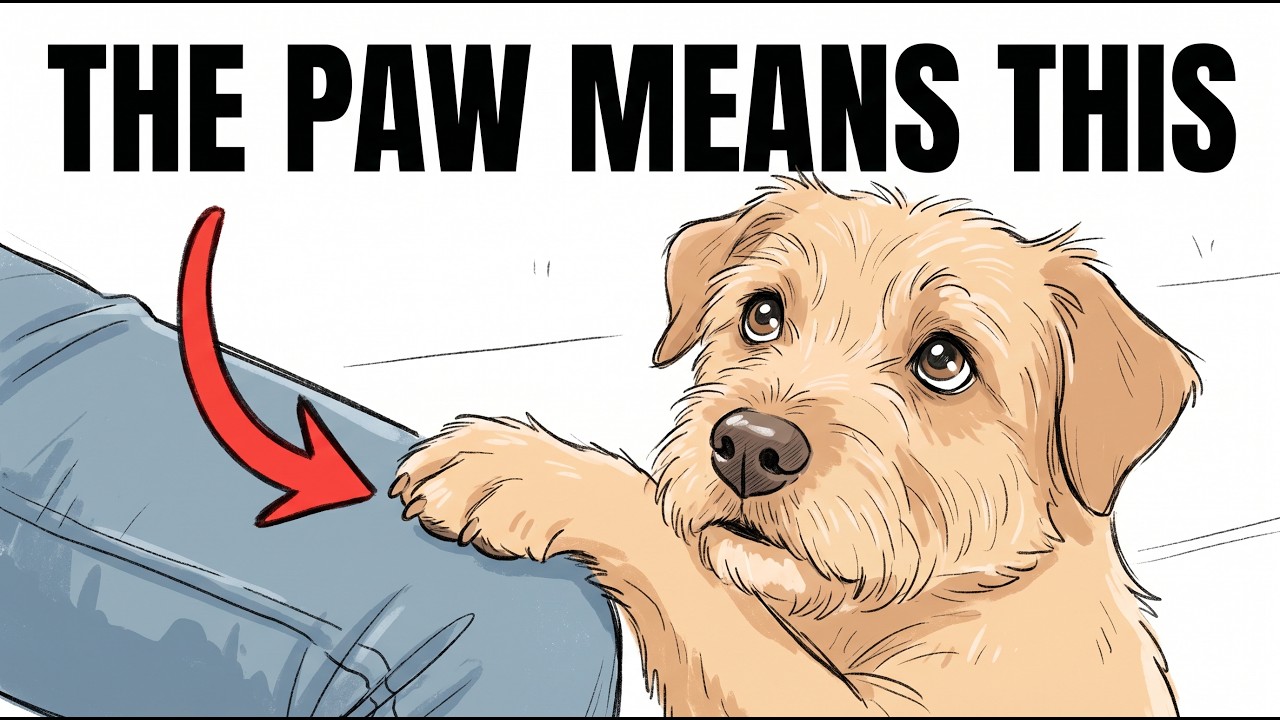 New insights from behavioral scientists and long-term observational studies are now revealing that this small gesture is actually a sophisticated form of silent communication, a language your dog has been using every time they reach out to touch you. The meaning changes depending on context, on your emotional state, on the history between you. And once you learn what your dog is really saying, you will never see that quiet moment the same way again.
The first and most profound truth is this: your dog is not using their paw the way you use your hand. Paws are built for digging, running, stabilizing, playing. They are functional tools, not instruments of tenderness.
So when your dog deliberately, gently, and without any external trigger places that paw on your body, they are performing an act that goes against their own biological design. They are using a part of themselves that was never meant for affection to express affection anyway. That is not a habit.
That is a choice.
In canine social structure, deliberate physical contact initiated without food, excitement, or command is one of the purest expressions of social bonding that exists. Your dog could lie next to you without touching. They could rest nearby without any contact at all.
But in that quiet moment, they chose to reach out and place a part of their body against a part of yours. The only beings dogs reserve this kind of unprompted, deliberate contact for are the ones their nervous system has filed under safe, under mine, under family. The next time your dog rests a paw on your knee while you watch television, you are not being inconvenienced.
You are being held.
The second meaning is about how your dog asks for attention without demanding it. Some dogs bark, whine, jump up, or stare with those eyes that stop you in your tracks. But another kind of dog exists, a dog who has learned over time that the quiet ask works better than the loud one.
The paw on your leg is often that quiet ask. It is your dog saying, I am here. I would like to be acknowledged, but I am not going to make a scene about it.
And the reason this matters is because it tells you something about the relationship you have built. Dogs who use the paw gesture for attention are usually dogs whose owners respond well to it. They have learned that this gentle signal produces a result.
A dog who has to bark or jump for attention is a dog whose softer signals have been ignored for too long. A dog who reaches out with one paw is a dog who trusts that you will see it. That distinction is worth sitting with because the dog placing their paw on you right now is showing you something important about the kind of person you have been to them.
Quiet enough to notice. Present enough to respond. Patient enough to let them ask in their own way.
That is not a small compliment.
The third meaning is rooted in hard science. Research conducted at Linköping University in Sweden found that physical contact between bonded dogs and their owners produces measurable physiological changes in both species at the same time. Cortisol drops.
Heart rate slows. Oxytocin, the bonding hormone, rises in both the human and the dog. But here is the part most people never hear: the effect is strongest when the contact is initiated by the dog rather than the owner.
 When your dog reaches out and places their paw on you, their body is not just expressing closeness. It is actively regulating itself through you. And yours is doing the same through them.
Night after night, evening after evening, sitting together on the sofa with their paw resting on your hand, you are both engaged in a quiet biological exchange that neither of you fully understands but both of you depend on. Your dog is not just touching you because they like the feeling. They are touching you because their nervous system has learned that contact with you produces calm.
Real, measurable, physical calm. Their breathing slows. Their muscles soften.
The stress chemistry in their body begins to settle. You are not just their companion in those moments. You are their off switch.
The fourth meaning is something every owner has experienced but few have named. Watch carefully when your dog places their paw on you next. Are you sitting in a particular way?
Did you just sigh? Have you been quieter than usual? Has your body language shifted?
Because there is a specific kind of paw placement that dogs reserve for moments when they have detected something in you that you may not have fully registered yourself. Dogs are extraordinarily sensitive to changes in human emotional state. They read your scent, your posture, your breathing, the microexpressions in your face that you cannot control and would not notice in yourself.
When something shifts in you, sadness, anxiety, illness, even the early warning signs of something physical that has not surfaced yet, your dog often knows before you do. And one of the ways they respond is by placing their paw on you. It is not random.
It is not coincidence. It is a deliberate, quiet form of contact that says, I noticed. I am here.
I am not leaving. Owners describe this experience again and again. They are sitting in a difficult moment trying to hold themselves together and their dog walks over and rests one paw on their leg.
They had said nothing. They had given no obvious signal. But the dog had read them anyway.
That is not your dog being lucky. That is your dog doing exactly what their biology has built them to do. Staying connected to the emotional state of the human they have bonded to and offering contact when contact is what is needed.
The fifth meaning is the part that most people find unexpectedly emotional. Your dog is not a creature that uses words. They cannot say I love you.
They cannot say I missed you. They cannot say I am glad you are home. They cannot say I have been waiting for this moment all day.
 But they can place their paw on you. In canine social structure, physical contact between bonded individuals is one of the primary ways relationships are maintained. Wild canids use it constantly.
They lean, they touch, they press against each other. They use their bodies to communicate connection in a way that does not require sound or expression. Your dog has carried that wiring forward.
When they walk over to you in the middle of an ordinary moment and place their paw on your leg, they are doing what their ancestors did with the members of their group for thousands of years. They are confirming the bond. They are saying, You are mine and I am yours.
We are still connected. I am still part of you. And the reason it lands so deeply when you start to understand it is because we live in a world where humans rarely tell each other these things, either.
But your dog is telling you every single day in the only language available to them. Once you start receiving that language properly, every one of those small touches becomes something different. Not a request.
Not a habit. A message.
The sixth meaning is about repair and reassurance. Has your dog ever placed their paw on you after something has happened? After you raised your voice?
After they did something they sensed you did not like? After a moment of tension in the house? After you came home from a difficult day and were not yourself.
That paw is rarely about the thing they did. It is about the disconnection they sensed. Dogs do not understand the concept of right and wrong the way humans do.
What they understand is the emotional temperature between you. When that temperature shifts, when something feels off, when distance enters the room, when your usual warmth disappears, your dog feels it before they understand why. And the paw is one of the ways they ask if everything is all right.
It is a small bid for repair, a quiet offering, a way of reaching across the space that has appeared between you and saying, Are we still us? Most owners respond to this without thinking. They reach down.
They place their hand over the paw. They speak softly. They reset.
And in that moment, something repairs that neither of you ever named. That is not a coincidence. That is your dog using one of the simplest tools available to them to keep the relationship intact.
They are not asking to be forgiven for some specific mistake. They are asking to be reassured that whatever happened, you are still theirs.
 When your dog places their paw on you, they are not asking for one thing. They are speaking to you in a dozen different ways at once. They are offering closeness.
They are asking for attention. They are regulating their nervous system through you. They are checking on you.
They are reminding you that you belong to them. They are repairing the quiet moments of distance that appear in any relationship. And all of it happens through one small gesture that you have probably received hundreds of times without ever fully decoding it.
The paw on your knee in the evening is not a coincidence. It is not an accident of comfort. It is your dog saying, in the only language they have, that out of everyone and everything in their world, the place they want to be is here.
Touching you. Connected to you. Anchored to you.
That is not a habit. That is love in the only form they have ever known how to give.
Every day, in homes across the world, this silent conversation repeats itself. The dog walks over, sits beside their human, and gently places a paw on a leg. And now, for the first time, the full emotional depth of that single touch is being understood.
The science is clear. The behavior is documented. The message is unmistakable.
Your dog has been speaking to you through that paw all along. And if you have ever wondered what they are really saying, you now have your answer.
This is not just a moment of comfort. It is a biological bond that spans thousands of years of evolution. It is a relationship built on trust so deep that a single touch can lower stress hormones in both species simultaneously.
It is a daily affirmation that, in a chaotic world, you are the safe place your dog returns to again and again. And it is happening every time that paw rests on your skin.
The next time your dog places their paw on you, pause. Look down. Recognize what is happening.
You are not being bothered. You are not being used for convenience. You are being chosen.
You are being held. You are being told, without a single word, that you are the center of their universe. And that, perhaps, is the most breaking news of all.