The gloves landed at my boots with a wet slap that silenced the entire block.
Marcus Brooks didn’t just challenge me that Labor Day afternoon. He handed me the only invitation I had been waiting for since the day his family moved in and started treating my daughter like prey.
If a story about a mother who buried her past to protect her child has ever hit you in the chest, stay with me. What follows is not a fairy tale. It is the slow, cold dismantling of an empire that mistook money for power.
I had spent ten years in places where the air itself tried to kill you. Fallujah. Kandahar. Forward operating bases so remote the helicopters never landed—they kicked the pallets out the back and banked hard while the ground fire chased them. I earned the rank of Major the only way that mattered: one close call at a time. My specialty was reading people the way a surgeon reads an X-ray and ending threats with the least possible noise. The men and women who served under me still asked for my team on the next rotation.
When I came home to the quiet Virginia suburbs, I locked every medal, every citation, every classified file behind a wall thicker than any federal judge could open without three separate signatures. I told the world—including my own sister—that I was a GS-7 administrative clerk pushing paper in a basement office at the Department of Defense. The cover was perfect. The mission that mattered now was raising Emma in peace.
For four months it worked.
Then the matte-black G-Wagon rolled down our street at six in the morning, followed by moving trucks that seemed to carry an entire lifestyle. Victor Brooks had bought the estate next door. Logistics tycoon. Self-made in freight, or so the neighborhood gossip claimed. Within forty-eight hours the low wooden fence I had built by hand became a border between two worlds.
His son Marcus was twenty-four, two hundred thirty pounds of steroid-swollen muscle packed into tank tops two sizes too small. He chained a heavy bag to a steel post right against our property line so every punch rattled my kitchen wall. I watched from behind the curtain, cataloguing the open stance, the dropped guard, the flat-footed weight. He trained to look dangerous in a mirror. I had trained to end people in the dark.
Victor drove past my driveway twice that first week, slowing to a crawl so the engine could announce him. His eyes swept my ten-year-old SUV, the unpainted porch railing, Emma’s purple bicycle. He looked at my life the way a man looks at a stain on a new suit.
My sister Jenna appeared on a Thursday without knocking. She had married Marcus two years earlier and now lived next door in the master suite. She spent twenty minutes describing Italian marble and heated floors that cost more than my truck, then sighed over my laminate counters and thrift-store curtains.
“You could have so much more if you just tried a little harder, Claire. That government salary isn’t doing you any favors.”
I washed dishes and let the insults hang until she left. Outside, the heavy bag kept thudding.
Marcus did not stay on his side of the fence. He forced elderly delivery drivers into the wet grass. He made neighborhood kids ride into the street. One afternoon he kicked old Mr. Henderson’s garden hose so hard the nozzle cracked against the curb. Nobody spoke.
I tracked his patterns the way I once tracked hostile patrols outside Jalalabad.
Then came the hot July afternoon when Emma was washing the SUV, humming to a pop song through the open window. Marcus crossed the property line, reached through the driver’s side, and twisted the radio knob until the entire plastic assembly snapped off in his hand. He dropped the broken piece on the wet asphalt and growled at my eleven-year-old daughter.
“Garbage music. Turn it down next time.”
Emma’s sponge hit the concrete. Her chin trembled. She was too frozen to scream.
I was six paces from the back door when the snap reached me. My threat assessment went from green to red in under a second. Pulse steady at sixty. Hands loose. Weight forward on the balls of my feet. I walked down the driveway with the unhurried pace of someone who had done this in far worse places.
I stopped four feet from him.
“Marcus. You just crossed a line. Don’t ever touch my property or threaten my daughter again.”
He snorted, puffed his chest, towered over me by eight inches and a hundred pounds.
“What are you going to do about it? Sue me? You’re just some washed-up old woman living off a pathetic military paycheck.”
He turned and swaggered away, tossing the broken knob like a trophy.
I held Emma until the shaking stopped. Over her shoulder I watched him disappear behind the fence.
Marcus Brooks had just placed himself on my active target list.
And I still had not shown him a single thing.
August arrived with heat and noise. Victor threw a backyard party to celebrate Marcus winning a plastic trophy at a semi-contact tournament with eight fighters—half of them teenagers. Marcus had advanced by forfeit when an opponent pulled a hamstring. The speaker system rattled every window on the block.
On my side of the fence, Emma had three friends over for a summer reading assignment. Quiet girls with textbooks and highlighters. Marcus spotted them through a gap in the boards. He dragged his sparring gear to the property line and began throwing hyper-aggressive shadow strikes, grunting loud enough for the girls to hear every exhale. Spinning kicks snapped through the top branches of the lilac bushes I had planted the year Emma was born. Between kicks he whistled low and flexed, watching to see if the girls were watching him.
Emma’s text arrived three words long: Mom, he’s scaring us.
I walked to the fence with the measured pace that keeps mistakes from happening.
“Take your circus somewhere else, Marcus. You’re bothering the kids.”
His ego detonated. Being corrected in front of teenage girls was more than the steroids could process. He stomped across the line in three heavy steps, grabbed a fistful of my shirt collar, and yanked me forward hard enough to lift my heels.
“You dare give me orders? I could snap your neck right now.”
Muscle memory overrode every civilian restraint I had practiced for four months. In less than a second I pivoted, locked his wrist, drove my thumb into the median nerve cluster on the inside of his forearm, and hyperextended the elbow past its natural point. The move was designed to neutralize a larger attacker without bruises, without broken bones, without evidence.
Marcus dropped into the grass like his legs had been unplugged. A strangled, airless sound left his mouth. His right arm spasmed, fingers curling into a claw.
I released the lock, jumped back two steps, and plastered wide-eyed shock across my face.
“Oh my God—careful, Marcus! Did you trip on a tree root?”
The girls at the picnic table stared, then one giggled and they returned to their books. From every other angle it looked like he had simply charged and face-planted.
He crawled away on hands and knees, arm curled against his ribs, face purple with humiliation.
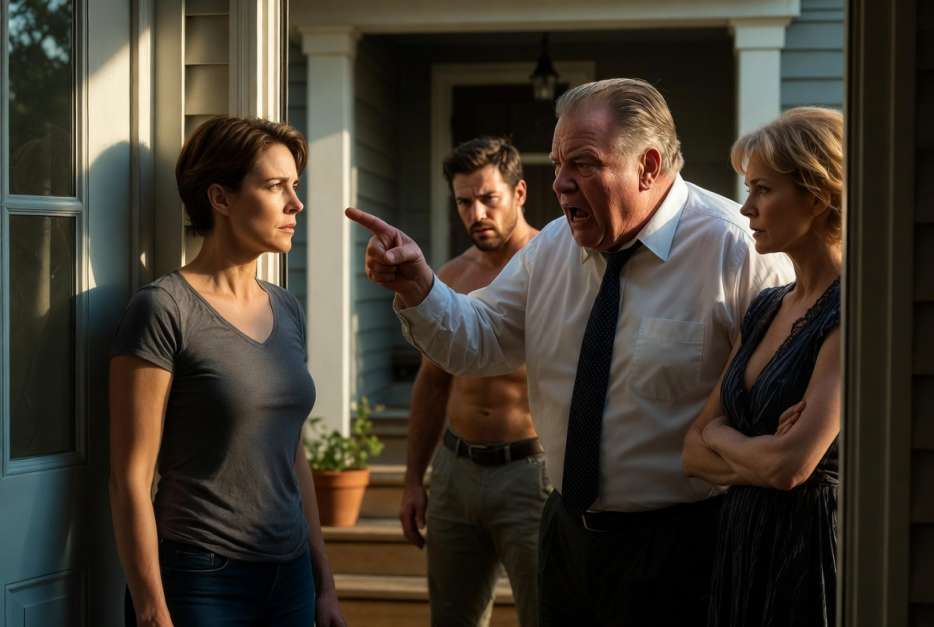
One hour later the front door shook under heavy fists. I opened it to find Victor Brooks filling the frame, face the color of raw beef. Marcus stood beside him cradling the spasming arm. And right behind them, arms crossed, expression detached, stood my sister Jenna.
My own blood, already on their side.
“You dare put your hands on my son,” Victor screamed. Spittle hit the doorframe. “He told me you used some dirty trick.”
I stayed rooted in the doorway, posture loose, hands visible.
“Check your own security cameras. Marcus attacked me first. He tripped.”
Victor was not interested in cameras. He stepped into the threshold and jabbed a thick finger so close to my eye I could smell the whiskey and tobacco.
“Listen to me, you pathetic soldier. I have money and power in this neighborhood. If you keep making trouble for my son and your sister, I will sue you into the ground. I will take this house and let Marcus smash your face in.”
I looked past him, past Marcus, and locked eyes with Jenna. I waited. I gave the blood connection every chance to mean something.
She rolled her eyes and let out a long, theatrical sigh.
“Stop causing drama, Claire. You’re just jealous because my husband and I are richer than you.”
Something in my chest turned to cold ash. Not the hot flash of anger. The quiet, permanent kind that settles after a fire has already gone out.
I reclassified my own sister as a hostile target.
I closed the door in their faces. The lock clicked like a rifle bolt.
On the other side, Victor was still screaming.
I sat down at the kitchen table and helped Emma with long division. My hand did not shake.
But the line had been drawn. And I had just invited them to cross it in public.
Labor Day. The entire neighborhood gathered at the end of the block for the annual barbecue. Mr. Henderson’s ancient charcoal grill. Checkered tablecloths. Kids running through a sprinkler. Paper lanterns strung between the oaks.
I stood near the grill holding a paper plate, talking to Mr. Henderson about his roses, when the Brooks men came marching down the street flanked by four of Marcus’s dojo friends. They took up the entire sidewalk, forcing Mrs. Patterson and her walker onto the grass.
Marcus wore a sleeveless compression shirt and white athletic tape on his fists. Victor walked behind him like a promoter escorting his fighter to the ring.
Marcus locked onto me from thirty yards away. He shoved a neighborhood kid so hard the boy dropped his hot dog. Conversations died. The music cut off mid-song.
He stopped five feet in front of me and threw a pair of MMA gloves at my boots.
“Put the gloves on, almighty sister-in-law. You think that cheap trick that made me trip was impressive? I challenge you right here, right now, in front of everyone.”
Victor laughed from the back of the crowd, arms folded, actively cheering for his son to beat a woman in front of children on a holiday.
Forty people stood frozen with plates and cups in their hands. The sprinkler hissed. The charcoal popped.
Emma stood at the edge of the lawn, face white, fingers gripping the hem of her shirt so hard her knuckles looked like stones. She was looking at me the way a child looks at the only person who has ever made her feel safe.
I understood then, with a clarity that cut through every layer of camouflage I had built, that if I backed down the psychological terrorism against my daughter would never stop. Marcus would own the street, the porch, the flinch in Emma’s shoulders every time a large man raised his voice.
I set the paper plate down. Wiped my hands. Gave Emma one slow, reassuring nod.
Then I unzipped my jacket, let it slide off my shoulders, and stepped into the center of the lawn in a plain gray T-shirt and tactical boots. No gloves. No tape. No theatrics.
“One rule,” I said, voice dropping an octave. Ten years of careful camouflage fell away in a single sentence. “When you want to quit, stay flat on the ground.”
Marcus burst into arrogant laughter and bounced on his toes, throwing flashy shadow punches for the crowd. He had no idea he had just stepped into the kill zone of a machine built to end fights, not win them.
He charged without a countdown—left jab, heavy overhand right designed to take my head off. To the civilians it looked terrifying. To me it telegraphed a full second early. His shoulder dipped. His guard dropped. His entire decision cycle was choked by ego.
I stepped inside the arc of the hook. His fist tore through empty air six inches behind my head. I pressed both palms against his tricep and chest and redirected two hundred thirty pounds of uncontrolled force. Simple physics. He stumbled past me and nearly smashed face-first into the asphalt.
The crowd stayed dead silent.
He spun, face dark red, and came harder—wild spinning roundhouse, the same kick that had won him the plastic trophy. The second his back turned, he took his eyes off the target for one full second. An eternity.
I stepped into the blind spot, hooked the heel of my boot hard behind his left ankle, and drove a palm strike through his shoulder blade. Rotational force, locked ankle, pressure through center of mass.
Marcus went airborne. His body rotated parallel to the ground for one suspended second before slamming into the hard-packed earth with a bone-rattling thud I felt through my boots. The impact drove every molecule of air from his lungs.
Before he could suck in a breath I was on him. Hips dropped. Full weight on his torso. Forearm across the back of his neck, pressing cervical spine toward the ground. Pinned face-down, cheek grinding into dirt.
“Tap the ground, Marcus,” I whispered three inches from his ear. “Show your daddy what a loser looks like.”
Five seconds of desperate thrashing. Legs kicking. Free hand clawing grass. Face going from red to purple.
Then his trembling hand rose six inches and tapped the earth three times.
I released. Stood. Adjusted my shirt. Brushed one blade of grass from my knee.
Ninety seconds.
The crowd remained frozen. A burger burned black on the grill. Somewhere a child was crying.
Marcus lay on his side, chest heaving in ragged wet gasps, staring at the sky with hollow eyes. His dojo friends did not step forward.
Victor broke the silence first, face contorted between rage and disbelief. He charged.
I shifted stance, dropped my center two inches, locked eyes on the center of his chest.
“Take one more step, Victor, and I will treat you as a direct threat.”
Survival instinct overrode rage. He froze mid-step. Then he ripped out his phone.
“I’ll make you rot in prison, you psycho.”
Two cruisers arrived in seven minutes. Officers Miller and Davis stepped out. Victor met them halfway, voice rising to a theatrical wail.
“This woman is a discharged veteran with PTSD. She went insane and violently attacked my son without provocation.”
Before I could speak, seventy-two-year-old Mr. Clark stepped forward.
“That is a blatant lie. Marcus challenged and attacked her first. He threw gloves at her feet and dared her to fight in front of the whole neighborhood. Every single person here saw it.”
Sixteen-year-old Tyler raised his cracked phone. The video was crystal clear—Marcus throwing the gloves, the shouted challenge, the charge with fists raised.
Officer Miller watched twelve seconds. Jaw tightened. He turned to Victor.
“If anyone is getting cuffed today, it’s your son for assault. Take him home right now or I arrest both of you for disturbing the peace and witness intimidation.”
Victor’s face cycled through four shades of red. He grabbed Marcus by the good arm and dragged him toward the street like damaged luggage. At the edge of the lawn he stopped and pointed at me, voice dropping to a trembling growl.
“This isn’t over, Claire. I will find out where you work and destroy your military career. I have money and power you can’t even imagine.”
I crossed my arms and watched him go.
I simply stood on the lawn and welcomed his final mistake.
Victor Brooks was a man of his word. Within seventy-two hours he hired a private investigator—former Richmond cop, semi-retired, cheap, and lazy enough not to ask the questions that might have saved his client. The PI ran my name through every civilian database, every public record, every background service available in Virginia.
He hit a wall so hard it must have felt like sprinting into concrete in the dark.
My file listed a GS-7 administrative clerk in a basement office. No photograph. No operational history. No unit. No deployment record. Everything above that clearance required signatures from a congressional oversight committee.
The PI typed a two-page report, billed six hours, and told Victor what he wanted to hear: I was exactly what I appeared to be. A nobody.
But Victor held a card he believed was bigger than any classified file. Brooks Global Transport was aggressively bidding on a forty-million-dollar military logistics contract—armored vehicle shipping and supply-chain work that would triple his revenue and lock in a decade of guaranteed payments. He believed that kind of money bought influence. Bought leverage. Bought people the same way it bought Italian marble.
Using country-club contacts and a state senator who owed him a favor, Victor secured a direct line to General William Brooks—director of federal procurement. No relation, just an unfortunate coincidence of last names that would later feel like cosmic timing.
Victor called on a Tuesday morning. He introduced himself as a major defense contractor and concerned citizen. He described me as a violent, unstable, psychologically damaged veteran who had brutally assaulted his son. He demanded my immediate dishonorable discharge. Then he played the ace.
He explicitly threatened to withdraw the entire forty-million-dollar bid if the military did not fire me and throw me onto the street.
Exactly ten minutes later my encrypted government phone rang—the specific secure tone that only activated from a cleared Pentagon line.
I was pouring a second cup of coffee. I answered.
“Claire,” General Brooks’s voice filled the receiver, deep and graveled and carrying the unmistakable warmth of a man who had just heard the funniest joke of his career. “I just had a nouveau-riche man named Victor order me to fire you.”
He let out a booming, raspy laugh that sounded like gravel rolling inside a steel drum.
“I let him exhaust all of his arrogance,” the general continued, tone shifting to the cold surgical precision of a three-star officer delivering an unappealable verdict. “Then I informed him that you are the lead security assessor holding the bid file for his company. His phone call threatening you constitutes a serious conflict-of-interest and personal-vendetta violation.”
I closed my eyes.
The forty-million-dollar bid was not suspended. Not flagged. Shredded permanently. Every background check, every compliance certification, every security clearance associated with Brooks Global Transport was now stamped with a federal conflict-of-interest violation that would follow the company through every government procurement database for the next two decades. No branch of the United States military would accept a bid from his company. No federal agency would process an application bearing his name.
With one phone call driven by pure uncut ego, Victor Brooks had permanently destroyed his own financial empire.
I thanked the general. He told me to stay sharp. He hung up.
I set the phone down, picked up my coffee, and took a slow, quiet sip.
The fallout arrived with terrifying speed.
The video of Marcus tapping out in ninety seconds spread across every local social-media page and neighborhood group chat within forty-eight hours. Someone uploaded it to a regional sports forum with the caption: “Local MMA hero gets handled by a soccer mom in combat boots.” The comments were merciless. The shares multiplied overnight.
Master Silva, head instructor at the dojo, watched the footage three times frame by frame. Then he called an assembly. Every student lined up on the mat. Marcus stood alone in the center. Silva stripped the black belt in front of thirty people who had watched him strut for years.
“You are banned from this dojo.”
Marcus drove home in silence, locked himself in his bedroom, and did not come out for three days.
Victor’s company entered a death spiral the same week. Losing the contract did not simply cost projected revenue. It triggered a chain reaction his accountants had never modeled because they had never imagined a scenario where Victor’s own mouth was the weapon. Investors who had been promised a guaranteed federal contract pulled funding overnight. Two of the largest warehouse clients terminated leases, citing “reputational and compliance concerns.” The bank that held the construction loan demanded full financial disclosure within thirty days.
The fake veneer of the Brooks empire—built on credit lines, inflated projections, and the arrogant assumption that money could outrun consequence—cracked from the foundation up.
Jenna, my sister, who had chosen heated bathroom floors and a Milan soaking tub over blood, now found herself trapped inside a collapse she did not understand. The marble was still polished. The floors still warm. But the money was evaporating faster than she could spend it, and the man who had promised her luxury was spending nights on the phone with bankruptcy attorneys.
Two months later a white moving truck with no logo idled in the Brooks driveway. They packed their own boxes.
I stood on my porch with a mug of black coffee and watched. Victor carried a floor lamp with a crooked shade. Jenna carried a garment bag and a box of kitchen utensils, designer sunglasses pushed up even though the sky was overcast. She did not look at me. Marcus sat in the back of the cab with his hood pulled over his head, shoulders hunched like a man trying to disappear inside his own body.
They did not look at any of the neighbors. Mr. Henderson stood at his mailbox. Mr. Clark sat on his porch steps. Mrs. Patterson stood at the end of her driveway with her walker. Tyler sat on his front steps with elbows on his knees.
Nobody waved. Nobody spoke.

The entire street stood in quiet collective witness as the family that had terrorized the block packed up their arrogance and broken furniture and drove away.
Mr. Clark raised his coffee mug in my direction—just a small lift of the wrist. A single nod.
I did not gloat. I did not wave. I did not say a word.
The truck turned the corner. The rumbling engine faded until the only sound left was the rustle of leaves and a mockingbird calling from the oak in my front yard.
I smiled. Turned around. Walked back inside.
Emma was at the kitchen table working through a fraction problem, bare feet swinging two inches above the floor. I pulled the notebook toward me, picked up a pencil, and showed her how to find the common denominator.
The pencil scratched softly against the paper. The kitchen was still. The fence outside stood exactly where I had built it—undamaged, unmoved—marking the quiet border of a life that belonged entirely to us.
There is one final detail the neighborhood never learned.
Three days after the moving truck disappeared, a single envelope arrived at my door with no return address. Inside was a photocopy of the private investigator’s original two-page report—the one that had told Victor I was a nobody. Across the bottom, in neat blue ink, someone had written six words:
Next time hire someone who can read a clearance wall.
The handwriting belonged to a man I had once pulled out of a burning vehicle outside Jalalabad. He had retired to Richmond. He had taken the job for the money. And when he recognized the name on the file, he had done the only decent thing left.
He had lied to Victor Brooks just enough to let the man destroy himself.
Sometimes the quietest people in the room are not the ones holding the keys.
They are the ones who already turned the lock and walked away.
If this story reminded you that true strength never needs to shout, and that arrogance always finds the bill it cannot pay, leave a quiet thought below. The ones who understand rarely need to say much.