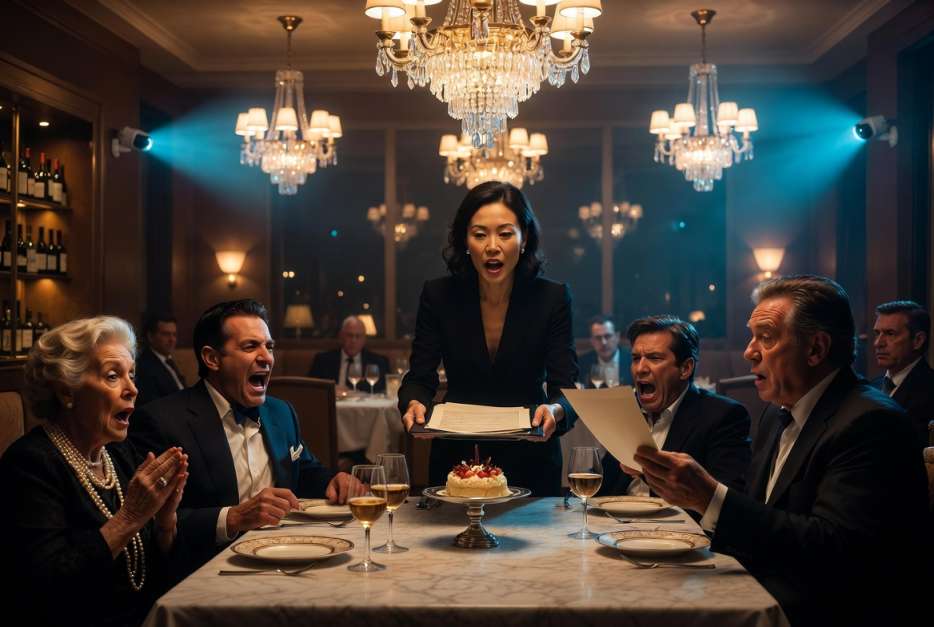
The night my father walked into Forge & Ember without a reservation, the entire dining room seemed to hold its breath.
He didn’t wait for the hostess. He didn’t look at the waiting list that stretched three months deep. He simply cut through the warm light and the low murmur of conversation, dropped a thick folder onto the black marble bar with a crack that made every fork pause, and said, loud enough for the nearest tables to hear, “Sign over fifteen percent tonight, or I call your landlord and have this place locked by morning.”
Four years earlier, the same man had stood in the driveway of the house I grew up in and told me I was dead to him. I had refused the husband they chose. I had refused to pour my savings into the failing catering company that bore our name. I had refused to keep pretending my older brother Derek was anything more than a charming thief who never paid the price for his mistakes. My mother had called me ungrateful. Derek had laughed. My father had removed my name from the family trust with the same calm signature he used on vendor checks.
“You’ll crawl back in six months,” he had said that day.
I never did.
I worked doubles. I slept above a twenty-four-hour laundromat that smelled of bleach and wet concrete. I learned every ugly number that keeps a restaurant alive. Two years later I opened Forge & Ember in a forgotten warehouse district most people still called a wasteland. Critics came. Reservations exploded. By year four we had senators, athletes, and the kind of quiet money that never needs to raise its voice. The articles never mentioned how close I had come to losing everything—one broken walk-in, one investor panic, one winter that nearly froze the pipes. I survived because I studied risk the way my father had never studied people.
Now he stood in front of me in a navy suit that still smelled of success, Derek beside him wearing that crocodile smile, my mother clutching her pearls as if my refusal might physically wound her. At their table sat my aunt, two cousins, and the family attorney, Leonard Pike, who kept his eyes fixed on the floor.
“This is generous,” my father said, tapping the papers. “Fifteen percent in exchange for family protection.”
“I haven’t needed protection for four years.”
Derek leaned across the bar. “You rent this building. Dad knows the landlord. One phone call and your little empire disappears.” My manager, Sofia, flicked a nervous glance toward me. I gave her the smallest nod. Keep the floor moving. Keep the wine pouring. I opened the folder. The contract was crude but lethal: immediate equity transfer, voting rights, full access to the books, and a clause that let my father’s company “manage” every future location.
“You came uninvited,” I said.
My mother’s voice sharpened. “We came to save you from yourself.”
I looked once at the security camera above the wine shelves, then at Leonard’s leather briefcase. He still wouldn’t meet my eyes. That was the first real hint they had no idea who actually owned the walls around them. I closed the folder and smiled the smile I had practiced in every mirror for four years.
“Dinner is on the house,” I said. “Stay as long as you like.”
My father mistook calm for surrender. He sat. He ordered the most expensive bottle on the list. He told Derek, loud enough for half the room, “By dessert she’ll sign.”
They ate like conquerors. Derek sent the rib-eye back twice. He insulted a server’s accent loud enough for neighboring tables to hear. My mother asked Sofia which nights generated the most cash. My father stepped outside once, phone pressed to his ear, and said the words “prepare the management transition” as if the building already belonged to him.
I moved between tables the way I always did—refilling glasses, checking plates, listening. When he finally summoned me with two fingers, I brought a silver dessert tray. No cake. Only a second folder.
He opened it. His smile thinned to nothing.
Inside was a copy of the letter his company had emailed that same afternoon to the property office of the building he thought I rented. It threatened zoning complaints, fabricated fire-code violations, and a coordinated social-media campaign unless the landlord terminated my lease. Leonard’s face went the color of old paper.
“Where did you get this?” my father asked.
“Your assistant sent it. The property office belongs to Ashford Urban Holdings.”
Derek shrugged. “Never heard of it.”
“I know.”
I slid one more page across the white tablecloth: state incorporation records. Ashford Urban Holdings was owned by Ember Group. The sole voting shareholder of Ember Group was me.
Silence hit the private room like a dropped tray.
My father stared. “You expect me to believe a cook bought an entire city block?”
A calm voice answered from the doorway behind him. “Not a cook. A client with excellent counsel.”
My attorney, Maya Chen, stepped in carrying a tablet. Beside her walked Fire Marshal Ortega and a woman my father recognized instantly: Evelyn Shaw, vice president of the bank that still financed his catering company.
My father’s chair scraped back. “What is this?”
Maya’s voice stayed level. “The result of your phone calls.”
The campaign against my “landlord” had triggered more than a legal response. My father had falsely claimed to represent the building owner. He had submitted forged inspection photographs. He had used company email to threaten commercial sabotage. Worst of all, Leonard had attached internal financial projections showing that my father intended to seize Forge & Ember’s revenue to cover overdue loans at the bank.
Evelyn folded her hands. “Those projections indicate material misrepresentation to our institution.”
Derek’s arrogance cracked for the first time. “That document was confidential.”
“Yes,” I said. “And now it’s evidence.”
My father turned on Leonard. “Fix this.”
Leonard removed his glasses slowly. “I advised you not to send the letter.”
“You drafted it!”
“At your instruction.”
The room erupted. My mother accused Leonard of betrayal. Derek lunged for the folder. Sofia stepped between us without a word. Two plainclothes investigators appeared at the doorway as if they had been waiting for the exact second the shouting started.
My father pointed at me, voice shaking. “You set us up.”
“No,” I said. “You walked in, threatened me on camera, ordered food, and explained your plan in front of witnesses.”
His eyes flicked toward the ceiling cameras.
I had not invited them. I had not pressured them. I had simply given arrogant people enough rope and enough time to document their own crime.
Then Maya tapped her tablet.
The dining-room speakers carried my father’s recorded voice, clear and cold: “By dessert, she’ll sign.”
Every guest in the main room heard it.
My father’s face went gray, but he still believed fear could save him. He grabbed the original contract and tore it in half. “There. No deal. No crime.”
Maya did not blink. “Destruction of evidence. Recorded from three angles.”
One investigator stepped forward and identified himself as Detective Harris from the financial-crimes unit. The second produced a warrant authorizing seizure of Leonard’s briefcase, my father’s phone, and Derek’s laptop.
My mother rose so quickly her chair toppled. “This is a family misunderstanding.”
“No,” I said. “A misunderstanding is forgetting a birthday. This is extortion.”
Derek shoved past the detective and headed for the kitchen exit. Sofia locked it remotely. The heavy click of the fire-rated security door sounded like a gunshot in the sudden quiet.
“You can’t trap us!” Derek shouted.
“It opens for staff credentials and emergencies,” Fire Marshal Ortega said. “You have neither.”
My father lowered his voice, the same voice that once made me believe blood was everything. “Elena. Listen to me. Whatever happened before, we can settle this privately. Blood matters.”
For one dangerous second I was twenty-eight again, standing in that driveway with two suitcases while rain soaked through my coat and my mother’s voice called me ungrateful from the porch.
Then I looked around the room I had built.
My servers stood straight. Sofia watched me with the fierce loyalty of someone who had seen every near-death moment of this place. Maya had spent months helping me construct protections no bully could pierce.
“Blood mattered when you abandoned me,” I said. “It mattered when you erased my name. It mattered every single day you waited for me to fail. You don’t get to remember family only when there’s profit on the table.”
Detective Harris collected the torn pieces of the contract. Evelyn informed my father that the bank had frozen further credit pending a full fraud review. Without that line of credit, his company could not make payroll next Friday. The forged complaints also exposed him to civil liability, and Maya had already filed for an emergency injunction barring him, Derek, and their agents from contacting my staff, vendors, investors, or tenants.
Derek stared at the final sheet I handed him. “Tenants?”
The warehouse next door—where my father’s catering company stored every piece of equipment it still owned—had been purchased by Ashford Urban Holdings six weeks earlier. His lease expired in thirty days. Renewal required clean financial disclosures and a compliance record free of fraud.
He had neither.
My mother’s whisper was almost lost under the low music still playing in the main dining room. “You bought our building too?”
“I bought an investment,” I said. “You made yourselves a risk.”
My father’s shoulders finally collapsed.
Leonard began cooperating before the detectives even asked. Derek’s laptop yielded fake invoices, diverted payroll taxes, and payments to a consultant who had filed false complaints against competitors for years. By morning my father and brother were charged with attempted extortion, fraud, and conspiracy. The bank called its loans. The catering company entered receivership within sixty days.
I did not celebrate.
I simply stood in the quiet private room after they were gone and let Sofia lock the front doors for the night. Maya poured two fingers of the same expensive bottle my father had ordered and never finished.
“You okay?” she asked.
I looked at the empty chairs, the crumpled contract still on the table, the security camera that had captured every word.
“I’m still standing,” I said.
Outside, the warehouse district lights glowed against the dark. Somewhere beyond those lights, the second location I had already planned was waiting—quiet, patient, and completely mine.
But the night was not finished with me yet.
Because when I finally opened the folder Leonard had left behind in the scramble, one name on the last page of the bank projections stopped my breath.
A name I had not heard in twelve years.
A name that should not have been there at all.
Twelve years.
That was how long it had been since I last saw the name Claire Ashford written in ink that was not my own.
I sat alone in the private room after Maya and Sofia left, the single desk lamp throwing a hard circle of light across the table. The bank projections Leonard had attached to the threat letter were detailed, almost obsessive. Cash-flow forecasts. Revenue seizures. A projected timeline for folding Forge & Ember into the dying catering company. And there, on the final page, buried in a list of “potential equity partners for stabilization,” was a name I had buried deeper than any memory of the driveway rain.
Claire Ashford.
My grandmother.
The woman my father had quietly erased from family conversations after she sold her shares in the original company and moved to a quiet house on the Oregon coast. The woman who had sent me one birthday card the year I turned thirty and never another. The woman whose maiden name I had quietly borrowed when I formed the holding company that now owned both buildings.
I had chosen Ashford Urban Holdings because it was a name no one in my family still used. A name that belonged to a woman they preferred to forget. I had never told her. I had never asked permission. I had simply taken the name the way a drowning person takes air.
Now it was staring back at me from a document my father had intended as a weapon.
Maya returned at midnight with two cups of coffee that had gone cold in the takeout bags. She sat across from me and waited.
“She doesn’t know,” I said finally. “About any of this. About the company. About the buildings.”
“Do you want her to?”
I didn’t answer. Outside, rain had started—soft at first, then steady against the high windows. The same kind of rain that had soaked my coat the night they cut me off. I closed the folder and stood.
“I need to go to Oregon.”
Three days later I stood on the porch of a small gray house that smelled of cedar and old books. Claire Ashford opened the door looking exactly as I remembered and nothing like I expected. Smaller. Sharper. Eyes the same steel gray as mine.
She did not hug me. She simply stepped aside and said, “You look like someone who finally stopped running.”
We sat in a living room filled with photographs of people I did not know. No pictures of my father. No pictures of Derek. Only landscapes and a single faded shot of a young woman who looked like me at twenty-five, standing in front of a restaurant that no longer existed.
I told her everything. The driveway. The trust. The years above the laundromat. The night my father slammed the folder on the marble. The letter. The warehouse. The name I had stolen.
When I finished, she was silent for a long time.
Then she said, “I sold my shares because your father was already forging numbers twelve years ago. I left because I could not watch him destroy what my husband built. I never stopped watching him, Elena. I simply stopped letting him know I was watching.”
She rose, walked to a writing desk, and returned with a thin envelope.
Inside was a stock certificate dated the week I opened Forge & Ember. Ten percent of Ember Group, nonvoting, held in a trust under her name.
“I bought in quietly through a third party the day the first review came out,” she said. “I wanted you to have something of mine that your father could never touch. I never told you because I was waiting to see if you would survive without me.”
My throat closed.
“You knew about Ashford Urban Holdings?”
“I recognized the name the moment the incorporation papers were filed. I smiled for a week.”
She sat again, folded her hands the same way Evelyn Shaw had folded hers in the private room.
“Your father is finished. The bank will take everything. Derek will take a plea. Your mother will pretend none of it happened. But there is one more piece you do not yet have.”
She slid a second envelope across the table.
Inside was a single photograph. My father, twelve years younger, standing in the back office of the old catering kitchen with a man I had never seen. Between them on the desk sat a stack of cash and a ledger that looked exactly like the one Derek’s laptop had revealed.
“That man is the consultant who filed the false complaints,” Claire said. “His name is Ray Kline. He has been blackmailing your father since the year I left. The money your brother diverted was never just for himself. It was payment. Your father has been bleeding the company dry to keep Kline quiet about something that happened the summer before you were cut off.”
I looked up. “What something?”
Claire’s voice dropped. “The summer your cousin’s restaurant burned. The one that was about to undercut your father’s biggest contract. The fire was ruled electrical. The insurance paid. Your father and Kline walked away richer. Derek was the one who made the call that night.”
The room tilted.
My grandmother reached across and covered my hand with hers—cool, steady, the first touch from anyone sharing my blood that had not been a threat or a demand in four years.
“You already own the buildings,” she said. “You already have the evidence that will finish them. But if you want the full story, if you want every door closed so they can never open another, you will need Kline. And Kline only talks to people who can offer him something better than silence.”
I drove back to the city with the photograph in my bag and the weight of twelve years of secrets pressing against my ribs.
Sofia met me at the restaurant before opening. Maya was already there. I laid the photograph on the same private-room table where my father had torn the contract.
“We need to find Ray Kline,” I said.
Maya studied the image for a long time. “Financial crimes already has the diverted payments. If we can connect him to the old fire, the statute may still allow a civil case. Possibly more.”
Sofia’s voice was quiet. “Are you sure you want to keep digging? They’re already finished.”
I looked at the high windows, at the light falling across the empty dining room I had built with my own hands, at the security cameras that had recorded every word of my father’s arrogance.
“They tried to take this from me,” I said. “They tried to take the second location before it even opened. I am done letting them decide what the ending looks like.”
That night, after the last guest left and the chairs were stacked, I stood alone in the renovated warehouse next door—the future second location of Forge & Ember. The space still smelled of dust and old steel. In thirty days the lease would expire and the equipment that once belonged to my father would be gone. In its place I would put new tables, new lights, a new open kitchen that looked out onto the street.
I walked the length of the empty floor and stopped beneath the high beam where the plaque would hang.
Built without permission.
The words felt different now. Heavier. Truer.
My phone buzzed in my pocket. An unknown number. A text that contained only a single sentence and a time.
I hear you’ve been looking for me. Midnight. The old loading dock behind your new building. Come alone or I disappear forever.
Ray Kline had found me first.
I stared at the message until the screen went dark.
Then I texted Maya and Sofia the location, set my phone to record, and walked into the dark.
The loading dock smelled of rain and rust.
I arrived ten minutes early and waited in the shadow of the dumpster where the security camera from the warehouse could still see me. Maya and Sofia were parked two blocks away with the line open on a second phone. Detective Harris had been notified but stayed back—any official presence and Kline would vanish.
At midnight a black sedan rolled up without headlights. The man who stepped out was smaller than the photograph suggested, older, wearing a jacket that had once been expensive. He kept both hands visible.
“Elena Vance,” he said. “Or should I say the owner of Ashford Urban Holdings. Cute name choice.”
“You know why I’m here.”
He smiled without warmth. “Your father paid me for twelve years to keep my mouth shut about a fire that should have put him in prison. Your brother made the call. I made the problem look electrical. The insurance paid. Everyone walked. Then your father started missing payments. I reminded him what I still had. He started diverting money. Your brother helped. The catering company was already dying. I just helped it die slower.”
“I want everything,” I said. “Documents. Recordings. The original ledger. And I want you to tell the detectives the truth.”
Kline laughed once. “And what do I get? A reduced sentence? A pat on the head? Your father is finished. Your brother is finished. Why should I hand you the last piece?”
I stepped closer. The security light above the dock caught the side of my face.
“Because the warehouse you’re standing in front of used to store every piece of equipment your clients still needed. Because in twenty-nine days that lease ends and the only person who can renew it is me. Because I already own the building your other clients rent across town. And because if you walk away tonight, I will make sure every single one of them knows exactly who Ray Kline is and what he did for my father.”
His smile faded.
“You wouldn’t.”
“I already have the photographs. I already have the payment records from Derek’s laptop. All I need is your testimony to close the circle. In exchange, I will guarantee that none of your other clients ever learn your name from me. And I will make sure the civil case against you is the only one that moves forward.”
He stared at me for a long time. Rain dripped from the edge of the dock roof onto the concrete between us.
Finally he reached into his jacket and pulled out a thin flash drive.
“Everything is on here. The original ledger. The call logs from the night of the fire. The insurance adjuster who looked the other way. Your father’s voice admitting it on a recording from 2014. I kept it all because I never trusted him not to try to erase me one day.”
I took the drive. My fingers closed around it like it might disappear.
Kline’s voice dropped. “Your grandmother was the only one who ever scared him. That’s why he paid so much to keep her away. She knew. She always knew. She just never had the proof until now.”
He turned back toward the sedan.
“One more thing,” he said over his shoulder. “Your mother knew about the fire. Not the details. But she knew enough to stay quiet when the insurance check cleared. She chose the money over the truth the same way your father did.”
The sedan disappeared into the rain.
I stood alone on the dock until Maya and Sofia pulled up. Detective Harris arrived five minutes later. The flash drive changed hands. The recording of the entire conversation was already uploading to a secure server.
By morning the financial-crimes unit had enough to expand the charges. By afternoon my father and Derek were denied bail on the new counts of arson-related fraud and conspiracy. My mother was named as a person of interest. Leonard Pike flipped completely and provided the remaining internal emails.
I drove to the restaurant in silence.
Sofia met me at the back door. “You look like you haven’t slept in a week.”
“I haven’t.”
We walked through the kitchen where the night crew was already prepping for service. The smell of roasting garlic and fresh bread should have felt like home. Instead it felt like the calm before a second storm.
Maya was waiting in the private room with Evelyn Shaw and a new face—an attorney from the insurance company that had paid out on the burned restaurant twelve years earlier. They wanted the flash drive contents. They wanted cooperation. They wanted to open a civil recovery action that would strip whatever assets my father still hid.
I signed the papers.
When they left, Maya stayed.
“There’s something else,” she said carefully. “Your grandmother called while you were at the dock. She wants to come for the opening of the second location. She wants to stand beside you when the plaque goes up.”
I closed my eyes.
The second location was scheduled to open in eight weeks. The renovations were already underway. The new dining room would occupy the exact footprint where my father’s equipment had once sat under tarps. The plaque was already ordered.
Built without permission.
I had thought those words were about defiance. Now they felt like something closer to inheritance.
That night I stood again in the empty warehouse, rain still tapping the high windows, and tried to imagine the room full of light and voices. I tried to imagine my grandmother at a corner table. I tried to imagine a future that no longer required looking over my shoulder for the next folder slammed onto a bar.
My phone rang. Claire’s number.
“I heard about Kline,” she said without greeting. “You did what I never could.”
“I only finished what you started.”
There was a long pause. Then her voice softened in a way I had never heard.
“There is one more thing your father never told you. The summer of the fire, the restaurant that burned belonged to your mother’s sister—your aunt who sat at the table that night and watched you refuse to sign. She never knew the truth. She only knew the insurance money kept her from losing everything. Your mother protected the secret to protect the money. That is the real reason they cut you off so completely. You were the only one who might have asked the wrong questions.”
The floor seemed to shift under my feet.
“Does she still not know?”
“No,” Claire said. “And I will not be the one to tell her. That choice is yours.”
I ended the call and stood in the dark for a long time.
Outside, the city kept moving. Inside, the future location of Forge & Ember waited for tables and chairs and the first reservation that would prove the second chapter had begun.
I walked the length of the space one more time and stopped beneath the beam where the plaque would hang.
Then I made the decision that would rewrite the ending no one expected.
Eight months after the night my father tore the contract in half, Forge & Ember opened its second location in the renovated warehouse that had once stored his equipment.
The dining room glowed under warm lights. The open kitchen sent the scent of wood smoke and herbs into the street. Sofia raised a glass at the pass. Maya laughed beside her. Claire Ashford sat at the corner table that would always be held for her, watching the room the way a woman watches something she helped protect from a distance.
Above the entrance, the plaque was already fixed in place.
Built without permission.
I stood beneath it as the first guests arrived and felt the weight of every choice that had led here. The driveway rain. The laundromat nights. The security cameras. The flash drive. The name I had borrowed and the grandmother who had quietly claimed me back.
My mother did not come.
Neither did my father or Derek. They were awaiting trial. The catering company had been sold in pieces. The bank had recovered what it could. The insurance company was still pursuing the civil case. Leonard Pike had received a reduced sentence for his cooperation. Ray Kline was in federal custody.
I had chosen not to tell my aunt about the fire.
Some truths destroy more than they heal. She had sat at that table the night of the threat and watched my father try to take what I built. She had said nothing. I would let her keep the version of the past she needed to survive. The rest belonged to the courts and to the quiet that had finally settled over my life.
On opening night I moved through the new dining room the way I always had—checking plates, refilling glasses, listening to the low hum of conversation that meant people felt safe enough to stay. Sofia caught my eye from across the room and nodded once. Everything was running the way it should.
Near closing, Claire rose and walked with me to the small office behind the kitchen. She closed the door and placed a final envelope on the desk.
“I had my attorney update the trust,” she said. “The ten percent I bought is now yours outright. Nonvoting still, if you prefer. Or voting, if you ever want the extra weight. There is also a provision that any future locations carry a small foundation in my late husband’s name—scholarships for culinary students who have been cut off by their own families. I thought you might like that.”
I opened the envelope. The papers were clean, precise, final.
“Why now?”
“Because you no longer need protection,” she said. “You only need the truth of what you built. And because I am eighty-two years old and I would like to see the plaque every time I visit.”
She kissed my cheek—the first real kiss from anyone who shared my blood in more than a decade—and returned to her table.
I stayed in the office a moment longer, listening to the last of the evening’s laughter.
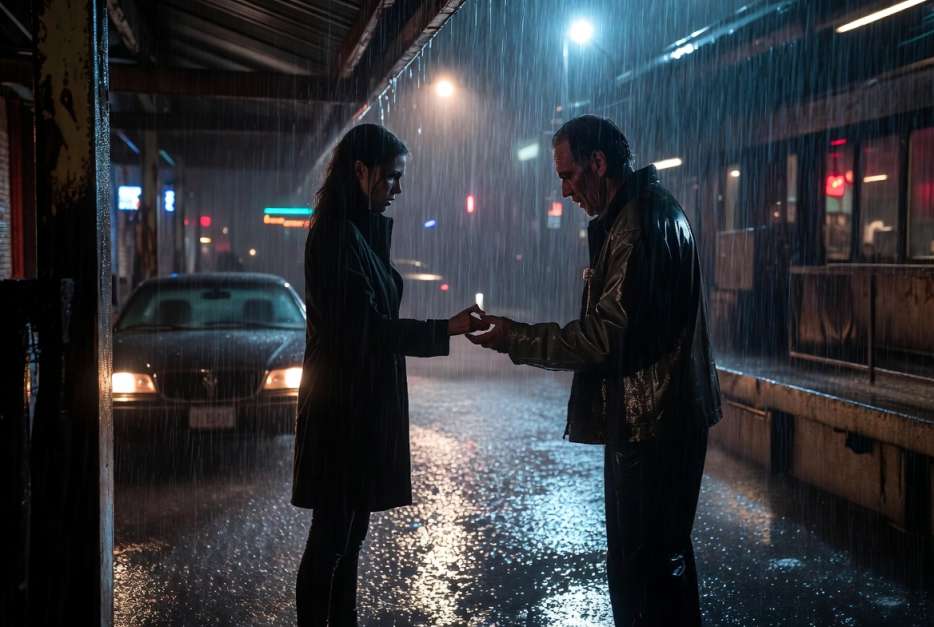
Then I opened the final drawer of the desk and took out the original folder my father had slammed onto the marble bar eight months earlier. The torn contract was still inside, the edges yellowed now. Beside it sat the letter he had sent to the property office, the incorporation records, the photograph of the old fire, and the flash drive copy Maya had insisted I keep.
I carried them all to the industrial shredder in the back hallway and fed them in one by one until nothing remained but confetti.
When I returned to the dining room, the last guests were leaving. Sofia locked the front doors. Maya turned off the main lights until only the warm sconces remained.
Claire stood under the plaque and read the words aloud once more.
“Built without permission.”
She looked at me and smiled the same steel-gray smile I saw in the mirror every morning.
“No,” she said quietly. “Built with every permission that ever mattered.”
I walked her to the car. The night air smelled of rain that had not yet fallen and the distant river. When her driver pulled away, I stood on the sidewalk and looked back at the two buildings that now carried my name in ways no one could take.
The original Forge & Ember glowed behind its windows. The new location waited dark and ready for tomorrow’s first reservation.
I had no need to watch my family fall any longer.
Peace tasted better than revenge ever could.
I opened the side door, stepped inside the quiet restaurant that was entirely mine, and walked into the life they had sworn I could never build.
If this story stayed with you the way it stayed with me while writing it, share it with someone who needs to remember that walking away can be the strongest thing you ever do. The next chapter is already waiting.