The earth beneath the holiest site in Islam is yielding a secret that could rewrite the very foundations of the faith: a growing body of archaeological and textual evidence suggests that for more than a millennium, the world’s 1.8 billion Muslims may have been directing their prayers toward a barren, uninhabitable valley in Saudi Arabia instead of the true birthplace of their religion, a discovery that threatens to ignite a theological earthquake.
Historian Dan Gibson, who has spent three decades traversing the Arabian Peninsula, has pieced together a radical new theory that points to the ancient Nabataean city of Petra, in modern-day Jordan, as the original holy city of Islam, not Mecca. Gibson’s research, which combines satellite imagery, analysis of the oldest surviving mosques and ancient manuscripts, challenges the core historical narrative accepted by every Muslim school of thought. If his conclusions are correct, the implications are staggering: every daily prayer, every pilgrimage, every act of devotion oriented toward the Kaaba in Mecca could be based on a catastrophic misunderstanding that occurred during a bitter civil war in the seventh century.
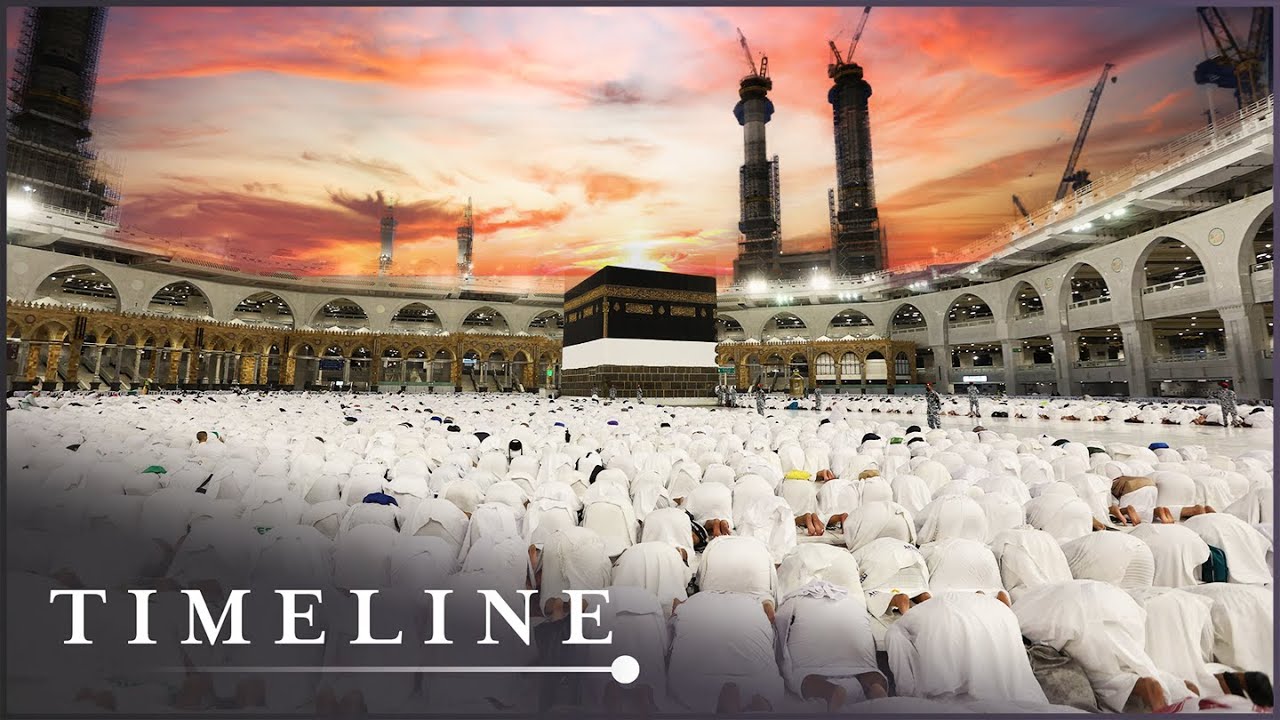 The first cracks in the traditional story appear when one examines the physical reality of Mecca itself. Gibson notes that the city lies in a barren, rocky valley with virtually no rainfall, only ten centimeters per year, and no archaeological trace of a significant settlement predating 800 A. D.
“I asked leading Saudi archaeologists about the record in Mecca,” Gibson recounts in the documentary. “They admitted there is no archaeological record in Mecca before 800 A. D.
No ruins of a great city, no walls, no public buildings, no temples.” This is a stunning void for a place described in Islamic tradition as the “Mother of all Cities,” a bustling trade hub that could raise thousands of men and armies.
Early Islamic texts paint a picture of a fertile, walled city with fields, trees, grass, and flowing water. Descriptions of the Prophet Muhammad’s birthplace speak of grapes, gardens, and a climate capable of sustaining agriculture. Yet modern soil analysis of the Mecca region shows no pollen from trees or vegetation consistent with such descriptions.
The early biographies also mention a city with walls, a feature Petra had, built between steep cliffs, while Mecca never possessed such fortifications. Furthermore, the name “Mecca” does not appear on any ancient map or in any literature before 740 A. D.
, 120 years after Islam’s founding, a baffling omission for what was supposedly a major mercantile center.
Gibson’s most compelling evidence comes from the direction of prayer, known as the qibla. The Quran commands Muslims to face the “Masjid al-Haram,” the Forbidden Gathering Place, but does not name Mecca. Using Google Earth and GPS technology, Gibson plotted the qibla directions of every surviving mosque built during the first one hundred years of Islam, from China to Egypt to Yemen.
The results are stunning: all of them, without exception, point not to Mecca, but to a single point in southern Jordan. That point is the ancient Nabataean capital of Petra. “From north, south, east and west, mosques all face towards one spot,” Gibson says.
“This isn’t some small error. They all specifically point to just one place under this point: the ancient city of Petra.”
 Among these early mosques is the famous “Mosque of the Two Qiblas” in Medina, where tradition holds the Prophet changed the direction of prayer from Jerusalem to Mecca. But when the mosque was torn down in 1987, the original foundation was found to face north, toward Jerusalem or Petra, not Mecca. Similarly, the oldest mosque in China, built by an uncle of Muhammad in 627 A.
D. , faces twelve degrees north of Mecca, directly toward Petra. Even the Great Mosque of Sana’a in Yemen, built in 705 A.
D. , points west of the line to Jerusalem, again aligning with Petra. This pattern holds for more than a dozen early mosques spanning the first century of Islam.
The historical narrative takes a dramatic turn around 683 A. D. during the second Islamic civil war.
A rebel leader, Abdullah ibn Zubair, seized control of the holy city and declared himself caliph. According to early Islamic records, he destroyed the original Kaaba sanctuary, leveled its foundation, and moved the Black Stone. Gibson argues that this war actually involved two separate cities: the original holy city, Petra, and a new location far to the south, what eventually became Mecca.
The Umayyad army besieged Petra for months, using catapults to hurl stones into the sacred precincts. Archaeological excavations at Petra have uncovered hundreds of catapult stones buried in layers dating precisely to this period, a physical confirmation of the battle.
After the Umayyads regained control, a series of massive earthquakes struck Petra, culminating in a devastating tremor in 713 A. D. that destroyed the city’s water supply system.
The city was abandoned. Meanwhile, the victorious Abbasid dynasty, which overthrew the Umayyads in 750 A. D.
 , needed to legitimize their rule. Gibson believes they systematically rewrote history, burning earlier manuscripts, editing older texts, and producing a new, politically correct version of Islam’s origins. The name “Becca,” an ancient Semitic word meaning “valley of weeping,” was easily changed to “Mecca” by altering a single letter in Arabic script.
The Abbasids also changed the qibla direction, aligning later mosques toward the new site in Saudi Arabia where the Black Stone had been relocated.
The documentary notes that the Quran itself only mentions Mecca once, in a late chapter, while the earliest surviving Qurans, written in pre-Kufic script, contain no verses about changing the qibla or the city of Mecca. This suggests later editorial tampering. The Abbasids also controlled the major centers of learning, particularly Kufa in Iraq, where they produced standardized versions of Islamic history and scripture.
All competing accounts were destroyed, leaving only the Abbasid narrative to become orthodoxy.
For the first eight decades of Islam, every mosque faced Petra. Then, beginning around the second century, some mosques begin to point to Mecca, while others point midway between the two sites, as if builders were confused or trying to compromise. By the late eighth century, the Abbasid capital Baghdad had a mosque pointing solidly toward Mecca, solidifying the change.
If Gibson’s theory is correct, the implications for modern Islam are profound. Every prayer, every Hajj pilgrimage to Mecca, every orientation of a mosque could be based on a historical error perpetuated by a political dynasty. Muslims have been commanded by the Quran to pray toward the “Forbidden Gathering Place,” which the evidence strongly suggests was the sacred precinct at Petra, not the Kaaba in Mecca.
The Black Stone, now housed in Mecca, may have originally been relocated from Petra.
Gibson does not claim that the religion of Islam is false, but that its geography and early history have been misidentified. He argues that this is not a deliberate falsehood but a misunderstanding that later historians corrected what they thought was an error, when in fact the earlier traditions were accurate.
 Scholars are divided. Some reject the theory outright, arguing that the qibla directions of early mosques can be explained by imperfect astronomical methods or regional variations. Others point out that the Quranic references to “Becca” are ambiguous and that the traditional link to Mecca is based on centuries of consensus.
However, Gibson’s use of modern technology and the growing availability of ancient manuscripts, combined with the stark absence of pre-Islamic archaeology in Mecca, has led many historians to re-evaluate the conventional story.
The documentary, titled “Sacred City,” presents Gibson’s journey through the deserts of Jordan and Petra, where he shows caves, temples, and boundary stones that match Islamic descriptions perfectly. The cave where Muhammad is said to have received his first revelation, known as the Cave of Hira, is described as facing the city and being near a mountain. In Petra, such a cave exists, while in Mecca the traditional Cave of Hira faces away from the city.
The discovery of hundreds of catapult stones at Petra provides a dramatic link to the historical accounts of the siege of the holy city. A palace in Humayma, twenty-seven miles from Petra, was identified as the home of Muhammad’s family, the Quraysh tribe, which is where the Abbasids found them when they sought a descendant of the Prophet to legitimize their revolt. They did not go to Mecca or Medina; they went to Jordan.
For the average Muslim today, the news is unsettling. If the direction of prayer has been wrong for over a thousand years, is it still valid? Islamic theology traditionally holds that the intention and sincerity of the worshipper are what matter, but the physical act of facing Mecca is considered a fundamental pillar.
The idea that the Quran’s command to face the “Masjid al-Haram” might have been originally fulfilled by facing Petra and not Mecca could shake the foundations of religious practice.
Gibson concludes that the evidence is overwhelming: the first holy city was Petra, the place of weeping, destroyed by earthquakes and civil war, and later replaced by a new sanctuary in southern Arabia. The Abbasids, having won the civil war, had the resources and motivation to rewrite history, a task made easier by the earlier destruction of all non-Quranic literature. The result is a story that has gone unchallenged for more than a thousand years.
But now, with satellite imagery, digital libraries, and a new generation of scholars willing to examine the evidence without fear, the truth is beginning to emerge. The documentary urges Muslims to consider whether they have been misled by Abbasid propaganda and to re-examine the sources of their faith. The question is no longer academic: it is a matter of prayer, pilgrimage, and identity.
The sacred city may not be where worshippers think it is, and the direction of prayer may have been wrong for more than a millennium. The breaking news is that the earth under Islam’s holiest site is telling a different story, one that changes everything.