The morning light in my kitchen still hit the old oak table the exact same way it had for twenty-five years.
I sat there in my robe, coffee gone cold, staring at the engagement announcement my son had texted me the night before. No phone call. Just a screenshot of an elegant cream card with gold lettering and a venue address that made my stomach tighten.
Thomas was getting married in six weeks.
I should have been happy. I tried to be. I even smiled at the photo of him and Zoe standing in front of her parents’ sprawling white house in the hills. She looked like she belonged in a magazine. He looked… polished. Different. The boy who used to fall asleep on this very table with homework stuck to his cheek was gone.
I called him that afternoon. He answered on the fourth ring, voice low, like he was somewhere he didn’t want to be overheard.
“Mom. Hey.”
“I saw the announcement. Congratulations, sweetheart. She’s beautiful.”
A pause. Then, carefully: “Yeah. Thanks. Listen… about the wedding. It’s going to be small. Intimate. Mostly Zoe’s side. Her parents are handling everything.”
I waited.
“They suggested… it might be better if you didn’t come to the main ceremony. Just the private dinner afterward. With family.”
The words landed like a slap that didn’t make a sound.
I laughed once, sharp. “I’m not family?”
“That’s not what I mean.” His voice tightened. “It’s just… the guest list is very specific. Business associates. People from their world. You’d feel out of place. I don’t want that for you.”
I looked around my kitchen. The chipped blue plates. The faded curtains my late husband had helped me hang when I was seven months pregnant and already a widow. The scuffed floorboards that still held the memory of Thomas’s first steps.
“Out of place,” I repeated.
“I’m trying to protect you.”
“From what?”
He didn’t answer. Somewhere in the background a woman’s voice murmured something soft and expensive. Then the line went quiet for a second too long.
“I have to go,” he said. “We’ll talk later.”
We didn’t.
That night I stood in front of the full-length mirror in my bedroom and really looked at myself for the first time in years. Fifty-two. Economics professor. Decent salary. Decent life. No designer labels. No second home. No inherited money. Just the quiet pride of having raised a boy alone after his father died in his sleep when I was twenty-seven and terrified.
Apparently that pride was not enough.
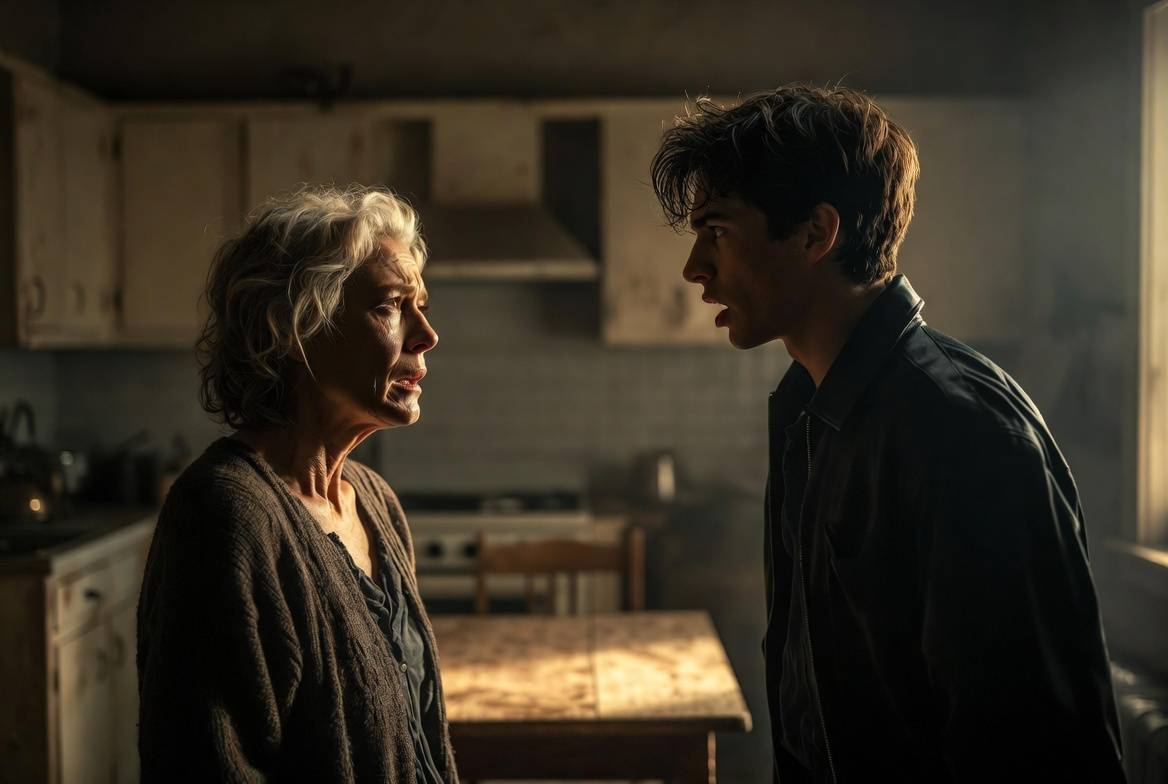
Two days later Thomas showed up at my door unannounced. He looked exhausted. He also looked expensive in a way that still didn’t sit right on him.
“Zoe’s parents met you at the engagement party,” he said without sitting down. “They… they think it would be awkward. You’re not… you don’t present the same way their circle does. It could reflect badly. On all of us.”
I stared at him.
“You’re embarrassed of me.”
“I’m being practical.”
“You’re ashamed.”
His jaw flexed. “Don’t make this harder than it has to be. I’m still your son. I’m just asking you to understand the situation.”
I understood perfectly.
I told him to leave.
He did.
And something inside me that had been holding steady for twenty-five years finally cracked.
That same week, pure coincidence, Thomas had mentioned the venue problem. The place Zoe had her heart set on—an old estate outside the city with rolling hills and a stone chapel—was owned by a man who refused every offer. They had already printed invitations with the address. The wedding was weeks away. Panic was rising.
I knew the owner.
We had gone to college together. Quiet man. Loved his land the way some people love their children. I called him. I told him it was my son. I vouched for him. I promised the place would be treated with respect. After three long conversations, he agreed—on the condition that my name stay out of it. I wanted the surprise. I wanted Thomas to look at me one day and realize I had still been fighting for him even when he stopped fighting for me.
The deal closed. Thomas called me, almost giddy, to say the venue was finally theirs. He never asked how. He just said, “Sometimes things work out when you least expect them.”
I smiled into the phone and said nothing.
Then, three days later, he came to my house and told me I was not invited to the wedding because I did not look rich enough to belong there.
I listened.
I cried once.
Then I asked him to leave again.
And that night I picked up the phone and called the owner of the estate.
I told him everything.
When I finished, there was a long silence on the other end.
Then he said, very quietly, “I have a son too. I understand.”
The next morning the deposit was returned. The contract was canceled within the legal window. The invitations became worthless paper.
I wrote Thomas a letter. I put every detail in it—the secret help, the phone call, the reason the venue had vanished. I drove to his apartment, left the envelope on the doorstep, and blocked his number before I even reached the highway.
I thought that would be the end of it.
I was wrong.
Part 2
He showed up that same night, eyes red, voice shaking.
I opened the door only far enough to see his face.
“Mom. Please. I didn’t know. I swear I didn’t know it was you. Zoe is devastated. Her parents are losing their minds. The invitations—everything—please. Just call him back. Fix it. I’ll do anything.”
I looked at the boy I had raised.
“Anything,” I said, “except treat me like I belong at your wedding.”
“That wasn’t—”
“It was exactly that.”
He started to cry. Real tears. The kind he used to cry when he was small and the world felt too big.
“I was wrong. I was so wrong. Just help us this once. Two weeks. That’s all we need. After the wedding we can talk. Really talk.”
I almost believed him.
Almost.
But the words he had spoken in my kitchen still lived in the walls: You don’t look rich enough. You’ll embarrass us.
I closed the door.
He stayed on the porch for twenty minutes, knocking, pleading, then finally left.
I sat on the floor with my back against the wood and felt nothing for a long time.
A week passed.
No calls. No texts. Silence so complete it felt deliberate.
I told a few close friends what had happened. Their faces changed when they heard the part about the wedding invitation. One of them, a woman who had raised three sons alone, simply said, “Some children only remember who you are when they need something.”
I started to believe her.
Then, two days before the wedding date, my phone rang with a number I didn’t recognize.
Zoe.
Her voice was thick, like she had been crying for hours.
“Mrs. Hale? Please don’t hang up. I need five minutes. Just five.”
I almost did hang up.
Something in the raw edge of her voice stopped me.
“I know you and Thomas are… not speaking. But I need you to know something. I never said you couldn’t come to the wedding. Neither did my parents. We never said anything like that.”
The room tilted.
“What?”
“Thomas told us you refused to attend. He said you didn’t approve of me. That you thought my family was arrogant. That you wanted nothing to do with the wedding. He told us to respect your decision and not contact you.”
I couldn’t speak.
Zoe kept going, words tumbling out. “I was so hurt. I thought you hated me. That’s why I stayed away. And when the venue fell through… he said you must have found out somehow and sabotaged it because you didn’t want the marriage to happen. I believed him. Until today.”
My hands were shaking so hard I almost dropped the phone.
“He lied to both of us,” I whispered.
“Yes.”
We stayed on the line in silence for almost a full minute.
Finally Zoe said, very softly, “I don’t think I can marry someone who would do this. Not to his own mother. Not to me.”
I closed my eyes.
When I opened them again the kitchen looked different. Smaller. Colder.
“I’m sorry,” I told her. “For everything you were made to believe.”
“I’m sorry too,” she answered. “For the part I played by staying quiet.”
We hung up.
I sat at the old oak table and watched the light move across the wood the way it always had.
Somewhere in the city my son was about to lose everything he had built on a foundation of lies.
And for the first time since he was born, I felt no urge to catch him when he fell.
Part 3
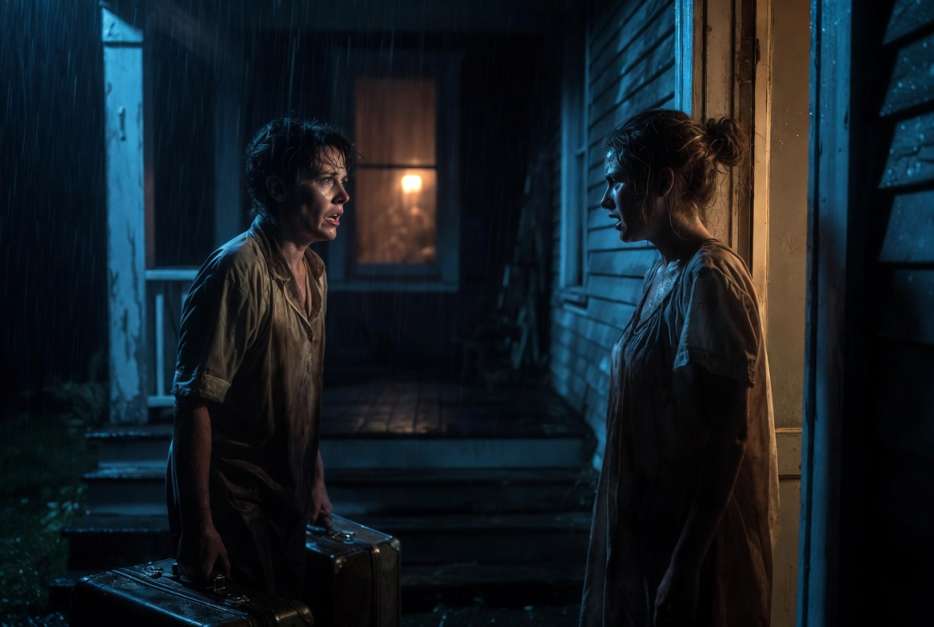
He came back the next evening with two suitcases and a face that looked like it had been crying for days.
I spoke to him through the intercom.
“Go away, Thomas.”
“Mom. Please. She kicked me out. She knows everything. I have nowhere else to go.”
“You have money. You have friends. You have the life you chose.”
“I don’t. Most of my friends weren’t even invited to the wedding. I cut them off when I started trying to fit into her world. I have nothing.”
I stared at the small screen that showed his face. The expensive haircut. The expensive coat. The expensive despair.
“You had me,” I said. “And you decided I was an embarrassment.”
“I was scared. I was trying so hard to belong. I started believing the things I was saying. I forgot who I was.”
“No. You remembered exactly who you wanted to be. Someone who didn’t come from this house. Someone who didn’t come from me.”
He pressed his forehead against the door.
“I’m sorry. I’m so sorry. Please just let me in. I’ll sleep on the couch. I’ll pay rent. I’ll do whatever you want. Just don’t leave me out here.”
I thought about the nights I had stayed up with him when he had fevers. The second jobs. The skipped vacations. The way I had smiled through every parent-teacher conference and every birthday party I attended alone.
I thought about the moment he looked me in the eye and said I did not look rich enough to stand beside him on his wedding day.
“You can stay in a hotel,” I told him. “Or with the friends you still have left. This house is no longer your home.”
His voice broke completely.
“You’re my mother.”
“I was. For twenty-five years I was. You decided that wasn’t enough.”
I turned off the intercom.
He stayed on the porch for almost an hour. I watched from an upstairs window as he finally dragged the suitcases back to his car and drove away into the dark.
I did not cry.
I simply sat on the edge of my bed and felt the weight of a life that had just become permanently quieter.
Two days later the wedding date arrived.
Zoe posted a short statement online. The marriage would not take place. She asked for privacy.
People who still had my number sent me screenshots. Some offered sympathy. Some offered judgment. I answered none of them.
Thomas did not call.
I told myself I was relieved.
I almost believed it.
Part 4
Three weeks of silence.
I went back to teaching. I graded papers. I made dinner for one. I started sleeping through the night again.
Then, on a Thursday evening, a letter arrived. No return address. Just my name in Thomas’s handwriting.
I almost threw it away.
Instead I opened it at the kitchen table.
He wrote that he was living in a short-term rental downtown. That Zoe’s parents had made it clear he was no longer welcome in their circle. That most of the people he had been trying so hard to impress had quietly disappeared. That he had started seeing a therapist. That he understood now how completely he had destroyed the only real relationship he ever had.
He did not ask to come home.
He simply said he was sorry, and that he would wait—however long it took—for the day I might be willing to speak to him again.
I folded the letter and put it in a drawer.
I did not answer.
Another month passed.
Then one afternoon, as I was leaving campus, I saw him standing near the parking lot. He looked thinner. Older. The expensive coat was gone. He wore a simple jacket I recognized from years ago.
He didn’t approach.
He just lifted one hand in a small, uncertain wave.
I got into my car and drove home.
That night I took the letter out of the drawer and read it again.
Something in the careful handwriting—no excuses this time, no justifications—made my chest ache in a way I had not allowed myself to feel since the night he first told me I did not belong at his wedding.
I still did not call.
But the next morning I walked into my office, closed the door, and cried for the first time in weeks.
Not for the son who had rejected me.
For the little boy who used to fall asleep on the oak table with his homework stuck to his cheek.
I was not ready to forgive.
But I was no longer certain I wanted to stay this cold forever.
Part 5
Six months after the wedding that never happened, I received another letter.
This one was shorter.
Thomas wrote that he had moved into a small apartment closer to the university. That he had taken a job teaching high-school history—something he used to talk about when he was young and still believed the world was kind. That he had started volunteering at a community center on weekends. That he still went to therapy every Thursday.
He said he understood if I never wanted to see him again.
He also said that every Sunday he drove past our old house just to look at the porch light. He never stopped. He just needed to know it was still on.
I sat with that letter for three days.
On the fourth day I drove to the address he had written at the bottom.
He opened the door looking stunned, as if he had been waiting for this moment and still couldn’t believe it was real.
We didn’t hug.
We didn’t cry.
We simply sat at a small kitchen table that was nothing like the oak one at home, and for a long time we said almost nothing.
Finally he spoke.
“I don’t expect you to forgive me. I just needed you to know that the person who said those things to you… I’m trying every day not to be him anymore.”
I looked at my son.
Really looked.
The expensive polish was gone. In its place was something quieter. Something that reminded me of the boy I had raised.
“I’m not ready,” I told him. “Maybe I never will be. But I’m here. That’s all I can give you right now.”
He nodded. Tears slipped down his face, but he didn’t wipe them away.
“That’s more than I deserve.”
We sat there until the light outside began to fade.
When I finally stood to leave, he walked me to the door.
“Mom?”
I turned.
“The porch light,” he said. “At the house. Is it still on?”
I thought of the old oak table. The chipped plates. The life I had built alone.
“Yes,” I answered. “It’s still on.”
I drove home through the gathering dark.
For the first time in months, the silence in the car did not feel like an ending.
It felt like the beginning of something slower. Something honest. Something that might, one day, become forgiveness.
Or maybe just peace.
Either way, I was no longer waiting for a son who needed me to be someone else.
I was simply a mother who had finally learned that love without self-respect is not love at all.
And that was enough.