The diamond bracelet flashed once beneath the chandeliers as Celeste Waverly’s hand came down toward the old woman’s face.
Elena Hart caught her wrist before it landed.
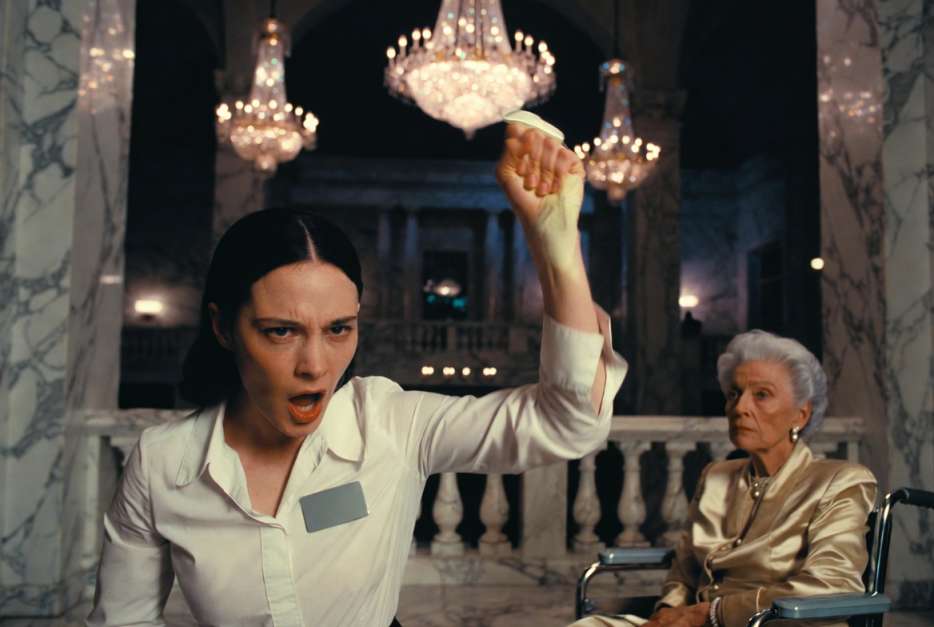
The movement was quicker than thought but not violent. Elena’s left hand closed just above the bracelet, her thumb braced against the inside of Celeste’s wrist, while her other palm steadied the forearm without twisting it. The bracelet gave a small metallic click against Celeste’s cocktail ring. Behind them, the silver wheelchair creaked as its occupant drew back.
“You will not touch her,” Elena said.
Her voice carried farther than she intended.
The string quartet continued for three uncertain notes before the first violinist lowered her bow. Conversation thinned across the museum’s marble atrium. A waiter stopped with six champagne flutes balanced on one hand. Near the central staircase, a woman in emerald silk turned slowly enough that the diamonds at her ears seemed to move before the rest of her did.
Celeste stared at Elena’s hand around her wrist.
Her face did not redden. Nothing so uncontrolled happened to Celeste Waverly in public. Instead, the muscles along her jaw tightened beneath carefully luminous makeup, and her pale eyes shifted from Elena’s white collar to the silver name badge pinned above her left breast.
“Do you know who I am?”
She spoke quietly, each word sharpened by the expectation that quietness would make people lean closer.
Elena did know.
Every employee at the Vale Museum knew Celeste Waverly. Her husband’s family name appeared above the new American Decorative Arts wing, on the invitation to that evening’s reception, and in a temporary vinyl inscription waiting behind a velvet curtain upstairs. The Waverlys had pledged forty million dollars toward the museum’s expansion. Their guests occupied three of the six front tables. Their foundation director had revised the seating plan twice that afternoon.
Elena also knew the elderly woman in the wheelchair had done nothing except place two fingers against the brass edge of the display pedestal to steady herself while examining a seventeenth-century ivory casket.
The glass case had not moved. No alarm had sounded. No object had been touched.
“I know exactly what you were about to do,” Elena said.
Celeste tried to pull free. Elena allowed her arm to move an inch, enough to show she was restraining the strike rather than attacking the woman. The bracelet remained on top of Celeste’s raised wrist, a rigid band of interlocking diamonds shaped like laurel leaves. Elena had noticed it at check-in because Celeste had held up the line while a photographer captured the foundation logo reflected in its stones.
“Take your hand off me,” Celeste said.
“When you lower yours.”
The old woman behind Elena took a shallow breath. She was petite, almost lost inside the polished wheelchair, though her champagne satin jacket caught the warm chandelier light. Short silver-white hair framed a face made delicate by age but not vague. Her pearl earrings trembled slightly. One of her hands rested on the navy padding of the chair; the other remained lifted near the display pedestal, fingers curved as if still remembering where the brass edge had been.
Elena felt the old woman’s surprise more strongly than her own anger. That kept her grip measured.
Celeste looked past Elena at the guests.
She had expected embarrassment to organize the room on her behalf. People usually rushed to spare a wealthy person the experience of being contradicted. A board member might laugh and call the whole thing a misunderstanding. A senior staff member might apologize for the event coordinator’s lack of judgment. Someone would touch Celeste’s elbow and guide her toward a quieter place where her version could become the official one.
No one moved.
The silence was not moral courage. Elena recognized fear when she saw it. Most of the guests were calculating relationships, pledges, photographs, and whether their own names might appear in tomorrow’s society pages beside the word assault.
Celeste’s eyes found Martin Bell, the museum’s deputy director, standing beside the staircase.
“Remove her,” she said.
Martin’s mouth opened, then closed.
He had spent the past three weeks reminding Elena that the Waverly reception needed to be flawless. He had told the catering staff to replace the champagne because Celeste disliked the label. He had moved a senior conservator away from the Waverly table after Celeste complained that the woman’s hearing aid made conversation awkward. An hour earlier, he had instructed Elena to remain visible but forgettable.
Now his gaze moved from Elena’s hands to the wheelchair.
He recognized its occupant.
A man emerged from the semicircle of guests near the north colonnade.
Adrian Mercer did not hurry. At sixty, he remained broad through the shoulders, and his black tuxedo seemed severe rather than festive. His silver hair was swept back from a high forehead. He walked with the unforced pace of someone who had never needed to prove he belonged in a room.
Guests stepped aside before he reached them.
Celeste followed their movement and turned.
The fury stayed on her face for half a second too long. Then she saw Adrian.
Her wrist softened inside Elena’s grip.
Adrian stopped beside the wheelchair. He looked first at the old woman, not at Celeste, and waited until she gave the smallest nod.
“The question,” he said, “is whether you know who she is.”
Celeste’s lips parted.
Adrian rested one hand lightly on the wheelchair’s silver handle.
“This is Eleanor Vale,” he said. “She founded this museum.”
A champagne flute struck the marble somewhere behind Elena. It did not break, but the sound traveled cleanly through the atrium.
Celeste stared at the old woman.
The Vale Museum carried Eleanor’s surname, though few guests had ever seen her. She had not attended a public opening in eleven years. Magazine profiles used the same photograph from her late sixties: Eleanor in a dark suit, standing on the museum steps with one hand in her pocket, looking irritated by the camera. Rumors had replaced her physical presence. Some people said she lived in Switzerland. Others claimed she no longer understood what happened inside the institution she had built.
Eleanor Vale looked at Celeste the way a woman looks at a cracked vase she has already decided not to keep.
“Mrs. Waverly,” she said. Her voice was low, clear, and carried the faint rasp of someone who had spent decades choosing her words carefully. “You raised your hand to strike me.”
Celeste’s free hand fluttered toward her throat, then dropped. The diamond bracelet still glittered between Elena’s fingers like a living thing that refused to be ignored.
“I— she startled me,” Celeste said. The words came out thinner than she intended. “I thought she was going to damage the—”
“The casket has survived three centuries and two world wars,” Eleanor said. “It does not require protection from my fingers.”
Adrian’s thumb moved once across the wheelchair handle. A private signal. Eleanor’s gaze shifted to Elena.
Elena felt the weight of that look the way she had felt the weight of the bracelet—cool, precise, impossible to ignore. She released Celeste’s wrist. The diamonds left a faint red imprint on Celeste’s skin, a temporary brand that would fade long before the evening’s damage did.
Martin Bell finally found his voice.
“Ms. Hart,” he said, stepping forward with the careful urgency of a man trying to extinguish a fire without admitting one existed. “Perhaps you should return to the coat check. Mrs. Waverly has had a long—”
“No.”
The single word came from Eleanor. It cut through Martin’s sentence the way a scalpel cuts silk.
Martin froze. The waiter with the champagne flutes still had not moved. Somewhere near the staircase a phone camera flashed once, then twice, then stopped when its owner realized what he had done.
Eleanor’s fingers found the control joystick of her wheelchair. The chair rolled forward three inches—just enough to place her fully between Celeste and the pedestal.
“This young woman,” Eleanor said, “did what every person in this room should have done. She stopped a violent act. If anyone is to leave, Mrs. Waverly, it will not be her.”
Celeste’s face had gone the color of the marble floor. The luminous makeup could not hide the blood draining from beneath it. Her pale eyes flicked from Eleanor to Adrian to the silent guests and back again, calculating exits that no longer existed.
“This is a misunderstanding,” she said. The quiet voice had lost its edge. “I was protecting the collection. Your collection.”
Eleanor’s smile was small and without warmth.
“My collection,” she repeated. “Yes. I remember it well. I also remember the last time a Waverly hand was raised inside these walls. It did not end well for the person who raised it.”
A collective intake of breath moved through the atrium like wind through dry leaves. Elena felt it against the back of her neck. She did not know the history Eleanor referenced, but the way Celeste’s shoulders locked told her that Celeste did.
Adrian spoke again, voice low enough that only the four of them could hear.
“Celeste. Walk away. Now. Before this becomes something your husband’s lawyers cannot bury.”
Celeste’s gaze dropped to the bracelet still warm from Elena’s grip. For one strange second Elena thought the older woman might tear it off and throw it. Instead Celeste turned, the emerald silk of her gown whispering against the marble, and walked toward the private elevator that served the board wing. Two of her guests peeled away from the crowd and followed like expensive shadows.
The string quartet, uncertain, began a soft Bach piece that no one had requested. Conversation restarted in careful, fractured pieces. Phones disappeared into clutches. Waiters rediscovered their trays.
Martin Bell approached Elena with the expression of a man who had just watched his carefully stacked career tilt.
“My office,” he whispered. “Tomorrow morning. Seven o’clock. Do not be late.”
Elena nodded once. She already knew what tomorrow would bring. The Waverlys’ forty million dollars would not forgive a public humiliation. Martin would not risk his position for an events coordinator who earned less in a year than Celeste spent on a single pair of shoes.
She turned to leave.
“Miss Hart.”
Eleanor’s voice stopped her.
Elena turned back. The old woman’s eyes were the same pale gray as the winter sky over the Hudson the morning Elena’s mother had left for the last time. Something in that color made Elena’s throat tighten.
“Come closer,” Eleanor said.
Elena stepped forward until the scent of Eleanor’s perfume—something old and expensive, iris and cold tea roses—reached her. Adrian remained at the wheelchair’s side, silent, watchful, a man who had clearly stood in this protective position for years.
Eleanor lifted one thin hand and touched the silver name badge on Elena’s chest with a single fingertip.
“Hart,” she said softly. “I knew a Hart once. A long time ago.”
Elena’s pulse jumped hard enough that she felt it in her wrists.
“My mother,” she said, the words leaving her before she could decide whether they were wise. “Catherine Hart. She worked here. Years ago. In the archives.”
Eleanor’s fingertip remained on the badge. The pearl earring nearest Elena trembled once.
“Catherine,” Eleanor repeated. The name left her mouth like something she had been holding behind her teeth for decades. “Yes. I remember Catherine.”
Adrian’s hand tightened almost imperceptibly on the wheelchair handle. His eyes met Elena’s for the first time. They were dark, assessing, and carried the same careful weight Eleanor’s did—the look of people who had buried something precious and were now deciding whether the ground had shifted enough to dig it up.
Eleanor lowered her hand.
“You will not lose your position over this,” she said. “I will speak with Martin. And with the board. Tomorrow morning you will report to my private study on the fifth floor instead of his office. There are things we need to discuss. Things your mother never told you.”
Elena’s mouth went dry.
“I don’t understand.”
Eleanor’s smile this time was different—smaller, sadder, and edged with something that looked almost like fear.
“Neither did she,” Eleanor said. “Until it was too late.”
She turned the wheelchair with a soft electric hum. Adrian fell into step beside her without being asked. The guests parted again, this time with a different kind of silence—the silence of people who sensed they had just witnessed the beginning of something that would appear in the society pages under a much darker headline than “Assault.”
Elena stood alone beside the ivory casket. The glass reflected her face: pale, freckled across the bridge of her nose, dark hair pulled into a knot that had begun to loosen under the chandeliers’ heat. Her white collar felt suddenly too tight. The silver name badge suddenly too heavy.
She pressed her fingers to the place where Eleanor had touched it.
Hart.
Catherine Hart.
Her mother had left the museum when Elena was six. Had left everything—the apartment on West 87th, the small collection of art books, the daughter who still woke some nights reaching for a woman who never came back. The only thing Catherine had taken was a single photograph of herself standing on the museum steps beside a younger Eleanor Vale, both of them laughing at something the camera never captured.
Elena had found that photograph in a box after her mother’s funeral three years ago. She had stared at it until the faces blurred. Then she had applied for a job at the Vale Museum the following week.
She had never expected to meet the woman in the photograph.
And she had never expected the woman to look at her as if she already knew every secret Elena had spent a lifetime not knowing herself.
Across the atrium, Celeste Waverly paused at the elevator doors. For one long moment her eyes found Elena’s. The diamond bracelet caught the light as Celeste lifted her hand—not in threat this time, but in a slow, deliberate gesture that looked almost like a promise.
Then the doors closed.
Elena exhaled. The air tasted of champagne and polished stone and the faint metallic tang of fear.
Tomorrow morning. Fifth floor. Eleanor Vale’s private study.
Things your mother never told you.
Elena’s hand drifted, without conscious thought, to her own abdomen—flat, ordinary, nothing yet visible. The nausea that had woken her at four a.m. for the past eleven days stirred again, low and cold.
She had taken the test that morning. Two pink lines. Clear. Unforgiving.
She had not told anyone. Not yet. Not when the father was a man who had already made it clear he wanted nothing permanent. Not when her job—the only stable thing left in her life—was about to become collateral damage in a war between a billionaire’s wife and the woman who had built this museum with her bare hands.
Elena straightened her collar. Smoothed the name badge. Lifted her chin the way her mother had taught her the one summer they still lived together: as if the world owed her nothing and she owed it even less.
She walked toward the staff exit, the sound of her heels on marble steady and deliberate.
Behind her, the ivory casket waited in its glass case, silent, ancient, and full of secrets that had outlived every person who had ever tried to protect them.
And somewhere on the fifth floor, in a study Elena had never been allowed to enter, a conversation that would rewrite both their lives had already begun.
Elena did not sleep.
The pregnancy test still lay on the edge of the bathroom sink where she had left it at 4:17 a.m., two pink lines staring up like an accusation she could not outrun. The small plastic stick had cost nine dollars. The life it announced would cost everything she had left.
Her studio apartment on the fourth floor of a pre-war walk-up in Inwood smelled of old radiator heat and the single white rose she had bought three days ago because the silence had started to feel dangerous. The rose was already browning at the edges. She sat on the edge of the bed in the dark, fully dressed for work, and watched the city lights crawl across the ceiling like slow fish.
She pressed her palm flat against her stomach. Nothing moved. Nothing showed. Only the low, constant nausea that had become her newest companion—the same nausea that had woken her every morning for eleven days and forced her to buy the test she never wanted to take.
Daniel had been clear. One night. No strings. No future. He had said it while still inside her, voice rough with afterglow and honesty. She had believed him because believing was easier than hoping. Now the consequence of that belief was rewriting her blood.
At 5:40 she stood, rinsed the test down the drain, and brushed her teeth until her gums ached. She pinned her dark hair into the same tight knot she always wore. White blouse. Black trousers. The silver name badge that Eleanor Vale had touched with one thin finger. She looked at herself in the cracked mirror and practiced the face she would need on the fifth floor: calm, professional, empty of secrets.
It did not work.
The subway rattled her downtown under a sky the color of wet ash. By the time she reached the staff entrance of the Vale Museum, the marble steps were still dark with last night’s rain. A security guard named Luis nodded her through without the usual smile. Word had already traveled.
Martin Bell was waiting inside the service corridor, coffee untouched in his hand, face the gray of someone who had not slept either.
“You’re early,” he said.
“You said seven.”
“I also said my office.” His voice dropped. “She sent word. You’re to go straight up. Fifth floor. The private elevator. Code is 1947.” He looked at her the way a man looks at a fuse he cannot extinguish. “Elena… whatever she wants, be careful. The Waverlys are already making calls. Celeste’s husband personally left a message for the board chair at six this morning.”
Elena kept her face still. “Thank you for the warning.”
Martin’s jaw worked. For a second she thought he might say something human. Instead he only nodded toward the elevator bank and walked away, coffee still full.
The private elevator smelled of lemon oil and old money. The brass panel was warm under her fingertip when she entered the code. 1947. The year Eleanor Vale had founded the museum with a single borrowed gallery and a stubborn refusal to fail.
The doors opened onto silence.
The fifth floor was not open to the public. Thick Persian runners swallowed the sound of her heels. Walls the color of aged parchment held portraits of people who looked like they had never once doubted their right to take up space. The air was cooler here, and carried the faint scent of beeswax, leather, and the same iris-and-tea-rose perfume Eleanor had worn the night before.
A single door stood open at the end of the corridor. Light spilled out in a long gold rectangle across the runner.
Elena stopped at the threshold.
Eleanor Vale’s private study looked nothing like the public galleries downstairs. It was smaller, denser, alive with the residue of a life spent refusing to be ornamental. Floor-to-ceiling shelves held books with cracked spines and handwritten labels. A massive partners’ desk of dark mahogany dominated the center, its surface almost bare except for a single silver-framed photograph turned face-down and a crystal decanter of water. Tall windows faced east; morning light poured through them in clean white sheets, catching dust motes that drifted like slow snow. A low fire burned in the marble fireplace even though it was July, as if the room itself rejected the season.
Eleanor sat in her wheelchair near the windows, back straight, hands folded in her lap. She wore a charcoal cashmere cardigan over a white silk blouse. No jewelry except the same pearl earrings from the night before. Adrian Mercer stood to her right, one shoulder against the bookcase, arms crossed, watching Elena the way a sentry watches a gate.
“Close the door,” Eleanor said.
Elena did. The soft click sounded final.
“Sit.” Eleanor gestured to the leather chair opposite the desk.
Elena sat. The leather was cool and expensive and held the faint scent of pipe tobacco that no longer existed in the room.
For a long moment no one spoke. Rain began again against the windows—soft, persistent, the kind of summer rain that made New York feel like it was being rinsed clean of last night’s sins.
Eleanor studied her without hurry. “You look like her,” she said finally. “Not the face. The way you hold your shoulders when you’re afraid and pretending not to be.”
Elena’s fingers tightened on the arms of the chair. “You knew my mother well.”
“I knew Catherine better than she ever allowed anyone to know her.” Eleanor’s voice was steady, but something moved behind her eyes—old grief, carefully locked. “She came to me in 1994. Twenty-two years old. Brilliant. Angry. Carrying a secret she thought would destroy her.”
Adrian shifted his weight. The floorboard under his shoe creaked once.
Elena waited. The nausea rolled through her in a slow wave. She swallowed it down.
“She was pregnant,” Eleanor said.
The words landed like a stone dropped into still water. Elena felt the ripples reach her own abdomen and settle there, cold.
“With me,” she said. It was not a question.
Eleanor inclined her head once. “She refused to name the father. She refused money. She refused every offer of help that came with conditions. She only asked for a job that would keep her close to beautiful things while she decided whether the world deserved another Hart.” A faint, sad smile. “I gave her the archives. She stayed six years. Then one morning she was simply gone. No note. No forwarding address. Only that photograph she left on my desk—the one of the two of us laughing on the steps.”
Elena’s throat closed. She had found that same photograph after the funeral. She had never known it was left behind as a goodbye.
“Why are you telling me this?” she asked.
Eleanor’s gaze did not waver. “Because last night you put your body between me and a woman who would have struck me for the crime of touching brass. Because you carry the same stubborn fire your mother did. And because the Waverlys are not finished with either of us.”
Adrian spoke for the first time. His voice was low, controlled, the sound of a man who measured every word before releasing it.
“Celeste Waverly’s husband, Richard, has already contacted three board members. He is framing last night as an unprovoked assault by a junior employee on a major donor. They want your termination by end of day. Publicly. With a nondisclosure agreement thick enough to choke on.”
Elena’s stomach lurched. She kept her hands still on the chair. “I expected that.”
“You will not be terminated,” Eleanor said. The words were iron. “I still hold the founder’s seat. The bylaws are older than most of the board members’ trust funds. They cannot remove you without my consent. And I do not give it.”
Silence stretched. Rain tapped harder against the glass.
Elena looked from Eleanor to Adrian and back. “There’s more. You didn’t bring me here just to save my job.”
Eleanor’s fingers tightened almost imperceptibly in her lap. For the first time she looked her age—fragile, temporary, fighting something larger than a boardroom war.
“There is more,” she said. “Your mother left something behind when she disappeared. Something the Waverlys have been hunting for twenty-eight years. Something that could destroy the foundation of everything they have built—and everything I have built as well.”
Adrian pushed off the bookcase and crossed to the desk. He opened the top drawer with a small key and withdrew a slim black folder, worn soft at the edges. He placed it on the polished wood between them but did not open it.
“Catherine took a document from the private archives the week before she vanished,” he said. “A letter. Handwritten. Dated 1962. It concerns the true provenance of the Waverly collection—the pieces that form the core of the new wing they are so eager to name after themselves. The letter proves that a significant portion of that collection was acquired through… methods that would not survive modern scrutiny. Or public knowledge.”
Elena stared at the folder. Her pulse beat hard in her throat. “And you think she left it with me? I was six years old when she left. I have nothing.”
“She left you the photograph,” Eleanor said quietly. “She left you the name. And she left you something else—something only a daughter would recognize when the time came.” Her pale eyes held Elena’s without mercy. “Last night, when Celeste raised her hand, she was wearing the diamond laurel bracelet. Do you know why that bracelet matters?”
Elena shook her head. The memory of the cold diamonds against her palm flashed hot.
“It belonged to my mother,” Eleanor said. “It was stolen from this museum in 1971 during a private viewing. The thief was never caught. The insurance paid. The story died. But the bracelet resurfaced three years ago at a Geneva auction—purchased, through intermediaries, by Richard Waverly as an anniversary gift for Celeste. She wears it as a trophy. She has no idea what it represents.”
Adrian’s voice cut in, soft and lethal. “The letter your mother took names the man who arranged the 1971 theft. His surname was Waverly. Richard’s father.”
The room tilted. Elena gripped the chair harder. Rain hammered the windows now, turning the city beyond into a gray smear.
“If that letter surfaces,” Eleanor continued, “the Waverly name becomes radioactive. Their foundation collapses. Their seats on every major board in this city become liabilities. And the forty million dollars they pledged to this museum becomes a public relations catastrophe they cannot survive.”
“And you want me to find it,” Elena said. Her voice sounded distant to her own ears.
“I want you to decide whether the truth is worth the war it will start.” Eleanor leaned forward slightly. The wheelchair creaked. “Your mother ran because she was terrified of what that letter would do to the people she loved—and to the child she was carrying. She chose silence. I am asking you if you will make the same choice… or a different one.”
Elena’s hand moved, almost against her will, to her stomach. She caught herself and forced it back to the chair arm. But Eleanor’s eyes tracked the movement with the precision of a woman who had spent a lifetime noticing what others tried to hide.
The silence that followed was different. Heavier. Intimate.
Eleanor’s voice dropped to something almost gentle. “How far along?”
Elena’s breath stopped. Heat flooded her face, then cold. She had told no one. Not a single living soul. Yet this woman who had known her mother for six years had looked at one involuntary gesture and known.
“Eleven days since the test,” she whispered. “Maybe six weeks. I haven’t… I haven’t seen a doctor yet.”
Adrian’s expression did not change, but something in his posture softened by a fraction—the first crack in the armor.
Eleanor nodded once, slow. “History has a vicious sense of humor. Your mother sat in that same chair, in this same room, and told me she was pregnant with you. She was terrified. Alone. And still she chose to protect a truth larger than herself.” She reached across the desk—slowly, carefully—and laid her thin hand over Elena’s. The skin was paper-dry and warm. “I failed her in the end. I let her disappear. I will not fail you.”
Elena’s eyes burned. She did not cry. She had trained herself out of crying years ago. But the burn stayed.
“What do you want me to do?” she asked.
Eleanor withdrew her hand and nodded to Adrian. He opened the black folder.
Inside lay a single sheet of yellowed paper, heavily creased, protected in archival sleeve. Even from across the desk Elena could see the elegant, old-fashioned handwriting.
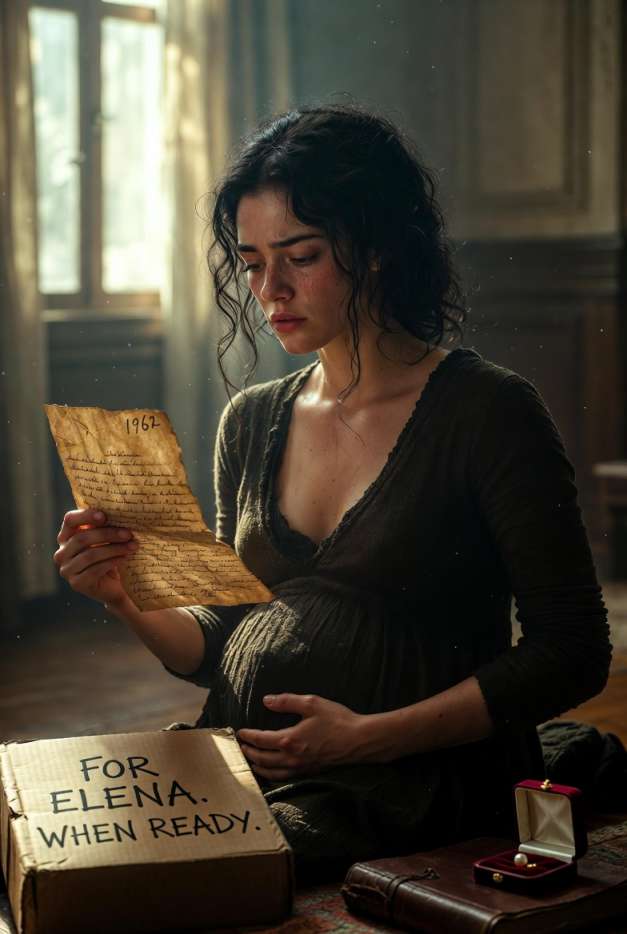
“This is a copy,” Adrian said. “The original is still missing. Your mother hid it somewhere only she—and now, perhaps, only you—would think to look. We have spent twenty-eight years searching every archive, every storage unit, every possible location. Nothing.” He slid a second sheet across the desk. A photograph. Black and white. Catherine Hart, young, fierce, standing in front of a small brick building Elena did not recognize. In her arms she held a cardboard box sealed with packing tape. On the side of the box, written in thick black marker, three words:
FOR ELENA. WHEN READY.
Elena’s vision blurred. She blinked hard. The burn in her eyes became tears she could no longer stop.
“That photograph was taken the day before she vanished,” Eleanor said. “We never found the box. We never found the building. But the bracelet you touched last night… Celeste wearing it… the letter… your mother’s timing… none of it is coincidence. The past is waking up. And it is hungry.”
A soft chime sounded from Adrian’s pocket. He glanced at his phone, face darkening.
“Richard Waverly just arrived downstairs,” he said. “With two lawyers and a publicist. They are demanding an emergency board meeting. Now.”
Eleanor’s expression hardened into something ancient and unbreakable.
“Then we will give them one.” She looked at Elena. “You have a choice to make, child. You can walk out of this room, sign whatever paper they put in front of you, and disappear the way your mother did. Or you can stay, and help me finish what she started.”
Elena stood. Her legs felt unsteady, but her voice did not.
“I’m not my mother,” she said. “I don’t run.”
Something like pride—and something like fear—flickered across Eleanor’s face.
“Good,” she whispered. “Because the war has already begun. And the next move belongs to Celeste.”
Adrian closed the folder with a soft, decisive snap. Outside, thunder rolled across the Hudson, low and long, like a warning the city had forgotten how to hear.
Elena looked down at the photograph of her mother holding the box marked FOR ELENA. WHEN READY.
She was ready.
She just didn’t know yet what the cost would be—for the child growing inside her, for the museum her mother had loved, or for the old woman who had just placed the weight of twenty-eight years of silence into her hands.
From the corridor outside came the sharp, expensive click of high heels on marble.
Celeste Waverly did not wait for invitations.
The door opened without a knock.
Celeste Waverly stepped into the study as if the room had been waiting for her permission to exist. Rainwater still glistened on the shoulders of her ivory trench coat. The diamond laurel bracelet flashed once beneath the cuff when she raised her hand to push back her hood. Behind her stood two men in charcoal suits who looked expensive enough to bill by the syllable, and a woman with a tablet already recording.
Richard Waverly entered last.
He was taller than the photographs suggested, silver at the temples, face arranged in the careful neutrality of a man who had never lost a negotiation he could not afford to lose. His eyes found Elena first, lingered one second too long on the name badge, then moved to Eleanor with the polite contempt reserved for obstacles that refused to die on schedule.
“Eleanor,” he said. The name sounded like a receipt being signed. “I believe we have a situation that requires immediate board attention.”
Adrian closed the black folder with a soft, deliberate motion and slid it into the desk drawer. The key turned. The sound was small and final.
Eleanor did not offer anyone a seat.
“You are in my private study, Richard. Uninvited. State your business and leave.”
Celeste’s smile was a blade wrapped in silk. “We are here because your employee assaulted a major donor in front of half of New York society last night. We have photographs. We have witnesses. We have a press statement ready to go at noon unless this is handled cleanly.” Her gaze slid to Elena. “And by cleanly, I mean her resignation, effective immediately, with a full apology and a nondisclosure that covers the next three generations of her family.”
Elena felt the words land against her skin like cold rain. She did not look away.
Richard cleared his throat. “Celeste is emotional. Understandably. What we want is simple. Miss Hart leaves quietly. The museum issues a statement regretting the misunderstanding. The forty-million-dollar pledge proceeds as planned. Everyone continues breathing.”
Eleanor’s hands remained folded in her lap. Only the slight tremor in her left pearl earring betrayed any tension.
“No.”
The single syllable hung in the air like smoke after a gunshot.
Celeste’s eyes narrowed. “You cannot protect a violent staff member indefinitely, Eleanor. The board will not stand for it. Not when the alternative is watching this institution bleed money and reputation.”
“The board,” Eleanor said, voice soft and lethal, “still requires my signature on any termination of foundation-level staff. That signature will not be given. Not today. Not next week. Not while I am breathing.”
Richard stepped forward. The lawyers behind him shifted like well-trained dogs scenting blood. “Then we will call an emergency vote of no confidence in the founder’s residual powers. The bylaws allow it under extraordinary circumstances. Assault of a donor qualifies.”
Adrian spoke then, quiet enough that everyone had to lean in to hear him. “You would lose. I have already spoken to four board members this morning. Two are prepared to resign rather than vote against Eleanor. One is drafting a counter-statement about donor conduct that includes the words ‘attempted battery.’ And the fourth—” he looked directly at Celeste—“owes Eleanor a debt that money cannot touch. Proceed if you wish. The newspapers will have a feast.”
Celeste’s jaw tightened. For a fraction of a second the polished mask slipped, revealing the raw, furious woman who had tried to strike an elderly founder the night before. Then it snapped back into place.
She turned her full attention on Elena.
“You,” she said softly. “You think you are clever. You think catching my wrist makes you righteous. Let me be very clear, Miss Hart. I will ruin you. Not just the job. Everything. Credit. Housing. Future employment in this city. I will make certain that every door you knock on has already been warned about the girl who assaults donors for sport. And if you are carrying anything—” her eyes dropped, deliberate, to Elena’s still-flat stomach—“I will make certain the father knows exactly what kind of unstable woman he left behind.”
The room went utterly still.
Elena felt the blood leave her face. She had told no one. Not a single person. Yet Celeste had looked at her the way a predator looks at a soft underbelly and known.
How?
Adrian’s posture changed. The quiet sentry became something colder. “That is enough.”
Celeste smiled, small and victorious. “Is it? I wonder what Daniel would say if he knew. He was quite clear with his friends that the night meant nothing. Imagine his surprise when the nothing starts demanding child support.”
Elena’s pulse roared in her ears. Daniel. The name hit harder than any slap. She had never told Celeste his name. She had never told anyone at the museum. Which meant someone had been watching her. Following her. Digging.
Eleanor’s voice cut through the silence like a wire under tension.
“Get out of my study.”
Richard placed a hand on his wife’s arm. “Celeste. We have made our position clear. The board will convene at eleven. We expect a resolution by close of business.” He looked at Eleanor one last time. “For old times’ sake, I hope you choose the path that keeps this museum solvent.”
They left the way they had come—heels sharp on marble, lawyers trailing, the woman with the tablet still recording until the door closed.
The silence they left behind was thicker than the rain.
Elena’s knees threatened to buckle. She locked them. Her hand found the edge of the desk and held on.
“How did she know?” she whispered. “About the baby. About Daniel. I told no one.”
Adrian’s face was grim. “Celeste employs people whose only job is to know things before their targets do. Private investigators. Data brokers. She has been building a file on you since the moment you grabbed her wrist last night. Possibly longer.” He glanced at Eleanor. “They know about the photograph of Catherine. They know you applied here three years ago using your mother’s old employee ID number as a reference code. They have been watching.”
Eleanor turned her wheelchair toward the windows. Rain sheeted down the glass, turning the city into an abstract painting of gray and silver.
“They are afraid,” she said. “The letter terrifies them more than any scandal about a slapped wrist. If Catherine hid it well enough that even I could not find it in twenty-eight years, then the only person who might still locate it is her daughter. That makes you dangerous, Elena. And danger makes people like the Waverlys vicious.”
Elena stared at the closed door. The diamond bracelet. The stolen letter. The box marked FOR ELENA. WHEN READY. The child growing inside her that Celeste had just threatened to weaponize.
She thought of her mother’s face in the photograph—young, fierce, holding that cardboard box like it contained the only future worth protecting.
“I need to find the box,” Elena said.
Eleanor turned back. For the first time that morning, real hope flickered across her features—fragile, almost painful.
“Yes,” she said. “You do. And you will not do it alone.”
Adrian opened a second drawer and withdrew a slim manila envelope. He handed it to Elena. Inside were three items: a key on a faded blue ribbon, a handwritten address on yellowed paper, and a single old subway token from the 1990s.
“Your mother left these with me the week she disappeared,” he said. “She told me to give them to you only if you ever walked back through these doors of your own free will and asked the right questions. The address is a storage facility in Queens that closed in 2009. The building was sold, then abandoned, then partially demolished. But the basement units were never fully cleared. The key still fits one of them. Unit 17-B.”
Elena’s fingers closed around the cold metal. The ribbon was soft with age, the same blue as the dress her mother wore in the only other photograph Elena still owned.
“Why wait until now?” she asked. “Why not give these to me three years ago when I first applied?”
Adrian’s eyes met hers. “Because your mother made me promise. She said the box was only to be opened when you were ready to fight for something larger than yourself. Last night you put your body between Eleanor and violence. This morning you refused to run. You are ready.”
Thunder cracked hard enough to rattle the windowpanes. Somewhere below them, the museum’s main entrance doors opened and closed. Voices rose—board members arriving early, lawyers gathering, the machinery of power beginning to turn against them.
Eleanor reached out and took Elena’s free hand. Her grip was surprisingly strong.
“Go now,” she said. “Before the board meeting ends and Celeste has time to put people on you. Adrian will drive. Take the service exit. Do not use your phone. Do not go home first. The storage unit is the only place left that still belongs to your mother’s silence. Whatever is inside that box… it is the only weapon we have left.”
Elena looked down at the key in her palm. Then at the old woman who had failed her mother and was now trying, desperately, not to fail her. Then at Adrian, who had kept a promise for twenty-eight years.
She thought of the two pink lines. Of Daniel’s voice saying “no strings.” Of Celeste’s smile when she said the word father. Of the cardboard box in the photograph, sealed with packing tape and three words that had waited half a lifetime.
FOR ELENA. WHEN READY.
She closed her fist around the key.
“I’m ready,” she said.
Adrian was already moving toward the private elevator, coat in hand. Eleanor watched them go with eyes that had seen too many goodbyes.
As the elevator doors began to close, Elena heard Celeste’s voice echo up the marble staircase from the floor below—bright, poisonous, and carrying perfectly in the sudden hush of the atrium.
“Find the girl. I want to know every place she has ever slept, every man she has ever touched, and every secret her dead mother left behind. And if that storage unit in Queens still exists… burn it.”
The doors sealed.
Elena’s reflection stared back at her in the polished brass—pale, determined, one hand still pressed protectively over the place where a new life had already begun to rewrite every future she had ever imagined.
Adrian hit the basement button. The elevator dropped.
Somewhere in Queens, a rusted lock on unit 17-B waited for a key that had been kept safe for twenty-eight years.
And somewhere in the rain-soaked city, Celeste Waverly’s people were already moving to destroy it first.
The service tunnel beneath the Vale Museum smelled of wet concrete and old electricity.
Adrian did not speak until the heavy metal door clanged shut behind them and the rain hit their faces like thrown gravel. His black car waited in the narrow loading alley, engine already running, wipers slashing. Elena slid into the passenger seat. The key on its faded blue ribbon burned against her palm.
“Queens,” Adrian said, pulling into traffic without looking at her. “Storage facility off Northern Boulevard. Condemned since 2011. The city keeps threatening to finish the demolition. So far the lawyers have delayed it.” His jaw was tight. “Celeste’s people will not be far behind. She does not bluff.”
Elena watched the city smear past the rain-streaked window. Her stomach rolled with every turn. She pressed her free hand low against her abdomen, a small private shield, and tried not to think about the word father spoken like a weapon in Celeste’s mouth.
“How long have you known about the baby?” she asked quietly.
Adrian’s hands flexed once on the wheel. “I didn’t. Not until Celeste said it. But Eleanor saw it the moment you touched your stomach this morning. She has always been able to read women the way other people read contracts.” He glanced at her. “You should see a doctor. Soon. Stress like this is not kind to the early weeks.”
Elena almost laughed. The sound came out broken. “A doctor. Right. Between being hunted by a billionaire’s wife and breaking into a condemned building to steal my dead mother’s secrets.”
“Not steal,” Adrian corrected. “Reclaim.”
They drove in silence for twenty minutes. The rain thickened. Thunder walked across the boroughs like something large and angry. Elena kept the key clenched so tightly the ribbon’s edge cut into her skin. She welcomed the small pain. It kept her from dissolving.
The storage facility sat behind a chain-link fence crowned with rusted barbed wire. Half the roof had collapsed. Spray-paint ghosts covered the remaining walls—tags, threats, a faded mural of a woman holding a child that someone had tried to black out. Adrian parked two blocks away beneath a broken streetlight.
“We go on foot from here,” he said. “Phones off. If we are separated, you run. Do not wait for me.”
Elena nodded. The nausea had become a living thing now, coiling under her ribs. She swallowed hard and stepped into the rain.
The fence had a section cut long ago and never repaired. They slipped through. Broken glass crunched under their shoes. The main building’s entrance was a dark mouth of twisted metal. Adrian produced a heavy flashlight from his coat. The beam cut a white tunnel through floating dust and the sweet-rot smell of old water damage.
Unit numbers were still faintly visible on some doors. Most had been pried open years ago, contents long scavenged. 17-B was at the far end of the lower level, down a concrete ramp that had become a shallow river of rainwater.
The lock was still there.
Heavy. Rusted. Untouched.
Elena’s fingers shook as she fitted the key. For one terrible second she thought it would not turn. Then the mechanism groaned, resisted, and finally gave with a sound like something ancient exhaling.
The door swung inward on protesting hinges.
Adrian’s light swept the interior.
The unit was small, maybe eight by ten. Dust lay thick as felt on everything. A single metal shelf unit stood against the back wall. On it sat one cardboard box, sealed with packing tape that had yellowed to the color of old bones. On the side, in thick black marker that had survived twenty-eight years of damp and darkness, three words:
FOR ELENA. WHEN READY.
Elena’s breath left her body.
She stepped forward. The floorboards—no, concrete—felt unsteady beneath her. Adrian stayed at the doorway, flashlight steady, listening to the building and the rain and the distant city for any sound that did not belong.
The tape peeled with a soft, sticky protest. Inside the box, wrapped in layers of acid-free tissue paper that Catherine must have stolen from the museum archives, lay three things.
First: a manila envelope, heavy with paper. Elena opened it with careful fingers. Inside was a handwritten letter on cream stationery, dated October 12, 1962. The ink had faded but the words remained clear. She read the first three lines and felt the world tilt.
It named Richard Waverly’s father. It detailed the arrangement of the 1971 theft of Eleanor’s mother’s diamond laurel bracelet. It listed the forged provenance documents used to launder half a dozen major pieces into the Waverly collection. It was signed. Witnessed. Undeniable.
Second: a small velvet box. Inside, nestled on cracked satin, lay a single pearl earring that matched the pair Eleanor still wore. And a note in Catherine’s handwriting, smaller, shakier:
For Eleanor, if I never make it back. Tell her I never stopped being grateful. And tell her the other one is with me always.
Third: a thin leather journal. Elena opened it to the first page. Her mother’s voice rose from the paper like a ghost learning how to breathe again.
If you are reading this, Elena, then you found your way back to the museum. I am sorry I left you. I am sorrier still for the reasons. The letter is the truth the Waverlys would kill to bury. I took it because silence felt like complicity, and I could not raise you inside a lie that large. But I was young and terrified and the man who fathered you… he was one of them. Not Richard. Not yet. But close enough that blood made the secret nuclear. I ran to protect you from that blood. From them. From me.
Elena’s vision blurred. She forced herself to keep reading.
If the bracelet ever resurfaces, it means they are still cleaning their history. If Eleanor is still alive when you read this, give her the pearl. She will understand. And if you are carrying a child of your own when this finds you… then you will understand why I ran. Some legacies are too heavy for one generation. You get to choose whether to set it down or burn the whole house down with it. I love you. I have loved you every day I was not brave enough to stay. — Mom
Elena closed the journal. Tears cut clean tracks through the dust on her face. She did not wipe them away.
Adrian’s voice came low and urgent from the doorway. “Elena. We have company.”
She heard it then—the scrape of shoes on wet concrete, more than one pair, moving fast down the ramp. A man’s voice, clipped, professional: “Unit 17. Confirm.”
Adrian killed the flashlight. Darkness swallowed the unit. He pulled Elena back against the side wall, body shielding hers, the letter and journal and velvet box clutched against her chest like a second heart.
Two figures appeared at the end of the corridor, silhouetted by the gray rain-light from above. One held a phone flashlight. The other carried something longer—crowbar or worse.
“Door’s open,” the first man said. “Someone beat us here.”
They moved closer. Elena’s pulse hammered so hard she was certain they could hear it. The baby. The letter. The pearl. Everything her mother had died protecting was in her arms and the men Celeste had sent were ten steps away.
Adrian’s mouth brushed her ear. “When I move, you run for the ramp. Do not stop. Do not look back. Car is two blocks north. Keys are in it.”
She shook her head once, fierce. She would not leave him.
He squeezed her shoulder hard enough to bruise. “The letter matters more than I do. Go.”
The men reached the open door. The phone light swept inside.
Adrian exploded outward.
The crowbar man went down hard with a wet sound of bone meeting concrete. The second man shouted, light swinging wildly. Elena ran. She clutched the box contents to her chest and sprinted up the flooded ramp, rainwater soaking her shoes, breath tearing her throat. Behind her came the sounds of a fight—grunts, a heavy impact, a sharp crack that might have been a phone or a skull.
She burst into the open air. Rain lashed her face. She did not stop. Two blocks. North. The black car waited like a promise under the broken streetlight.
Keys in the ignition. She threw herself into the driver’s seat, letter and journal and velvet box piled in her lap, and turned the engine. Headlights cut the rain. In the rearview mirror she saw a figure stagger out of the facility entrance—Adrian, one hand pressed to his side, the other waving her forward.
She almost got out.
Then two more men appeared behind him, running. One raised a phone to his ear. The other raised something darker.
Adrian looked straight at her through the rain and mouthed a single word.
Go.
Elena slammed the car into gear. Tires spun on wet asphalt, caught, and launched her into the storm. In the mirror Adrian turned to face the men. Then the rain and distance swallowed him.
She drove with one hand on the wheel and the other locked around the letter that could destroy the Waverlys. Tears and rain and terror mixed on her face until she could not tell which was which.
Her phone—forgotten, still off—vibrated once in her coat pocket as if trying to warn her. She did not check it. She already knew what it would say.
Somewhere behind her, in the ruined storage facility, the war her mother had started twenty-eight years ago had just claimed its first modern casualty.
And Elena Hart, six weeks pregnant with a Waverly-adjacent secret in her blood, was now the only person alive who held the match.
Elena drove until the rain turned the world into a single moving bruise.
She did not know the streets of Queens. She only knew she had to keep moving. Every pair of headlights in the rearview mirror became Celeste’s men. Every siren became the sound of Adrian’s body hitting wet concrete. The letter, the journal, and the velvet box sat on the passenger seat like living things that might vanish if she looked away too long.
Her phone remained off. She had not checked it since the storage unit. She was terrified of what messages might be waiting—from Eleanor, from unknown numbers, from Daniel. Especially from Daniel.
The journal’s words looped in her skull like a curse.
The man who fathered you… he was one of them.
One of them. Waverly blood. Or close enough that the secret became nuclear. Elena’s free hand drifted to her stomach again. The child inside her now carried two legacies of silence and theft and running. She did not know whether to feel sick or chosen.
A gas station appeared through the downpour—harsh fluorescent light, empty pumps, a single attendant smoking under the overhang. Elena pulled in, killed the engine, and sat shaking for a full minute before she trusted her legs.
She bought a bottle of water, a protein bar she could not imagine eating, and a cheap prepaid phone with cash. In the bathroom she locked the door, turned on the prepaid, and dialed the only number she had memorized from the museum directory.
Eleanor answered on the first ring.
“Elena.” The old woman’s voice was raw. “Where are you? Adrian’s phone goes straight to voicemail. The board meeting collapsed into chaos after Celeste left. Richard is threatening lawsuits by morning.”
“I have it,” Elena whispered. Her throat felt scraped. “The letter. The original. And a journal. And something for you—a pearl earring. Mother left a note.”
Silence. Then a sound that might have been a sob, quickly mastered. “God. Oh, Catherine.” Another breath. “Adrian?”
Elena closed her eyes. The fluorescent light buzzed like an insect above the sink. “He stayed behind so I could run. There were at least two men. Maybe more. He told me to go. I… I left him.”
“Listen to me.” Eleanor’s voice sharpened into steel. “You did exactly what he needed you to do. The letter is the only thing that keeps any of us alive after tonight. If Celeste’s people have Adrian, they will use him as leverage. We will get him back. But first you must disappear. Do not come to the museum. Do not go home. Do you still have the car?”
“Yes.”
“There is a place. An apartment in Brooklyn Heights that has been empty for eleven years. It belonged to me once. No one knows it still exists under a different name. The address is 14 Pierrepont Street, garden level. Key is under the third flowerpot from the left. Go there. Lock every door. I will send someone I trust when it is safe.”
Elena memorized the address. Her free hand pressed harder against her stomach. “Eleanor… the journal. Mother wrote that my father was one of them. A Waverly. Or close.”
The line went so quiet Elena thought the call had dropped. Then Eleanor spoke, and every year of her age was suddenly audible.
“I know,” she said. “I have always known. Catherine would never name him, but I saw the way she flinched whenever Richard’s father entered a room. I saw the fear. And I saw you, the day you first walked into the museum three years ago, and I knew the blood had come home.” A pause. “That child you are carrying… it is the third generation of this particular war. You get to decide whether the war ends with you, or whether it finally burns the Waverlys to the ground.”
Elena’s knees weakened. She sat on the closed toilet lid, the prepaid phone cold against her ear. “I don’t know how to do this.”
“Neither did your mother. Neither did I. We only knew how to survive until the next morning. That is all anyone ever knows.” Eleanor’s voice softened. “Go to the apartment. Read the rest of the journal if you can bear it. And Elena—whatever happens tonight, you are not alone. Not anymore.”
The call ended.
Elena sat in the buzzing light until her hands stopped shaking enough to drive. She threw the prepaid into her bag, returned to the car, and pulled back into the storm.
Brooklyn Heights was quieter than Queens, the rain softer against brownstone facades and old trees. 14 Pierrepont Street looked like every other elegant townhouse on the block—dark windows, wrought-iron railings, the kind of place that had never known what it felt like to be hunted. The garden-level entrance was half-hidden by overgrown ivy. The third flowerpot from the left held a key wrapped in plastic, exactly as promised.
The apartment smelled of closed air and lavender sachets that had long since lost their scent. Dust cloths covered the furniture. Eleanor had kept it ready, somehow, for eleven years—as if she had always known this night would come. Elena locked the door, deadbolted it, drew every curtain, and only then allowed herself to sink onto the nearest covered sofa with the contents of the box spread across her lap.
She read the journal from beginning to end by the light of a single lamp.
Catherine Hart had been twenty-two, brilliant, and in love with a man who could never claim her publicly. His name appeared only once, written so small it was almost invisible: Edward. No surname. But the context was clear enough. Edward Waverly—Richard’s younger brother, the family disappointment, the one who had died in a sailing accident in 1998 according to every public record. Catherine had loved him. She had believed him when he said he would leave the family name behind. She had believed him until the night she overheard the plan to destroy the 1962 letter and bury the bracelet scandal forever. That same night she stole the letter, packed the box, and vanished with a six-week-old secret in her womb.
Elena’s biological father was Edward Waverly.
Richard Waverly’s brother.
Celeste’s brother-in-law.
Which made Elena… family.
The knowledge settled into her bones like cold water. She was not just the daughter of a museum archivist who had stolen a letter. She was the illegitimate Waverly grandchild they had spent decades erasing. And the child she carried—Daniel’s child—now sat at the intersection of two bloodlines that had been at war since before she was born.
She did not realize she was crying again until a tear dropped onto the open journal and bloomed across her mother’s handwriting.
A soft knock sounded at the garden door.
Three light taps. Then two. Then three again.
Elena froze. Eleanor had said someone she trusted. But Celeste’s people were thorough. They could have followed. They could have forced the pattern out of someone.
She stood, heart slamming, and moved to the door without turning on more lights. Through the peephole she saw a man in a dark coat, rain dripping from his hair, one hand pressed to his ribs. His face was cut. His left eye was already swelling shut. But it was him.
Adrian.
She tore the locks open. He nearly fell into her arms. Blood had soaked through the side of his shirt. His breathing was shallow, controlled, the breathing of a man who had practiced staying conscious through worse.
“You should have kept driving,” he rasped.
“You’re an idiot,” she whispered, half laughing, half sobbing, guiding him to the sofa. “A stubborn, bleeding idiot.”
She found a first-aid kit in the bathroom that Eleanor had somehow kept stocked. While she cleaned the knife slash along his ribs—clean, deep, but not immediately fatal—Adrian told her what happened in clipped, pain-edged sentences. He had taken down two men. A third had arrived with a blade. He had left them all on the concrete and stolen one of their cars. He had driven in circles for an hour to make sure he was not followed before risking the address Eleanor had given him years ago “for the day everything burned.”
“The letter?” he asked when she finished taping the gauze.
Elena placed the manila envelope in his uninjured hand. “Safe. And the journal. My father was Edward Waverly. Richard’s brother.”
Adrian closed his eyes. A long breath left him. “Then you are the heir they never wanted. And that child—” his gaze dropped to her stomach—“is the end of their clean bloodline myth. Celeste will not stop. She will come harder now.”
Elena sat on the floor beside the sofa, the pearl earring small and cool in her palm. Outside, the rain finally began to ease. Somewhere in the city, Celeste Waverly was still awake, still hunting, still certain that money and lawyers and fear could rewrite history one more time.
Elena looked at the letter. At the journal. At the man who had nearly died to give her a head start. At the quiet apartment that had waited eleven years for this exact night.
“I’m done running,” she said.
Adrian’s uninjured hand found hers and held on.
“Good,” he murmured. “Because tomorrow we stop hiding the truth. We put it on the front page of every paper that still has a spine. And we see which of us the city decides to believe.”
Elena leaned her head back against the sofa. Exhaustion crashed over her in a single heavy wave. The baby—her baby, Edward Waverly’s grandchild, Daniel’s child, the living intersection of every secret in the room—chose that moment to make its presence known with a fresh roll of nausea.
She breathed through it. When it passed, she opened her eyes and found Adrian watching her with something that looked almost like reverence.
“Get some sleep,” he said. “I’ll keep watch. At first light we move.”
Elena closed her eyes. Sleep did not come easily. When it finally did, she dreamed of her mother standing on the museum steps in 1996, laughing, one hand resting on a cardboard box, the other resting protectively over a belly that held the girl who would one day come back to finish the war.
In the dream, Catherine looked straight at her and smiled.
Then the smile faded, and Catherine mouthed two words that followed Elena down into deeper dark:
They’re coming.
First light came gray and reluctant over Brooklyn Heights.
Elena woke to the sound of Adrian moving carefully through the apartment. He had changed into a clean shirt from the closet Eleanor had kept stocked; the bandage at his ribs showed faint pink at the edges. His face was the color of old paper, but his eyes were clear and sharp. On the dining table he had already laid out the letter, the journal, the pearl earring, and a new burner phone still in its packaging.
“We have a two-hour window,” he said without preamble. “Eleanor has arranged a secure drop with a journalist at the Times who owes her more than one favor. After that, the letter goes to three more outlets simultaneously. Once it is public, Celeste’s lawyers will have to fight in daylight. Until then, we are still prey.”
Elena sat up. The nausea was worse this morning—sharp, metallic, relentless. She breathed through it, one hand on her stomach, and nodded.
“What about you?” she asked. “You need a hospital.”
“Hospitals ask questions and create records. Celeste owns half the private wings in this city.” He met her eyes. “I will live. The letter matters more.”
She wanted to argue. Instead she stood, crossed to the table, and picked up the pearl earring. It felt heavier than its size. “I want Eleanor to have this before anything else.”
Adrian’s expression softened. “She will. I already sent word. A courier she trusts will meet us at the drop point.”
They left the apartment at 6:12 a.m. The rain had stopped, leaving the streets washed and shining. Adrian drove with one hand; the other stayed pressed lightly against his side. Elena kept the manila envelope inside her coat, against her heart. Every few blocks she checked the mirrors. No one seemed to follow. That only made the silence louder.
The drop was set for a quiet café two blocks from the Times building. Neutral ground. Public enough to discourage open violence. They parked a street away and walked the rest. Elena’s legs felt unsteady. The baby—or whatever storm the baby was becoming—chose that moment to send another wave of dizziness through her. She gripped Adrian’s arm.
“You good?” he murmured.
“No,” she said honestly. “But I’m here.”
The café was half full with the early shift of journalists and night workers. A woman in a charcoal coat sat alone at a corner table, laptop open, coffee untouched. She looked up when they entered and gave a single, almost invisible nod. Eleanor’s contact.
Adrian steered Elena toward the table. They sat. No greetings. The woman slid a small digital recorder across the wood.
“I need you to say your names and that you are providing this document of your own free will,” she said quietly. “Then I need the original for authentication. You will get high-resolution scans immediately. The story runs online within the hour if the letter checks out. Print tomorrow.”
Elena’s hands did not shake as she opened the envelope and placed the 1962 letter on the table. The journalist’s eyes moved across the first lines. Her face changed—professionally blank, then not blank at all.
“Jesus Christ,” she whispered.
Adrian began to speak for the recorder—names, dates, chain of custody, the storage unit, the journal’s corroboration. Elena watched the street through the café window. A black SUV had pulled up across the intersection. Another behind it. Men in dark coats stepped out, scanning.
“Adrian,” she said under her breath.
He followed her gaze. His jaw locked. “Finish it,” he told the journalist. “Now.”
The woman was already photographing every page with a specialized camera, hands flying. “Thirty more seconds.”
The men crossed the street. One of them raised a phone to his ear and looked straight through the café window at Elena. He smiled—small, cold, certain.
“Done,” the journalist said. She slid a flash drive across the table. “Backups. Go. Side door. I’ll stall.”
They moved. Adrian’s hand at the small of Elena’s back guided her through the kitchen, past startled cooks, into a narrow alley that smelled of garbage and rain. Behind them the café door opened hard. Voices rose—shouts, a woman’s sharp protest, the scrape of chairs.
They ran.
Two blocks. Three. Adrian’s breathing turned ragged. Blood had begun to seep through the fresh bandage. Elena pulled him into the recessed doorway of a closed bookstore and forced him to stop.
“You’re opening the wound.”
“We don’t have time—”
A car screeched to the curb ten feet away. The passenger window lowered. Celeste Waverly herself sat in the back seat, ivory coat immaculate, diamond laurel bracelet catching the morning light like a threat. Beside her sat a man Elena had never wanted to see again.
Daniel.
He looked older than the night she had last seen him. Tired. Cornered. But his eyes found hers and did not look away.
Celeste leaned forward, voice carrying cleanly in the quiet street.
“Get in the car, Elena. Both of you. Or I release every photograph my people took of you leaving that storage unit with stolen property. I release Daniel’s full statement about your… condition. And I release the medical records that show Adrian Mercer was treated for a stab wound at a clinic that no longer exists as of twenty minutes ago. Your choice. Public destruction, or a private conversation.”
Adrian’s hand tightened on Elena’s arm. “Don’t.”
Elena looked at Daniel. He gave the smallest shake of his head—apology, warning, something broken. Then he mouthed two words she could not hear but somehow understood: I’m sorry.
The flash drive with the letter’s scans burned in her pocket. The original was already in the journalist’s hands, racing toward authentication. But Celeste did not know that yet. Or perhaps she did, and this was simply the next move in a game she had been playing longer than Elena had been alive.
Elena stepped forward.
“Elena—” Adrian started.
She looked back at him once. At the blood on his shirt. At the man who had nearly died for a letter written before either of them was born. Then she opened the car door and slid inside.
Celeste’s smile was radiant and terrible.
“Wise girl,” she said. “Daniel, close the door. We have a great deal to discuss about family.”
The door shut. The locks engaged with a soft, expensive click. Through the tinted window Elena saw Adrian take one step toward the car, face carved with fury and fear, before two of Celeste’s men blocked his path.
The SUV pulled into traffic.
Celeste turned to Elena, bracelet glittering, and placed one perfectly manicured hand on Elena’s still-flat stomach as if she already owned what grew there.
“Welcome to the family, little thief,” she whispered. “Let’s talk about what you’re willing to trade to keep that baby—and your precious letter—alive.”
Outside, the city moved on, unaware that the war for the Vale inheritance had just entered its bloodiest hour.
And somewhere in a café two blocks away, a journalist hit send on a story that would either save them all… or destroy everything Elena had left to lose.