
The cruelest thing David Montgomery ever gave his mother was not the order to leave.
It was the word my.
“If you refuse to move into assisted living,” he said, standing in the kitchen Catherine had paid to rebuild, “then pack your things and get out of my house.”
The water had gone ice-cold around Catherine’s hands, yet she did not move them from the sink.
Soap bubbles clung to her wrinkled fingers. Beyond the window, a heavy March sky pressed down on the bare trees, turning the late afternoon the color of old steel. The roasted chicken she had spent hours preparing sat untouched beneath a sheet of foil, its warmth disappearing into the silence.
Behind David stood his wife, Emily.
She wore a cream cashmere sweater Catherine had purchased for her the previous Christmas. One hand rested lightly on the back of a kitchen chair. The other curled around a glass of white wine.
A faint smile tugged at the corners of her mouth.
Not joy.
Not relief.
Victory.
Catherine slowly turned off the faucet.
“Your house?” she repeated.
David exhaled through his nose, as though she were a stubborn employee forcing him to repeat an obvious instruction.
“The deed is in my name.”
The words wounded her more deeply than his command.
The deed might have carried David’s name, but nearly every wall, floorboard, window, and piece of furniture held evidence of Catherine’s sacrifice.
Her money had rebuilt the kitchen after Emily declared the old cabinets “embarrassingly suburban.” Her savings had replaced the leaking roof, added the screened porch, refinished the floors, and purchased the Persian runner Emily proudly described to guests as something she had “discovered in a little gallery downtown.”
Catherine had even paid the overdue property taxes two years earlier, after David claimed a bank error had frozen his account.
He had kissed her cheek then.
“You saved us, Mom.”
Now he would not look directly into her eyes.
Upstairs, ten-year-old Peter’s bedroom door creaked.
Catherine heard it and knew he was listening.
Emily heard it too.
“Peter,” she called sharply, “go back to your room.”
The door closed.
Catherine dried her hands on a towel embroidered with blue roses—one of the few items in the kitchen that had once belonged to her.
Three years earlier, after Albert died, David had begged her not to remain alone in Queens.
“You’re family, Mom,” he had said, kneeling beside her chair after the funeral. “You shouldn’t wake up in an empty apartment every day. Come live with us. We’ll take care of each other.”
She had believed him.
She sold the apartment where she and Albert had spent thirty-eight years of marriage. Then she transferred nearly everything she had saved during thirty-two years of sewing lace, silk, and satin into wedding dresses for women who believed a perfect gown could protect them from an imperfect future.
David called the new house a family investment.
Catherine received a narrow bedroom at the back of the second floor, where the morning sun never reached the carpet.
At first, she convinced herself it was enough.
Then she began cooking every meal, cleaning every room, ironing David’s shirts, washing Emily’s delicate sweaters by hand, and watching the children whenever Emily wanted to shop, travel, attend charity lunches, or disappear for weekends with friends.
Every Friday, Catherine baked Peter a chocolate cake.
Every night, she held six-year-old Alice until the child fell asleep against her shoulder.
Gratitude became expectation.
Expectation became obligation.
Eventually, the word please disappeared completely.
Emily filled her social media pages with photographs taken inside the beautiful home Catherine had helped create. There were pictures of brunches on Catherine’s porch, holiday dinners served on Catherine’s china, and Emily laughing beside the fireplace Catherine had paid a mason to restore.
Catherine was never included in a single photograph.
When she accidentally appeared in the background of one picture, carrying a tray of champagne glasses, Emily cropped her out.
Still, Catherine remained quiet.
She told herself silence preserved peace.
She told herself David was under pressure.
She told herself Emily was young, insecure, and still learning how to share a home.
Then her grandmother Clarice’s jewelry vanished from her bedroom.
The pearl brooch.
The amber necklace.
The silver bracelet.
And the amethyst ring Clarice had worn every day until arthritis made it impossible to slip over her knuckle.
David barely looked up from his phone when Catherine told him.
“Maybe you misplaced them.”
Emily tilted her head and offered a false, sympathetic smile.
“At your age, memory slips happen.”
Six months later, Catherine saw photographs from Emily’s vacation in Cancún.
There, shining around Emily’s wrist beneath the tropical sun, was Clarice’s missing silver bracelet.
Catherine did not confront her.
Not because she doubted what she had seen.
Because she had finally begun paying attention.
She started writing dates in a small black notebook.
The day David asked her to sign a “routine insurance form.”
The afternoon Emily searched her drawers while pretending to look for an extra blanket.
The morning a letter from Montgomery & Vale disappeared before Catherine could open it.
The calls that stopped the moment she entered a room.
The whispers about memory clinics.
The brochures for assisted-living facilities hidden beneath a stack of magazines.
Then, one evening, Catherine overheard Emily speaking on the phone in the hallway.
“Just a few more months,” Emily had whispered with a laugh. “Then she’ll be in assisted living, and I can turn that depressing room into my walk-in closet. She still thinks David’s a good son.”
Catherine stood motionless in the darkness, one hand pressed against the wall.
She expected rage.
Instead, she felt something colder.
Clarity.
Now David stood before her wearing the navy shirt she had ironed that morning.
“You’ve made this difficult for everyone,” he said.
“For everyone?”
“You forget things. You wander downstairs at night. You interfere with how Emily raises the children.”
“I come downstairs when Alice has nightmares.”
“That is exactly what I mean. She has parents.”
Emily’s smile deepened.
Catherine looked from her son to his wife.
“What happens to the money I invested in this house?”
David’s jaw tightened.
“You lived here rent-free for three years.”
Catherine almost laughed.
Instead, she folded the towel carefully and placed it beside the sink.
“Rent-free,” she repeated.
“You ate our food,” Emily said. “Used our electricity. We included you in family vacations.”
“You left me with the children while you went to Italy.”
“That was still an opportunity for you to spend time with your grandchildren.”
Catherine nodded once.
The gesture unsettled them.
They had expected tears.
They had prepared for pleading, accusations, perhaps a dramatic collapse that would justify calling a doctor.
They had not prepared for agreement.
“All right, David,” she said. “I’ll pack.”
For the first time that evening, uncertainty flickered across her son’s face.
“You will?”
“Yes.”
Emily recovered first.
“That’s best for everyone.”
Catherine walked past them and climbed the stairs.
Her knees ached, but she did not touch the banister.
She passed Peter’s room and heard a quiet sob behind the door.
At the end of the hall, Alice stood barefoot in pink pajamas, hugging the stuffed rabbit Catherine had sewn for her.
“Grandma?”
Catherine knelt despite the pain in her joints.
Alice’s lower lip trembled.
“Are you going somewhere?”
Catherine touched the child’s cheek.
“For tonight.”
“Daddy said you’re sick.”
“I’m not sick.”
“He said you forget us.”
Catherine felt something tear inside her chest.
She pulled Alice close and breathed in the scent of strawberry shampoo.
“I could never forget you.”
Peter opened his door.
He stood rigidly in the hallway, trying to look older than ten.
“Dad said you have to leave.”
“Yes.”
“I heard.”
Peter’s face flushed with anger.
“I’ll tell him no.”
“No.” Catherine placed a hand on his shoulder. “You must not fight this battle for me.”
“But it’s wrong.”
The certainty in his voice nearly broke her.
She looked at both children and wondered how many small cruelties they had witnessed while adults assumed they were too young to understand.
“Listen to me carefully,” she whispered. “Sometimes people mistake kindness for weakness. They think a quiet person has no voice because she chooses not to shout.”
Peter stared at her.
“What happens then?”
Catherine rose.
“Eventually, she speaks.”
Inside her room, she removed an old leather suitcase from the closet.
She packed four dresses, two cardigans, her medications, Albert’s photograph, David’s hospital bracelet from the day he was born, and a faded picture of her mother standing beneath a summer arbor.
At the bottom of her dresser lay the black notebook.
She slipped it into her handbag.
Then she reached beneath the mattress and removed a sealed envelope.
On the front, in Albert’s handwriting, were five words:
WHEN THE HOUSE IS NO LONGER HOME.
She had found the envelope eleven days after overhearing Emily’s phone call.
It had been hidden inside the lining of Albert’s old winter coat, stitched into place with gray thread.
Albert had known she would recognize the slightly uneven seam.
Inside the envelope was a telephone number and a single instruction.
Call Henry. Say only: “The blue room is empty.”
Catherine had made that call twenty minutes before dinner.
Henry had not asked questions.
He had simply said, “I understand.”
Now Catherine closed the suitcase and carried it downstairs.
Emily stood in the foyer, already holding Catherine’s coat.
The speed with which she offered it was almost comical.
David remained near the kitchen doorway.
He looked pale.
Perhaps he was remembering the woman who had slept in a hospital chair beside him when he had pneumonia at seven. Perhaps he was recalling the extra shifts she worked when he wanted to attend an expensive summer program. Perhaps he was remembering that Albert had once made him promise, beside Catherine’s birthday cake, that he would never allow her to feel unwanted.
If those memories came, they did not stop him.
“The facility in White Plains still has an opening,” he said. “We can call tomorrow.”
Catherine put on her coat.
“That won’t be necessary.”
“You don’t have anywhere to go.”
The doorbell rang.
Emily glanced toward the front window.
Her face changed.
David opened the door—and stopped breathing.
A long black limousine waited at the curb, its polished surface reflecting the gray sky.
The driver stepped out and opened the rear door.
From the back seat emerged Henry Montgomery.
At seventy-four, Henry still moved with the deliberate confidence of a man accustomed to rooms falling silent when he entered. His charcoal overcoat was immaculate. Silver hair swept back from a stern, narrow face. A black cane touched the pavement, though Catherine knew he used it more for authority than support.
He had been Albert’s closest friend, business partner, and the public face of Montgomery & Vale for nearly forty years.
He was also one of the wealthiest men in New York.
David stared at him.
“Uncle Henry?”
Henry had never been David’s uncle, but he had permitted the title since David was small.
He walked past him without acknowledgement.
His eyes settled on Catherine’s suitcase.
“Are you ready?”
She nodded.
“The house is all yours now,” she told her son.
Emily’s triumph vanished.
David stepped onto the porch.
“What is this? Where are you taking her?”
Henry turned.
For one second, something unreadable passed between the two men.
Not surprise.
Recognition.
Then Henry’s expression hardened.
“Somewhere she is wanted.”
Catherine walked toward the limousine.
Peter appeared at an upstairs window. Alice stood beside him, her small palm pressed against the glass.
Catherine raised her hand.
As the car pulled away, the children disappeared behind a bend in the road.
Only then did Catherine allow herself to close her eyes.
Henry sat opposite her.
“You waited longer than Albert expected,” he said.
“I hoped he was wrong.”
“He was rarely wrong about people.”
“He was wrong about David.”
Henry looked out the window.
“No,” he said quietly. “I’m afraid Albert understood David before either of us did.”
The limousine carried Catherine into Manhattan as darkness spread across the city.
She expected Henry to take her to his townhouse or a hotel.
Instead, they stopped before a private residence on East Seventy-Second Street, a limestone building with tall windows and brass lanterns.
A housekeeper named Marta led Catherine upstairs to a guest suite larger than the entire Queens apartment she had sold.
Fresh flowers stood on the bedside table.
A fire glowed beneath a marble mantel.
On the bed lay a folded nightgown, a cashmere robe, and slippers in Catherine’s exact size.
She stared at them.
“How long has this room been prepared?”
Henry removed his gloves.
“Three years.”
Catherine turned.
“Since Albert died?”
“Since two weeks before.”
The answer struck her with such force that she gripped the back of a chair.
Henry’s face softened.
“Sit down.”
“I don’t want to sit down. Tell me what my husband knew.”
“Tomorrow.”
“No.”
“He left specific instructions. The documents must be opened in the presence of counsel.”
“I have spent three years sleeping beneath my son’s roof while he emptied my accounts, stole my belongings, and discussed locking me away. Do not tell me to wait because a dead man enjoyed arranging surprises.”
Henry flinched.
For a moment, Catherine saw guilt.
Then it disappeared.
“Albert believed the truth would be safer if revealed in stages.”
“Safer for whom?”
Henry did not answer.
Catherine opened her handbag and removed the envelope.
“What is the blue room?”
Henry looked at the five words on the front.
“The office Albert kept before Montgomery & Vale moved its headquarters. The walls were blue. It was where the three of us began.”
“The three of us?”
“You, Albert, and me.”
“I sewed samples in that room.”
“You did more than that.”
“I was never part of the company.”
Henry studied her for several seconds.
“That,” he said, “is the first lie we will correct tomorrow.”
Catherine slept badly.
She dreamed of Albert at thirty, his sleeves rolled to the elbows, laughing as he carried bolts of ivory silk through the narrow blue room above a laundromat in Queens.
In those days Montgomery & Vale had been little more than a rented table, two sewing machines, and Albert’s unreasonable certainty that American bridal houses would one day compete with Paris.
Catherine had designed lace patterns after David fell asleep.
She had found ways to dye synthetic fabric so it resembled antique silk.
When a supplier refused to extend credit, she sold Clarice’s diamond earrings to buy enough material for their first major order.
Albert called her their miracle.
Henry called her “the hands behind the curtain.”
Then the business grew.
Factories opened.
Magazines began mentioning Albert and Henry.
Catherine stayed home with David and accepted private sewing clients.
She never resented it.
At least she had told herself she did not.
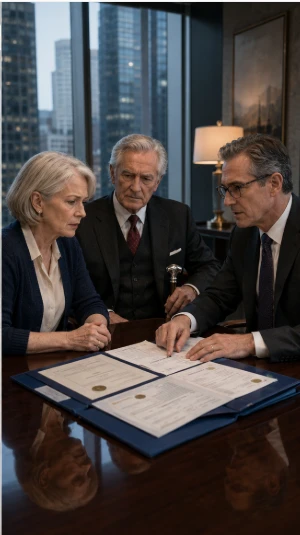
At eight the next morning, Henry escorted her to Samson, Wright & Pierce, a law firm occupying the upper floors of a glass tower in Midtown.
Attorney Oliver Samson met them in a conference room overlooking the East River.
He was a compact man in his early sixties, with rimless glasses and a voice so calm it made every sentence sound irrevocable.
He placed a thick blue folder on the polished table.
“Mrs. Montgomery,” he said, “before we begin, I need to know whether you have signed any documents concerning Montgomery & Vale, Northbridge Family Holdings, Clarice Textile Trust, or your late husband’s estate during the past three years.”
Catherine thought of David’s insurance forms.
“I signed papers he put in front of me.”
“Did you read them?”
“He covered most of the pages with colored tabs and said they authorized him to speak to my health insurer.”
Oliver’s mouth tightened.
“Did you sign before a notary?”
“No.”
“Did anyone photograph your identification?”
“Emily asked to scan my driver’s license for a cruise reservation.”
Henry closed his eyes.
Oliver opened the folder.
Inside were Albert’s notarized will, shareholder records, trust agreements, a power of attorney, and transfer documents carrying an almost perfect imitation of Catherine’s signature.
Oliver placed one finger on a single line.
“This,” he said quietly, “is where your son made his mistake.”
Catherine leaned closer.
The document purported to transfer all her interests in Clarice Textile Trust to Northbridge Family Holdings.
Her signature appeared at the bottom.
It looked authentic.
But the date was February 12.
“That’s impossible,” she said. “My right hand was in a cast.”
Oliver nodded.
“You fractured your wrist on February ninth. The orthopedist’s records show you could not hold a pen.”
Henry added, “David knew that.”
“He drove me to the hospital.”
“The notary seal is also fraudulent,” Oliver said. “The notary died fourteen months before this document was supposedly witnessed.”
Catherine stared at her son’s name.
“What is Clarice Textile Trust?”
Oliver opened the final document.
It was older than the others, the paper slightly yellowed.
At the top appeared a name Catherine had not seen in decades:
CATHERINE CLARICE MONTGOMERY, SETTLOR AND PRIMARY BENEFICIARY.
Her breath caught.
Oliver turned the page.
“In 1989, Albert transferred forty-one percent of Montgomery & Vale’s original shares into a trust created for you. Henry transferred another ten percent in recognition of your design patents and start-up contributions. With subsequent restructuring, stock splits, acquisitions, and retained dividends, the trust now controls fifty-one percent of Montgomery & Vale Group.”
Catherine heard the words but could not make them fit together.
“Fifty-one percent?”
“You are the controlling owner.”
“No. Albert and Henry owned the company.”
“That was the public arrangement,” Oliver said. “Not the legal one.”
Henry folded his hands.
“Albert insisted your interest remain protected. He believed publicity would make you a target.”
“A target for what?”
No one answered immediately.
Oliver continued.
“The estimated present value of the trust is eighty-six million dollars, excluding certain intellectual property interests, commercial properties, and retained royalties.”
Catherine stared at him.
Eighty-six million dollars.
She thought of the cracked soles of the shoes she had worn for two winters because she did not want to ask David for money.
She thought of comparing canned soup prices.
She thought of Emily sighing when Catherine requested twenty dollars for Alice’s school fundraiser.
“You are saying I have been wealthy all this time?”
“Technically, yes.”
“Then why did no one tell me?”
The question came out sharper than she intended.
Henry looked away.
Oliver answered carefully.
“Albert restricted disclosure while he was alive. After his death, the trust’s dormant-control clause remained in place until one of several conditions occurred.”
“What conditions?”
“Incapacity proceedings against you. Unauthorized attempts to transfer trust assets. Evidence of coercion. Or removal from your primary residence.”
Catherine understood.
“The blue room is empty.”
“It was the activation phrase,” Henry said.
Anger rose through her so swiftly that her vision blurred.
“You watched.”
“Catherine—”
“You knew what David was doing, and you watched.”
“We monitored financial activity.”
“You prepared a bedroom three years ago.”
“Albert ordered us not to interfere until the clause was triggered.”
“My husband is dead. His orders should not have mattered more than my life.”
Henry’s face tightened.
Oliver intervened.
“There is more.”
He produced bank records.
David had not merely forged the transfer.
He had pledged assets held by Clarice Textile Trust as collateral for loans totaling eleven million dollars. Money had flowed through Northbridge Family Holdings into luxury purchases, real estate, cryptocurrency accounts, and a private investment fund.
The house Catherine had been ordered to leave had been renovated using those funds.
Emily’s vacations, jewelry, car, and social-club membership had been paid from them.
David had also submitted medical statements suggesting Catherine suffered from progressive cognitive decline.
The physician’s signature was false.
“He planned to have me declared incompetent,” Catherine whispered.
“Yes,” Oliver said.
“Why?”
“To validate the earlier transfers and prevent you from challenging them.”
Catherine looked at Henry.
“And you knew?”
“I suspected.”
The conference-room door opened behind them.
Catherine turned.
A woman in a dark suit entered, followed by two men.
The woman was introduced as Nora Keene, a forensic accountant retained by Albert before his death. One man represented the Manhattan District Attorney’s Elder 𝓪𝓫𝓾𝓼𝓮 Unit. The other was a federal investigator specializing in financial crimes.
Nora placed a silver recording device on the table.
“Mrs. Montgomery,” she said, “your son’s fraud is larger than the trust transfer. We believe he used your forged authorization to move pension funds belonging to hundreds of Montgomery & Vale employees.”
Catherine’s heart seemed to stop.
“Employees?”
“Thirty-seven million dollars,” Nora said. “Possibly more.”
David had not merely stolen from his mother.
He had stolen from machinists, warehouse clerks, drivers, designers, and seamstresses—people who had spent their lives trusting the company Catherine helped create.
“Will he be arrested?”
The district attorney answered.
“Search warrants are being executed now.”
Catherine pictured Peter and Alice watching strangers enter the house.
“No.”
Everyone looked at her.
“The children are there.”
“We have coordinated with child services,” the investigator said. “They will not be left alone.”
“Do not frighten them.”
“We will be careful.”
Oliver closed the blue folder.
“Mrs. Montgomery, your son’s nightmare has begun. But before this is over, you must decide whether you want only the assets returned—or whether you want every person involved held accountable.”
Catherine looked at the forged signature.
She remembered David at five, asleep with a feverish cheek against her chest.
She remembered him at sixteen, racing into the kitchen after receiving his first college acceptance.
She remembered his face the night Albert died, broken with grief.
Then she remembered him standing in the kitchen.
My house.
“Everyone,” she said.
The search of David’s home lasted six hours.
Catherine watched from Henry’s library as Nora received updates.
Investigators found three laptops, two encrypted drives, medical forms bearing forged signatures, and boxes of financial records hidden behind a false panel in David’s home office.
They recovered Catherine’s pearl brooch and amber necklace from Emily’s dressing table.
The silver bracelet was still in a travel case.
The amethyst ring was missing.
Emily was not arrested that day.
David was taken downtown for questioning and released pending presentation of charges.
Shortly after nine that night, Catherine’s phone began ringing.
David.
She let it ring twelve times.
On the thirteenth, she answered.
“How could you do this?” he shouted.
Catherine said nothing.
“Police came into my home in front of my children!”
“My grandchildren.”
“They took my computers. They froze our accounts. Emily can’t even use her credit card.”
Catherine looked around Henry’s library, where shelves rose to a painted ceiling.
“Perhaps she can sell my bracelet.”
Silence.
Then David lowered his voice.
“Mom, listen to me. You don’t understand what’s happening.”
“I understand that my signature appears on documents I never signed.”
“Henry arranged those papers.”
Catherine’s fingers tightened around the phone.
“What did you say?”
“Henry told me the trust was supposed to pass to me. He said Dad created a technical mess and that the transfers were only correcting it.”
Across the room, Henry stood beside the fireplace.
He could not hear David’s words, but he watched Catherine closely.
“Why didn’t you tell me?”
“Because Henry said the trust would collapse if you interfered. Mom, I know how it sounds, but I was protecting the company.”
“With eleven million dollars?”
“Some investments failed.”
“And the employee pensions?”
David hesitated.
That hesitation answered her.
“I was moving the money temporarily. Henry knew.”
“Did Henry tell you to put me in assisted living?”
“No.”
“Did he tell you to steal my jewelry?”
“That was Emily.”
“Did he tell you to throw me out?”
Another silence.
“No.”
Catherine closed her eyes.
“At least one choice was entirely yours.”
“Mom—”
She ended the call.
Henry raised an eyebrow.
“What did he say?”
“He blamed you.”
Henry gave a tired smile.
“Of course he did.”
Catherine studied the man who had known her for more than forty years.
He seemed offended, but not surprised.
“What did you tell David about the trust?”
“Nothing that would justify forgery.”
“That was not my question.”
Henry’s grip tightened around his cane.
“Albert wanted David tested.”
“Tested?”
“He worried the boy’s ambition lacked boundaries.”
“So you tempted him?”
“I gave him opportunities to prove Albert wrong.”
Catherine felt the first cold touch of suspicion.
“What opportunities?”
Henry turned toward the fire.
“Minor responsibilities. Access to certain accounts. A seat in strategy meetings.”
“You told him the trust belonged to him.”
“I told him he would inherit significant interests someday.”
“That is different.”
“Yes.”
“Did you know he formed Northbridge Family Holdings?”
“I knew he was considering it.”
“Did you introduce him to the advisers who created it?”
Henry did not answer.
Catherine remembered something Albert once told her.
Henry never lied when silence could serve him better.
She placed the phone on the desk.
“I am tired.”
“Of course.”
As Henry walked toward the door, Catherine spoke again.
“Why was Clarice’s amethyst ring not recovered?”
He paused.
“I have no idea.”
“Emily took everything else.”
“Perhaps she sold it.”
Henry left.
Catherine remained beside the fire.
For the first time since the limousine arrived, she wondered whether she had been rescued.
Or collected.
The following morning, Oliver obtained an emergency order restoring Catherine’s authority over the trust and freezing Northbridge’s assets.
A second order allowed her to return to the house.
She did not go immediately.
Instead, she asked Nora Keene to meet her privately at a café near Bryant Park.
Nora arrived carrying a leather briefcase and an expression of guarded curiosity.
“You did not tell Henry about this meeting,” she said.
“No.”
“Why?”
“Because I need an answer from someone who is not his employee.”
“I am retained by the trust.”
“Who hired you?”
“Albert.”
“And after Albert died?”
Nora hesitated.
“Henry authorized continued payment.”
Catherine stirred tea she did not intend to drink.
“Then I will ask carefully. Do you believe Henry was involved in David’s fraud?”
Nora’s gaze shifted toward the window.
“I believe Henry knew more than he has admitted.”
“How much more?”
“There are patterns.”
“What patterns?”
Nora lowered her voice.
“Whenever David transferred funds, Henry’s companies benefited indirectly. A loan would move through Northbridge, fail publicly, and reappear as capital in one of Henry’s private entities. The path was designed to make David look reckless while shielding the final recipient.”
“Henry used my son.”
“Possibly.”
“Why did you not tell me yesterday?”
“Because I cannot prove it yet.”
“Does Oliver know?”
“I do not know what Oliver knows.”
Catherine studied her.
“Albert trusted you.”
“He did.”
“Then help me understand why my husband built a trap around me and left Henry holding the key.”
Nora leaned back.
“He didn’t.”
Catherine froze.
“The activation system had three custodians,” Nora explained. “Henry, Oliver, and me. Any two could open the file.”
“Then why did Henry say Albert ordered him not to interfere?”
“Albert’s instructions allowed intervention at any time if there was danger to you.”
The café seemed to tilt.
“Henry lied.”
“Yes.”
“Why?”
“That is what I have been trying to learn for three years.”
Nora opened her briefcase and removed a photocopy of a ledger page.
A series of handwritten numbers filled the paper.
At the bottom, Albert had written:
H.M. KNOWS ABOUT L. WATCH THE PURPLE STONE.
Catherine read it twice.
“What does L mean?”
“I hoped you might know.”
“The purple stone must be Clarice’s ring.”
“That was my conclusion.”
Catherine remembered Henry’s face when she asked about it.
Too still.
Too blank.
“Emily did not steal the jewelry for herself,” she said. “Someone wanted the ring, and she took everything so it would look like ordinary theft.”
Nora nodded.
“Exactly.”
“Why would Albert hide evidence inside my grandmother’s ring?”
“Perhaps he did not hide evidence inside it. Perhaps the ring is a key.”
Catherine touched her bare finger.
Clarice had loved puzzles.
As a girl, Catherine watched her grandmother remove the amethyst ring every Sunday and place it beside a locked rosewood box. Clarice claimed the box contained letters “too dangerous for ordinary drawers.”
After Clarice died, Catherine inherited the jewelry but never found the box.
Then she remembered the underside of the ring.
A tiny engraving.
Not initials.
A sequence.
14-9-4-9-1.
She had assumed it was a jeweler’s code.
Nora wrote the numbers.
“Converted to letters, that spells N-I-D-I-A.”
“It means nothing.”
“Perhaps backward?”
“AIDIN.”
Catherine shook her head.
Then an old memory surfaced.
Albert in the blue room, laughing as he called Clarice’s elaborate filing system “Nidia.”
“What is Nidia?” Catherine had asked.
“Diana backward, if you spell it badly,” he had joked.
But Diana was Clarice’s middle name.
“Diana,” Catherine whispered.
Nora leaned forward.
“Who is Diana?”
“My grandmother. Clarice Diana Bell.”
“Could it be a password?”
“Or a safe-deposit name.”
They searched old property and bank records.
By late afternoon, Nora found a dormant account at Hudson National Bank registered under C. Diana Bell Holdings.
The vault required two things: identification from Clarice’s lawful heir and a physical key.
A key Catherine did not possess.
Unless the amethyst ring contained it.
Catherine returned to David’s house that evening with a court officer and a locksmith.
The place smelled different.
Cold.
Abandoned.
A strip of police tape crossed David’s office door. Drawers stood open. The children’s coats were gone.
Emily had taken Peter and Alice to her mother’s home in Connecticut.
Catherine entered her former bedroom.
The bed had already been stripped.
Three measuring tapes lay on the floor.
Emily had apparently begun planning the walk-in closet before Catherine’s suitcase reached the bottom of the stairs.
On the wall, pencil marks showed the proposed locations of shelves.
Catherine stood in the center of the narrow room and felt no desire to cry.
She opened the closet and removed Albert’s remaining clothes.
At the back hung a dark gray suit he had worn to David’s wedding.
Catherine carried it downstairs and spread the jacket across the dining-room table.
She examined every seam.
Albert had known she would look inside clothing.
The winter-coat envelope had not been an accident.
Under the collar, she found a row of tiny stitches made with pale purple thread.
Not random stitches.
Numbers.
3-12-1-18-9-3-5.
Clarice.
Catherine cut the seam.
Inside the collar lay a narrow strip of photographic film wrapped in wax paper.
Her hands trembled.
The film showed six frames of documents.
One was a birth certificate.
One was a letter signed by Henry.
Another appeared to be a photograph of a damaged car.
The final frame showed Albert holding a newspaper dated eight days before his death.
Across the bottom, in Albert’s handwriting, were the words:
IF I DIE, IT WAS NOT AN ACCIDENT.
Catherine dropped the magnifying glass.
For three years, she had accepted that Albert lost control of his car on a wet road north of Albany.
The police said he struck a guardrail and went over an embankment.
Henry had identified the body.
Henry had arranged the funeral.
Henry had stood beside Catherine while the coffin was lowered into the ground.
Now Albert’s message stared up from the dining-room table.
It was not an accident.
She called Nora.
Within an hour, Nora arrived with a portable film scanner.
The enlarged images were grainy but readable.
The birth certificate concerned a baby boy born forty-two years earlier at St. Vincent’s Hospital.
The mother’s name was Lydia Bell.
Catherine’s younger sister.
The father’s line was blank.
Catherine stopped breathing.
David had been born at St. Vincent’s.
Catherine had held him when he was less than an hour old.
The story she had been told was that Lydia had suffered a catastrophic hemorrhage after giving birth and begged Catherine and Albert to raise the child. Lydia died before sunrise.
Catherine and Albert adopted David privately.
They never told him.
Lydia’s last request had been simple: Let him believe he was always wanted.
Catherine had honored it.
The second frame showed a letter from Henry to Lydia.
My dearest L,
I cannot acknowledge the child. Albert would use it to destroy me, and Catherine would never forgive us. You knew I had obligations. You knew what would happen if anyone discovered—
Catherine could not continue.
Nora read the final signature.
“Henry.”
The room went silent.
Catherine thought of David’s gray eyes.
Henry’s gray eyes.
The identical way both men rubbed a thumb across the side of the index finger when anxious.
The way Henry had always been unusually generous to David—gifts, internships, private dinners, advice offered behind Albert’s back.
“Henry is David’s father,” Catherine whispered.
Nora did not speak.
A third frame showed a memorandum written by Albert.
Henry has begun approaching David privately. He believes blood gives him a claim. David does not know. I fear Henry intends to use him against Catherine and the company.
The fourth showed bank transfers from employee pension accounts into an entity controlled by Henry.
The transfers began four years before Albert’s death.
The fifth showed Albert’s car in a service garage.
A handwritten note indicated the brake line had been cut and replaced three weeks before the fatal crash.
The mechanic’s name appeared at the bottom.
Raymond Pike.
Nora searched public records.
Pike had died two months after Albert.
An apparent overdose.
Catherine pressed both palms against the table.
“My husband knew Henry was stealing.”
“Yes.”
“He knew Henry had begun manipulating David.”
“Yes.”
“And then he died.”
Nora’s voice softened.
“We still need proof.”
Catherine looked at the missing ring in Clarice’s photograph.
“The proof is in the vault.”
Emily called just before midnight.
Her voice shook.
“Catherine, I need to speak with you.”
“Where are the children?”
“Asleep.”
“Are they safe?”
“Yes.”
“Then speak.”
“I didn’t know David moved pension money.”
“But you knew about my trust.”
“I knew there was money.”
“You wore my grandmother’s bracelet.”
Emily began crying.
Catherine waited.
She had listened to brides weep in fitting rooms for decades. Some tears came from joy, some from fear, and some from the hope that tears could erase consequences.
She had learned the difference.
Emily’s tears were fear.
“Who asked you to steal the amethyst ring?” Catherine asked.
The crying stopped.
“I don’t know what you mean.”
“Then I will give the police a recording of your hallway conversation and ask them to add conspiracy, elder 𝓪𝓫𝓾𝓼𝓮, theft, and attempted unlawful confinement to the charges.”
“You recorded me?”
Catherine had not.
Emily did not know that.
“Who wanted the ring?”
A long silence followed.
“Henry.”
Catherine closed her eyes.
“When?”
“Seven months ago.”
“What did he tell you?”
“That it belonged to his family. He said Albert had taken it years ago and hidden information inside it.”
“Where is it?”
“I gave it to him.”
“Why steal the other pieces?”
“He told me to make it look like you were confused. He said if only one item disappeared, you might remember too clearly.”
Catherine’s stomach turned.
Emily’s cruelty had not been invented by Henry.
But he had recognized it and given it purpose.
“What did he promise you?”
“That David would control Montgomery & Vale. That we’d have the kind of life we deserved.”
“You already had a house, two healthy children, and a woman who cooked, cleaned, and cared for them.”
“That wasn’t enough.”
“No,” Catherine said. “For you, nothing will ever be enough.”
Emily inhaled sharply.
“David doesn’t know Henry is involved.”
“He knows something.”
“Not everything. Henry told him the documents were legitimate. David thought Albert wanted him to have the company.”
“And you encouraged him.”
“Yes.”
“Did Henry tell David to place me in assisted living?”
“No. That was my idea.”
The honesty was more chilling than another lie.
“Why?”
“Because you were watching us.”
Catherine looked down at Albert’s film.
“At least you noticed.”
“Can you stop the charges?”
“No.”
“Please. For the children.”
“You used those children as an excuse every time you wanted something from me.”
“They’ll lose their father.”
“They lost him the moment he decided money mattered more than decency.”
Emily’s voice hardened.
“You think you’re better than us because Albert hid millions in your name?”
“No. I think I am better than you because when I had nothing, I still knew stealing was wrong.”
Catherine ended the call.
Then she sent Nora the recording.
This time, she had made one.
The next morning, Catherine confronted Henry in his study.
He stood behind a vast mahogany desk, reviewing documents.
She placed the enlarged birth certificate before him.
For the first time in all the years she had known him, Henry lost control of his face.
His skin turned gray.
“Where did you find this?”
“In Albert’s suit.”
Henry reached for the paper.
Catherine pulled it away.
“You were Lydia’s lover.”
His mouth tightened.
“It was complicated.”
“She was twenty-three.”
“She was an adult.”
“You were married.”
“My marriage was already dead.”
“But your reputation was alive.”
Henry walked toward the window.
“Lydia understood the situation.”
“She died giving birth to your son.”
His shoulders stiffened.
“Albert and I made certain David had a good life.”
“Albert and I made certain David had a good life. You sent birthday gifts and called yourself generous.”
“I protected him.”
“You corrupted him.”
Henry turned.
“David made his own choices.”
“After you spent years whispering that my husband had cheated him.”
“He was entitled to know the company would one day be his.”
“It was never his.”
“It should have been.”
“Because he carries your blood?”
Henry’s silence answered her.
Catherine’s anger sharpened.
“You did not want a son. You wanted a key.”
“That is unfair.”
“You ignored Lydia when she begged you to acknowledge him. Then, when he became useful, you crept into his life and convinced him that greed was destiny.”
“I taught him ambition.”
“You taught him resentment.”
Henry’s cane struck the carpet.
“Albert kept him small. A minor position, a limited salary, no voting authority. He treated David like an employee.”
“Because Albert had discovered the pension theft.”
Henry went still.
Catherine placed the photograph of the damaged brake line beside the birth certificate.
“Did you 𝓀𝒾𝓁𝓁 my husband?”
“No.”
The answer came instantly.
Too instantly.
“Did you arrange his accident?”
“No.”
“Why did Albert believe his death would not be accidental?”
“Albert had become paranoid.”
“Why did you take Clarice’s ring?”
“I did not.”
“Emily has confessed.”
Something cold entered Henry’s eyes.
“Emily is desperate.”
“She gave you the ring seven months ago.”
Henry looked toward the door.
Catherine understood that she had pushed too far without protection.
Then Oliver Samson stepped into the study.
Henry’s expression changed again.
“You,” he said.
Oliver closed the door behind him.
“Catherine asked me to come.”
Henry stared at the attorney.
“You are violating privilege.”
“My client is Clarice Textile Trust. Catherine controls the trust.”
“I hired you.”
“Albert hired me. You merely paid the invoices.”
Catherine placed a small recorder on the desk.
The red light glowed.
Henry gave a bitter laugh.
“You think a few old photographs prove murder?”
“No,” Catherine said. “I think the vault will.”
At the word vault, Henry’s gaze flickered toward the painting behind his desk.
It lasted less than a second.
It was enough.
Oliver saw it too.
Catherine walked toward the painting.
Henry moved in front of her.
“You have no authority to search my home.”
“I do not need to.”
She turned to Oliver.
“Call the investigators.”
Henry’s composure cracked.
“Wait.”
Catherine faced him.
“You have one opportunity to tell me the truth.”
Henry lowered his voice.
“The ring is not here.”
“Where is it?”
“In my office at Montgomery & Vale.”
“Why?”
“Because the key inside it opens Albert’s private archive.”
“You knew.”
“I suspected.”
“Did you open it?”
“The key requires a secondary code.”
“Diana.”
Henry stared at her.
Catherine saw fear.
Not fear of prison.
Fear of what the vault contained.
Oliver called Nora.
Within two hours, investigators obtained consent from the trust’s newly restored controlling shareholder to enter the executive offices of Montgomery & Vale.
Henry accompanied them, insisting the situation was a misunderstanding.
The company’s headquarters occupied twelve floors of a tower near Madison Square Park.
Employees watched in silence as Catherine walked through the lobby.
Most did not recognize her.
A bronze wall displayed portraits of the company’s founders.
Albert Montgomery.
Henry Montgomery.
There was no portrait of Catherine.
Yet beneath the photographs, the company motto came from a sentence she had once stitched onto the first sample book:
WHAT ENDURES IS WHAT WE BUILD WITH OUR HANDS.
Catherine stopped before it.
Henry followed her gaze.
“We can add your portrait.”
She looked at him.
“You still think this is about a wall.”
In Henry’s office, investigators found the amethyst ring locked inside a desk safe.
The stone lifted on a tiny hinge.
Beneath it rested a brass key no longer than Catherine’s thumbnail.
Nora carried the ring to Hudson National Bank.
The private vault lay three levels beneath the street.
Its steel door required the brass key, Catherine’s identification, the password Diana, and a second key held by the bank.
Inside were three archive boxes, a cassette recorder, sealed letters, and a bound ledger.
There was also a video camera.
Old-fashioned, heavy, and attached to a monitor.
A bank officer inserted a tape.
Albert appeared on the screen.
Catherine gripped the edge of the table.
He sat in the blue room, thinner than she remembered him, his face lined with exhaustion.
The date in the corner was twelve days before his death.
“Cathy,” he began, “if you are watching this, I failed to stop something I should have seen years ago.”
Her eyes filled.
Albert looked down at his hands.
“Henry has been stealing from the pension fund. He has hidden the transfers through private companies and begun using David as an intermediary. David does not understand the full scheme. But he understands enough to know he is crossing lines.”
Catherine closed her eyes.
Her son had not been entirely deceived.
“He believes Henry is his father,” Albert continued.
Her eyes opened.
Across the vault, Henry’s face drained of color.
Albert looked into the camera.
“And in this, Henry has told him the truth.”
David already knew.
The revelation cut more deeply than anything before it.
Henry had not merely influenced him.
David had chosen his biological father over the parents who raised him.
Albert continued.
“Lydia told me before she died. Henry refused to acknowledge the child. Cathy and I adopted David because we loved him before we understood what love would cost.”
Catherine pressed a fist against her mouth.
“I never told you Henry was the father because Lydia asked me to protect David from the shame Henry placed upon her. That secrecy became my greatest mistake. Secrets do not disappear. They become doors, and eventually someone finds the key.”
Henry moved toward the monitor.
An investigator blocked him.
Albert’s voice hardened.
“Henry approached David two years ago with proof of his paternity. He told David I had stolen his birthright. He promised him control of the company. Since then, David has provided signatures, account access, and internal approvals.”
Catherine whispered, “Two years.”
During those two years, David had eaten at her table.
Asked about her arthritis.
Watched her care for his children.
All while helping Henry steal the company beneath her hands.
“I confronted David,” Albert said on the recording. “He begged me not to tell you. He claimed he wanted only what should have been his. I told him blood entitled him to nothing that character could not sustain.”
Catherine remembered Albert’s last week.
He had been quiet.
Distracted.
He had hugged her for a long time before leaving for Albany.
She had thought he was worried about the weather.
“I planned to present the evidence to federal authorities,” Albert said. “Henry discovered the audit. Yesterday, the mechanic who services my car called and warned me someone had tampered with the brake line. He repaired it and agreed to testify. This morning he disappeared.”
Nora looked toward the federal investigator.
Albert leaned closer to the camera.
“If I die, Henry arranged it.”
Henry laughed harshly.
“This is the speculation of a sick man.”
The tape continued.
“I have placed original bank records, audio recordings, and correspondence in this vault. But there is one thing Henry does not know.”
Albert paused.
Catherine felt everyone in the room lean toward the screen.
“The pension money has not been lost.”
Nora’s head snapped up.
Albert almost smiled.
“I discovered the scheme early enough to redirect the final transfers. Henry believes thirty-seven million dollars rests in accounts he controls. It does not. The funds were moved into a protected restitution trust under Catherine’s authority.”
Henry stumbled backward.
“That’s impossible.”
Albert’s recorded image continued.
“The money Henry believes he stole is marked. Every subsequent transaction documents his intent. The employees’ pensions are safe. Henry’s freedom is not.”
For the first time, Catherine felt something beyond grief.
Albert had not been helpless.
He had built a trap.
But the recording was not finished.
“Cathy, the documents in the third box will prove Henry’s financial crimes. The cassette will prove more. I am sorry you must hear it.”
The bank officer opened the third box.
Inside lay a small cassette labeled DAVID—OCTOBER 14.
They placed it in the recorder.
Static filled the vault.
Then David’s voice emerged.
“Henry, slow down. I agreed to the transfers, not this.”
Henry answered.
“If Albert reaches Albany, we all go to prison.”
“What are you saying?”
“The brake line has already been handled.”
A long silence followed.
David whispered, “You said you were only going to frighten him.”
“I said I would solve the problem.”
“Call it off.”
“I cannot.”
“I’ll warn him.”
“And tell him what? That his beloved son helped steal forty million dollars? That you forged your mother’s authorization? You’ll destroy yourself.”
David’s breathing became ragged.
“What if he dies?”
“Then the company passes where it belongs.”
Another silence.
Then David said the words that shattered the last defense Catherine had built around him.
“All right.”
Not no.
Not I’ll stop you.
Not I’ll call the police.
All right.
The cassette continued.
“Make sure my mother never knows.”
Henry replied, “Then keep her dependent. When the time comes, have her declared incompetent.”
The tape clicked off.
No one moved.
Catherine stared at the recorder.
Her son had known.
He had known Albert’s car might be sabotaged.
He had chosen silence.
Not because he wanted his father dead, perhaps.
But because he wanted the company more than he wanted Albert alive.
Henry reached for his cane.
Two federal agents moved toward him.
“This proves nothing,” he said. “The recording could be fabricated.”
Nora lifted the ledger.
“The transfers, shell companies, mechanic payments, and your correspondence will prove the rest.”
The agents placed Henry under arrest.
As they led him toward the vault door, he looked at Catherine.
For the first time, the great Henry Montgomery appeared old.
“You think Albert was innocent?” he asked. “Ask Oliver why your husband never took that trip alone.”
Oliver stiffened.
Catherine turned.
“What does he mean?”
Henry smiled as the agents pulled him away.
“He means you still haven’t opened Albert’s final letter.”
David was arrested at dawn.
Catherine watched from across the street as officers led him out of Emily’s mother’s house.
He wore no coat.
His hands were cuffed in front of him.
For one moment, he looked directly at the car where Catherine sat beside Nora.
Even through the window, she saw the shock on his face.
He had expected anger.
He had expected accusation.
What he saw instead was grief so complete that it frightened him.
He lowered his head.
Emily was arrested later that morning on charges related to forgery, conspiracy, theft, and attempted financial exploitation of a vulnerable adult.
Peter and Alice were placed temporarily with Emily’s older sister, Rachel, a schoolteacher whom Catherine had met only twice.
Catherine called her immediately.
“I don’t care what Emily told you about me,” she said. “I need to know the children are safe.”
Rachel’s reply was quiet.
“They are. Peter won’t speak. Alice keeps asking for you.”
“May I see them?”
“Yes.”
Catherine visited that afternoon.
Alice ran into her arms so hard they nearly fell.
“Daddy said you made the police come.”
Catherine held her tightly.
“The police came because grown-ups broke serious rules.”
“Is Daddy bad?”
Catherine looked over Alice’s shoulder at Peter.
He stood in the hallway, waiting for her answer.
“No person is only one thing,” Catherine said. “Your father made terrible choices. He will have to answer for them.”
“Does he love us?” Peter asked.
“Yes.”
“Then why did he do it?”
Catherine had no answer that would not poison something inside him.
“Sometimes people love others,” she said slowly, “but love is not strong enough to defeat what they want. That is not the fault of the people they love.”
Peter’s eyes filled.
“Did he hurt Grandpa?”
Catherine’s breath stopped.
“What have you heard?”
“Mom and Dad fought last year. Mom said he let something happen to Grandpa.”
Rachel looked startled.
Peter continued.
“Dad told her to shut up.”
Catherine crouched before him.
“Your grandfather loved you very much.”
“That isn’t what I asked.”
He was David’s son, but in that moment Catherine saw Albert’s insistence on truth.
“Yes,” she said. “Your father knew Grandpa was in danger, and he did not stop it.”
Peter turned away.
Alice began crying.
Catherine gathered them both into her arms.
She wished she could sew the family back together as she had repaired torn lace—matching edges, hiding damage beneath careful stitches.
But some tears were not meant to disappear.
Some needed to remain visible so no one could pretend the fabric had never been ripped.
Albert’s final letter stayed unopened for three days.
Catherine carried it from room to room in Henry’s townhouse, though the townhouse no longer belonged to Henry.
The federal court froze his assets. Under the trust agreement, his voting shares in Montgomery & Vale were suspended pending criminal proceedings.
Catherine became acting chairwoman of the company overnight.
Newspapers printed photographs of her entering headquarters beneath headlines calling her THE SECRET QUEEN OF MONTGOMERY & VALE.
Reporters waited outside the townhouse.
Employees sent flowers.
Retirees wrote letters thanking her for protecting their pensions.
None of it felt real.
At night, Catherine stared at Albert’s sealed envelope.
Henry’s final words echoed in her mind.
You think Albert was innocent? Ask Oliver why your husband never took that trip alone.
On the fourth morning, Catherine asked Oliver to join her.
They sat in the blue room.
After the company moved headquarters, Albert had preserved the original office inside an old Queens building owned by the trust. Catherine had not entered it in thirty years.
The walls were still blue.
Her first sewing machine stood near the window.
On a shelf rested the sample book she had stitched in 1978.
Oliver looked older than he had at the law firm.
“You know what is in the letter,” Catherine said.
“I know part of it.”
“Was someone with Albert when his car crashed?”
Oliver removed his glasses.
“Yes.”
“Who?”
“Me.”
The answer shocked her.
“You?”
“Albert asked me to accompany him to Albany. We were supposed to meet federal prosecutors.”
“But you survived.”
“I was not in the car when it went over the embankment.”
“Why?”
“We stopped at a service station. I went inside to call Nora from a pay phone because Albert believed our mobile phones were compromised. While I was inside, Albert saw Henry’s car across the road.”
“Henry was there?”
“Albert drove away before I returned. I believe he wanted to draw Henry away from me and the evidence.”
“Why did you never tell the police?”
“I did. The detective dismissed it because traffic cameras showed Henry entering Manhattan two hours earlier.”
“So he had an alibi.”
“A false one, apparently.”
Catherine looked at the envelope.
“Is Albert dead?”
Oliver’s expression changed.
It was slight.
But Catherine saw it.
The room seemed to narrow around her.
“Oliver.”
He did not answer.
She stood.
“Is my husband dead?”
Oliver’s eyes filled with something she had never expected from him.
Fear.
“I identified no body,” he said.
“Henry did.”
“Yes.”
“The coffin was closed.”
“Yes.”
“Because the injuries were severe.”
“That is what Henry told you.”
Catherine’s legs weakened.
She gripped the table.
“What are you saying?”
“Open the letter.”
Her fingers tore the envelope.
Inside were two pages in Albert’s handwriting.
Cathy,
If Henry’s plan failed, I intended to come home before supper.
If his plan succeeded, everyone would believe I died.
There was no safe middle.
I discovered that the mechanic Henry paid had installed a second device beneath the steering column. It was designed to lock the brakes and ignite the fuel line. Oliver and I agreed that if we saw Henry following us, we would separate. I would take the car. Oliver would protect the evidence.
But I made another arrangement without telling him.
Catherine stopped reading.
Her heartbeat pounded against her ribs.
She forced herself onward.
A state investigator named Samuel Reed had been working undercover inside Henry’s network. He arranged for the car to be driven remotely through the final section of road while I exited at an abandoned service lane.
The vehicle that went over the embankment carried a body from a medical research facility, placed there to convince Henry his plan succeeded.
Catherine made a sound that did not seem human.
Oliver rose, but she lifted one hand.
“Do not touch me.”
She continued reading.
I am alive.
The words blurred.
She wiped her eyes.
I know what this truth will do to you.
I have committed a cruelty in the name of protecting you. For that, there may be no forgiveness.
Samuel discovered that Henry’s network reached beyond the company into law enforcement, banking, and organized crime. If Henry suspected I survived, he would have killed you, David, and anyone who could draw me into the open.
I entered federal protective custody under another identity. I was told it would last months.
It lasted years.
Catherine sank into the chair.
Three years.
Three years of mourning.
Three birthdays spent speaking to Albert’s photograph.
Three anniversaries sitting alone beside a candle.
Three years beneath David’s roof, believing the one person who would have defended her was buried beneath a stone in Queens.
She read the final lines.
I could not contact you until Henry acted against the trust and 𝓮𝔁𝓹𝓸𝓼𝓮𝓭 the full network.
If you are reading this, that has happened.
Whether I have the right to ask anything of you, I do not know.
But if any part of the love we built remains, come to the greenhouse at Bellweather House at six o’clock tonight.
A.
The letter slipped from her fingers.
Oliver stood silently.
“You knew,” she whispered.
“I learned he was alive six months after the funeral.”
“You watched me bury an empty coffin.”
“I was under federal order.”
“You watched me sell my home.”
“I tried to convince you not to.”
“You watched my son destroy me.”
“We did not know how far David had gone until recently.”
“You all knew enough.”
Oliver’s voice broke.
“Yes.”
Catherine looked around the blue room.
Albert’s plans had protected the company.
His trap had preserved the pensions.
His secrecy had gathered evidence against Henry.
But every brilliant layer had used Catherine’s pain as camouflage.
Henry had treated her like a key.
David had treated her like a burden.
And Albert—the man who loved her best—had treated her like someone whose heart could be broken for strategic reasons.
She stood.
“Where is Bellweather House?”
“Westchester.”
“Is Albert there now?”
“Yes.”
Catherine picked up the letter.
“I want a car.”
Rain began before dusk.
Bellweather House stood behind iron gates on sixty acres of woodland, an old estate used by the federal government as a secure residence.
The greenhouse glowed at the far end of a stone path.
Catherine walked toward it alone.
Her umbrella trembled in the wind.
Through the glass walls, she saw rows of citrus trees, white orchids, and climbing jasmine.
Then she saw the man standing beneath an iron arch.
Albert.
Older.
Thinner.
A white scar crossed the left side of his face.
But alive.
Catherine stopped outside the door.
For three years she had imagined this impossible moment in dreams.
In those dreams, she ran to him.
Now she could not move.
Albert opened the greenhouse door.
“Cathy.”
Her name in his voice nearly destroyed her.
He stepped forward.
She slapped him.
The sound cracked through the greenhouse.
Albert closed his eyes.
She struck him again.
“You let me bury you.”
“I know.”
“You let me sleep beside your photograph.”
“I know.”
“You let me believe I had lost the one person in this world who knew me.”
His face crumpled.
“I know.”
Catherine hit his chest with both hands.
“You do not know!”
He allowed her to strike him until her strength failed.
Then she stood before him, shaking.
Albert did not reach for her.
“I wrote to you every week,” he said.
“Letters I never received.”
“They are inside.”
“I do not want them.”
“I understand.”
“No, Albert. You understand plans. You understand trusts, contingencies, secret accounts, and traps within traps. You understand how to move people across a board.”
He lowered his head.
“But you never understood that I was not one of your pieces.”
“No.”
The admission surprised her.
Albert looked at her.
“I understand that now.”
Rain hammered the greenhouse roof.
“Why didn’t you take me with you?”
“Because Henry was watching you. If you vanished, he would know I survived.”
“Then why not tell me?”
“Because Samuel believed Henry would test you. Phones, surveillance, threats. If you knew, one look or one mistake could expose everything.”
“So you decided I was too weak to carry the truth.”
“I decided I could not risk your life.”
“You risked my soul.”
Albert’s eyes filled with tears.
“Yes.”
Catherine turned away.
On a table near the orchids stood hundreds of envelopes bundled with string.
Each bore her name.
Catherine.
My Cathy.
Mrs. Catherine Montgomery.
One letter for every week of his absence.
Beside them lay photographs.
Peter playing baseball.
Alice entering kindergarten.
Catherine leaving the grocery store.
Catherine sitting alone at Albert’s grave.
Someone had watched her life and sent the images to him.
“You saw me,” she whispered.
“Only photographs.”
“You knew I was living with David.”
“Yes.”
“You knew he was taking my money.”
“Not at first. When the transfers began, Nora alerted me. We needed proof that connected David to Henry.”
“So you waited.”
Albert’s voice broke.
“Yes.”
She faced him.
“Did you know he would throw me out?”
“No. That clause was meant to end the operation before you were physically harmed.”
“You let him harm me in every other way.”
“Yes.”
Again, he did not defend himself.
Perhaps that was the only reason she stayed.
Albert approached the table but kept distance between them.
“Henry spent his life believing blood created ownership. He thought David belonged to him because David carried his blood. David thought the company belonged to him for the same reason.”
“And you?”
“I thought love gave me the right to make choices for you.”
Catherine looked at him.
“That was your form of ownership.”
“Yes.”
Outside, thunder rolled across the estate.
Albert removed a small object from his pocket.
Clarice’s amethyst ring.
“The investigators released it to the trust.”
He placed it on the table, not in her hand.
“I cannot ask you to forgive me.”
“No.”
“I cannot ask you to come home because I destroyed the place where home existed.”
“Yes.”
“But there is one truth I need you to hear. Every document, every share, every patent, every protected account—none of it was my gift to you. It was yours from the beginning. I hid your name because I told myself I was protecting you. In reality, I was protecting a company built on the illusion that Henry and I created it alone.”
Catherine looked around the greenhouse.
“Why tell me this now?”
“Because tomorrow the board will ask you to preserve Montgomery & Vale exactly as it was.”
“They already have.”
“And you must not.”
Albert’s voice gained strength.
“The company was built on your designs, your labor, and your sacrifice. Henry stole money. David forged documents. I stole recognition.”
He nodded toward the letters.
“Do what none of us had the courage to do.”
“What?”
“Build something that does not require a woman to disappear behind it.”
For a long moment, Catherine listened to the rain.
Then she picked up Clarice’s ring.
“I will not decide about us tonight.”
“I know.”
“You will not follow me.”
“I know.”
“You will answer every question I ask, even when the answer condemns you.”
“Yes.”
“And you will never again confuse protecting me with controlling me.”
Albert met her eyes.
“Never.”
Catherine slipped the ring into her pocket.
She left him standing beneath the iron arch.
At the greenhouse door, she paused.
“Albert.”
Hope flashed across his face.
She did not offer forgiveness.
Not yet.
“Tomorrow,” she said, “you will testify.”
He nodded.
“I will.”
“And after that, you will come to Queens.”
“Why?”
“The blue room needs repainting.”
For the first time, a fragile smile touched his face.
“What color?”
Catherine opened the door.
“Mine.”
The trial began seven months later.
Henry faced charges including conspiracy, attempted murder, wire fraud, pension theft, obstruction, and money laundering.
Albert’s testimony lasted four days.
The courtroom erupted when the supposedly dead founder entered through a side door under federal protection.
Reporters called it the corporate trial of the century.
Henry’s attorneys attacked Albert’s credibility, arguing that a man who staged his death and deceived his wife could not be trusted.
Albert did not resist the characterization.
“I lied to the woman I loved,” he told the jury. “That makes me a coward in my marriage. It does not make Henry innocent.”
The recordings, ledgers, marked transfers, and mechanic payments proved the rest.
Henry was convicted on every major count.
He received a sentence that ensured he would die in prison.
Emily accepted a plea agreement and served eighteen months, followed by probation and restitution.
David refused a plea.
He insisted Henry manipulated him.
The cassette defeated him.
So did emails in which David discussed having Catherine declared incompetent, joked about converting her room, and asked whether Albert’s “road problem” had been resolved.
He was convicted of conspiracy, fraud, elder 𝓪𝓫𝓾𝓼𝓮, and obstruction.
Before sentencing, he asked to address Catherine.
She sat in the front row beside Peter and Alice.
David looked older than forty-two.
Prison gray had entered his hair.
“Mom,” he began, “I know I don’t deserve to call you that.”
Catherine did not react.
“I spent my whole life feeling like Dad held something back from me. When Henry told me the truth about my birth, everything made sense. I thought Dad had kept me from my real father because he wanted control.”
Albert sat behind Catherine, silent.
David continued.
“Henry said the company was supposed to be mine. He said Dad stole my inheritance and used you to hide it. I believed him because I wanted to.”
His voice shook.
“When I heard about the car, I told myself Henry was bluffing. Then Dad died, and I knew. I knew what I had allowed.”
Peter stared at the floor.
“I should have gone to the police. I should have told you. Instead, I convinced myself it was too late and that exposing Henry would destroy all of us.”
David looked at Catherine.
“But the truth is uglier. I was afraid of losing the money.”
Catherine’s eyes burned.
“I threw you out because Emily said we had to prove you were unstable. But when I said those words, part of me enjoyed it. I enjoyed having power over the person who had loved me most.”
A sob moved through the courtroom.
“I am sorry.”
Catherine rose when the judge allowed her to respond.
She faced the man she had raised.
“I loved you before you had a name,” she said. “I loved you before I knew whose blood ran through your body. I worked, sacrificed, lied about being tired, and went without things you never noticed because I believed love meant giving a child every chance to become good.”
David wept openly.
“But love does not erase truth,” Catherine continued. “You did not betray Albert because Henry was your biological father. You betrayed Albert because Henry offered you what your character was too weak to refuse.”
David closed his eyes.
“I forgive the child you were,” she said. “I mourn the man you chose to become.”
He looked up.
“Will you ever forgive that man?”
Catherine considered the question.
“Forgiveness is not a door you demand someone open because prison has closed every other one.”
She returned to her seat.
David was sentenced to fourteen years.
As officers led him away, Peter did not look at his father.
Alice did.
She raised one hand.
David pressed his cuffed hands to his heart.
Then he disappeared through the side door.
Catherine dissolved Montgomery & Vale’s old board.
She replaced directors who had ignored warnings with employees, pension representatives, independent auditors, and designers.
The bronze founders’ wall came down.
In its place, she installed a woven tapestry containing the names of every worker employed during the company’s first twenty years.
Her name appeared among the seamstresses.
Not above them.
Among them.
She renamed the company Clarice House, after the grandmother who had taught her that beautiful things could hide mechanisms, messages, and keys.
A portion of Henry’s recovered assets funded retirement accounts for workers harmed by the scheme.
Another portion created legal clinics for elderly people facing financial exploitation by relatives.
The former blue room became the first office of Home Is Not a Deed, a foundation providing emergency housing to older adults forced from homes they had financed but did not legally own.
Catherine’s old bedroom in David’s house was never converted into a closet.
She sold the property after the court placed it in constructive trust.
The proceeds went toward Peter and Alice’s education, but under conditions neither parent could alter.
Catherine purchased a modest brick house in Queens, three streets from the apartment she had sold.
It had a sunny kitchen, a small garden, and enough bedrooms for grandchildren.
Peter and Alice spent weekends there.
Peter learned to bake chocolate cake.
Alice learned to sew.
One Friday evening, nearly two years after the limousine arrived, Catherine sat at the kitchen table guiding Alice’s fingers through a line of uneven stitches.
“Slowly,” she said. “The fabric tells you when you’re pulling too hard.”
Alice frowned in concentration.
Peter stood at the stove stirring melted chocolate.
The front door opened.
Albert entered carrying groceries.
He no longer lived under federal protection.
He did not live with Catherine either.
Not yet.
He occupied a small apartment six blocks away and came to dinner when invited.
Their marriage had not returned to what it was.
Catherine did not want it to.
What they had before was built partly on silence—hers, his, and the silence surrounding David’s birth.
They were building something else now.
Something slower.
Something in which no one disappeared.
Albert placed a carton of cream on the counter.
“I bought the wrong kind,” he admitted.
Catherine looked at it.
“You did.”
“I can go back.”
Peter laughed.
“Grandpa, Grandma says mistakes don’t become crimes until you hide them.”
Albert looked at Catherine.
“She says that often.”
“She has reason.”
Alice held up the cloth.
Her stitches wandered wildly across the fabric.
“It’s ruined.”
Catherine examined the line.
“No.”
“It’s crooked.”
“Crooked is not ruined.”
She turned the cloth over.
On the reverse, the thread formed a strange pattern.
Letters.
Alice had been practicing Catherine’s secret stitch code.
Catherine read the message.
LOOK IN THE CAKE TIN.
She glanced at Peter.
He grinned.
Inside the cake tin lay an envelope.
Catherine opened it.
The letter was from David.
He had written many during his first year in prison.
She returned them unopened.
Then Peter asked whether refusing to read them was strength or fear.
The question stayed with her.
This letter was different.
It contained no request for forgiveness.
No excuses.
David wrote that he had begun teaching literacy classes in prison. He described a man of sixty who had never read a letter from his daughter because shame prevented him from admitting he could not understand the words.
David had helped him read it.
At the bottom, he had written:
I used to believe inheritance was something a parent owed a child.
Now I understand the only inheritance that mattered was the chance you gave me to become decent.
I wasted it.
I do not ask you to tell me I can still be the man you hoped for.
I will try to become him whether you ever see it or not.
Catherine read the letter twice.
Then she folded it.
Albert watched from across the kitchen.
“Will you answer?”
“I don’t know.”
“That’s fair.”
She looked at him.
Years earlier, Albert would have offered a strategy.
Now he simply waited.
Catherine took out a sheet of paper.
She wrote one sentence.
Becoming better does not change the past, but it may prevent the past from owning everything that comes next.
She signed her name.
Not Mother.
Not Mom.
Catherine.
Peter placed the letter in an envelope.
Alice licked the seal.
Albert returned to the stove.
Outside, spring rain began tapping against the windows.
For a brief moment, Catherine remembered the last cold evening in David’s house—the untouched chicken, the bubbles on her hands, the faint smile on Emily’s face, and the word my falling like a blade between mother and son.
David had believed ownership came from a name on a deed.
Henry believed it came from blood.
Albert had once believed it came from love strong enough to justify control.
They had all been wrong.
Catherine looked around her kitchen.
At Peter measuring flour.
At Alice untangling thread.
At Albert asking before opening a cupboard because he had finally learned that sharing a room did not give him authority over everything inside it.
Home was not the building David had taken.
It was not the company Henry had tried to steal.
It was not even the marriage Albert had nearly sacrificed to save her life.
Home was the place where truth could enter without being thrown out.
The doorbell rang.
Catherine wiped flour from her hands and opened the door.
Nora Keene stood on the porch holding a narrow package wrapped in brown paper.
“We found this in a final box from Henry’s private archive,” she said.
Catherine opened it.
Inside lay an old rosewood box.
Clarice’s box.
The amethyst ring fit perfectly into a small indentation in the lid.
A hidden lock clicked.
Catherine lifted the top.
Inside were letters, photographs, and a document written nearly seventy years earlier.
She read the first page.
Then the second.
Her knees weakened.
Albert came beside her.
“What is it?”
Catherine looked at Nora.
“Has anyone else seen this?”
“Only the archivist.”
The document was Clarice’s original partnership agreement for a small textile workshop founded in 1954.
The workshop’s name appeared at the top:
BELL & MONTGOMERY FABRICS.
Albert stared.
“My father’s company.”
Clarice had been his father’s secret partner.
Not an employee.
Not a seamstress hired by the week.
A fifty-percent owner whose name had been removed when the company was sold.
Attached was a legal assignment transferring Clarice’s unpaid ownership interest, royalties, and successor rights to Catherine.
Nora’s voice was quiet.
“Albert’s father used profits from that workshop to fund the business that eventually became Montgomery & Vale. Clarice’s claim was never legally extinguished.”
Albert sat down.
Catherine continued reading.
A handwritten letter rested beneath the agreement.
My dear Catherine,
Men will one day tell you that the life you helped build belongs to them because their names are on the door.
Let them talk.
Doors can be renamed.
Blood can lie.
Paper can be forged.
But work leaves a trail, and truth is patient.
The final paragraph changed everything.
If my claim is ever proven, the Montgomery interest does not belong to Albert, Henry, or any son born after them.
It belongs to you.
Not fifty-one percent.
All of it.
Catherine looked at Nora.
“What does this mean?”
“It means Clarice’s ownership predates every later division of Montgomery & Vale. Because the original sale relied on a fraudulent representation that Albert’s father was sole owner, the successor shares attributed to the Montgomery side were never validly separated from Clarice’s interest.”
Albert’s voice was barely audible.
“How much?”
Nora smiled.
“After Henry’s forfeiture and the invalidation of the old Montgomery allocations, Catherine owns approximately eighty-nine percent of Clarice House.”
Catherine stared at the document.
All those years, Albert believed he had secretly protected her by giving her control of the company.
He had never known that the company had been hers before either of them entered the blue room.
Henry had murdered, manipulated, and stolen to seize something his family had never truly owned.
David had betrayed everyone for an inheritance that had never existed.
Even Albert’s grand secret had been built upon an older secret kept by a woman whose name men erased from the first page.
Catherine began to laugh.
Not because it was funny.
Because after grief, betrayal, murder, resurrection, trials, and millions of dollars, the truth had arrived inside a rosewood box and made every powerful man in the story look absurd.
Albert slowly smiled.
“What will you do?”
Catherine looked at Clarice’s letter.
Then at Alice’s crooked stitches.
Then at Peter’s chocolate-covered spoon.
She carried the document to the stove.
Nora gasped.
“Catherine?”
Catherine held the corner above the flame.
Albert rose.
“That paper could make you one of the wealthiest women in the country.”
“I already control the company.”
“But this gives you nearly all of it.”
“No.”
She pulled the page away before it caught fire.
“This gives me a choice.”
The following week, Catherine placed Clarice’s claim into a permanent employee trust.
No Montgomery, Bell, Vale, or future executive could ever own more than a small percentage of the company again.
The workers became its majority owners.
Catherine retained enough authority to protect the foundation and prevent another takeover, but she rejected the fortune that had destroyed three generations of men.
When reporters asked why she had surrendered billions, she answered with one sentence:
“Because anything people are willing to 𝓀𝒾𝓁𝓁 their family to possess should never belong to one family again.”
That evening, Catherine returned home.
No limousine waited at the curb.
No attorney carried a secret file.
No cameras flashed.
Peter had burned the first cake and started another.
Alice had fallen asleep on the sofa with thread wrapped around one finger.
Albert stood in the kitchen doorway.
“May I stay for dinner?” he asked.
Catherine looked at him for a long moment.
Then she moved one chair away from the table.
“You may stay for dinner.”
It was not complete forgiveness.
It was not a restored marriage.
It was a beginning freely given, which made it more valuable than anything hidden in Albert’s trust or Clarice’s box.
Albert sat.
Catherine placed the roasted chicken between them.
This time, it was warm.
This time, no one told her where she belonged.
And when she looked around the table, Catherine finally understood the inheritance Clarice had truly left her.
Not money.
Not fabric.
Not a company.
The courage to remove her life from the hands of people who believed loving her made them owners—and to place it, at last, in her own.
THE END!