At precisely 6:15 p.m. on August 29, 2024, Loran Kenstley Cole was pronounced dead inside the execution chamber at Florida State Prison in Raiford, ending a brutal crime saga and a legal odyssey that consumed three decades.
Cole, 57, was executed by lethal injection for the 1994 murder of 18-year-old Florida State University freshman John Edwards, a crime that also involved the horrific rape and kidnapping of Edwards’ older sister, Pam.
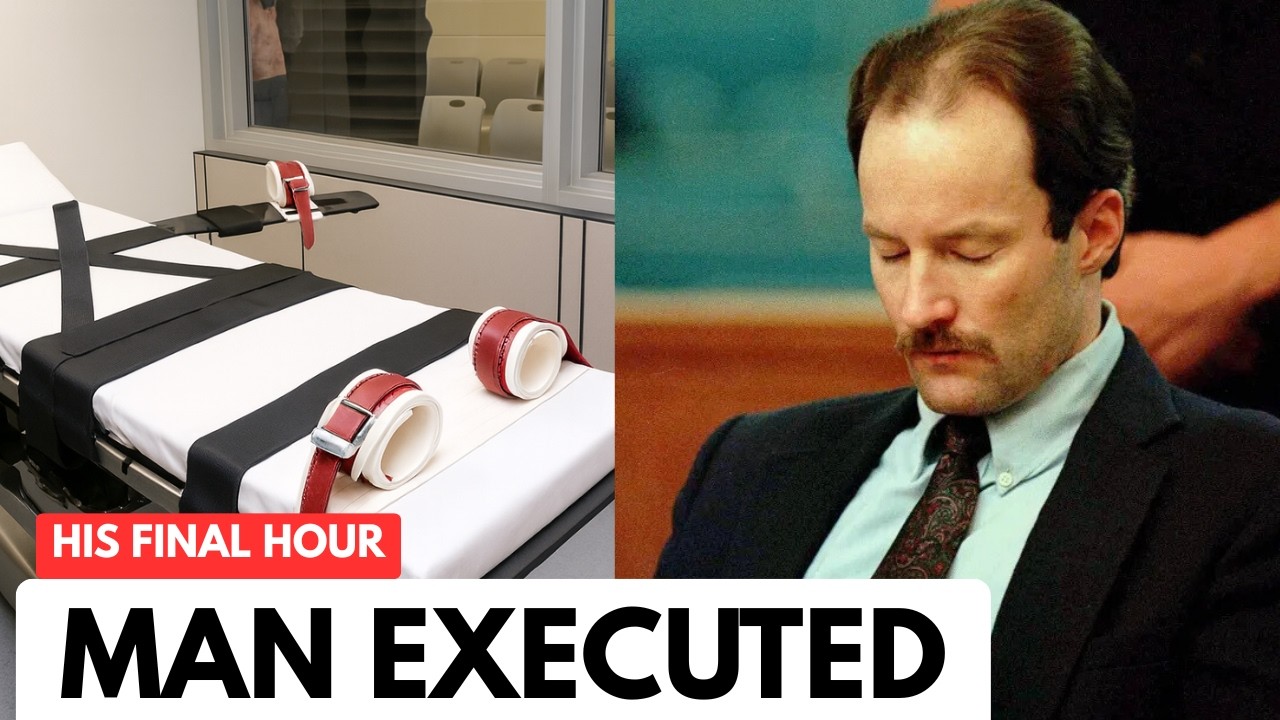 When the warden entered the chamber and asked the condemned man if he had any final words, the room fell silent. Cole’s response was chilling in its brevity. “No, sir,” he said calmly.
With that, Florida initiated its standard three-𝒹𝓇𝓊𝑔 execution protocol. The first 𝒹𝓇𝓊𝑔, etomidate, was administered to induce unconsciousness. It was followed by rocuronium bromide to paralyze his muscles, and finally, potassium acetate to stop his heart.
But the execution did not proceed without visible complications. Witnesses reported that just three minutes into the procedure, Cole began taking deep, labored breaths. His cheeks puffed outward with each struggling exhale.
His body, already ravaged by Parkinson’s disease, began to tremble involuntarily on the gurney. The tremors raised immediate questions about whether the sedative had properly taken hold, a central concern of his final legal appeals.
At the five-minute mark, the warden stepped forward. He shook Cole’s arm and called his name. There was no response.
Cole had already stopped breathing.
The execution was the first carried out in Florida in 2024, the 106th in the state since the reinstatement of the death penalty in 1976, and the 13th nationally this year.
To understand how Cole ended up on that gurney, one must return to a cold February evening in 1994. The Ocala National Forest, a sprawling expanse of pine flatlands in Central Florida, was the setting for a weekend camping trip.
John Edwards, a college freshman with his entire future ahead of him, had driven to the forest with his 21-year-old sister, Pam. It was supposed to be a simple, innocent getaway for the two siblings.
They set up their campsite, enjoying the quiet solitude of the woods. They had no reason to fear. Then a man approached them, introducing himself as Kevin.
He was friendly and offered to help them set up their camp. He left, but returned shortly with another man he claimed was his brother. The four of them sat around the campfire, the initial tension melting away in the warmth of the flames.
It was a trap. The man calling himself Kevin was Loran Cole. The other man was 20-year-old William Paul.
Someone suggested they go for a walk into the deeper woods. It was there, on a secluded trail, that the veneer of civility shattered completely.
Cole attacked Pam Edwards without warning. He threw her to the ground, struck her in the head, and slapped handcuffs on her wrists. Simultaneously, Paul struggled with John.
John Edwards fought back valiantly. He managed to wrestle a walking stick from Paul and used it to defend himself. But the fight was uneven.
Cole left Paul with John and took Pam back to the campsite. In the darkness of that night, John Edwards was brutally murdered. His throat was slashed.
His skull was fractured multiple times.
His attackers hid his body beneath a pile of pine needles and palm fronds, as if trying to erase him completely from the world. He was just 18 years old.
Back at the campsite, Pam Edwards endured a nightmare that would haunt her forever. She was raped repeatedly by Cole that night.
The following morning, the horror continued. She was raped again. Her captors then gagged her and tied her between two trees, leaving her to die in the forest.
But Pam Edwards possessed a will to survive that her attackers had not counted on. Alone in the woods, she chewed through the rope that bound her.
She freed herself in the early hours of Sunday morning. Bloodied and traumatized, she stumbled onto a road where a passing driver found her.
Despite her ordeal, Pam had the presence of mind to give authorities a detailed description of her attackers. Within 72 hours, Cole and Paul were arrested together at a park in Ocala.
The case that followed was one of profound legal asymmetry. William Paul accepted a plea deal, pleading guilty to first-degree murder, armed robbery, and kidnapping.
Paul was sentenced to five concurrent life sentences. The death penalty was taken off the table entirely. The Edwards family accepted this deal to spare Pam the trauma of testifying again.
Cole, however, refused to plead guilty. He went to trial. He was convicted of first-degree murder, kidnapping, robbery, and sexual battery.
He was sentenced to death.
This disparity between the fates of the two co-defendants became a central pillar of Cole’s decades-long appeals process. Cole claimed he did not commit the murder.
He pointed to forensic evidence he argued tied Paul to the murder weapon. He insisted that Paul was the actual killer, and that his own role, while criminal, did not warrant the death penalty.
The prosecution disagreed. The jury disagreed. The Florida Supreme Court disagreed.
 Cole was condemned to die.
But to understand Loran Cole, one must go back further than 1994. Cole was born in Iowa, and his early years gave little indication of the violence to come.
Things began to fall apart in his teenage years. In 1984, at the age of 17, Cole was sent to the Arthur G. Dozier School for Boys in Marianna, Florida.
The Dozier School has become infamous in the annals of American juvenile justice. It operated for over a century, from 1900 until 2011.
It was known to insiders as one of the most brutal reform institutions in the country. Students were subjected to rampant physical and sexual 𝓪𝓫𝓾𝓼𝓮.
Decades later, researchers would uncover evidence of dozens of unmarked graves on the property. The state of Florida eventually formally recognized these atrocities and offered compensation to survivors.
Cole spent just six months at Dozier, from June to November of 1984. He claimed the experience broke him.
He alleged that he was raped by a guard. He said he was beaten approximately twice a week during his stay.
He claimed that when he attempted to escape, guards broke both of his legs. Whether every detail of his claims was fully verifiable was something the courts wrestled with for years.
What is not in dispute is that Dozier was a deeply harmful institution. It was a pressure cooker of violence that left lasting scars on the boys who passed through its gates.
After Dozier, Cole’s trajectory bent sharply toward criminality. Between 1985 and 1991, he accumulated a record of charges and convictions.
By 1990, he was wanted in Cincinnati on a counterfeiting charge. His life was unraveling thread by thread.
In late 2003, Cole filed a motion seeking post-conviction DNA testing. He argued that DNA evidence could prove Paul had also raped Pam Edwards.
He claimed this would cast doubt on who was the actual killer. The Florida Supreme Court dismissed the appeal.
The court ruled that even if DNA testing confirmed Paul’s involvement in the sexual assault, it did not prove Cole was innocent of murder.
Over the next 15 years, Cole continued to file legal challenges, motions to vacate his death sentence, and writs of habeas corpus. The courts reviewed and rejected them all.
His attorneys raised a different kind of argument, rooted not in forensic evidence but in the story of who Cole was before the crime. They argued the jury should have known the full extent of the Dozier 𝓪𝓫𝓾𝓼𝓮.
They argued that Cole’s time at the reform school was a mitigating factor that the jury never fully appreciated. The courts did not find it sufficient to overturn the sentence.
As Cole’s execution drew nearer, his attorneys raised one final, urgent concern. Cole had been diagnosed with Parkinson’s disease.
His lawyers argued that his involuntary tremors would make the placement of intravenous lines unsafe and potentially inhumane. They argued the execution could become a medical procedure gone wrong.
The Florida Attorney General’s office responded sharply. They argued Cole had been aware of his Parkinson’s symptoms since at least 2017.
They argued he had waited until the death warrant was signed to raise the issue, which they characterized as a delay tactic. The courts were not persuaded.
The United States Supreme Court declined to take up his final appeal. No stay of execution was granted. The one-paragraph decision offered no explanation.
The date held. The legal road had fully closed. Every court had spoken.
Every appeal had been denied.
For his final meal, Cole requested pizza, ice cream, M&Ms, and a soda. Under Florida protocol, the meal cannot exceed $40 in cost.
It was a small ritual, one of the last gestures of individual choice before the state took that choice away forever. The witnesses were assembled.
Representatives from the media, officials, and members of the victim’s family who chose to attend filed into the viewing room. The gurney stood ready.
Cole was brought into the execution chamber. The warden asked the standard question. Cole refused to speak.
 The drugs began to flow. The witnesses watched the man on the gurney take his final, labored breaths.
His body shuddered, whether from the Parkinson’s, from the drugs, or a combination of both, no one can say with certainty. Then, stillness.
The warden approached. He shook Cole’s arm. He called his name.
There was no response.
At 6:15 p. m. , Loran Kenstley Cole was pronounced dead.
The man who had taken a life was now gone himself.
For the Edwards family, the moment was the culmination of a three-decade wait for justice. John Edwards never came home from that camping trip.
His parents carried the weight of his loss for 30 years, through every appeal, every hearing, every denied motion. Pam Edwards built a life on the other side of that night.
She became a wife, a teacher, and a professor. She carved out something meaningful from the wreckage of her trauma.
Her survival instinct, the moment she chewed through that rope, remains a testament to human resilience. She refused to let her brother’s murder and her own assault define her entirely.
Closure is a complicated word for families of murder victims. It means different things to different people.
What is clear is that the Edwards family waited a very long time for this day. They saw the man who killed their son and brother face the ultimate penalty.
The Ocala National Forest is still there. Hikers and campers still visit on weekends. Most people who walk those trails have no idea what happened there in 1994.
John Edwards would be in his late 40s today. He would have graduated from Florida State. He might have started a family, built a career, lived a full life.
That version of his story ended on a Saturday in February 1994, in a patch of woods, at the hands of two men he was kind enough to welcome to his campfire.
Loran Cole spent 30 years on death row. He argued that the system failed him long before he failed anyone else.
He pointed to the brutality of the Dozier School. He pointed to the co-defendant who received life in prison for the same crime. He pointed to his Parkinson’s disease.
The courts agreed with none of these arguments. The system he claimed had failed him ultimately held him accountable for the life he took.
Florida carried out the sentence it had promised 30 years ago. The long arc of the law bent toward its final conclusion in a sterile room in Raiford.
The case of Loran Kenstley Cole will be studied for years to come. It raises uncomfortable questions about childhood trauma, criminal accountability, and the disparities inherent in capital punishment.
Was Cole a monster who deserved to die? Or was he a broken product of a system that abused him as a child?
The state of Florida answered that question definitively on August 29, 2024. The needles were inserted. The drugs were delivered.
Loran Kenstley Cole is gone. John Edwards is gone. The families on both sides are left to live with the aftermath.
The execution chamber at Florida State Prison is empty tonight, but it will not remain so for long. There are other inmates on death row, other cases winding their way through the courts.
The machinery of the state continues to operate. The waiting continues.
For Pam Edwards, the waiting is finally over. She no longer has to fear a new appeal or a last-minute stay.
She can focus fully on the life she has built, the students she teaches, the family she loves. She carried the weight of that night in the forest for three decades.
Now, she is free to put it down. Her brother rests in peace. And the man who killed him has been held to account.
The final words of Loran Kenstley Cole were two simple syllables. No apology. No explanation.
 No plea for mercy.
Just a quiet refusal to engage with the world one last time. He took his secrets and his suffering to the grave.
Florida State Prison stands as a silent monument to the finality of the death penalty. Once the sentence is carried out, there is no going back.
There are no appeals left. There is no more DNA to test. There are no more arguments to make.
The case of Loran Kenstley Cole is closed. The chapter is finished. The only thing left is the memory of the victims and the lingering questions about the system that delivered this man to his fate.
John Edwards was an 18-year-old boy who went camping with his sister. He died a violent death that shocked the conscience of the nation.
His killer spent 30 years eating three meals a day, reading books, filing motions, and waiting. That waiting is now over.
The execution was carried out with clinical precision. The drugs did their work. The heart stopped beating.
The state of Florida watched it all happen, ensuring that the process was carried out according to the law. The witnesses reported what they saw.
The deep, labored breaths. The trembling body. The final stillness.
It took five minutes for the warden to confirm that Cole had stopped breathing. It took 30 years for the state to reach that point.
The system is slow. It is deliberate. It is designed to ensure that no innocent person is executed.
In this case, there was no doubt about guilt. The evidence was overwhelming. Pam Edwards’ testimony was devastating.
The only question was whether Cole deserved to die or whether he should have been sentenced to life in prison like his co-defendant.
That question was answered by a jury, by a judge, and by the Florida Supreme Court. They all agreed that death was the appropriate sentence.
Loran Kenstley Cole was executed. The justice system carried out its work.
The Arthur G. Dozier School for Boys is closed now. It was shut down in 2011 after decades of 𝓪𝓫𝓾𝓼𝓮.
The state offered compensation to survivors. But no compensation can undo the damage that was done to the boys who lived through that horror.
Cole was one of those boys. His time at Dozier was brief, but it left a mark that lasted his entire life.
He used that experience as a shield in court. He argued that it made him who he was.
The state argued that he made choices as an adult, that he chose to attack John and Pam Edwards, that he chose to 𝓀𝒾𝓁𝓁.
The state argued that Dozier was not an excuse for murder. The courts agreed.
Now, Cole is dead. The debate over his fate is over.
The execution of Loran Kenstley Cole was the 106th execution in Florida since the death penalty was reinstated in 1976.
It was the 13th execution in the United States in 2024. It was the first in Florida this year.
There will be more executions. There will be more debates. There will be more families waiting for justice.
The system continues to function. The wheels of justice continue to turn.
But for one family in Florida, the turning has stopped. The Edwards family has finally reached the end of the road.
They can mourn their son and brother without the shadow of a pending execution hanging over them.
The waiting is over. The sentence has been carried out. Loran Kenstley Cole is no more.