The state of Missouri carried out the execution of Leonard Taylor on Tuesday evening, February 7, 2023, at exactly 6:07 p. m. inside the Potosi Correctional Center in Bonne Terre.
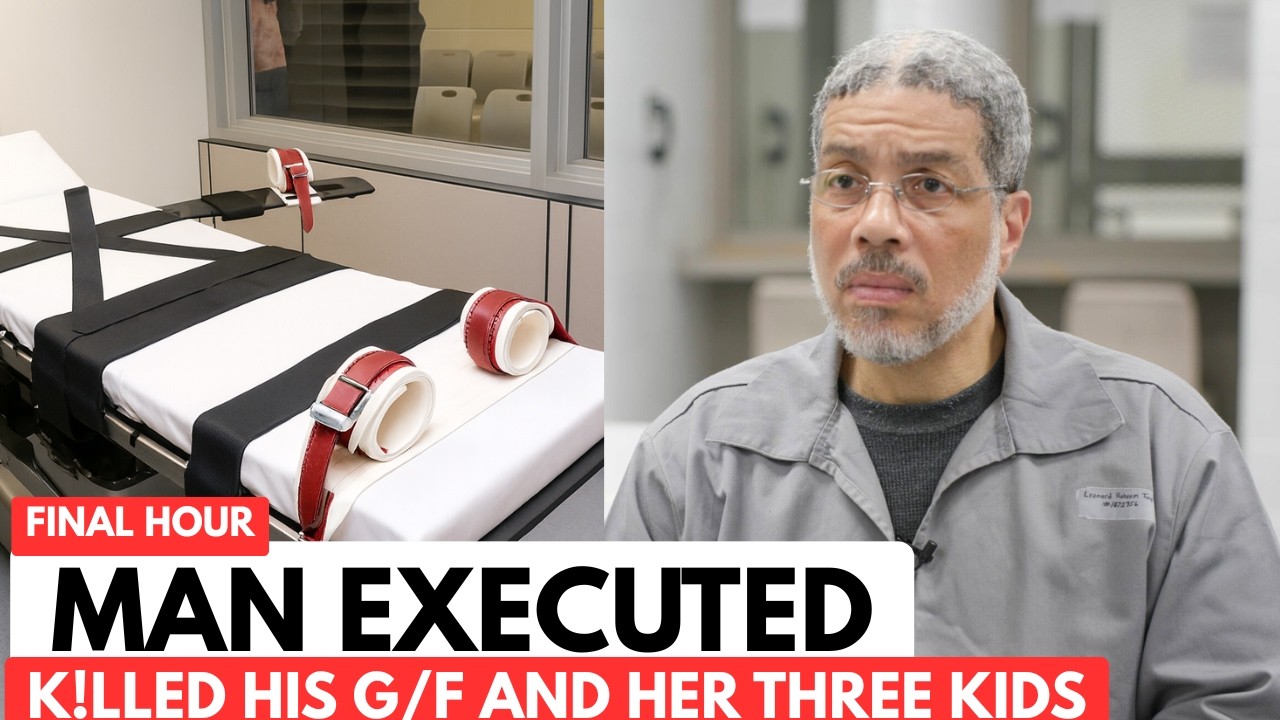 Taylor, 58, was pronounced dead at 6:16 p. m. after receiving a lethal dose of pentobarbital.
He had spent nearly 15 years on death row for the murder of his girlfriend, Angela Rowe, and her three young children.
But this execution did not pass without widespread controversy. In the final hours before his death, innocence organizations, forensic experts, and civil rights groups raised urgent questions about the evidence that put Taylor on death row. The state of Missouri, the courts, and the victims’ family stood firmly behind the conviction.
The execution proceeded after every appeal was denied, including a last-minute request to the U. S. Supreme Court.
Leonard Taylor, who also went by the name Raheem after converting to Islam, was convicted in 2008 of four counts of first-degree murder. The victims were Angela Rowe, 28, and her three children: Alexis Conley, 10, AC Crea Conley, 6, and Tyrese Conley, 5. They were found dead on December 3, 2004, in their home on Harney Avenue in Jennings, Missouri, a small city just north of St.
Louis. Each had been shot multiple times, including gunshot wounds to the head described as execution-style.
The central issue that divided experts and advocates for years was the timeline of the murders. Taylor had flown from St. Louis to Ontario, California on the morning of November 26, 2004, to meet his teenage daughter Deja for the first time.
Security cameras at Lambert International Airport captured him passing through security, boarding a Southwest Airlines flight at 8:10 a. m. The bodies were not discovered until a full week later, on December 3.
 If the victims were killed after Taylor left Missouri, he could not have physically committed the crimes. The original medical examiner, Dr. Philip Burch, initially estimated that the victims had been dead for two to three days before discovery placing the time of death around November 30 or December 1.
That would have been after Taylor was already in California. But by trial, Dr. Burch revised his estimate, testifying that the bodies could have been dead for up to three weeks, accounting for the home’s air conditioning slowing decomposition.
That shifted the time of death to mid-November, when Taylor was still in the state.
Taylor’s legal team and the Midwest Innocence Project argued that the revised time of death was unscientific and that independent forensic pathologist Dr. Jane Turner disagreed with Burch’s later conclusion. They also pointed to testimony from Taylor’s daughter and her mother, who said they had spoken by phone with Angela Rowe and one of the children while Taylor was in California.
If true, that would prove the victims were alive after November 26.
Another key piece of evidence was a statement from Taylor’s brother, Perry Taylor, who told police that Leonard had confessed to the murders. But Perry recanted at trial, claiming police had threatened him with prison time if he did not implicate his brother. Perry died in 2015, leaving his original statement unchallenged in later appeals.
Physical evidence included DNA from Angela Rowe’s blood found on Taylor’s glasses, which police seized when they arrested him in California. A relative who drove Taylor to the airport claimed Taylor threw what appeared to be a gun into a sewer drain along the way. No weapon was ever recovered from that drain or anywhere else.
No eyewitnesses placed Taylor at the scene of the murders.
 Despite these unresolved questions, a jury convicted Taylor in 2008, and he was sentenced to death. Over the next 15 years, his appeals focused on procedural and legal grounds rather than a full factual review of the innocence claim. Every court that examined the case, including the Missouri Supreme Court and the U.
S. Supreme Court, allowed the conviction to stand.
In the months leading up to the execution, organizations including the Midwest Innocence Project, the NAACP, and various religious groups urged Governor Mike Parson to grant clemency or convene a board of inquiry. The governor denied the request, calling Taylor’s innocence claims self-serving. Taylor’s legal team also requested that an Imam be allowed in the execution chamber for spiritual support, but the state attorney general denied that request as well.
Taylor spent his final days calm and at peace, according to those who spoke with him. He told his advocate that whatever was Allah’s will was Allah’s will. His favorite song was “Family Reunion” by The O’Jays.
The Missouri Department of Corrections did not publicly confirm details of his final meal request, and no verified account has been released.
In the execution chamber, Taylor did not speak aloud. He had prepared a written statement released afterward. It began with a passage from the Holy Quran, Sura 2, verses 153 and 154, about patience and perseverance.
Then he wrote: “Muslims don’t die. We live eternally in the hearts of our family and friends. From Allah we come and to Allah we all shall return.
Everybody will get their turn to die. Death is not your enemy. It is your destiny.
Look forward to meeting it. ” He closed with a single word: “Peace. ”

Witnesses reported that as the pentobarbital was administered, Taylor moved his feet, then took five or six deep breaths before all movement stopped. He was pronounced dead nine minutes after the injection began.
After the execution, reporters spoke with Jerriun Rowe, Angela Rowe’s sister. She said, “Justice is served. ” Then she added, “Not really.
” The mixed emotion reflected the deep complexity of the case. For nearly two decades, the victims’ family had waited for closure, but the lingering doubts expressed by innocence advocates may never fully fade.
The Midwest Innocence Project released a statement saying Taylor’s life had been “stolen by unreliable testimony and unscientific conclusions and a system that refused to correct its mistakes. ” They noted that since 1973, more than 190 people have been exonerated from death row in the United States, including four from Missouri. A National Academy of Sciences study estimated that more than 4% of those on death row may be factually innocent.
The state of Missouri and the victims’ family maintained that the conviction was just and that the sentence had been rightfully carried out. Governor Parson’s office issued no further comment after the execution.
Leonard Taylor was the third inmate executed in Missouri since November 2022. His death came after a 15-year legal battle that raised fundamental questions about the reliability of forensic evidence, witness testimony, and the finality of capital punishment. The names of the victims Angela Rowe, Alexis Conley, AC Crea Conley, and Tyrese Conley remain at the heart of a story that offers no easy resolution.
One side sees a just verdict upheld. The other sees a possible miscarriage of justice. The only certainty is that four lives were violently ended, and a man is now dead by state action, with his final words echoing a message of peace and faith.