The black government vehicle idled like a held breath, its engine a low growl beneath the snapping flags. Gravel crunched under the Colonel’s boots as he stepped fully into the morning light—silver at the temples, uniform pressed sharp enough to cut the damp air. His eyes, the color of storm clouds over open water, locked on mine with the kind of recognition that carried weight.
“Commander Mitchell,” he repeated, voice carrying across the frozen formation. Not a question. A summons.
Every soldier on that road felt it. The kind of shift in pressure that happens when the chain of command suddenly remembers who owns the sky.
I straightened, notebook still closed in my hand, coffee long forgotten on the gym floor behind us. The cold morning clung to my skin, but inside, something steadier burned—years of proving the ocean didn’t care about your gender, only your will. Briggs stood two paces ahead, his shoulder still angled like he owned the ground between us. His smile had frozen halfway, cracking at the edges.
The Colonel didn’t even glance at him. “Fall the formation back to the gym. Training resumes in ten. Mitchell, with me.”
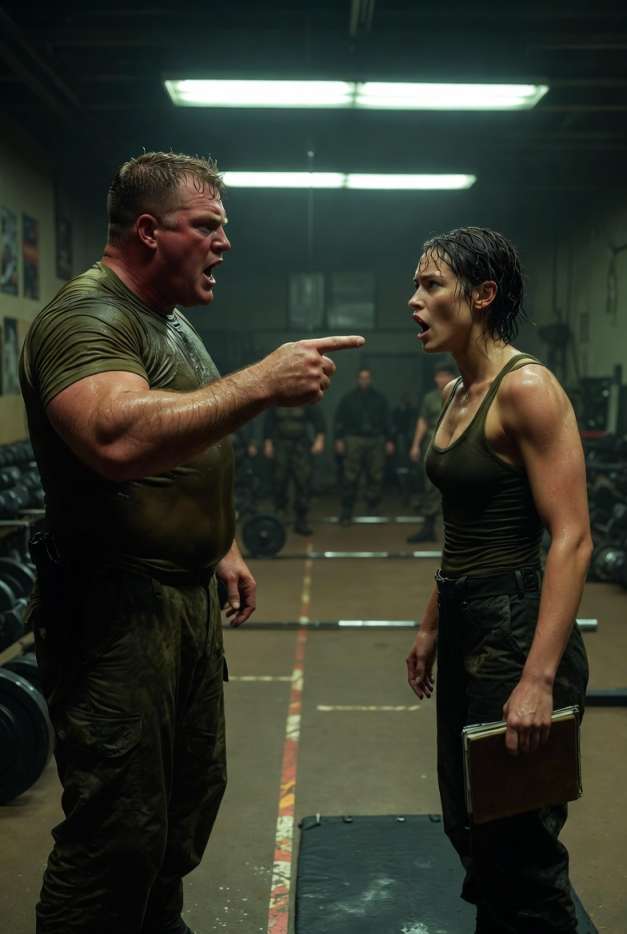
Briggs’s jaw worked like he was chewing glass. A vein throbbed at his temple, visible even from where I stood. He wanted to say something—anything—to reclaim the moment. But the Colonel’s presence sucked the oxygen from the insult before it could form. The line of soldiers parted without a word. Boots scraped gravel. Someone coughed once, nervously. Mason, the young one, met my eyes for half a second. There was apology in them. And something sharper—recognition.
I walked past Briggs without looking back. His shadow tried to follow, heavy and resentful, but it couldn’t touch me now.
The Colonel’s name was Hargrove. I knew the file. Two tours in the sandbox, a reputation for cutting through bureaucratic meat like a KA-BAR through silk. He held the sealed folder like it was both shield and weapon. We climbed into the vehicle. The door shut with a solid thunk, sealing out the wind, the flags, the gym’s metallic echo.
Inside, the air smelled of leather, fresh ink, and faint cigar smoke from some earlier meeting. Hargrove settled across from me as the driver pulled away, heading deeper into Fort Liberty’s maze of brick and wire.
“You made an impression,” he said, not unkindly. His gaze flicked to the notebook in my lap. “Briggs has been running that program like his personal fiefdom for eighteen months. Joint ops tend to attract the territorial ones.”
I kept my face neutral, but my pulse thrummed with the memory of his shoulder clipping mine. “Territorial is one word for it, sir.”
Hargrove’s mouth twitched—the ghost of a smile. “You didn’t flinch. Good. You’ll need that.”
He opened the folder. Inside were photographs, redacted reports, maps marked with overlapping grids of ocean and desert. My stomach tightened, not from fear, but from the familiar pull of purpose. The kind that had dragged me through BUD/S when every instructor swore a woman would break. The kind that whispered in the dark after every lost teammate: Keep going. The tide doesn’t stop.
“This isn’t just a joint training rotation, Commander,” Hargrove said, sliding a photo across the seat. A sunken vessel, half-buried in silt, its hull scarred by something that wasn’t corrosion. “We’ve got a ghost ship. Iranian tech, American components, and a crew that vanished without a trace six weeks ago. The brass wants Navy eyes on the water side, Army muscle on extraction. You’re the bridge.”
I studied the image. The metal looked wrong—twisted in patterns that spoke of pressure from inside, not outside. My mind flashed to the North Atlantic, two years back: cold water closing over my head, the taste of failure and salt. I pushed it down.
“And Briggs?” I asked.
Hargrove closed the folder. “He’s good in the field. Too good to sideline. But he’s got blind spots the size of aircraft carriers. Prove you belong. Not for him—for the mission. The rest will sort itself.”
The vehicle stopped outside a low, windowless building that smelled of ozone and secrets. Inside, the briefing room hummed with monitors and quiet tension. Maps glowed on the walls. Coffee steamed on a side table—black, strong, the kind that kept ghosts at bay.
I took a seat. Hargrove stood at the head, outlining timelines, contingencies, the kind of nightmare that looked clean on paper but bled in execution. My mind cataloged every face in the room. The quiet intelligence officer with nervous hands. The Delta operator who watched everyone like prey. And later, when the door opened again, Briggs—called in for the operational brief, his face a mask of professional calm that didn’t reach his eyes.
He sat two chairs down. Close enough to smell the sweat still drying on his collar. Close enough to feel the heat of his resentment.
As Hargrove spoke of insertion points and exfiltration windows, Briggs’s boot tapped once under the table. A rhythm like a countdown. His gaze slid to me during a pause—measuring, calculating. Not just hate. Something deeper. A man who had built his identity on being the hardest in the room, now forced to share it with a woman whose record made his look like basic training.
I met his eyes. Held them. In that second, the room narrowed to the space between us: the weight of unspoken wars, the ghosts we both carried, the mission that might kill us both before we ever settled this.
Later that night.
The barracks hallway stretched long and dim, lit by emergency strips that painted everything in sickly green. I stood at the window at the end, staring out at the empty field where flags still whipped in the dark. Rain had started—soft, insistent, the kind that soaked through resolve if you let it.
Footsteps behind me. Heavy. Familiar.
Briggs stopped a few feet away. No audience now. Just the rain and the quiet.
“You think this makes you special?” he said, voice low. “Being called out by the Colonel like some goddamn savior?”
I turned. The glass behind me was cold against my back. “I think the mission doesn’t care what you think of me, Sergeant.”
His laugh was short, bitter. Up close, the red in his face had faded to something raw. Scars peeked from under his sleeve—old burns, maybe. A story he never told. “I’ve buried better operators than you. Men who earned their place. You waltz in with your notebook and your quiet little stares like you’re taking notes for a fucking memoir.”
I saw it then—the wound. Not just sexism. Fear. The kind that came from watching your team get smaller, year after year, while the world changed faster than you could adapt. His hands flexed at his sides, knuckles white. He wanted to push. To test if I’d push back in the dark where no one would see.
Instead, I stepped closer. Not threatening. Just close enough that he could see the steadiness in my eyes. “I’ve buried people too, Ryan. Good ones. The ocean doesn’t ask for permission. Neither does whatever’s waiting out there on that wreck.”
For the first time, something flickered behind his anger. Surprise. A crack in the armor.
The rain drummed harder against the glass.
He opened his mouth, then closed it. Turned on his heel. But before he disappeared down the hall, he paused. “Watch your six, Commander. This program eats the weak.”
The words should have stung. Instead, they settled like fuel on the fire already burning in my chest.
I stayed at the window long after his footsteps faded. The notebook felt heavy in my pocket now—not just schedules, but the beginning of something else. Names. Observations. The shape of the threat inside our own ranks.
Dawn would come too soon. With it, more drills. More tests. And somewhere beyond the wire, a sunken ship holding secrets that could drown us all.
But for the first time since stepping into that gym, I smiled into the dark.
Let them watch.
Chapter 2: Echoes in the Silt
The rain had turned Fort Liberty into a living thing by 0430—sheets of it hammering the tin roofs of the barracks, turning the gravel paths into shallow rivers of mud. Avery Mitchell stood in the doorway of the ready room, the hood of her rain jacket pulled low, watching the downpour eat away at the edges of the parade field. Each drop felt personal, like the ocean testing her again, reminding her that water always found the cracks.
She hadn’t slept. The ghost ship’s photographs had followed her into the dark: that twisted hull, the way the metal seemed to scream without sound. Her fingers still carried the phantom chill of North Atlantic water from two years ago—the night her swim buddy had slipped beneath the waves during a training evolution gone wrong. She had dived after him until her lungs burned black, until the surface lights looked like dying stars. They recovered the body three days later. The report called it “unavoidable.” Avery called it the moment she stopped believing in mercy.
The door behind her banged open. Briggs stepped through, gear already strapped tight, water streaming off his broad shoulders. He didn’t acknowledge her at first. Just grabbed a rifle from the rack and checked the action with sharp, angry movements. Metal on metal. The sound sliced through the rain.
“Morning, Commander,” he finally said, voice flat as wet concrete. “Sleep well in officer country?”
She adjusted the strap of her own pack. “Well enough to run the course twice before you rolled out of bed, Sergeant.”
His eyes flicked to her—quick, assessing. The crack she’d seen in the hallway last night was gone, sealed over with fresh layers of armor. But it was there, beneath. She could smell it on him like ozone before lightning: the fear of being replaced. Of watching the rules he’d bled for get rewritten by someone who looked nothing like the men he’d followed into hell.
Outside, the rest of the joint team waited in the deluge. Twelve operators—Navy, Army, a couple of Marines who looked like they’d rather be anywhere else. Hargrove stood at the front, rain sliding off his cap in perfect sheets, unfazed. “Today we simulate the approach,” he called over the storm. “Two teams. Surface insertion, subsurface recon. Mitchell leads Blue. Briggs, Red. Make it real.”
Briggs’s jaw tightened so hard Avery heard the pop from ten feet away. He said nothing. Just shouldered past her toward the starting line, his boot splashing mud across her pant leg. Deliberate. A small claim on territory.
The course wound through the training grounds like a scar: razor wire, mock buildings, a flooded trench that smelled of diesel and rot. Blue team formed up around her—silent, waiting for the signal. Mason was there, the kid from yesterday, his young face pale under the hood. He gave her a tight nod. Loyalty bought with nothing more than eye contact in the road. It was enough.
“Go.”
They moved like ghosts in the gray. Avery took point, low and fast, the rain masking their footfalls. Her breath stayed even, heart locked down. Every step was calculated: the weight of the pack, the slick grip on her carbine, the way the mud tried to pull her under like the Atlantic once had. Behind her, the team flowed. No wasted motion. No questions.
Red team hit them at the first choke point.
Briggs came in hard—too hard. His shoulder slammed into one of her swimmers during the breach simulation, sending the man sprawling into the wire. “Reset!” the observer shouted, but Briggs was already pressing the advantage, driving his element forward like a battering ram. His eyes found hers through the rain. Hungry again.
Avery adjusted. She flanked left, using the flooded trench as cover. Cold water climbed her chest, soaking through layers, biting into skin. Memories flashed—black water, failing lights, a hand slipping from hers. She shoved them down and surfaced on the other side, taking the high ground behind a crumbling wall.
“Flank secured,” she whispered into the comms. Her voice didn’t shake.
Briggs’s reply crackled back, distorted by static and scorn. “Cute maneuver, princess. Try not to drown in a puddle.”
The words landed like hooks. But she didn’t bite. Instead, she watched him through her scope as his team overextended. Arrogance made him predictable. He pushed too far, too fast, believing strength was enough. When Blue team converged, it was surgical. Mason took the rear. Avery dropped into the center.
They “captured” the objective in forty-three seconds.
Hargrove’s voice cut through the rain from the observation tower. “Blue wins. Red, debrief your gaps.”
Briggs stood in the middle of the mock street, chest heaving, rain mixing with the sweat on his face. His team avoided his eyes. One man muttered something about “Navy bullshit.” Briggs silenced him with a look that could curdle blood. Then he turned that look on her.
Later, in the drying room, steam rose from uniforms hanging like surrendered flags. Avery peeled off her soaked layers, muscles burning in that good, honest way. The scar along her left ribs—courtesy of a failed boarding op in the Gulf—itched under the fluorescent lights. A reminder that every win cost pieces.
The door hissed open. Briggs.
He stopped when he saw her, half-dressed, the scar visible. For a moment, the bully mask slipped. His gaze lingered—not leering, but reading. Cataloging damage the way only survivors did. Then the wall slammed back up.
“You think one lucky sim makes you ready for what’s out there?” He jerked his chin toward the distant coast, where the real ocean waited. “That wreck isn’t playing games. It already ate a crew. Good men.”
Avery pulled on a dry shirt, slow and deliberate. “Then why are you fighting me instead of it, Ryan?”
The use of his first name hit like a slap. He stepped closer, the steam swirling around them like smoke from a burning ship. Up close, she saw the toll: the slight hitch in his left shoulder from an old wound, the way his eyes carried nights he’d never admitted to. A man who had given everything to the green machine, only to watch it evolve without him.
“Because I’ve seen what happens when standards slip,” he said, voice rough. “When they send in the pretty face and the impressive file instead of the guy who’s done it in the dirt. My brother was on the last joint op that went sideways. He didn’t come home because someone higher up wanted ‘diversity optics.’”
The confession hung there, raw and unexpected. Not an excuse. A wound laid bare. Avery felt it twist in her own chest—the shared language of loss. But she couldn’t let it soften her. Not yet.
“Your brother died because missions fail, not because of me,” she said quietly. “Blaming ghosts won’t bring him back. And it sure as hell won’t save the next team.”
Briggs’s hand clenched on the locker door. Metal groaned. For a second, she thought he might swing. Instead, he exhaled sharply and stepped back.
“Briefing at 1400,” he muttered. “Try not to get us all killed with your notebook wisdom.”
He left. The steam settled. Avery stared at the empty doorway, the scar on her ribs throbbing in time with her pulse. She had won the sim. But the real war was just beginning—inside the team, inside herself.
The afternoon briefing room smelled of burnt coffee and tension thick enough to chew. Hargrove laid out the latest intel: satellite anomalies over the wreck site, strange electromagnetic signatures that messed with drones. “Whatever’s down there isn’t just salvage,” he said. “It’s active. And it’s calling.”
Avery studied the new images. The hull now showed faint lights—bioluminescent? Or something mechanical, pulsing like a heartbeat under silt. Her throat tightened. The ocean had always been her element. Now it felt like it was turning on her.
Briggs sat across the table, silent. But his foot tapped that same countdown rhythm. When the meeting broke, he caught her arm in the hallway. Not rough. Just enough to stop her.
“Tonight,” he said. “Night dive simulation. You and me. No teams. Let’s see if you belong in the black water.”
His eyes challenged her. Dared her. Beneath the anger, there was something almost like respect trying to claw its way out. Or maybe just the need to break her where it mattered most.
Avery nodded once. “See you at the pool, Sergeant.”
As she walked away, the rain outside had stopped. But inside her, the storm roared louder. The ghost ship waited. Briggs waited. And somewhere in the silt, secrets that didn’t care about rank or resentment were stirring awake.
She gripped her notebook tighter.
By morning, one of them might not be coming back up.
Chapter 3: Black Water Confession
The training pool at Fort Liberty was a concrete abyss under sodium lights, its surface rippling like it was alive and hungry. Midnight had stripped the base to its bones—only the hum of generators and the distant bark of a sentry dog broke the silence. Avery stood at the edge in her dive gear, the neoprene hugging her like a second, colder skin. The tank on her back felt heavier tonight, pressing down on the old scar along her ribs. Every breath through the regulator tasted of recycled fear.
Briggs was already in the water, his silhouette cutting the surface like a blade. No audience this time. No Hargrove watching from the observation deck. Just the two of them and the black beneath.
“You sure you want to do this without a safety line, Commander?” His voice echoed off the tiles, distorted by the mask. “Wouldn’t want to lose you to the deep on my watch.”
Avery didn’t answer with words. She stepped off the edge, the water swallowing her in one cold gulp. It closed over her head with a familiar roar, muffling the world above. Bubbles streamed past her face as she descended, the lights fracturing into shards of white. Ten feet. Twenty. The bottom was painted to mimic ocean floor—uneven, shadowed, with mock wreckage scattered like broken promises.
Briggs moved beside her, powerful strokes that stirred silt clouds. They circled the simulated wreck—a steel frame twisted to echo the real one. Their lights cut narrow beams through the murk. In the green glow, his eyes behind the mask looked almost feral. Testing. Waiting for her to hesitate.
She didn’t.
They worked in silence at first, hand signals sharp and precise. Avery mapped the “hull,” noting weak points, her mind overlaying the briefing photos. The water pressed in, familiar pressure building against her chest. Memories clawed up: the North Atlantic, her buddy’s glove slipping from hers, the way the dark had laughed as it took him. Her regulator hissed louder. She forced her breathing steady, fingers tracing a seam on the mock structure.
Briggs tapped her shoulder—hard. Enemy contact. He pointed toward the far shadows where a diver silhouette (one of the instructors, silent observer) had appeared. Game on.
They moved together, not as enemies but as predators. Briggs took the high approach, Avery the low. She slipped through a narrow gap in the frame, the metal scraping her tank with a sound like teeth on bone. The instructor “attacked” from the flank. Briggs was there first, powerful kick driving him forward, locking the man in a controlled grapple. Avery flanked, securing the “objective”—a weighted pouch representing intel.
Surface time came too soon. They broke the water together, masks fogged, chests heaving. The air above felt thin, fragile.
Briggs yanked his mask off, water streaming down his face. “Not bad,” he admitted, the words dragged out like they hurt. “For a desk sailor.”
Avery treaded water, studying him. The pool lights painted harsh shadows under his eyes. “Your brother,” she said quietly. “What was his name?”
The question hung between them, unexpected. Briggs’s jaw flexed. For a long moment, only the lap of water against the sides filled the space. Then he swam to the edge, hauled himself out, and sat with his legs still dangling in. Droplets fell from his gear like slow tears.
“Jacob,” he said finally. “Jake. He was my little brother. Followed me into this life like it was the family business. Last joint op in the Gulf. They paired him with some hotshot from another branch. Protocol got ignored. He took a round covering her retreat.” His voice cracked, just once. “They called it heroic. I call it preventable.”
Avery pulled herself up beside him, close enough to feel the heat radiating from his skin despite the chill. She didn’t offer platitudes. Instead, she unclipped her tank and set it down with a heavy clank. “I lost my swim buddy in the Atlantic. Training accident, they said. But I replay it every night. The way his hand felt. The way the water didn’t care.”
Their eyes met. No masks now. Just two scarred souls staring into the same abyss. Something shifted in Briggs—anger softening at the edges into a raw, reluctant understanding. He reached out, almost unconsciously, and brushed a strand of wet hair from her face. The touch lingered a second too long, electric in the cold air.
“You’re not what I expected,” he muttered.
“Neither are you.”
The moment stretched, fragile as surface tension. Then the pool room door slammed open.
Hargrove strode in, flanked by two MPs, his face carved from granite. “Training’s over. Both of you, dry off. We’ve got movement on the wreck site. Real movement. Satellite caught a signal burst two hours ago. Looks like someone’s waking it up from inside.”
Avery’s stomach dropped. Briggs stood, water pooling at his feet.
“And there’s more,” Hargrove continued, handing Avery a tablet. The screen showed grainy underwater footage—lights pulsing deep, and a shadow that looked almost human moving against the current. “We’re accelerating. Wheels up at 0600. This is no longer simulation.”
As Hargrove turned to leave, Briggs caught Avery’s arm again. This time his grip was different—urgent, protective. “Whatever’s down there,” he said, voice low, “we face it together. No more games.”
She nodded, but as they walked out into the night, a new unease coiled in her gut. The tablet image burned behind her eyes. That shadow hadn’t moved like a diver. It had moved like it belonged down there.
Back in her quarters, Avery opened her notebook. The pages were damp at the edges now. She wrote one line, hand steady despite the adrenaline:
It’s not just a ship. It’s calling us home.
Outside, the flags snapped in a fresh wind. Dawn was coming, blood-red on the horizon. But in the dark between them, something older and hungrier than any grudge had begun to stir.
Briggs’s footsteps paused outside her door for a long moment before fading away.
Chapter 4: The Call from Below
The C-17 Globemaster cut through the night sky like a blade through silk, engines thrumming a low, relentless heartbeat that vibrated deep in Avery’s bones. Inside the cargo hold, red jump lights bathed everything in hellish glow—seats, pallets, the faces of operators who knew this might be their last flight. She sat strapped in beside Briggs, their shoulders brushing with every turbulence bump. The fragile truce from the pool still felt new, raw, like skin over an unhealed wound.
Briggs stared straight ahead, jaw set, but his hand rested on the bench between them, close enough that their knuckles touched when the plane shuddered. No words. Just the shared weight of what they’d confessed in the black water. Jacob. Her swim buddy. Names that had no business surfacing now, yet refused to stay buried.
Hargrove moved down the aisle, briefing in clipped tones over the engine roar. “Insertion via HAHO jump. Navy element secures the surface perimeter. Army leads the descent to the wreck. Mitchell, you have dive command. Briggs, you’re her shadow. Questions?”
None came. But Avery felt the undercurrent—eyes flicking between her and Briggs. Mason gave her a small, nervous thumbs-up from across the way. The kid was growing on her, all wide eyes and quiet competence. The others? Some still carried Briggs’s original poison in their stares. Standards slipping. Optics over readiness.
The ramp lowered at 0230. Wind howled in, tearing at their chutes. Avery stepped to the edge, the void yawning below—miles of dark ocean glittering under a sliver moon. Briggs was right behind her. She could feel his presence like a shield and a question mark at once.
“See you on the water, Commander,” he said, voice steady against the gale.
They jumped.
Freefall was pure violence—air screaming, body tumbling until the chute snapped open with a crack that jolted her spine. The ocean rushed up, black and endless. She hit the surface hard, the cold slamming through her suit like a betrayal. Inflatable raft deployed. Briggs surfaced ten yards away, powerful strokes bringing him alongside. Their team coalesced around the marker buoy, silent as seals.
The wreck site lay two klicks east. The water here felt wrong—thicker, charged, like the ocean itself was holding its breath. Avery dove first, Briggs matching her descent. Lights pierced the dark in narrow, disciplined beams. Deeper. Pressure building. The scar on her ribs sang with old pain.
Then they saw it.
The ghost ship rested at an unnatural angle on the seabed, half-buried in silt, but glowing. Not lights exactly—veins of bioluminescence crawling across the hull like living circuitry. Iranian markings mixed with American serial numbers that shouldn’t exist. And in the center of the main deck hatch, that shadow from the footage moved again. Humanoid. Slow. Deliberate.
Briggs signaled Hold position. His hand found her arm underwater, grip tight. They watched as the figure—diver? Something else?—disappeared into an open breach. Bubbles rose, carrying a faint metallic tang that seeped through their regulators.
They advanced.
Inside the wreck, the world narrowed to corroded corridors and flickering emergency strips that shouldn’t still work. Avery’s light swept across bulkheads etched with symbols that hurt to look at directly—mathematical? Runes? Something between. Briggs stayed glued to her six, his breathing measured in her earpiece.
“Contact,” Mason’s voice crackled from the surface team. “We’ve got unidentified vessels approaching from the north. Fast movers.”
Tension spiked. Avery pressed forward into what looked like a control room. Consoles hummed faintly. In the center, a cylindrical device pulsed softly, wired into the ship’s systems. American design. Iranian casing. A hybrid abomination.
Briggs knelt beside it, gloved fingers tracing connections. “This isn’t salvage. It’s a beacon. Someone turned it on from the inside.”
Avery’s blood ran colder than the water. “Exfil the device. Now.”
As they worked to secure it, the shadow reappeared—silhouetted in the doorway. Not a diver. The suit was wrong, too sleek, movements too fluid. It raised a hand, and the ship’s systems flared brighter. Alarms that had no right to function screamed through the hull.
Briggs reacted first. He shoved Avery behind a console as the first burst of energy—lightning trapped in water—ripped through the space. Sparks danced in the murk. Her vision blurred. Pain lanced through her side, old scar reigniting like fresh fire.
“Move!” Briggs roared into the comms.
They fought their way out, the shadow pursuing with unnatural grace. In the narrow passages, it was chaos—fins kicking silt, lights swinging wildly, Briggs’s powerful frame shielding her as they ascended through collapsing sections. Metal groaned around them like a dying beast.
They broke surface near the raft just as the unidentified boats closed in. Gunfire stitched the water. Mason hauled them aboard, face ashen. “They’re not Iranian. Markings are… off. Like the ship.”
Hargrove’s voice came over long-range comms from the orbiting command bird. “Abort and RTB. The beacon’s active. We’ve got signatures lighting up across the sector. This just became a hot zone.”
Avery collapsed against the raft’s side, coughing seawater, ribs screaming. Briggs knelt beside her, stripping off his mask. His face was streaked with silt and something darker—blood from a gash above his eye. He looked at her, really looked, and for the first time the hunger in his eyes wasn’t for dominance.
“You good?” he asked, voice rough.
She nodded, but the device now secured in the raft’s center pulsed faintly even out of water. It felt alive. Watching.
As the extraction helo thundered in, winching them up one by one, Avery glanced back at the water. The ocean surface swirled unnaturally over the wreck site. And for a split second, she swore she saw the shadow break the surface too—watching them leave.
Back on the helo, Briggs sat shoulder to shoulder with her again. The truce had hardened into something sharper. Alliance. Maybe more. His hand found hers in the dim red light, callused palm grounding her against the roar.
But as the helo banked toward the carrier, Hargrove’s updated transmission came through, voice tight:
“New orders. The beacon isn’t just calling ships. It’s calling people. We’ve got reports of operators from both sides going dark near the site. Including one name you’ll recognize.”
The tablet screen lit up with a photo.
Jacob. Briggs’s brother. Alive. Or something wearing his face.
Briggs’s grip crushed hers. His breath hitched once—raw, broken.
The black water had given up one of its ghosts.
And it was coming for them.
Chapter 5: Ghosts Don’t Die Quietly
The carrier’s flight deck roared with controlled chaos—jets screaming into the predawn sky, deck crew moving like shadows in orange vests, salt spray mixing with jet fuel in the heavy air. Avery’s boots hit the nonskid surface still dripping from the ocean, the secured beacon device strapped to a pallet beside her. It hummed faintly, a vibration she felt in her teeth, as if the thing had a pulse synced to her own racing heart.
Briggs was off the helo before the rotors fully wound down. He paced the deck like a caged animal, eyes locked on the pallet. The gash above his eye had been hastily bandaged, blood already seeping through. When two sailors approached to move the device, he stepped in front of them, broad shoulders rigid.
“Nobody touches it until we know what the hell it did to my brother.”
Hargrove appeared from the island superstructure, face etched deeper with new lines. “Medical bay first. Both of you. Then debrief. This is bigger than one missing man.”
But Briggs wasn’t hearing it. He turned on Avery as the deck crew gave them space. The wind whipped between them, carrying the carrier’s massive momentum through the waves. “You saw the photo. Jake. My Jake. That thing down there had him walking around like some goddamn puppet. How?”
His voice cracked on the last word—not weakness, but the sound of a man watching the last anchor of his life get pulled into the abyss. Avery felt it echo in her own chest. The North Atlantic ghost had never truly left her either. She reached for his arm, steadying him as the deck pitched.
“I don’t know,” she said, voice low but firm, forcing him to meet her eyes. “But we’re going to find out. Together. No more solo charges, Ryan. That’s how people get lost.”
For a heartbeat, the storm in him stilled. His hand covered hers on his arm—rough, desperate. The same hand that had shielded her in the wreck. Something unspoken passed between them: two survivors recognizing the same fracture lines. Then Hargrove’s team pulled them apart toward the infirmary.
In the sterile lights of the medical bay, Avery sat on the exam table while a corpsman checked her ribs. The scar was inflamed, angry red lines spreading like the bioluminescence on the ship. Briggs was in the next bay, his voice carrying through the partition as he argued with the doctor.
“Sedate me later. I need to see that footage again.”
She closed her eyes, letting the hum of the ship and the distant slap of waves fill the silence. The beacon was locked in a Faraday cage two decks below, but she could still feel it. Calling.
Debrief was held in a secure compartment deep in the carrier’s belly. Screens showed enhanced imagery: Jacob—or the thing wearing his face—moving with the wreck’s shadows. Same build. Same scar on the left forearm from a childhood accident Briggs had mentioned in the pool. But the eyes were wrong. Too calm. Too empty.
Hargrove laid it out flat. “The device isn’t a beacon. It’s a bridge. Some kind of neural interface tech. Iranian reverse-engineering of a black project we lost years ago. It doesn’t just call ships. It calls minds. Rewrites them. We’ve lost three more operators in the last hour—good men, suddenly going dark and heading toward the site like moths.”
Mason shifted uncomfortably in his seat. “Sir… what if it’s already affecting us?”
The question landed heavy. Avery glanced at Briggs. His knuckles were white on the table edge. She saw the war in him—the desperate need to believe his brother could be saved versus the soldier’s knowledge that some things came back wrong.
After the briefing, they found a quiet corner on the hangar deck, away from the noise. Crates stacked high created a makeshift cave of steel and shadow. Briggs leaned against one, staring at nothing. Avery stood close, the carrier’s engines a constant low growl beneath their feet.
“Tell me about him,” she said softly. “The real Jake.”
Briggs exhaled, long and pained. His shoulders sagged for the first time. “He was the better of us. Laughed more. Followed me anyway. Last letter I got, he said the joint ops were changing him. Making him question the green machine. Then radio silence.” He looked at her, eyes glistening in the dim red lights. “If that thing has him… I have to go back down. Even if it means I don’t come back up right.”
Avery stepped into his space, tilting her head up. The air between them thickened—salt, sweat, the metallic tang of the sea. “You’re not going alone. I lost someone too. I won’t lose you to the same dark.”
The confession hung there. Then Briggs moved, pulling her in. The kiss was fierce, born of exhaustion and shared ghosts—lips tasting of ocean and desperation, hands gripping like the water might tear them apart any second. It wasn’t romance. It was survival. Two broken pieces slamming together to make something that might hold.
They broke apart as alarms began to wail across the carrier.
“General quarters! All hands! Unidentified submerged contact closing fast!”
They ran toward the ready room, gear half-on. The ship tilted as evasive maneuvers began. In the corridor, Mason met them, face pale. “It’s the wreck. It’s moving. And we’re getting reports—Jacob’s signal just pinged onboard. Somewhere below decks.”
The beacon had found a way in.
Chaos erupted. Footsteps thundered. Orders barked. Avery and Briggs grabbed weapons and dove into the stairwells, hearts pounding in sync. The carrier, a floating fortress, suddenly felt like another wreck—hollow corridors echoing with something ancient and hungry.
They found the first sign in engineering: a technician slumped against a bulkhead, eyes open but vacant, faint glowing veins tracing under his skin like the ship’s hull.
Briggs checked his pulse. “Still alive. But gone.”
Avery’s grip tightened on her rifle. The hum was louder here. Closer.
They pressed deeper, the carrier’s massive frame groaning around them as if resisting an invisible tide. In a shadowed auxiliary control space, they cornered it—Jacob. Or what had been Jacob. The figure turned slowly, face illuminated by console lights. Same features. Wrong smile.
“Ryan,” it said, voice layered like it spoke through water. “You finally came home.”
Briggs froze, rifle lowering an inch. The pull was visible on his face—the brother he’d mourned, standing there, offering absolution in the dark.
Avery saw the trap. She stepped forward, voice sharp. “Jake’s gone. That thing is using him.”
The figure’s head tilted. “We all lose pieces, Commander. The ocean keeps them. Joins them.”
Briggs raised the rifle again, but his hands shook. Avery placed her hand on his back—steady, grounding. In that touch, she felt the war inside him crest.
Gunfire erupted from behind them—loyal crew? Compromised? Chaos swallowed the space as the carrier rocked harder. The entity that was Jacob lunged, not at them, but toward the ship’s main systems.
Briggs fired. The shot echoed like judgment.
But as the figure crumpled, the carrier’s lights flickered. The hum from the beacon below intensified, spreading through the decks like infection.
Avery dragged Briggs back as alarms screamed hull breach in sectors that should have been miles from the sea.
The ocean had followed them aboard.
And it was rewriting the ship from the inside out.
Chapter 6: The Ship Remembers
The carrier’s steel corridors had become a submerged tomb. Red emergency lights pulsed like a dying heart, casting long shadows that twisted with every shudder of the massive hull. Bulkheads groaned under invisible pressure, as if the ocean outside had grown hands and was squeezing. Avery moved down the narrow passageway with Briggs at her side, their rifles up, breaths synced in the stale, metallic air. The kiss on the hangar deck felt like another lifetime—something stolen from the jaws of the dark.
“Engineering’s compromised,” Hargrove’s voice crackled over the damaged comms, laced with static that sounded too much like whispers. “We’ve lost two squads. They’re not shooting at us. They’re… joining it.”
Briggs’s jaw was granite. The shot he’d fired at the thing wearing Jacob’s face still echoed in his ears. He hadn’t spoken much since, but Avery felt the fracture widening inside him with every step. Grief and rage braided together into something lethal.
They reached a sealed hatch. Avery keyed in her override. The door hissed open, revealing chaos: consoles sparking, technicians slumped in chairs with those faint glowing veins tracing under their skin. One of them—the chief engineer—lifted his head slowly. His eyes weren’t his anymore. They held the same empty calm as the shadow on the wreck.
“Commander,” the man said, voice layered with unnatural resonance. “The bridge is waiting. All pieces return to the whole.”
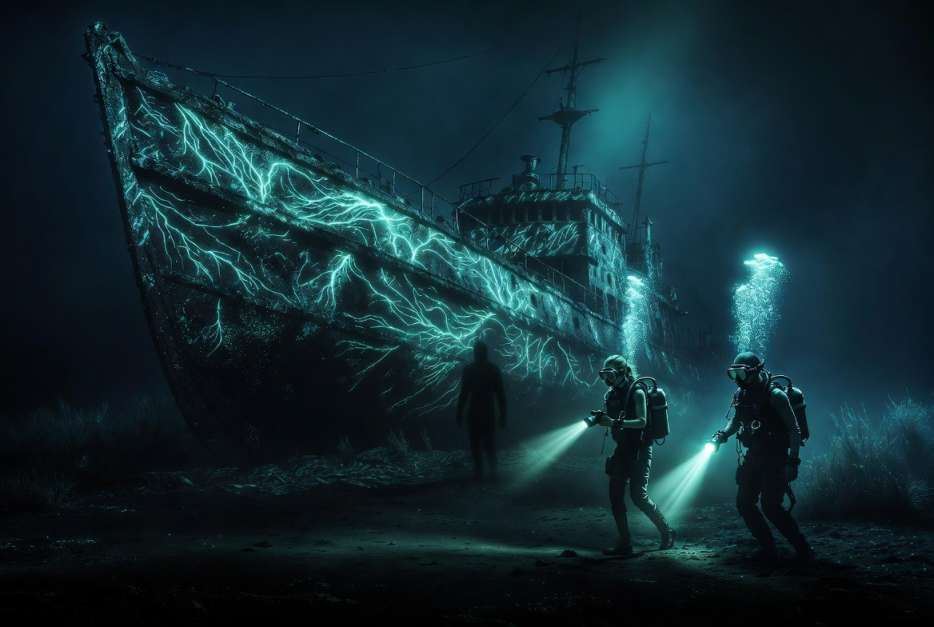
Briggs didn’t hesitate. A single suppressed shot dropped the man. Avery felt no satisfaction, only the cold certainty that they were running out of time. The beacon’s hum had spread through the carrier’s systems like blood in water. It was learning the ship—rewriting its electronic nervous system.
They pressed on toward secondary control, Mason trailing with a small group of cleared Marines. The kid’s hands shook on his weapon, but he kept pace. “It’s in the walls,” he whispered. “I can feel it in my head. Like it’s whispering my mom’s voice.”
Avery’s scar burned hotter. The North Atlantic memory surged unbidden: cold closing in, her buddy’s hand slipping away. She pushed it down, but the effort cost her. Briggs noticed. His free hand brushed hers for a split second—anchor in the storm.
In secondary control, they found Hargrove barricaded with a handful of loyal crew. The Colonel’s uniform was torn, blood streaking one sleeve, but his eyes were steel. “The device is adapting. It’s not just control. It’s assimilation. Memories, skills, fears—it’s using them to turn the crew. We need to destroy it before it reaches the reactors.”
Briggs slammed a fresh magazine into his rifle. “Then we go back down. To the wreck. End it at the source.”
Avery met his gaze. The man who had once tried to break her in the gym now looked at her like she was the only solid ground left. “We go together,” she said. “No martyrs.”
But as they planned the counter-assault—diversion teams on the surface, a small element descending with charges—the lights flickered again. Stronger this time. The hum peaked, vibrating through the deck plates.
And then it touched her.
A whisper, not in her ears but behind her eyes. You already belong to us. The water remembers every loss. Images flashed: her swim buddy reaching, Briggs’s brother smiling with those wrong eyes, the carrier sinking slowly into silt while glowing figures walked its decks forever.
She staggered. Briggs caught her, alarm cutting through his exhaustion. “Avery?”
“I’m fine,” she lied, but her voice wavered. The scar on her ribs glowed faintly under her shirt—subtle, but there. The ocean had marked her long ago. Now it was collecting.
They moved anyway. The descent back to the water was a nightmare of close-quarters fighting. Compromised crew appeared from side passages—friends turned vessels, fighting with the precision of elite operators but without mercy. Mason took a hit to the shoulder protecting Avery’s flank. Briggs fought like a man possessed, every strike for Jacob, for the brother he couldn’t save the first time.
They reached the launch bay. Rafts deployed in the carrier’s shadow. The sea was no longer black—it shimmered with faint veins of light spreading from the wreck’s direction. As they dove, the water felt thicker, welcoming. Almost loving.
Down they went. The ghost ship waited, hull pulsing brighter now, as if excited by their return. Inside, corridors had shifted—metal rearranged by unseen forces. They planted charges near the beacon’s core while shadows moved in the periphery.
Briggs covered her as she worked. “If I don’t make it—”
“You will,” Avery cut him off, fingers flying over the detonator. “We both will. Then we deal with whatever’s left of us.”
A final shadow emerged—Jacob again, or the echo of him. It didn’t attack. It simply stood, holding out a hand toward Briggs.
“Come home, brother. The machine needs your anger. It makes the strongest bridge.”
Briggs’s rifle trembled. Tears mixed with seawater behind his mask. Avery saw the breaking point—the love and hate colliding. She placed her hand on his arm, steady as the tide.
“He’s gone, Ryan. But you’re not. Not yet.”
Briggs fired. The figure dissolved into light and bubbles.
They triggered the charges and ascended hard, the wreck convulsing behind them in a silent scream of light. Explosions bloomed underwater like underwater stars. The carrier above listed slightly, fighting its own infection.
They broke the surface to pandemonium. Helos swarmed. The ship was stabilizing—but barely. As medics pulled them from the raft, Avery saw it: the glowing veins on her own arm, faint but spreading. Briggs noticed too. His face drained of color.
The ocean had taken its payment after all.
Back on the carrier’s medical bay, as doctors swarmed and alarms slowly quieted, Briggs sat beside her bed, gripping her hand like it was the only real thing left.
“We ended it,” he whispered. “Didn’t we?”
Avery looked at the monitors. The hum was gone from the ship.
But inside her chest, something new and ancient had begun to whisper back.
Chapter 7: What the Tide Leaves Behind
The carrier limped into port under a bruised sky, its massive hull scarred not by torpedoes but by something far quieter and more complete. Sunlight, thin and unforgiving, cut across the flight deck where Avery Mitchell stood alone at the railing. The ocean stretched out behind them—calm now, almost innocent, reflecting broken shards of blue and gold. But she knew better. The sea never forgot. It simply waited.
Her left arm still carried the faint trace of glowing veins beneath the skin, like bioluminescent scars that refused to fade. The doctors had run every test. Nothing. No infection they could name. No tech they could extract. Just her, changed in ways the machines couldn’t measure. Sometimes, in the quiet hours, she heard it: the whisper of currents, the pull of depths, memories that weren’t entirely hers.
Briggs approached from behind. His footsteps were heavier now, weighted by everything they had survived. The gash above his eye had stitched into a new scar—another line on a map of losses. He stopped beside her, close enough that their shoulders touched, but not close enough to pretend the distance between them had closed.
“You’re still you,” he said. It wasn’t a question. More like a prayer he repeated every few hours.
Avery turned her head. The wind tugged at her hair, carrying salt and the faint metallic ghost of the wreck. She reached up, tracing the line of his new scar with her thumb. “Am I?” Her voice was quiet, steady, but the words carried the weight of every dive, every lost breath. “I feel it sometimes. Like the water’s still inside me. Watching through my eyes.”
Briggs caught her hand, pressing it to his chest where his heart beat—strong, stubborn, alive. The man who had once tried to drive her out of his gym now held on like she was the only thing anchoring him to the surface. “Then I’ll watch with you. Every damn day. We dragged Jake back from that thing… or what was left of him. We can fight this too.”
They had recovered Jacob’s body from the wreck before the final charges. Not alive. Not quite gone either. The remains now rested in a sealed lab somewhere inland, studied by people who would never understand the cost. Briggs had said his goodbyes in the morgue—raw, private, the kind of grief that reshaped a man. Avery had stood outside the door, giving him the space she herself had never been given.
Mason survived. The kid would wear his shoulder wound like a badge, already spinning stories for the new recruits about the woman who stared down the black water and made it blink. Hargrove had recommended them both for citations. Medals that would feel hollow compared to the things they carried home in silence.
But the ocean had kept its share.
As the carrier docked, families waited on the pier—wives, children, parents clutching signs and wiping tears. Avery watched a young woman run to one of the surviving operators, laughing through sobs. Normal life, rushing back in like tide filling footprints. She wondered if she still belonged in that world.
Briggs leaned in, forehead resting against hers. The kiss that followed was slower this time—not born of desperation, but of something deeper. A promise forged in pressure and darkness. “We go home,” he murmured against her lips. “Real home. No more joint programs. No more proving anything to anyone but each other.”
Avery closed her eyes, letting herself believe it for a moment. The warmth of him. The solid deck beneath her boots. The future they might carve out of the wreckage.
Yet as they walked down the gangway together, hand in hand, she felt it again—the subtle pull at the edge of her mind. Not commanding. Inviting. A soft current suggesting she could be more. Stronger. Connected to every soul the sea had ever claimed.
She glanced back at the carrier one last time. The hull looked ordinary now, sunlight glinting off repaired sections. But in one shadowed porthole, she thought she saw a faint glow. Or maybe it was just the reflection of her own eyes.
Briggs squeezed her hand. “You okay?”
Avery smiled—small, tired, real. “I’m here.”
They disappeared into the crowd of returning heroes, two survivors carrying invisible wounds and a love tempered by the deep. Behind them, the ocean lapped gently against the pier, patient as ever.
Some ghosts sink.
Some rise.
And some… simply learn to swim inside the living.
The End… for now.