The chandeliers shuddered once, twice, then held in a trembling truce above the chaos. Sophie’s bare feet—still warm from Elias’s grip—pressed harder into the marble as if the floor itself might betray her next. The air tasted of crushed roses, spilled champagne, and something sharper: ozone from the awakening machines beneath the stage. Her heart hammered against her ribs like a prisoner demanding release, each beat echoing the lullaby that refused to fade from her mind.
Elias’s hand stayed locked in hers, small but unyielding, his dirty palm leaving faint streaks of blood on her pale-blue gown. He was trembling too, but not from fear alone. From recognition. The girl in the glass chamber—Subject White—mirrored Sophie’s face with eerie precision: the same wide hazel eyes, the same slight upturn at the nose, the same faint scar on the left eyebrow that Sophie had always been told came from a childhood fall she couldn’t remember. But this girl’s eyes held centuries of exhaustion, as if she had already lived every second of Sophie’s stolen future and found it wanting.
“Who are you?” Sophie breathed, her voice barely carrying over the rising hum of the platform.
The girl inside the chamber tilted her head, pressing one palm flat against the glass. Condensation bloomed around her fingers. “I was the proof,” she said, her voice soft yet amplified through hidden speakers, carrying the same gentle lilt Sophie sometimes heard in her own dreams. “The first one who didn’t break completely. They called me White because I came before colors. Before Pink. Before Blue.”
Arthur Whitmore’s image on the screen leaned forward, his surgical lamp casting deep shadows across a face that should have been dust and memory. His smile was the kind that promised answers while sharpening the knife. “Subject White survived the initial neural cascade. You two… you are the refinement. The pair that completes the circuit.”
Nathaniel staggered toward the control panel, his tuxedo jacket now askew, silver cufflinks catching the erratic light like dying stars. “Father, this wasn’t the plan—”
“Your plans were always small, Nathaniel,” Arthur cut in, his voice a dry rasp laced with paternal disappointment. “Sympathy optics. Donor billions. A pretty symbol in a wheelchair. I gave you an empire’s foundation, and you built a theme park on it.” He coughed, a wet, rattling sound, but his eyes never left the twins. “The marker wasn’t meant for charity. It was meant for legacy. For rewriting what bodies forget.”
Victoria lay crumpled on the floor where she had fainted, her champagne gown pooling like spilled secrets. Marisol knelt beside her, one hand instinctively checking for a pulse, the other still gripping Elias’s shoulder as if letting go would dissolve him entirely. The nurse’s face was streaked with tears, but her jaw was set—the face of a woman who had stolen a baby from hell and raised him in quiet defiance.
Eleanor Whitmore retrieved her cane with shaking hands, the silver tip clicking against marble like a judge’s gavel. “Arthur,” she whispered, the name both prayer and curse. “You died in Zurich. I buried an empty casket because you asked me to.”
“You buried a convenient fiction, Mother.” Arthur’s image flickered as federal agents swarmed the edges of the ballroom, their shouts muffled by the thickening electronic hum. “The procedure demanded privacy. And sacrifice. Celeste understood that better than any of you.”
The name hit Sophie like a physical blow. Dr. Celeste Amari. The woman on the earlier video—her biological mother—whose recorded message had already cracked the world open once. Sophie’s knees buckled, but Elias caught her, his thin arms surprisingly strong. The warmth between them surged again, not gentle this time but electric, flooding her legs with phantom sensations: grass underfoot on a summer lawn she had never visited, cold tile in a nursery she half-remembered, the press of tiny fingers that weren’t hers.
“I feel you,” Elias murmured against her ear, echoing those first six words but deeper now. “Not just standing. Everything.”
The glass chamber hissed, releasing a faint mist that smelled of antiseptic and something floral—jasmine, perhaps, from a garden long lost. Subject White stepped forward as the front panel slid open with a pneumatic sigh. She was barefoot too, like Elias, her simple white shift brushing the floor. Up close, the resemblance was devastating. Not a clone, exactly—there were subtle differences in the tilt of her shoulders, the faint lines of old pain around her mouth—but close enough to steal Sophie’s breath.
“Don’t trust the warmth,” White said, her voice carrying the weight of someone who had spoken these warnings before. “It’s the hook. The bond pulls memories forward, yes. But it also pulls them. The ones who designed us.”
Sophie reached out instinctively. Their fingers brushed. A spark—not metaphorical, but literal—jumped between them, and for one blinding second, Sophie saw flashes: a sterile room with three bassinets instead of two. A woman with dark curls and fierce eyes—Celeste—fighting masked orderlies. Arthur’s younger face, cold and calculating, signing documents while monitors beeped in symphony. Pain. Separation. A scream that never quite ended.
Sophie yanked her hand back, gasping. Elias steadied her, but his own face had gone ashen. He had seen it too.
Federal agents were shouting now, trying to secure the platform, but the machinery ignored them. Lights on the hidden lab consoles pulsed in sync with the twins’ heartbeats—Sophie could feel the rhythm in her bones.
Dr. Mercer, still restrained but grinning like a man who had bet everything on one final hand, spat blood from a split lip. “You can’t stop sequence resumption. The marker activates in proximity. Pink and Blue together trigger White. White completes the triad. Neural regeneration at cellular level—full motor restoration, memory integration, perhaps more. But the cost…”
“What cost?” Eleanor demanded, her authority fracturing under the weight of decades of lies.
Mercer laughed bitterly. “The first subject who fully activates becomes the vessel. The others feed her.”
White’s eyes met Sophie’s with a sorrow so profound it felt ancient. “I’ve been here before. In other rooms. Other galas. They reset me when I get too close to remembering everything. But tonight… with both of you… I think this one sticks.”
Nathaniel lunged for the black device in his pocket again, but Eleanor’s cane cracked across his wrist with surprising force. The device clattered away. “No more,” she said. “Not my grandchildren.”
But Arthur’s image only smiled wider. “Too late, Mother. The gate is open. Look at them.”
Sophie felt it then—the pull not just from Elias, but from White. A third thread weaving into the bond. Her legs steadied fully, strength flooding muscles that had never truly worked. She took one step toward the chamber, then another. Elias followed, barefoot and resolute. The marble felt alive beneath them, vibrating with shared history.
Victoria stirred, reaching weakly. “Sophie… my baby…”
But Sophie’s gaze stayed fixed on White. “You said you were the first me.”
White nodded. “They harvested what they needed. Left the shell. I’ve watched you live my second chance from inside this glass for years. Through cameras. Through dreams. You were supposed to stay broken. Safer that way.”
Elias’s voice cracked with protective fury. “We’re not staying broken. Not anymore.”
The hum crescendoed. The platform’s equipment whirred louder—syringes rising from hidden compartments, monitors displaying synchronized brainwave patterns that danced like twin flames merging into one. Federal agents hammered at locked exits, but the ballroom had become its own sealed world.
Arthur’s voice softened, almost tender. “Come closer, children. Let the procedure finish what it started. Celeste’s research was beautiful. Flawed, but beautiful. With the three of you aligned, we can heal more than legs. We can heal time itself.”
Sophie’s mind reeled. Heal time? The flashes returned: Celeste’s desperate fight, Arthur’s ambition stretching back generations, experiments not on diseases but on potential—human potential twisted into something godlike and monstrous. She saw, in splintered visions, other subjects before White. Failures. Echoes.
Her hand found Elias’s again. Then, trembling, she extended the other toward White.
“Don’t,” Marisol whispered from behind them, but her voice was distant, drowned by the rising symphony in Sophie’s blood.
The moment their three hands connected—Pink, Blue, White—the ballroom lights exploded in a cascade of sparks. The projection screen fractured into a thousand images: nursery cries, forged signatures, Celeste’s tear-streaked face, Arthur’s hidden laboratory deep beneath Swiss mountains. Pain lanced through Sophie’s temples, but beneath it bloomed something else. Clarity. Power. Terror.
She saw her mother—Victoria—not as villain but as another victim, drugged and manipulated, her grief weaponized. She saw Nathaniel as the dutiful son who had traded his soul for approval. She saw Eleanor’s buried guilt, Marisol’s quiet heroism, and her own life as a carefully staged performance.
But most of all, she saw the cost White had warned of. The bond wasn’t healing. It was consuming. Memories poured in too fast—White’s decades of isolation, Elias’s hidden childhood in Marisol’s modest apartment, Sophie’s galas and braces and forced smiles. Her body arched as muscles knit and nerves sang.
White gasped, her form flickering as if the glass had never truly contained her. “It’s starting. The vessel… one of us has to carry it all.”
Elias’s grip tightened. “Not her. Not you.”
Sophie looked at her brother—her twin, her other half—and felt the love she had never been allowed to know crash over her like a wave. Then at White, the sister who had suffered so the story could continue. Tears streamed down her face, but her voice held steady for the first time in her life.
“We carry it together,” she said. “Or not at all.”
The chamber shattered outward in a shower of glass that somehow fell like snow—soft, impossible. Alarms wailed. Arthur’s image glitched, his smile twisting into fury. “No! The sequence demands—”
But the sequence was changing.
Sophie stood tall between her siblings, legs strong, heart shattering and reforming in the same breath. The warmth between them no longer burned. It anchored. Guests who had once applauded her “bravery” now stared in reverent horror as the three children—broken, remade, unbreakable—faced the machines, the lies, the architect who had tried to own their blood.
Outside, sirens grew louder. Inside, the nightmare was only beginning.
Arthur leaned into his camera, eyes gleaming with something like pride. “Then let the real trial begin.”
The lights died completely.
In the sudden dark, Sophie whispered the six words back to Elias, her voice fierce with new life: “You were never born broken either.”
And somewhere in the shadows, a new hum answered—not from machines, but from the three of them, rising together.
The gala had ended.
The war for their souls had just begun.
The darkness in the ballroom was absolute for three heartbeats—long enough for Sophie to feel the weight of every stolen year pressing down on her shoulders. Then emergency lights flickered on, bathing everything in a sterile red glow that turned the marble floor into a lake of blood. Glass from the shattered chamber crunched under her bare feet, but there was no pain. Only the electric hum of the bond linking her, Elias, and White—three strands of the same fractured soul, now vibrating in uneasy harmony.
Sophie’s breath came in sharp bursts. Her legs held her upright with a strength that felt borrowed, exhilarating, and terrifying all at once. She could feel the marble’s cool veins beneath her soles, the faint draft from a high vent brushing her ankles, the distant thunder of federal agents trying to breach the sealed doors. Every sensation was amplified, as if her body had been asleep for twelve years and was now waking up screaming.
Elias stood to her left, his ragged shirt torn further in the chaos, a fresh cut on his cheek from flying glass. His eyes—mirror images of her own—burned with a protective fire that made Sophie’s chest ache. He had spent years on the outside, raised by Marisol’s quiet love and hidden fear, dreaming of a sister whose voice he heard in nightmares. Now he was here, barefoot and bleeding, refusing to let go of her hand.
White—pale, ethereal, her white shift now streaked with dust and faint smears of blood—stood to Sophie’s right. She moved with the grace of someone who had practiced every motion in confinement, her fingers flexing as if testing whether freedom was real or another reset. “It’s accelerating,” she whispered, voice raw. “The marker doesn’t just heal. It remembers everything. And it wants a single vessel to hold it.”
Arthur’s image stabilized on the fractured screen, his wheelchair-bound form leaning forward like a spider sensing movement in its web. “Wise girl,” he crooned. “But which one will break first? The sheltered princess? The stolen boy? Or the ghost who has already died a hundred times?”
Nathaniel lay slumped against the orchestra pit, cradling his injured wrist, his once-impeccable tuxedo ruined. For the first time, Sophie saw genuine terror in his eyes—not for himself, but for the empire he had built on their bones. “Father,” he rasped, “shut it down. They’re just children.”
“Children?” Arthur laughed, a sound like dry leaves scraping across stone. “They are the culmination. Celeste and I designed the marker to unlock human potential—regeneration, memory synchronization, perhaps even shared consciousness. You turned it into a fundraising gimmick, Nathaniel. I intend to finish what we started.”
Victoria stirred where Marisol had propped her against a toppled chair. Her flawless chignon had come undone, strands of hair clinging to tear-streaked cheeks. She reached out a trembling hand toward Sophie. “My babies… I thought I lost you both. I let him convince me…”
Sophie wanted to run to her, to collapse into the arms that had wheeled her through a thousand staged moments of hope. But the bond held her in place, pulsing with White’s ancient pain and Elias’s raw anger. “You didn’t know,” Sophie said softly, the words tasting of both forgiveness and accusation. “But you didn’t ask hard enough, either.”
The platform beneath them groaned. Hidden mechanisms whirred louder, and new panels slid open along the walls—revealing not more medical equipment, but rows of monitors displaying other subjects: faded photographs of children with similar features, dates stretching back decades. Test logs scrolled in cold clinical text. Subject Gamma: Motor function restored 87%. Cognitive overload at day 41. Termination recommended.
White’s face tightened. “I watched them fade. One by one. They thought separating us would slow it, but proximity… it completes the circuit. The three of us together—we’re the key. One mind. One body. The others dissolve.”
Elias’s grip tightened painfully. “No. We fight it. Together.”
A new voice cut through the speakers—Celeste Amari’s recording, glitching back to life from some buried backup. Her face appeared beside Arthur’s, exhausted but defiant, cradling newborn Sophie and Elias in the hospital bed. “If you’re hearing this, my loves, the bond has awakened. Do not let them merge you. The marker was meant to heal, not consume. Arthur twisted it. Find the failsafe—my journal, hidden in the foundation’s original vault beneath the east wing. The code is your first shared memory: the lullaby.”
The words unlocked something deep inside Sophie. The lullaby swelled again, not just in her head but between all three of them. Elias began humming it instinctively. White joined, her voice cracking with decades of suppressed grief. Sophie’s throat tightened as she added her own fragile notes. The harmony wasn’t perfect—it was raw, broken, human—and the machines stuttered in response.
Sparks flew from the platform. Arthur snarled, slamming a fist on his armrest. “Insolent. Security override—initiate containment!”
But the federal agents had finally breached a side door. Shouts and flashlight beams sliced through the red gloom. Gunfire cracked—warning shots—as foundation security clashed with law enforcement. Chaos erupted: guests screaming and diving behind tables, Dr. Mercer trying to crawl toward an exit only to be tackled, Nathaniel rising unsteadily to his feet with a look of cornered desperation.
Marisol pulled Elias back. “We have to run. Now.”
But Elias shook his head, eyes locked on Sophie and White. “We can’t leave her. She’s us.”
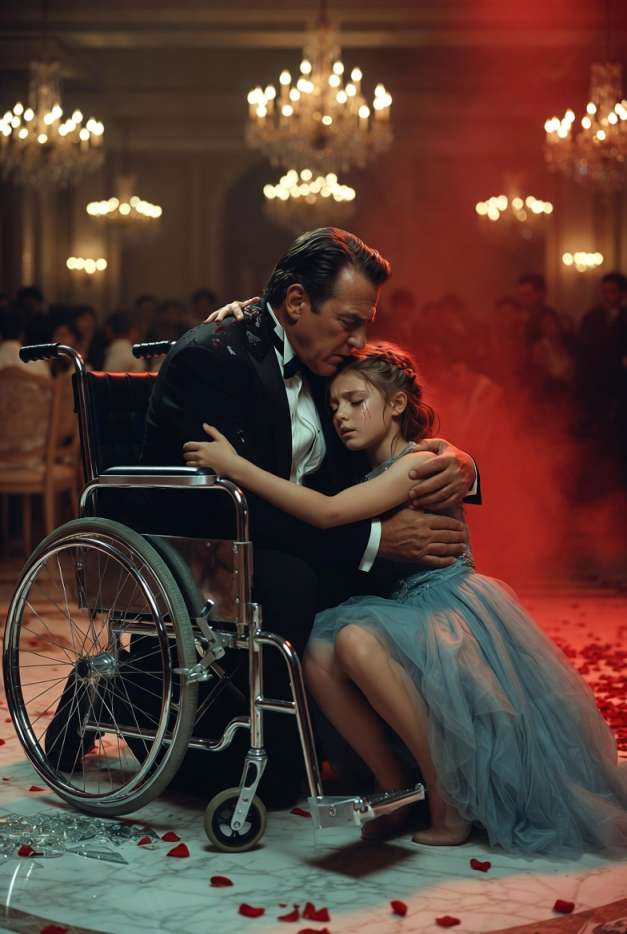
White smiled sadly, stepping closer until their shoulders touched. The bond surged, flooding Sophie with a vision so vivid it felt like stepping into another life: a sunlit lab years ago, Celeste arguing with Arthur over ethics, Nathaniel as a young man watching with hungry ambition. “I’ve carried the weight alone long enough,” White said. “If we share it, maybe none of us breaks.”
Sophie’s heart fractured at the quiet courage in those words. This girl—this older echo of herself—had endured resets, isolation, the slow erasure of self, all so the Whitmore machine could continue. Tears burned Sophie’s eyes, but she didn’t wipe them away. She let them fall, hot and real, as she pulled both siblings into an awkward, desperate embrace right there on the fracturing platform.
The contact ignited the bond fully. Light poured from their joined forms—not metaphor, but visible, a soft golden glow that pushed back the red emergency glare. Memories cascaded: Sophie’s lonely galas, Elias’s hidden birthdays with Marisol baking lopsided cakes, White’s silent screams in the glass. Pain, yes. But also strength. Shared laughter they had never known. A childhood stitched together from fragments.
The machines screamed in protest. The platform bucked, throwing them to their knees but not apart. Arthur’s image distorted. “No—no! The vessel must be singular!”
Celeste’s voice returned stronger: “The failsafe is love, my children. Not the bond. The choice to remain three.”
Sophie lifted her head, meeting Elias’s gaze, then White’s. In that moment, she felt the full weight of her new reality—not a symbol, not a victim, but a girl choosing her own story. “We stay three,” she said aloud, voice carrying over the din. “We fight as three.”
The glow intensified, stabilizing. The monitors began wiping themselves—logs erasing in cascades of digital snow. Arthur roared in fury as his feed cut to static.
Eleanor, leaning heavily on her cane, shouted across the room: “Get them out! The vault—east wing!”
Federal agents swarmed in, cuffing Nathaniel and Mercer. Victoria rose on shaky legs, reaching for her children—all three—with a mother’s desperate love finally unfiltered by lies.
But as the group moved toward the breached doors, the floor trembled again. A deeper hum rose from far below—not the ballroom’s machinery, but something older, buried in the foundations of the Whitmore empire itself. White’s eyes widened in fresh horror.
“He has a secondary site,” she whispered. “Arthur never puts everything in one place. The real procedure… it’s waiting underground.”
Elias looked at Sophie, his small hand still warm in hers. “We end this tonight.”
Sophie nodded, legs steady, heart pounding with a cocktail of fear, rage, and something new: purpose. The barefoot boy who had whispered six words had given her back her body. Now, with her brother and her shadow-sister at her side, she would take back their lives.
They ran—three children leading a broken family and armed agents through corridors lined with portraits of Whitmores who had built fortunes on hidden sins. Behind them, the ballroom’s remaining lights exploded in a final cascade. Ahead, the east wing vault waited, its doors sealed with generations of secrets.
And deep below, in chambers no gala had ever glimpsed, Arthur Whitmore smiled in the dark, waiting for his keys to come home.
The night was far from over. The real miracle—the one forged in choice, not control—had only just begun to unfold. Sophie’s trembling fingers tightened around her siblings’ hands as they descended into the unknown. Whatever waited there, they would face it together. Not as subjects. Not as symbols.
As family.