The lunch line barely moved.
Trays slid across stainless steel with the wet scrape of cheap plastic. Boots tapped restless rhythms on linoleum worn thin by decades of soldiers who thought the world owed them something. No one talked louder than necessary. In this mess hall, silence was survival.
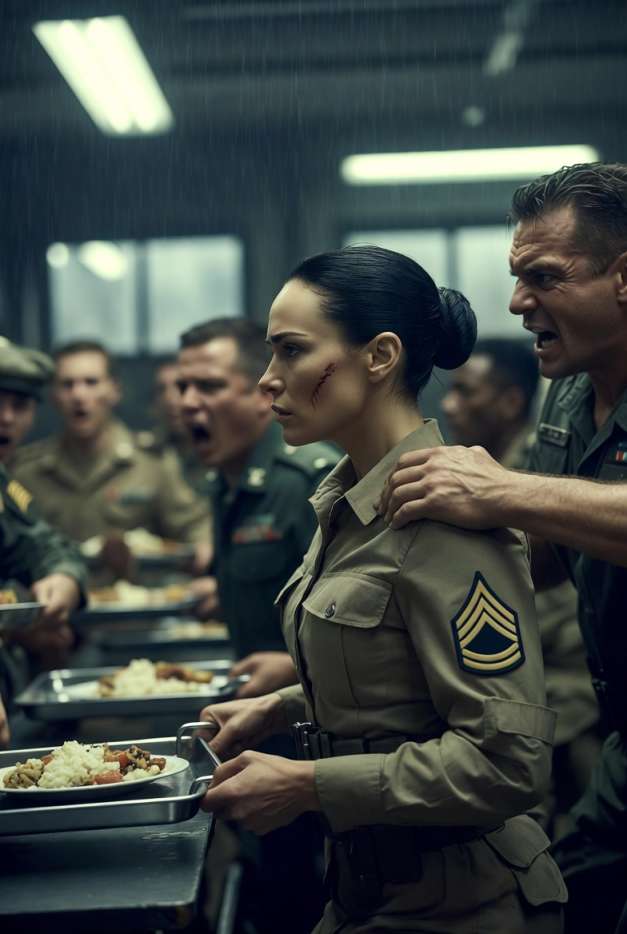
She stood halfway through the line, posture straight as a rifle barrel, eyes fixed forward like the horizon itself. Rain drummed against the high windows, turning the world outside into streaks of gray and green. Steam rose from the serving pans, carrying the smell of overcooked green beans and institutional gravy.
A private behind her muttered, just loud enough for his buddies, “Line’s dead today.”
She didn’t react. Not a twitch.
Staff Sergeant Marcus Reeves did.
He cut in from the side like he owned the air between them, shoulder clipping hers hard enough to rattle the tray in her hands. Coffee sloshed. A single drop hit the floor.
“Move,” he said. Flat. Entitled. The voice of a man who’d spent twelve years climbing on other people’s backs. “You’re in the wrong place, soldier.”
She steadied the tray without looking down. Her fingers—long, scarred across the knuckles—didn’t tremble.
“I’m exactly where I’m supposed to be,” she answered. Calm. Flat. No edge to cut with.
Reeves laughed under his breath, the sound ugly in the quiet. “Didn’t ask.”
A few heads turned. Eyes flicked away just as fast. No one stepped in. This was the Army. You learned quick whose shadow you stood in.
He leaned closer. Close enough she could smell the stale nicotine on him. “You new? Or just confused?”
She finally turned her head.
Lieutenant Colonel Elena Voss. Forty-seven years old. The kind of face that had seen too many sunrises over too many deserts. Sharp cheekbones, a thin white scar tracing her left jawline like a question mark no one dared ask about. Gray threaded through dark hair pulled into a regulation bun so tight it looked painful. Eyes the color of winter rain—steady, unreadable, and deep enough to drown in.
“I’m neither,” she said.
Reeves smirked. “That so?”
“Yes.”
The silence stretched, thick as the humidity rolling off the pines outside.
“Then you’ll understand how this works,” he pressed, voice dropping into that dangerous register he used on new lieutenants.
“I already do.”
“Then move.”
“No.”
It wasn’t loud. But it landed like a slap in the face.
Reeves’ jaw tightened. The muscle jumped. “You don’t get to say no to me.”
“I just did.”
A couple of soldiers exchanged glances. Someone’s spoon clattered against a tray.
Reeves raised his voice just enough for the room to hear. “You’re out of line.”
“I’m in line,” she replied. “You’re not.”
The ripple moved through the mess hall like wind over tall grass. Forks paused mid-air. Conversations died.
He stepped closer. “Careful. You’re pushing it.”
“You’re already past it.”
His hand came up—firm, possessive—landing heavy on her shoulder. Fingers digging just enough to remind her who held the power here.
“Listen—”
Elena Voss didn’t flinch. She looked at his hand like it was a piece of dirt on her uniform. Then back at his face.
“Take your hand off me,” she said. “And don’t touch me again.”
No anger. Just the quiet certainty of someone who had buried better men than him.
Reeves smirked wider. “Or what?”
The room held its breath.
“Or you’ll regret it,” she said.
A beat.
Then the double doors at the far end opened.
Not with a crash. Just enough. Measured boots. Coordinated. The sound of authority that didn’t need to announce itself.
Colonel Pierce entered first, Command Sergeant Major Hale at his shoulder. A half-dozen officers behind them. Rain glistened on their shoulders. The smell of wet wool and pine followed them in.
Reeves straightened. A flicker of relief crossed his face. Finally. The real chain of command.
They walked past him without a glance.
Straight to her.
Pierce raised his hand. Hale followed. Every officer behind them mirrored the motion in perfect unison.
A sharp, unified salute.
Directed at her.
The air in the mess hall snapped tight enough to crack bone.
Reeves’ face drained of color. His hand fell from her shoulder like it had been burned.
Elena Voss shifted her tray to one hand. Returned the salute—clean, effortless, the muscle memory of twenty-eight years.
No surprise in her eyes. No reaction beyond protocol.
“Ma’am,” Pierce said, voice low with respect.
Hale added, “Good to see you back, Colonel.”
She nodded once. “At ease.”
The officers stepped back. Still watching. Still aware.
Reeves didn’t move. Couldn’t.
Elena turned to him. Same calm eyes. Same steady voice.
“What were you saying, Sergeant?”
His mouth opened. Nothing came out.
“I asked you a question.”
“I—” He swallowed hard, Adam’s apple bobbing. “I didn’t realize—”
“That’s correct,” she said.
A few people shifted uncomfortably. Trays forgotten.
“You didn’t realize,” she repeated, voice carrying just far enough. “And that’s the problem.”
He nodded quickly. “Yes, ma’am.”
“You assumed.”
“Yes, ma’am.”
“You decided I didn’t belong.”
“Yes, ma’am.”
“You put your hands on someone you thought had less authority than you.”
He hesitated. The room waited.
“Yes… ma’am.”
She stepped half a pace closer. Not threatening. Just present. The rain outside seemed louder.
“And if I did?” Her voice dropped, intimate and merciless. “If I had less rank… would your behavior have been acceptable?”
Silence swallowed the hall.
“No, ma’am.”
“But you did it anyway.”
“Yes, ma’am.”
“Why?”
He struggled for words. “I… I made a mistake.”
“That’s not an answer.”
His jaw clenched so tight the bone showed white. “I thought—”
“I know what you thought,” she cut in softly. “That’s already established.”
A pause that felt like a lifetime.
“What matters,” she continued, “is why you thought it was okay.”
He had nothing left. The man who had ruled this mess hall with fear and sarcasm stood stripped bare in front of two hundred witnesses.
She nodded once, decisive.
“Here’s what’s going to happen.”
Reeves stood straighter, as if posture could save him. “Yes, ma’am.”
“You’re reassigned. Effective immediately.”
His eyes flickered with panic. “Ma’am?”
“To this facility. Support duty.”
The words landed harder than any fist. Support duty. The place where careers went to bleed out slowly.
“You’ll report early. Stay late. Work under supervision.”
“Yes, ma’am.”
“No command authority.”
His jaw tightened until it trembled. “Understood.”
“You’ll learn every role here.”
“Yes, ma’am.”
“And you will treat every person you meet like they matter.”
“Yes, ma’am.”
She held his gaze without blinking. The scar along her jaw caught the fluorescent light.
“Not because of rank.”
A long pause.
“Because of principle.”
“Yes, ma’am.”
“Dismissed.”
He stepped back. Slow. Measured. A different man already cracking open.
The line resumed its shuffle. Noise crept back in—trays, boots, low murmurs. But something fundamental had shifted in the air, like the pressure before a storm finally breaks.
Days bled into weeks.
Marcus Reeves showed up before dawn the first morning. Scrubbed floors until his knees bled through his pants. Carried trays for soldiers who once feared his temper. Cleaned spills no one else noticed.
At first his movements were mechanical. Stiff. A man serving a sentence.
Then a private—barely nineteen, hands shaking—dropped an entire tray. Mashed potatoes and gravy splattered across the floor like blood.
Everyone froze.
Reeves stepped forward before anyone else could.
“Hey,” he said, voice rough but steady. “Grab that side.”
The private blinked. “Yes, ser—”
“Just grab it.”
They cleaned it together. No lecture. No edge. Just two men on their knees in the mess, shoulders brushing, doing the work.
Someone noticed.
Then someone else.
One afternoon, Command Sergeant Major Hale walked through again. Saw Reeves wiping down tables with the new privates. Didn’t interrupt. Just gave a single nod.
Reeves nodded back.
No words needed.
She returned on a Thursday.
No announcement. No escort. Just walked into the mess hall in the same rain-soaked uniform, tray in hand, posture unchanged.
Reeves saw her from across the room. Set his cleaning cloth down with deliberate care. Walked over. Stopped at a respectful distance—farther than necessary.
“Ma’am.”
Elena Voss looked at him. Really looked. The hardness in her eyes had softened, just a fraction. The kind of look a commander gives when she sees the first green shoot in scorched earth.
“What changed?” she asked quietly.
He didn’t rush the answer. Rain hammered the roof like distant artillery.
“I stopped looking up,” he said. “And started looking around.”
A beat.
“I was wrong.”
“Yes,” she said. Simple truth.
“I won’t be again.”
She studied him for a long moment—the new lines of exhaustion around his eyes, the way his shoulders sat different. Then reached into her pocket.
Pulled out a small challenge coin. Silver. Worn. Held it out.
He hesitated.
“Take it.”
He did. Turned it over in his callused palm.
Engraved on one side: Leadership begins where ego ends.
On the other, her name and a date from a deployment no public record would ever mention.
Reeves looked up, throat tight. “Thank you, ma’am.”
She nodded once. Then stepped past him.
Back into the line.
And waited.
No one questioned it. No one moved ahead. Not out of fear of rank.
Because they understood now.
Reeves stood there a second longer—watching her back, the straight line of her shoulders against the gray light—then went back to work.
Quiet.
Steady.
Changed.
But the story wasn’t over.
Far from it.
That night, in the quiet of her temporary quarters, Elena Voss sat at a small desk under a single lamp. The rain had eased into a whisper. She touched the scar on her jaw—souvenir from a roadside ambush in Kandahar eleven years earlier. The day she lost her best friend and learned that authority without humanity was just another form of violence.
She had come back to Fort Liberty for a reason deeper than one sergeant’s ego. A larger rot was spreading through the training command. Men like Reeves weren’t the disease. They were symptoms.
And she was here to cut it out.
Meanwhile, in the barracks, Marcus Reeves turned the coin over and over in his hands, unable to sleep. For the first time in years, he saw his own reflection clearly.
The line between them had never been about rank.
It had always been about character.
And the real test was only beginning.
The rain had stopped by the time Elena Voss left the mess hall, but the air still hung heavy with it. Puddles reflected the sodium lights like broken mirrors. She walked the long perimeter road alone, boots sucking at the mud, the challenge coin she’d given Reeves now a memory in her pocket instead.
Her shoulder still carried the ghost of his grip. Not pain—memory. She’d felt worse. Much worse.
Two weeks earlier, in a windowless briefing room at the Pentagon.
“Colonel Voss,” the general had said, sliding a classified folder across polished wood. “Fort Liberty’s training command is bleeding talent. Good kids quitting. Reenlistment rates in the toilet. We need someone who can see the rot without burning the whole place down.”
Elena had stared at the folder. Photos. Reports. Whispers of sergeants like Reeves who ruled their small kingdoms with fear. Officers who looked the other way.
“I’m not a fixer,” she’d answered.
The general had smiled without warmth. “No. You’re the scalpel.”
She’d accepted because saying no had never been an option. Not after Kandahar. Not after watching her platoon sergeant drag a wounded private through a kill zone while she held the line with a shattered radio and three rounds left.
Some scars you carried on the outside. Others you carried by becoming the person who refused to let them happen again.
Reeves couldn’t sleep.
He sat on the edge of his bunk in the NCO quarters, the challenge coin heavy in his palm. The barracks around him were quiet except for the occasional cough, the creak of springs, the distant rumble of a generator. He kept seeing her eyes. Not angry. Worse. Disappointed. Like she’d expected better and found him exactly as small as he was.
He stood up, pulled on his PT uniform, and went for a run in the dark. Five miles. Then ten. His lungs burned, but the shame burned hotter.
By the time the sun cracked the horizon, he was back in the mess hall, scrubbing grease traps no one had touched in months. A young specialist watched him from the doorway, hesitant.
“Need help, Sergeant?”
Reeves wiped sweat from his eyes. “Yeah. Grab a brush.”
They worked in silence. The specialist—Hernandez—kept stealing glances.
“You good, Sergeant?”
Reeves paused, brush dripping. “Not yet. But I’m trying.”
Elena’s days were a blur of inspections, late-night briefings, and quiet conversations in corridors where fear still lingered. She moved like a shadow through the command—observing, listening, never raising her voice. But everyone felt her presence.
One evening, she found Reeves alone in the supply warehouse, inventorying expired MREs under harsh fluorescent lights. The air smelled of cardboard and dust.
“Ma’am,” he said, coming to attention.
“At ease, Sergeant.” She picked up a clipboard, scanned it. “How’s the learning going?”
He hesitated. “Painful. But necessary.”
She nodded. For a moment, neither spoke. The warehouse hummed around them—distant forklifts, the tick of cooling metal.
“I wasn’t always like this,” Reeves said suddenly. Voice rough. “Before my first deployment… I was the guy who helped the new privates. Then Iraq happened. Lost my squad leader to an IED. Came back thinking the only way to keep people alive was to make them afraid of me.” He laughed bitterly. “Worked until it didn’t.”
Elena studied him. The lines on his face weren’t just age. They were choices.
“Fear keeps people in line,” she said quietly. “Respect keeps them alive when it matters.”
He met her eyes. “I’m starting to see that.”
She turned to leave, then paused. “Tomorrow. Zero four hundred. Training area seven. Be there.”
“Yes, ma’am.”
Training Area Seven at 0400.
Fog clung to the ground like smoke. Elena stood at the edge of the obstacle course in full kit—rucksack, rifle, the works. Reeves arrived exactly on time, breathing hard from the run over.
“Run it with me,” she said.
No explanation. No warmup.
They ran.
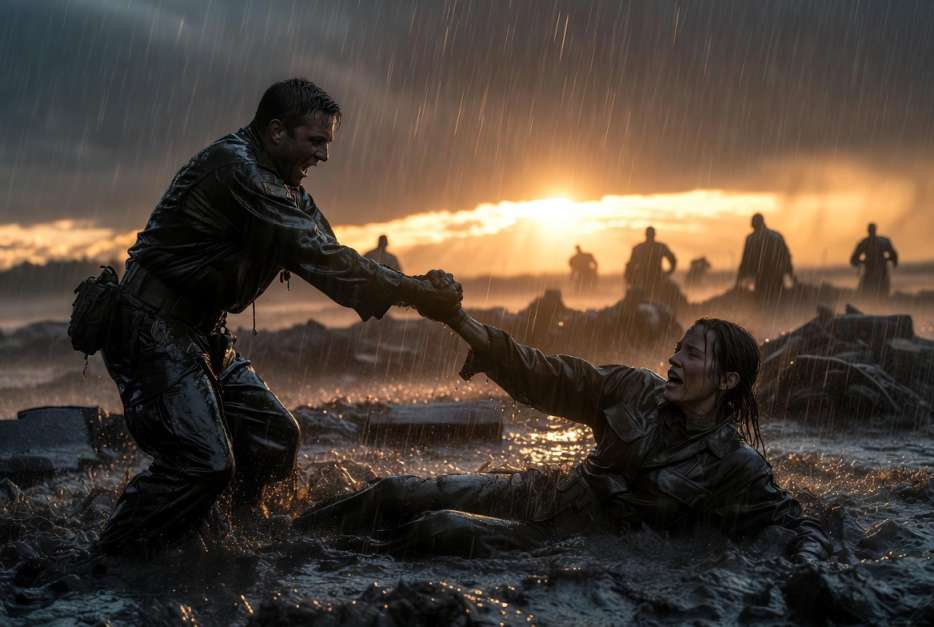
Walls. Ropes. Mud pits that sucked at boots like quicksand. Elena moved with the economy of someone who’d done this thousands of times, but Reeves saw the effort—the way her jaw tightened on the rope climb, the scar on her jaw flashing white when she gritted her teeth.
Halfway through, she slipped in the mud. Landed hard.
Reeves froze for half a second—old instinct to dominate—then reached down.
She took his hand. Let him pull her up.
They finished together. Collapsed against a wooden barrier as the sun burned off the fog. Both breathing like they’d run through hell.
“Why me?” he asked between gasps. “You could’ve crushed me. Ended my career.”
Elena wiped mud from her face. “Because I’ve been you. Not exactly. But close enough. Thought rank made me right. Took losing people to learn it doesn’t.”
She stared into the treeline. “There’s more going on here than one sergeant with a bad attitude. Supply discrepancies. Favoritism in promotions. Kids getting hurt because leaders care more about looking good than being good.”
Reeves straightened. “I’ve seen it. Looked the other way.”
“Change that,” she said.
The weeks that followed were harder.
Reeves started speaking up in small ways. Redirecting a bullying corporal. Staying late to train struggling privates. Word spread quietly. Some respected it. Others—old allies—didn’t.
One night, three senior NCOs cornered him behind the motor pool.
“You think sucking up to that bitch makes you better?” one sneered.
Reeves didn’t swing. He stood his ground. “She’s not the problem. We are.”
They left him with a black eye and bruised ribs. He showed up for duty anyway.
Elena saw the injury the next morning in the mess hall. Said nothing in public. But that afternoon, she called those three NCOs into her office. The door stayed closed for forty minutes. When they emerged, their faces were pale.
No official punishment. Just a look in their eyes that said they’d been seen—all the way through.
The storm broke on a Friday night.
A live-fire exercise went wrong. Bad orders from a captain trying to impress the wrong people. A young private—Hernandez—took shrapnel to the leg because safety protocols had been “flexed.”
Elena was on the scene in minutes. Reeves arrived right behind her.
While medics worked, she stood in the pouring rain, voice cutting through the chaos. “Exercise terminated. Full investigation. Now.”
Later, in the hospital corridor, sterile lights buzzing overhead, Reeves found her sitting alone, staring at her hands.
“He’s gonna be okay,” Reeves said.
Elena didn’t look up. “This time. What about next time?”
He sat beside her. The silence stretched, different now. Not heavy with shame. Heavy with shared weight.
“I want in,” he said finally. “Whatever you’re doing to fix this place. I’m in.”
She turned. For the first time, she smiled—just a ghost of one. “Good. Because I need someone who knows where the bodies are buried. Metaphorically.”
Two months later.
The command had changed. Slowly. Painfully. Some leaders transferred. Others adapted. Reeves ran the support section now—not with fear, but with the quiet authority of a man who’d earned every ounce of it.
Elena prepared to leave for her next assignment. She found him in the same mess hall line where it all began.
He stepped aside. Not out of deference to rank. Out of respect.
She shook her head. “We wait together.”
They stood side by side. Trays sliding. Boots tapping. The line moving.
When they reached the end, Reeves pulled something from his pocket. Another coin. Simpler. Newer.
Engraved: Respect isn’t given. It’s proven.
He handed it to her.
Elena took it. Turned it over. Her thumb traced the words.
“Thank you, Marcus.”
He nodded. “Thank you, ma’am. For not letting me stay small.”
She stepped past him into the line of soldiers. No one moved ahead. No one needed to.
Outside, the rain had stopped again. The sky was clearing, just enough for a sliver of blue over the pines.
Elena Voss walked toward her vehicle, the new coin warm in her palm. Behind her, the base continued its rhythm—changed, but still breathing, still becoming.
She allowed herself one last look back at the mess hall.
The line was still there.
But now, it moved with something it hadn’t had before.
Dignity.
The End.