The Pacific Ocean that morning offered no mercy. Four-foot swells churned beneath a gray sky, as if the sea itself were whispering a warning. Twenty operators stood in perfect formation on the training grounds of the Naval Special Warfare Center in Coronado. Their postures were nearly identical—except for one.
Lieutenant Commander Arwin Blackwood occupied the end position. Her body was ramrod straight, shoulders squared, but her gaze wasn’t fixed forward like the others. It drifted toward the sea, calculating something only she understood.
Admiral Victor Hargrove walked slowly down the line. Each step was a judgment. His weathered face was unreadable, three rows of ribbons gleaming on his chest like old battle scars. He stopped in front of Arwin a beat longer than necessary.
“Lieutenant Commander Blackwood,” his voice carried across the formation, “your cover is one centimeter off regulation.”
Her cap was positioned with perfect precision. Arwin didn’t blink.
“Yes, sir. I’ll correct it immediately, sir.”
Three positions down, Lieutenant Orion Thade smirked. The expression needed no words. Everyone knew: Admiral Hargrove had turned the pilot program integrating women into SEAL teams into his personal stage to prove one thing—women didn’t belong here.
Arwin Blackwood was no rookie. She moved through the equipment room with terrifying efficiency. When she lifted her tactical vest, she immediately noticed the left side was two pounds heavier. Someone had tampered with it. She silently redistributed the weight without complaint. Reporting it would only tell her enemy they had struck a nerve.
Captain Vesper Reeve entered, her naval intelligence insignia standing out. The two women exchanged a brief nod—subtle enough for outsiders to miss, but enough for Arwin to feel it: her ally was still there.
As the helicopter lifted off, the rotor wash kicked up dust devils. Arwin tracked its ascent vector with automatic precision, calculating wind speed and direction like someone who had flown through far more darkness than light.
Fifteen miles offshore, the Pacific was ice-cold. Arwin’s team hit the water thirty seconds after Thade’s. Beneath the green-tinted depths, she took point. Her hand signals were different—sharper, more efficient, nothing from the standard SEAL manual. Junior Lieutenant Estraas Kelwin noticed immediately: this wasn’t training technique.
They slipped into the decommissioned oil platform. Darkness swallowed everything. Training sensors covered the structure. Arwin moved like a ghost, avoiding every trigger point with impossible familiarity, as if she had memorized this place long before it became a training site.

When they reached the package, Thade’s team was already there. Orion Thade had his hands on the case, victory etched across his face behind the rebreather.
In seconds, everything changed. Arwin deliberately manipulated the current. Suddenly, Thade’s team reacted to a threat that didn’t exist. The package ended up in Arwin’s team’s hands. No simulated shots fired. No direct confrontation.
Aboard the command vessel, Admiral Hargrove clenched his jaw at the report.
“The time difference was negligible,” he dismissed. “Unconventional tactics indicate poor adherence to protocol.”
Arwin stood tall, her voice calm but unyielding:
“The mission prioritizes successful extraction, Admiral. Not methodology.”
The following days were deliberate hell. Every exercise seemed designed to break her. Every word from Thade carried barbs. Yet Arwin remained steady—never excelling so obviously that she drew suspicion, never faltering enough to be removed.
The night infiltration exercise unfolded under a moonless sky. Thade’s team advanced with textbook aggression. Arwin’s team… simply vanished. Tracking beacons showed almost no movement for the first thirty minutes.
“Perhaps the terrain is too challenging for them,” Hargrove said with satisfaction.
Then the command center exploded with alerts.
Thade’s team was detected. Their communications were compromised. Meanwhile, Arwin’s team was already inside, silently disabling defenses without firing a shot. They completed the objective in perfect silence.
During the debrief, the room felt like it was filled with lead.
“We used a seasonal drainage ravine from historical satellite imagery,” Arwin explained.
Thade leaned forward. “That distance in that time is impossible.”
Arwin presented numbers and diagrams. Hargrove slammed the table.
“Enough! You used classified techniques without authorization!”
Arwin met his eyes directly.
“My full operational record contains sections classified above the clearance level of this briefing, sir.”
The words hung like a blade.
Then came the “accident”—or what appeared to be one.
During the urban close-quarters battle exercise, the simulation system malfunctioned. Real smoke filled the corridors. Security doors slammed shut. Thade and his men were trapped in the thickest smoke.
Arwin didn’t head for the exit. She pushed deeper into the structure. Alone. She navigated collapsed ceilings, bypassed proprietary security with command sequences even Thade had never seen, and reached the master control node. She restored the systems and saved everyone.
In the Admiral’s austere office, the air crackled with tension.
“Explain yourself, Blackwood. How did you know that override sequence?”
“Standard emergency protocols, Admiral.”
“Don’t insult my intelligence!”
Arwin remained unflinching. “Not all training appears in public records, sir.”
The hall gleamed under precise lighting. American flags flanked the stage, the SEAL Trident displayed prominently. Admiral Hargrove stood center stage in full dress uniform.
He called each operator forward. Thade received “Beacon” with visible pride.
Finally, only Arwin remained.
Hargrove smiled thinly, turning the moment into a public trap.
“Lieutenant Commander Blackwood… what call sign have you been assigned?”
The room fell silent.
Arwin stepped forward, accepted the ceremonial chalice of saltwater, and spoke in a voice that carried to every corner:
“Iron Widow, sir.”
The chalice slipped from the Admiral’s fingers and shattered on the stage. Saltwater spread like spilled secrets.
“That’s not possible…” he whispered.
Arwin turned to the audience, her voice steady and clear:
“Seven years ago, six SEALs were captured during a compromised intelligence operation in North Korea. They were held at a black site called Song Juan, considered irretrievable. A specialized asset known as Iron Widow executed an unsanctioned rescue. She brought all six men out alive, despite sustaining severe injuries herself.”
She looked straight at Hargrove.
“One of those six men was then-Captain Victor Hargrove.”
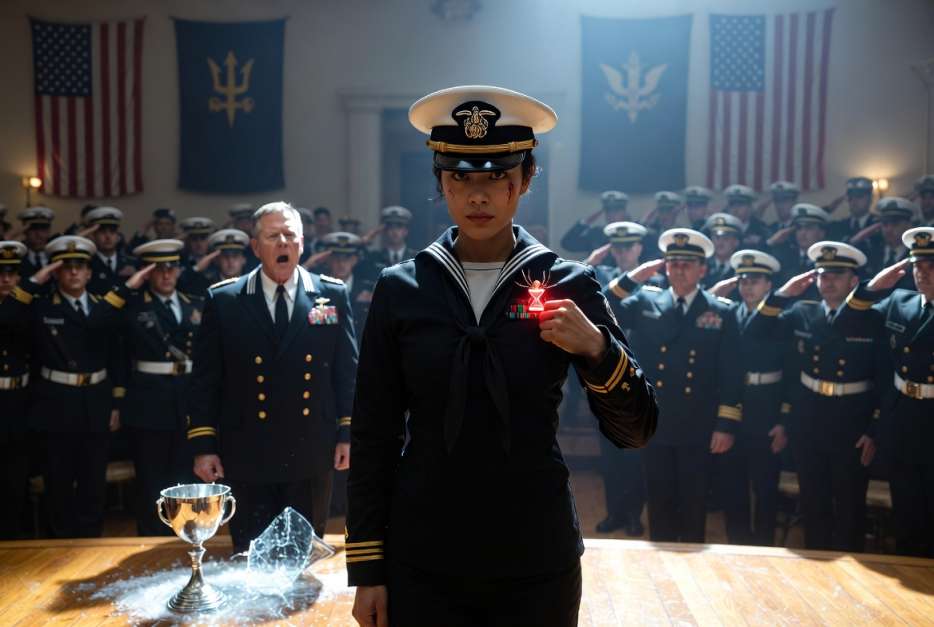
The entire hall froze.
Thade shot to his feet, his voice thick with emotion: “You carried me three miles through the mountains with a broken femur… I never saw your face.”
Captain Vesper Reeve stepped forward, removing her intelligence insignia to reveal the stars of a Rear Admiral.
“Lieutenant Commander Arwin Blackwood’s identity as Iron Widow has been classified at the highest levels for seven years. Her placement in this program was the final phase of a counter-intelligence operation to identify the source of the original betrayal.”
Hargrove turned ashen, gripping the podium for support.
Arwin continued:
“I made a promise to those six men that I would find who betrayed them, no matter how long it took or how high the betrayal reached. That promise ends tonight.”
She pinned a widow spider brooch—its red hourglass gleaming—to her collar.
The entire room rose. Hands saluted with profound respect. Trident pins fell at her feet—one by one—as operators offered the deepest gesture of honor a SEAL could give.
Hargrove sank into his chair, a broken man.
One month later.
The same training room. Twenty new operators stood at attention.
But this time, Lieutenant Commander Arwin Blackwood stood at the front as instructor. The widow spider pin gleamed on her collar. Beside her was Orion Thade—now an assistant instructor—with entirely different eyes.
She swept her gaze across the formation, pausing briefly on the two female lieutenants.
“This program will push every limit you think you have,” she said, her quiet voice commanding total attention. “You will fail. You will succeed. But what matters most is not where you came from or what you look like. It’s what you bring to the team, and how completely you are willing to commit to something greater than yourself.”
Her voice dropped, carrying the weight of seven silent years:
“I didn’t know if I could do it. I only knew it had to be done. And sometimes… that is enough.”
As the new cohort dispersed, Kelwin approached.
“Commander… that night in North Korea, how did you know you could save them?”
Arwin offered a rare, weary but genuine smile.
“I didn’t know I could, Lieutenant. I only knew I had to. And that was enough.”
Outside, the Pacific continued to roll. But today its waves seemed to whisper a different story—the story of a woman the world had underestimated, who finally made the world stand and salute.