The cracked pavement of the construction site in Houston burned under the midday sun, each fissure a small wound in the earth itself. Ava Morgan’s prosthetic leg clicked against it with the steady rhythm of a metronome she could never silence. Click. Step. Click. The sound followed her like a ghost that refused to be left behind in the desert.
Laughter sliced through the humid air, sharp as shrapnel.
“Someone call the VA. We got a stray limping through!”
The words landed like a slap. Ava’s fingers tightened around the faded Marine cap in her hand until the fabric bit into her palm. She didn’t turn. She didn’t slow. The jeers rose around her—three men on scaffolding, their hard hats tilted back, mouths open in ugly grins. The foreman, Rick Tanner, leaned against a sawhorse like a king on his throne, his belly straining against a sweat-stained polo. He mimicked her gait with exaggerated swings of his hips, and the crew howled.
Ava kept walking. Inside her chest, something ancient twisted—not shame, but the heavy, bone-deep fatigue of a woman who had carried men twice her size through burning streets while bullets sang overhead. This was nothing compared to that. Just noise. Cheap, stupid noise.
But the sun pressed down harder. The smell of hot tar and diesel clung to her skin. Her stump ached where the prosthetic socket rubbed raw, a familiar fire she greeted like an old enemy. She touched the dog tags beneath her shirt, their metal warmed by her skin. Still here. Still breathing.
She reached the corner, where the chain-link fence gave way to cracked sidewalk. That was when the black SUVs arrived.
Three of them, engines growling low like predators. They swung in formation, blocking the site entrance with military precision. Dust swirled in their wake. Doors opened in unison. Seven men stepped out—boots hitting pavement like synchronized thunder. Navy SEALs. Not in dress uniforms, but the quiet power in their posture screamed it anyway: shoulders squared, eyes scanning, faces carved from missions most civilians would never sleep through.
The laughter died as if someone had cut the throat of the wind itself.
Ava stopped. Her heart, which had learned to beat steady under fire, stuttered now.
From the lead vehicle, Logan Beck emerged. Tall, weathered, the kind of man whose stillness carried more weight than most men’s shouting. His gaze found her instantly. Recognition. Not pity. Something deeper. He remembered Fallujah. The smoke. The screams. The woman who ran back into hell three times while everyone else was pulling out.
Beck’s jaw tightened. He turned toward the crew, voice low but carrying like a rifle shot.
“Who the hell just humiliated Sergeant Ava Morgan?”
Rick Tanner’s smirk faltered. “It was just a joke, man. Lighten up.”
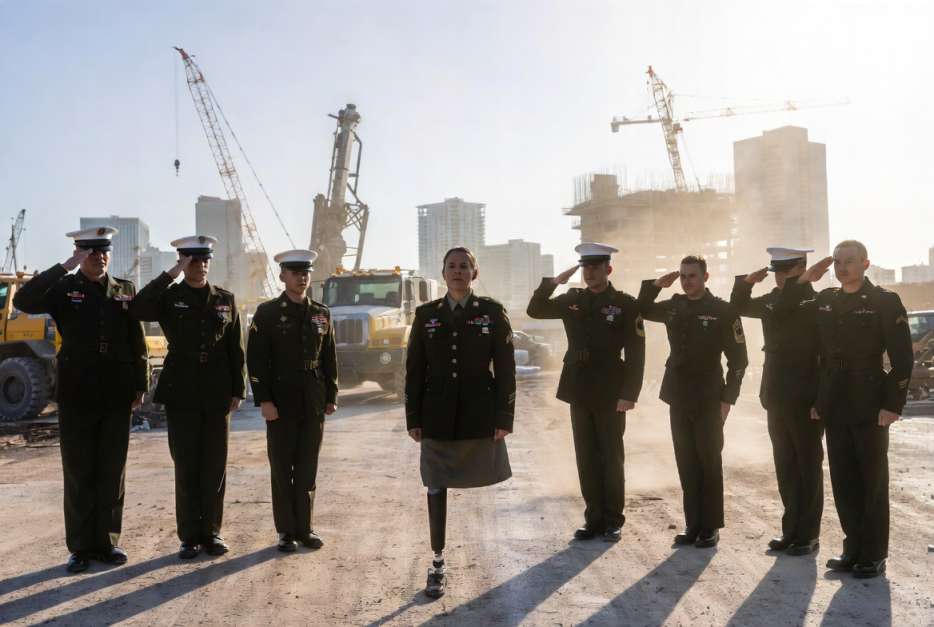
“A joke.” Beck let the word hang, cold and heavy. He walked forward until he stood inches from the foreman. The other SEALs fanned out behind him, silent sentinels. One of them lifted his phone, screen already recording. “She dragged three of us—including me—out of a burning Humvee under sniper fire. Lost her leg doing it. That’s not a goddamn joke.”
Silence swallowed the site. Hammers stopped mid-swing. A radio crackled unanswered. Ava felt the weight of every eye shift from mockery to something raw and uncomfortable.
She turned slowly. The world narrowed to the man walking toward her now. Logan Beck. Brother in arms she hadn’t seen in years. He stopped two paces away, came to attention, and saluted—sharp, perfect, reverent.
“Permission to honor you, ma’am.”
The other SEALs followed. Seven salutes, crisp against the brutal Texas sun. Ava’s throat closed. Her right hand rose instinctively, returning it. Tears burned but she refused them. Not here. Not yet. The prosthetic felt heavier, yet lighter all at once—like the leg she’d lost had just been given back in spirit.
Beck reached into his pocket. A small, round coin glinted in his palm. The Brotherhood coin. Navy SEAL issue. Earned, never given.
Ava’s fingers trembled as she took it. The metal was cool, solid. Real.
For the first time in years, the quiet lady from the faded strip-mall apartment wasn’t invisible.
The apartment smelled of instant coffee and faint gun oil she could never quite wash from her memories. Two small rooms. A narrow balcony overlooking an alley where stray cats fought at dusk. Ava sat on the edge of her bed that evening, the Marine cap resting in her lap like a sleeping child. The coin from Beck lay beside it, catching the last light bleeding through cheap blinds.
She hadn’t cried at the site. She cried now—silent, shaking sobs that rattled the dog tags against her chest. Not from weakness. From the sudden, crushing relief of being seen.
Flashback hit her like incoming mortar.
Fallujah, 2004. Smoke choked the air, thick with burning fuel and fear. The Humvee was a funeral pyre. Men screaming inside. Ava’s boots pounded the dirt as she ran back in—once, twice, three times. Shrapnel tore through her thigh on the final pull. She felt the leg go, but she kept dragging Logan’s dead weight until hands grabbed them both. The explosion that followed stole the rest.
She woke in the VA hospital weeks later to polite smiles and discharge papers. No parades. Just a prosthetic and a lifetime of learning how to walk again—literally and otherwise.
The phone buzzed. Unknown number. She almost didn’t answer.
“Ms. Morgan? This is Elena Ramirez from Channel 12. The video’s gone viral. Over two million views in four hours. People want to hear your story.”
Ava stared at the coin. “My story’s not for ratings.”
But something in her shifted. The fatigue cracked open, letting in a dangerous sliver of light.
The Days That Followed
Rick Tanner was fired by morning. The construction company issued a public apology laced with corporate-speak that still felt like an admission. Ava didn’t watch the news. She went to the VA as usual on Tuesday, olive duffel slung over her shoulder, cap tucked inside.
This time, people stared differently. Not with whispers of pity, but with nods of respect. An older veteran at the bus stop saluted her quietly. A young mother with a child in a wheelchair smiled like she’d seen a miracle.
At the café near her apartment two weeks later, a boy no older than ten approached. He was missing his right arm below the elbow. His mother hovered behind him, eyes shining.
“My mom says I’m like you,” he said, voice steady despite the tremor in his small shoulders. “She says I don’t need two arms to be strong.”
Ava knelt—her prosthetic clicking softly—and looked him in the eye. The café smelled of fresh bread and rain that had just started falling outside. “You already are strong,” she told him, voice low and fierce. “Every morning you wake up and decide to keep going? That’s the hardest battle there is. I’m proud of you, kid.”
The boy’s mother wept quietly. Ava felt her own scars loosen their grip just a fraction.
The Stage
Veterans Appreciation Week arrived with Houston heat that made the air waver. Ava stood backstage in her Marine cap, heart hammering against her ribs like it had in the streets of Fallujah. Logan Beck was there, standing beside her like a silent guard.
“You don’t have to do this,” he said.
“I do,” she answered. “For the ones still walking those streets alone.”
She stepped into the lights. The audience—veterans, families, active duty—fell quiet. Ava gripped the podium, prosthetic leg planted firm.
“Scars don’t mean you’re broken,” she began, voice steady but raw. “They mean something tried to destroy you and failed. I lost a leg in Fallujah saving men who wear the same uniform as all of you. But the real loss would’ve been believing the world when it told me I was less because of it.”
She spoke of the mockery. The silence after. The coin that reminded her she was never truly alone. Each word landed like a heartbeat. No grandstanding. Just truth, stripped bare.
The applause when she finished wasn’t polite. It was thunder. It was recognition.
Months bled into transformation. The construction company mandated sensitivity training that actually meant something. Workers who once laughed now stopped to help elderly veterans cross streets. Ava became more than a symbol—she became a bridge.
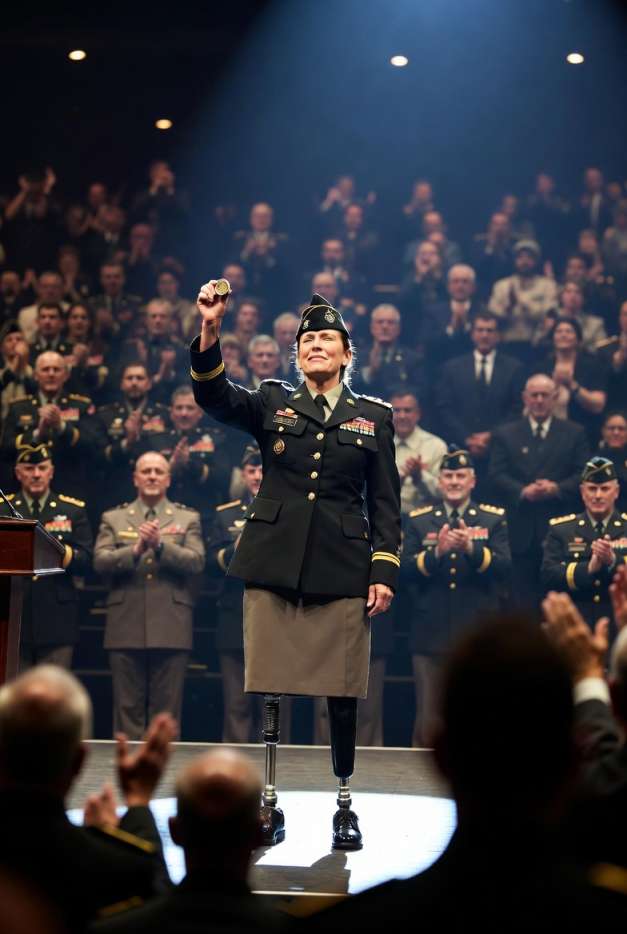
One evening, six months later, she stood backstage again at the National Veterans Conference. The auditorium buzzed with thousands. Logan waited in the wings, the rest of the SEALs scattered through the crowd like quiet guardians.
Ava walked onto the stage. No limp in her spirit now.
“Honor doesn’t live in how many limbs you have,” she said, voice carrying to the rafters. “It lives in how you face the storm when it tries to break you. And sometimes, the greatest honor is simply refusing to walk alone.”
She held up the Brotherhood coin. It caught the light like a promise.
In the front row, the boy from the café sat with his mother, both arms—real and prosthetic—raised in salute.
The applause rolled like waves. But Ava wasn’t listening to the sound anymore. She was listening to the quiet voices—the ones that had always been there, limping through their own construction sites, carrying invisible wounds.
Heroes walk among us. Sometimes they limp. Sometimes they stay silent for years. But when the right eyes finally see them, the world changes.
And change, Ava learned, doesn’t begin with noise.
It begins with one steady click on cracked pavement, and the courage to keep walking anyway.
Houston rain fell like thin blades, tearing through the muggy afternoon air. Ava stood at the door of her apartment, raindrops dripping from the awning onto her shoulders. The Brotherhood coin still weighed heavy in her pocket, a constant reminder. She hadn’t slept the night before. Every time she closed her eyes, she saw the smoke of Fallujah, Logan’s screams as he was trapped beneath the burning metal frame.
A knock sounded at the door—quiet but determined.
She opened it. Logan Beck stood there, his jacket soaked, rain tracing lines down his weathered face. He wasn’t smiling. He offered no small talk.
“I owe you an apology,” he said directly, his voice low and hoarse. “Not for that day at the construction site. But for letting you come home alone.”
Ava gripped the doorframe. Her jaw tightened. “You don’t owe me anything, Beck.”
But he stepped inside, carrying the scent of rain and memories. They sat in the small living room, the dim yellow light casting uneven shadows on the walls. Logan spoke—not in heroic tones, but as if he were tearing the words from his own guts. He told her about the nights after Fallujah, waking in the hospital knowing Ava had lost her leg pulling him out. He spoke of the guilt that made him leave the service earlier than planned, of the nights he still woke to explosions inside his head.
“You’re the hero, Ava. But me… I’m just the one who survived because of you.”
She looked at him, not with empty sympathy, but with shared pain. Her hand unconsciously touched her prosthetic, where the skin was still raw and sensitive. “We’re all broken pieces, Logan. The question is how we weld them back together.”
Outside on the balcony, the rain grew heavier. Distant thunder rumbled like distant artillery. Ava felt her heart stir—not young romantic love, but the deep connection of two people who had walked through hell together.
When Logan left, he left behind a warning: “The construction company didn’t just apologize. They’re worried. And Rick Tanner… he’s not the type to let go easily.”
The next morning, the construction site was eerily quiet. Ava walked past it on her way to the VA, her steps slower than usual. Rick Tanner stood alone by the fence, his swagger gone. His face was gaunt, eyes bloodshot from sleepless nights. When he saw her, he didn’t sneer. He lowered his head.
“I… I didn’t know,” he stammered. “I have a son in Afghanistan. If he comes back and ends up… like you…”
Ava stopped. Last night’s rain had left puddles on the pavement, reflecting her weary face. She didn’t forgive him right away. She couldn’t. But she didn’t turn away either.
“What matters isn’t what you knew,” she said quietly, her voice steady. “It’s what you do from now on.”
He nodded, his knuckles white as he gripped the metal bar. It wasn’t the end of his story—just the beginning of an inner battle Ava knew too well: the war with oneself.
But not everything was gentle. That afternoon, her phone rang. An unknown number. The man’s voice on the other end was ice cold.
“Ms. Morgan, you think you’re a hero? That video cost me my job. Don’t think this ends so easily.”
The call ended abruptly. Ava stood frozen in her living room. Her prosthetic suddenly felt like lead. She touched her dog tags, but their warmth wasn’t enough to push back the fear creeping in. Someone was watching. Someone didn’t want her story to spread.
Logan called moments later, his voice urgent. “I heard. Don’t go out alone. I’m on my way.”
When he arrived, they sat at the small kitchen table. Logan checked his phone, eyes sharp as they had been in the desert. “He’s Tanner’s cousin. Works for a subcontractor. We can’t let this slide.”
That night, Ava didn’t sleep. She stood on the balcony as night wind carried the scent of the river and exhaust. She remembered her own words on stage: Honor doesn’t depend on how many limbs you have. But now that honor was being tested in a new way—not by bullets, but by the silent shadows of everyday life.
A week later, the invitation to speak at the community center arrived. Ava hesitated. Her hands trembled as she held the paper. But then she thought of the one-armed boy at the café, of the veterans still suffering silently in dark apartments.
She accepted.
The hall was packed. Neon lights flickered. Ava stepped onto the stage, her prosthetic clicking loudly in the silence. She didn’t read from a prepared speech. She told the raw truth.
She spoke of the day she ran into the burning Humvee, the smell of charred flesh, the agony of waking up without feeling in half her leg. She spoke of mornings in Houston, staring in the mirror and wondering what she was still worth. And she spoke of the day seven SEALs saluted her—the moment that reminded her she had never truly been alone.
In the middle of the audience, a middle-aged woman stood up, trembling. “My son didn’t come home. But today… I feel like he’s here, through you.”
Tears rolled down Ava’s cheeks. Not for herself. But for all the souls still wandering between two worlds.
After the talk, Logan waited for her outside. He took her hand gently—not gripping tightly, but firmly enough to lend strength. “You did it.”
But as they left, a shadowy figure trailed them under the yellow streetlights. Ava felt it. Old fear surged, but this time it didn’t stop her. It made her steps stronger.
Two months passed. Ava’s story no longer belonged only to Houston. It spread across the country. Major networks invited her. A publisher reached out about a book. But the more famous she became, the more cracks appeared.
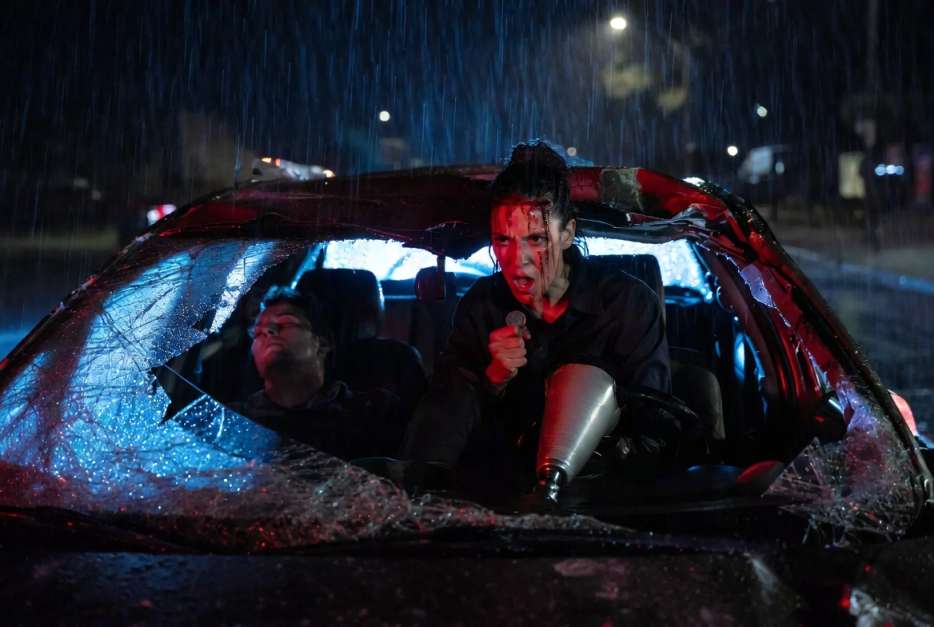
One stormy night, Logan drove her home. Headlights swept across the wet road. Suddenly, a truck barreled out from a dark alley, high beams blinding.
“Swerve!” Ava shouted.
Logan yanked the wheel. Their car skidded violently. The screech of metal was deafening. Glass shattered. When everything stopped, Ava felt warm blood trickling down her temple.
She turned to Logan. He was unconscious, head slumped against the steering wheel.
Outside in the pouring rain, a man’s silhouette stood not far away, his face hidden in shadow. He raised his phone, recording once more.
Ava clenched the Brotherhood coin in her fist. Her heart pounded. This was no longer a joke. This was a new war.
She whispered into the darkness: “I survived hell once. You won’t break me this time.”
The rain hammered the wrecked car like accusations. Ava’s hands shook as she fumbled for her seatbelt. Blood mixed with rainwater on her face, warm and metallic. Logan’s breathing was shallow beside her, a faint groan escaping his lips as consciousness flickered back.
“Logan… stay with me,” she whispered, her voice raw. She pressed her palm against the gash on his forehead, the same way she had once pressed against wounds in Fallujah. The world outside the cracked windshield blurred—red and blue lights flashing in the distance. Sirens wailed closer.
The shadowy figure had vanished into the storm, but Ava knew he’d left his mark. This wasn’t random. This was personal.
Paramedics pulled them from the wreckage. In the ambulance, Logan gripped her hand with surprising strength. “Don’t… let them win,” he rasped. His eyes, usually so steady, now carried the same haunted look she saw in her own mirror every morning.
At the hospital, under harsh fluorescent lights that smelled of antiseptic and regret, Ava sat in the waiting room. Her prosthetic leg throbbed in time with her heartbeat. A nurse offered coffee; she waved it away. Instead, she pulled out the Brotherhood coin, turning it slowly between her fingers. The metal had warmed from her touch, carrying the weight of every unspoken promise between warriors.
Hours later, a doctor emerged. Logan would be fine—concussion, bruised ribs, but no permanent damage. Relief washed over Ava like a wave, but it was quickly followed by a colder current: anger. Pure, burning anger at the people who refused to let the past stay buried.
When Logan woke the next morning, pale against the white sheets, he didn’t waste words. “We fight back. Together.”
News of the “accident” spread faster than the original video. Social media exploded with support—and conspiracy theories. Ava’s phone wouldn’t stop ringing. Reporters. Veterans’ groups. Even a senator’s office.
She stood on her narrow balcony that evening, the city lights of Houston twinkling like distant stars. The air smelled of wet concrete and jasmine from a neighbor’s pot. Logan leaned on the railing beside her, bandages visible under his collar. His presence was solid, grounding.
“I was scared that day in Fallujah,” he admitted quietly. “Not of dying. Of failing the men counting on me. When you ran back in… you carried more than our bodies. You carried our hope.”
Ava looked at him, the city’s glow softening the lines on her face. For the first time, she allowed herself to feel the crack in her armor. “I was terrified too. Every step. But fear doesn’t get to decide who we are.”
Their hands brushed. Not a grand romantic gesture, but something quieter, deeper—two scarred souls recognizing each other in the dark.
The next day brought confrontation. Rick Tanner showed up at her door, cap in hand, eyes downcast. “My cousin… he’s lost. Angry. I told him to stop. He wouldn’t listen.”
Ava studied him. No longer the arrogant foreman. Just a man wrestling with his own failures. “Then help me end this,” she said. “Not for me. For your son. For every kid who needs to believe strength isn’t measured in limbs.”
Tanner nodded. A fragile alliance formed in the shadow of old wounds.
The National Veterans Conference had waited. Now, with fresh bruises and a fire in her chest, Ava stepped onto the grand stage once more. Thousands filled the auditorium—uniforms, families, quiet heroes in civilian clothes. Cameras rolled. The air hummed with anticipation.
She didn’t open with her prepared notes. She held up her prosthetic leg in metaphor, speaking of the night of the crash.
“They tried to silence me with fear,” her voice rang clear, steady despite the tremor in her soul. “But silence is where I learned to roar.”
She shared the raw moments: the mockery at the construction site, the salutes that healed something deep inside, the truck in the rain. Each word painted a scene—close-up on trembling hands, wide shot of a rain-soaked city, the sound design of breaking glass and rising sirens.
In the front row, the one-armed boy from the café sat tall beside his mother. Logan stood off-stage, watching with pride and something warmer. Even Rick Tanner sat in the back, anonymous but present.
As she finished, the applause wasn’t thunder—it was a wave that lifted her. But the real climax came afterward. A young Marine approached her backstage, eyes bright with unshed tears.
“I was about to quit,” she confessed. “Your story… it reminded me why I signed up.”
Ava pulled her into a hug. In that embrace, generations of quiet strength connected.
Six months later, spring softened Houston’s edges. Ava walked the same construction site—not as a target, but as an honored guest. The company had renamed a safety wing after her. Workers nodded with genuine respect. Rick Tanner supervised with a quieter authority, his son now writing letters from overseas about the “lady who saved more than lives.”
Logan stood beside her, no longer just a brother-in-arms. Their bond had grown into something steady and real—shared sunsets on the balcony, quiet conversations that healed old scars.
She still limped. The click remained. But now it was a rhythm of victory, not pain.
One afternoon, at a small park, the one-armed boy ran up to her again. This time he carried a drawing: a woman with a prosthetic leg, standing tall while saluting soldiers.
“You made me believe,” he said simply.
Ava knelt, eye level. “We make each other believe.”
As the sun dipped low, casting long shadows across the grass, Ava felt the full weight of her journey. What began as mockery on cracked pavement had become a legacy. Not of perfection, but of persistence. Of choosing to walk forward when every instinct screamed to hide.
Heroes don’t always run. Sometimes they limp. Sometimes they stumble. But they keep moving.
And in their footsteps, others find the courage to follow.