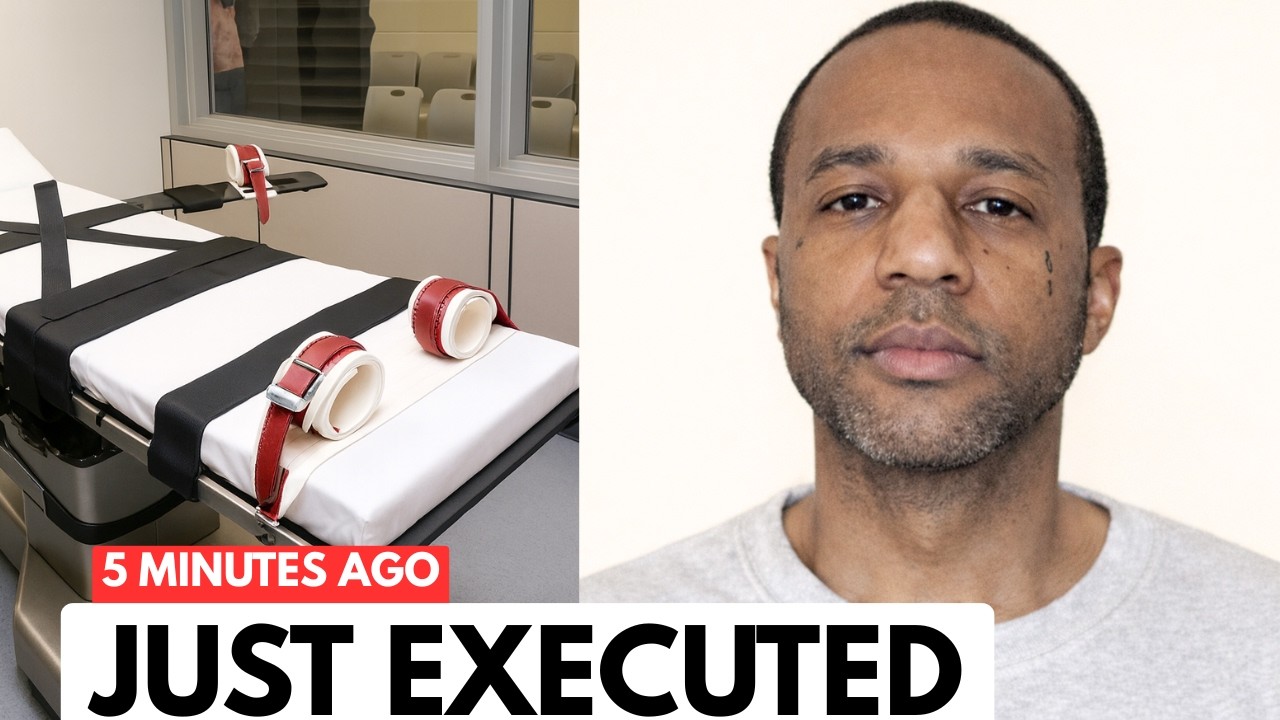
Kendrick Simpson was executed by lethal injection on February 12th, 2026, at Oklahoma State Penitentiary after 19 harrowing years on death row. This controversial case revisits deep trauma, a violent act, and an agonizing debate over justice, redemption, and the death penalty’s place in modern America. The execution defines a complex chapter in Oklahoma’s capital punishment history.
 Simpson’s journey into infamy began January 15th, 2006. Newly relocated to Oklahoma City as a Hurricane Katrina refugee, 22-year-old Simpson carried an AK-style 𝒶𝓈𝓈𝒶𝓊𝓁𝓉 rifle into Fritz’s, a local hip-hop club. What started as a minor confrontation spiraled quickly, ending in a lethal rampage that shocked the community and set off decades of legal battles.
The trigger was an argument sparked by a trivial remark about Simpson’s red Chicago Cubs cap. Despite a brief attempt at peace, violence erupted when Glenn Palmer, 20, punched Simpson after mistrusting his truce. The conflict didn’t end there; both groups left separately, only to confront each other again at a nearby 7-Eleven convenience store.
Simpson’s decision to open fire was cold, deliberate, and decisive. He chased Palmer’s vehicle through Oklahoma City streets, firing 20 rounds from his 𝒶𝓈𝓈𝒶𝓊𝓁𝓉 rifle. Two young men, Glenn Palmer and Anthony Jones, lost their lives instantly. London Johnson, seated in the back, survived, becoming the sole eyewitness to the brutal 𝒶𝓈𝓈𝒶𝓊𝓁𝓉.
After the shootings, Simpson revealed his remorse in a chilling admission: “I’m a monster.” Yet prosecutors painted a portrait of cold-blooded malice, reinforced by testimony from Simpson’s accomplices and a jail cellmate who described his laughter and lack of remorse. The narrative defined Simpson as a dangerous and unrepentant killer.
However, the defense unveiled a turbulent and tragic backstory. Born in New Orleans’ toughest neighborhoods, Simpson endured 𝒔𝒆𝒙𝒖𝒂𝒍 𝓪𝓫𝓾𝓼𝓮, a crack-addicted teenage mother, dropping out of school, and surviving a near-fatal drive-by where he was shot five times. The scars of Hurricane Katrina’s devastation compounded his trauma, all crucial context for his defense.
Psychologist Dr. Philip Massad testified that Simpson likely suffered from post-traumatic stress disorder (PTSD), a factor that could explain his actions. Yet, Oklahoma’s trial court barred this evidence during the guilt phase, limiting the jury’s insight to only a fraction of Simpson’s mental health struggles until sentencing, potentially skewing the verdict’s foundation.
The jury convicted Simpson swiftly, finding him guilty of two counts of first-degree murder, armed 𝒶𝓈𝓈𝒶𝓊𝓁𝓉, and firearm possession by a felon. Sentencing followed; within two hours, they decided on death. At 23, Simpson entered death row, a place where time moves painfully slow and hope dims under ceaseless appeals and judicial scrutiny.
During his 19 years on death row, Simpson transformed in ways that challenged perceptions. From a high school dropout to a published author, he earned a GED, took college courses, and expressed remorse through poetry and essays. This evolution sparked complex questions: Does capital punishment account for rehabilitation and change over time?
Simpson’s legal team fought relentlessly for clemency, highlighting his post-traumatic growth and flawed trial processes. Appeals reached the US Supreme Court and challenged Oklahoma’s execution protocols, yet all failed to halt his pending execution. His last hope was a clemency hearing on January 14th, 2026, merely weeks before the scheduled execution.
At the clemency hearing, Simpson pleaded for his life, addressing victims’ families and lawyers alike. “I’m not the worst of the worst. I’m not a monster,” he insisted, showing profound remorse. Yet the families of Palmer and Jones demanded justice for their lost loved ones. The Oklahoma Pardon and Parole Board split 3-2, denying clemency.
As dawn broke on February 12th, 2026, Simpson faced his final moments. His last meal was modest—a bacon cheeseburger, onion rings, and a strawberry milkshake. Witnesses included family and legal counselors. Death penalty opponents held vigils outside, but inside, the path to the execution chamber was set in motion, final and irrevocable.
Simpson’s last words were brief yet poignant: “I love y’all. Thank y’all for being here to support me.” His spiritual adviser, Reverend Don Heath, read scripture as the three-𝒹𝓇𝓊𝑔 lethal injection began. The process sedated, paralyzed, and stopped Simpson’s heart within 12 minutes, culminating at 10:19 a.m. Central Time with the official pronouncement of death.
Reactions to Simpson’s execution remain deeply divided. Glen Palmer’s sister, Crystal Allison, witnessed the moments and recounted the haunting smile Simpson wore, “the same smile tormenting me for 20 years.” In contrast, Reverend Heath called Simpson “a new man” who “didn’t deserve this,” emphasizing Simpson’s apparent peace at death’s door.
Oklahoma Attorney General Gentner Drummond celebrated the outcome, declaring “justice has been served,” and expressed hope it would bring peace to the families devastated almost two decades ago. Simpson’s execution marked the state’s first of 2026 and the 17th since Oklahoma resumed the death penalty in 2021 after a six-year pause following previous botched executions.
Kendrick Simpson’s case forces a reckoning on America’s justice system: can true transformation coexist with irreversible punishment? It spotlights the tension between accountability and redemption, trauma and violence, youth and consequence. As Oklahoma moves forward, this execution will haunt debates about capital punishment’s moral and practical legitimacy for years to come.